

State libraries are losing visitors: how to change this
A reader comes to the library for a book or knowledge — and encounters confusing signs, long queues at the reference desk, and staff who are busy and cannot always spare the time.
For state libraries, this is becoming critical: the visitor leaves empty-handed and next time chooses an electronic version or another place. Losing visitors here is not a matter of convenience, but a direct threat to the library's mission as a public space.
Outdated navigation is a systemic problem: a hall spread over several floors, dozens of departments, and information about where the right shelf is or how to sign up for an event is scattered across paper posters and verbal hints.
A new guest spends 10–15 minutes just to find their bearings. Some never reach their destination at all — and do not come back. Staff physically cannot keep up with answering the same questions, even though they could be doing more useful work.
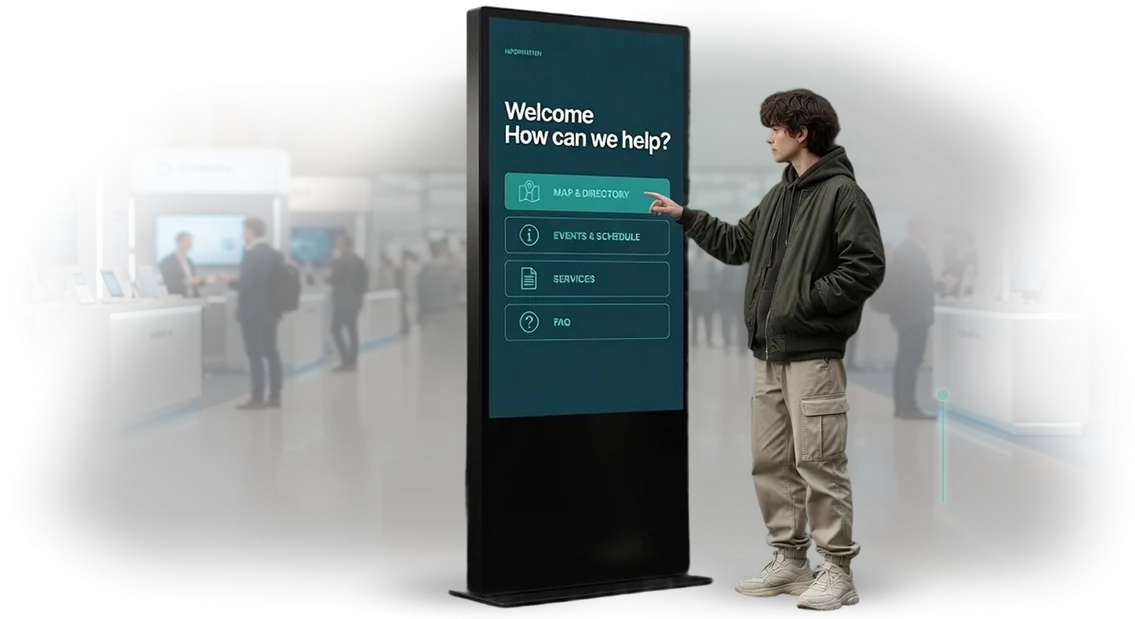
An interactive kiosk solves this pain from both sides at once. At any moment, the visitor finds the route, schedule, collection information and services on their own — without waiting or stress.
And the library gets a tool that takes routine workload off the reference service and makes navigation clear even for first-time visitors. The kiosk works around the clock and does not get tired of repeated questions.
We design such kiosks specifically for the needs of state libraries: the interface is adapted for different ages and skill levels, and we help plan the information structure so the reader finds what they need in a couple of taps.
As a result, the library not only retains existing visitors but also attracts new ones — those who feared getting confused come back and recommend the library to acquaintances. Modern information kiosks become part of the library's image as a lively, open and tech-savvy place.
What a modern interactive kiosk gives a library
Readers are used to waiting in the library: a queue at the catalog, searching the shelves, asking staff for clarification. This takes time and diminishes the impression even of a good collection.
An interactive kiosk removes these barriers — the visitor serves themselves, and staff help where it is really needed.
Fast search and navigation
The touchscreen shows the exact location of a book: hall, bookcase, shelf. The query is processed instantly, and the reader immediately heads to their destination. Search takes minutes instead of half an hour, and during peak hours this is especially noticeable.
Reducing staff workload
Typical questions — "where is the collection?", "how do I sign up?", "when is it open?" — are handled by the kiosk. Librarians stop being distracted by the same things and work with rare editions and complex requests. Automating the reference service reduces workload and shortens queues.
The kiosk is available during library working hours and does not require breaks. Readers get information in seconds, and administration sees request statistics — this helps plan purchases and events.
This format also changes the library's image: it looks modern, technological and open. Readers come back, bring friends, and staff focus on development. The experience of our team confirms: after launching a kiosk, libraries report growth in satisfaction and repeat visits. Let's discuss how this could work for you?
Kiosk formats for the needs of readers and staff
In state libraries, a reader enters the building with a specific request: find a book, attend an event, work with the catalog. Without fast navigation, they spend time finding the right room, and staff answer the same questions dozens of times per shift.
Interactive kiosks remove this burden, but only if the device format matches the type of space and the usage scenario.
The visitor passes through the lobby, moves along corridors and stops in themed halls — each stage suits its own format. We have selected three basic solutions for this reader journey: a floor-standing kiosk, a wall-mounted panel and a touch table.
| Format | For whom | What it gives the library |
|---|---|---|
| Floor-standing kiosk — greets at the entrance | Readers without a specific route, guests | Fast book search, navigation through halls, event schedule without staff involvement. Reduces the queue at the reference desk and speeds up movement through the building. |
| Wall-mounted panel — accompanies in corridors | Users in small halls, at transitions between floors | Saves space, round-the-clock access to information, instant updates of content and event posters. Makes it possible to cover points where a large terminal cannot be placed. |
| Touch table — works in activity zones | Children's halls, groups, exhibition participants | Engages readers through interactive quizzes, maps and presentations. Increases time spent at the library, attracts new audiences and strengthens the modern image of the library. |
The combination of formats is selected for the specifics of each state library. We analyze visitor flows, the location of functional zones and frequent reader questions so that each kiosk solves a specific task at its stage.
This approach gives a measurable result: staff are less distracted, readers get what they need faster, and the investment in equipment pays off immediately after launch.
Development stages of a kiosk for state libraries
We structure the work so that the library does not face unexpected problems: every stage of kiosk development is coordinated, and you understand what you are paying for and what you receive.
The ordering process takes from two weeks to a couple of months — the timeline depends on the complexity of the interface and content, but all key steps are fixed in the schedule.
-
Brief and requirements analysis. We meet and analyze the library's needs: what information visitors search for most often, what services need to be promoted, whether there are specific requirements. The output is a clear technical specification that protects against unnecessary rework.
-
Design mockup and approval. We draw the menu structure and the look of the screen: large buttons, convenient arrangement of sections, the library's recognizable style. You make edits before production starts — this saves time and budget during kiosk implementation.
-
System development and content loading. We create the software, load catalogs, event posters, working hours, hall maps. You receive a tool that is easy to extend: replacing information takes minutes without involving programmers.
-
Production and technical verification. We manufacture the enclosure, mount protected screens and controls. At this stage the kiosk already undergoes testing: taps, barcode scanning, work with library cards — everything is checked before shipment.
-
Delivery, installation and mounting. We bring the kiosk to the library, connect it to the network and local database, and verify startup. We set up backup and failure protection so the reference service works stably even on peak-load days.
-
Staff training. We conduct an orientation for librarians: how to update information, replace event posters, turn the system off and reboot it. Your employees start using the kiosk on their own after the first session.
-
Maintenance and support. After launch, we stay in touch: we answer questions, help with content changes and, if necessary, visit the site. Expanding sections and adding new functions is possible within long-term cooperation.
This approach allows the kiosk to be introduced without upheaval for the team or chaos in work processes. Each stage ends with a clear result for the library — from a signed mockup to trained staff and a working device in the lobby.
What is included in the delivery and implementation package
The full delivery and implementation package is a turnkey solution for a state library. You do not need to purchase equipment separately, find a software contractor or think about launch: we deliver a working kiosk along with all documentation, support and staff training. Below is everything included in the package.
- Kiosk equipment — a professional touch terminal resistant to intensive use and vandalism. The enclosure is suitable for installation in a lobby or reading room and does not require constant supervision.
- Software — a preinstalled interface with hall navigation, catalog search and reference information. The administration system allows staff to change content without involving a programmer.
- Instructions and manuals — clear materials for staff and visitors: how to turn on the kiosk, update the schedule, use the search. Everything is presented in a simple step-by-step format.
- Warranty and technical support — official warranty on equipment and software. If something goes wrong, you contact our service — we run remote diagnostics and resolve the issue promptly.
- Staff training — short practical sessions for librarians. Employees learn to manage the kiosk, upload event posters and help visitors.
- Implementation and launch — delivery, installation, on-site setup and performance verification. The kiosk is handed over already loaded with up-to-date information about your library.
As a result, you get not just a device, but a working service for visitors. People start using the kiosk on the very first day, and your employees save time — they answer fewer repetitive questions and orient readers faster.
The delivery package covers the task now and leaves room for the future: when the schedule, event poster or collection structure changes, you can easily make changes yourself or ask us for help.
Case study: how a kiosk paid for itself in a city library
An ordinary kiosk in a library is perceived as "just a stand with a screen," but in reality it addresses the main pain of any cultural institution — physical queues and overloaded staff.
Let's take a real example of a city library that came to us with the request to "relieve the reference service."
Situation before
According to the institution's own statistics, during peak hours readers waited up to 15 minutes for assistance. Staff simultaneously answered phone calls, issued books and searched for publications by request — this created tension and reduced service speed.
The administration understood: they needed a solution that would not require hiring additional staff.
What changed after launch
We installed a touch kiosk with a collection navigation system, hall map and event schedule. Visitors began finding the departments they needed and checking book availability on their own — without turning to a librarian.
Already in the first month of operation, the reference service felt a noticeable freeing up of time, and by the end of the quarter the peak-hour queue had decreased by 40%.
Circulation indicators also went up: guests began borrowing books more often because the search no longer depended on staff availability.
The kiosk's payback was confirmed in practice — the savings in staff working hours and the growth in book circulation covered the implementation cost in the first year of operation. The library received a modern tool that continues to work without constant team involvement.
The institution is now planning to expand the functionality to match visitor needs — adding an event poster and online booking.
How to choose a format for a specific library?
There is no universal kiosk for all libraries. The optimal format depends on the size of the premises, visitor flow and the device's tasks.
A small library is best served by a compact wall-mounted panel, while a large one with a lobby and departments needs a floor-standing terminal with a large screen and floor-by-floor navigation.
The area determines the design: a narrow floor-standing kiosk or wall-mounted panel suits a cramped vestibule, while a spacious lobby can take a dual-screen terminal (search and event poster).
Visitor flow dictates the requirements for reliability and interface simplicity so that no queues form. The tasks are the main criterion: catalog, registration, payment, event poster — each scenario requires its own functions.
We select the format for each specific library. At the consultation we analyze the floor plan, attendance, audience and the list of services to automate. In the end, we propose a configuration: screen size, installation method, functions and design to match the interior.
This approach protects against overpaying for unnecessary functions and against an awkward device that visitors ignore. You get a kiosk tailored to your library's tasks, save staff time and improve service quality.
Contact us for a consultation — we'll help you choose the format and prepare a technical specification.
Common concerns of libraries and our answers
Libraries most often postpone the implementation of interactive kiosks not because of cost, but because of doubts: "what if the equipment breaks down," "staff won't master it," "visitors won't understand it." We hear these questions at every meeting and decided to answer them right away — honestly and based on experience from dozens of projects for state institutions.
What if the kiosk breaks down?
We provide a warranty on the equipment and software. While repairs are underway, we provide a replacement kiosk so the reference service never stops. Over 10 years of work, serious failures have been rare, and even those were resolved within a day or two.
Won't staff struggle to operate it?
Employees receive on-site training — it takes no more than a couple of hours. The administration panel is designed so that even someone who has previously only worked with a text editor can figure it out. Updating the schedule, replacing content, adding event posters — all done in a couple of clicks.
Won't visitors understand how to use the kiosk?
The interface follows the logic of "one large button — one action." Guests of any age find the information they need on the first try: this is confirmed by the data from our projects.
For elderly people, an enlarged font and voice prompts are provided, so administrator assistance is hardly ever needed.
What if questions come up after launch?
Technical support is available during the library's working hours by email or phone. If necessary, a specialist will connect to the kiosk remotely — we solve most tasks remotely without visiting the site. Annual contracts also include regular preventive checks.
We take on all technical risks, and the library gets a working tool from day one. Book a consultation with our team — we'll tell you how such a kiosk will fit into your library's space and show examples of already working solutions.Order kiosk development for your library
You have seen how reader expectations are changing: the modern visitor wants an instant answer — where to find a book, how to sign up, which hall is free.
An interactive kiosk removes this burden from staff, but it is important that it suits your library in terms of budget, space and tasks.
With 10+ years of experience, we have built such kiosks for dozens of institutions and know how to explain the solution in terms of its benefits.
To order a kiosk, you don't need to understand technology. Fill out a short form — and we'll send you a cost estimate and realistic timelines for your format.
We'll also advise which option suits you best: a floor-standing kiosk for the lobby, a compact kiosk at the entrance, or a module for the children's hall. The consultation is non-binding.
What you get after your request:
- A cost estimate for your tasks — from an information kiosk to a solution with event schedule and library map.
- A timeline assessment: you know when the kiosk will be up and running even before signing the contract.
- A format recommendation: we'll advise what fits best into your space and visitor flow.
- Advice on content: which sections will benefit your readers specifically.
- An engineer site visit or an online meeting to clarify installation conditions.
- Support after launch: we'll update content and refine functions for new tasks.
Leave a request on the website or message us — we'll respond within one business day. You'll receive a concrete plan and understand how the kiosk will fit into your library's life.