

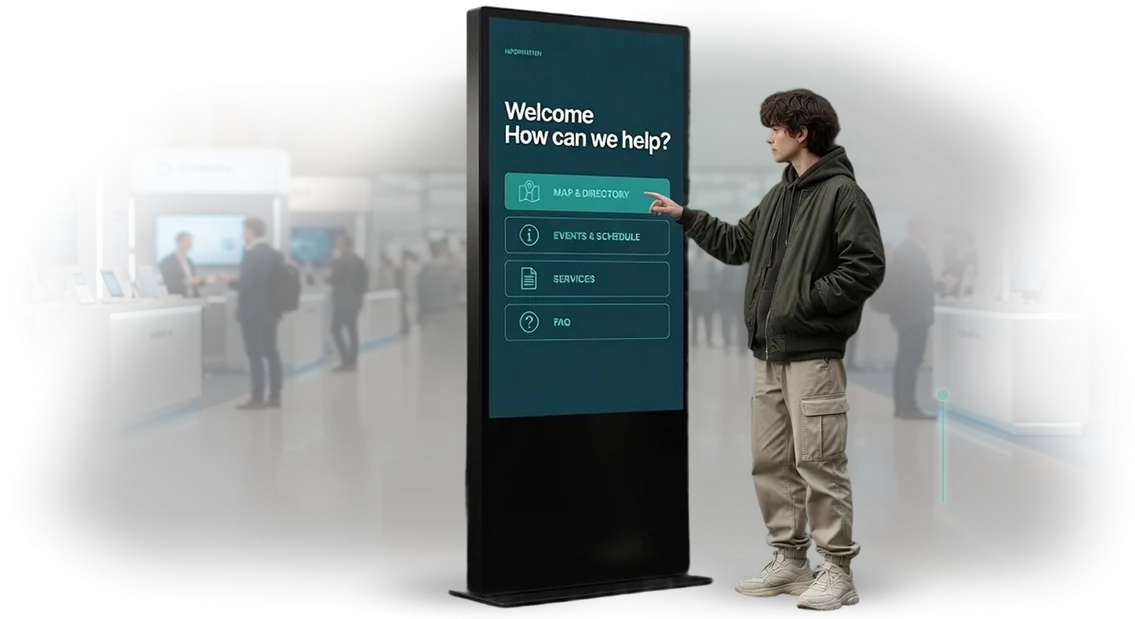
Why IT parks and technology centers need an interactive kiosk
An IT park or technology center houses dozens of residents, meeting rooms, laboratories, and recreation areas. A guest or new employee spends 10–15 minutes looking for the right office, and if navigation is poor, they get lost and frustrated.
As a result, first impressions suffer, meetings are disrupted, and the reception desk is overwhelmed with questions.
Familiar paper signs and plaques do not meet the expectations of modern visitors. People are used to quick digital prompts on their phones, yet in a technopark they are forced to search for small arrows with their eyes.
Reception staff constantly get distracted explaining directions instead of focusing on their own tasks.
An interactive kiosk solves this problem: the guest independently finds the right company, meeting room, or café on the center's map. The information kiosk works around the clock, never gets tired, and politely answers hundreds of repetitive questions. Navigation in the technopark becomes fast and clear — just touch the screen to get a route.
This is not simply a sign but part of the technology center's image. A modern IT park should look innovative — a digital assistant at the entrance immediately creates the right impression for residents, guests, and investors.
You reduce the load on staff, speed up the flow of people, and gain a positive experience that increases loyalty. An interactive kiosk is the expected standard for a space that positions itself as technological.
What an interactive kiosk gives your guests and employees
Guests of a technopark often get lost in the buildings and waste time finding the right company or meeting room. Signs do not answer live questions, and the reception repeats the same thing ten times over.
An interactive kiosk solves both problems: the visitor finds a route on the touchscreen themselves, and administrators focus on truly important tasks.
Fast navigation and relief for the reception desk
The kiosk works like a smart pointer: by name, field, or office number, the guest receives a short route with a technopark map. Café, parking, meeting rooms — all in one place, without calls to the desk. Guests are less late for meetings, and employees are less distracted by standard questions.
Modern image and useful analytics
The kiosk immediately shows that the technopark keeps pace with the times — a plus when meeting investors and tenants.
In addition, the kiosk quietly collects anonymized statistics: which points are searched most often, when peak load hours occur, and what visitors find most useful. This data helps improve navigation, distribute reception workloads, and develop infrastructure.
Our team develops kiosks tailored to the specific site — from building layouts to integration with the booking system. You get a solution that saves employee time and improves service quality for guests.
Interactive kiosk formats for technology centers
For a kiosk to deliver value, its format must match the usage scenario. In a technology center, some tasks are handled by a floor-standing interactive panel, others by a compact wall-mounted screen, and still others by a full-fledged counter with a virtual concierge. The right choice determines how naturally guests and employees will interact with the system.
We help you choose a format for your specific task: where it will be placed, who will use it, and what information it should convey. Below is a checklist of the main kiosk types for technology centers and their purpose.
| Kiosk format | For whom and where | What it gives the customer |
|---|---|---|
| Floor-standing kiosk | Halls, reception, waiting areas | Creates an impressive "magnet" for visitors, allows showing 3D models of projects, maps, videos — holds attention and builds the image of an innovative company |
| Wall-mounted kiosk | Narrow corridors, elevator lobbies, passages | Saves space, provides quick navigation and reference information — a visitor finds the right office or meeting room within 30 seconds |
| Counter kiosk | Entrance area, administrator zone | Replaces a live reception after 18:00 and on weekends: answers questions, issues passes, schedules meetings, accepts requests |
The same kiosk can combine functions: interactive catalog, navigation, meeting room booking, event announcements. For a technology center, it is also a way to collect analytics — which sections are in demand, how many visitors used it, and which services were searched most often.
When choosing a format, consider three questions:
- Where will the kiosk be located and how much space is available? A wall-mounted kiosk suits narrow spaces; a floor-standing or counter kiosk suits open areas.
- Who is the main audience? If it is guests who need help and navigation, a counter is the better choice. If it is employees — a fast wall-mounted search for internal services.
- What is the main goal? To show the company's technological sophistication — a floor-standing screen with vivid 3D graphics. To provide quick access to information — a wall-mounted kiosk or counter.
We develop the interface and content for each format: from large touch elements for floor-standing panels to a convenient menu for wall-mounted screens.
As a result, you get a tool that works for visitor comfort and solves specific business tasks — without unnecessary costs for unsuitable equipment.
How kiosk development and implementation work
For IT parks and technology centers, it is important that the kiosk starts working quickly and without failures. Visitors and tenants get navigation, event schedules, and answers to frequently asked questions, while the administration handles fewer routine requests.
That is why we have built a process of six clear stages: at each stage you understand what is happening and when the result will appear.
Stages of kiosk development and implementation
-
Brief and task audit. We discuss which zones need to be connected, who will use the kiosk, and what information to place. We study the features of the space to propose convenient navigation scenarios.
-
Design and concept. We create the menu structure: map, events, space rental, contacts, FAQ. We prepare an interface prototype — you see the kiosk logic before development even begins.
-
Content creation. We write texts, prepare the complex map, and select visual materials. Content is adapted for technopark visitors: concise, clear, with emphasis on the key directions.
-
Interface development. We assemble screens with large control elements and logical transitions. The customer receives an intuitive, modern kiosk that requires no training: a guest finds what they need within 10–15 seconds.
-
Testing and configuration. We check key scenarios: resident search, route to a meeting room, event schedule. We ensure the kiosk operates stably during peak load hours.
-
Launch and support. We install the kiosk, connect it to the network and updates, and train your staff. After launch, we stay in touch: update content, add new locations, and maintain kiosk operation.
Kiosk support is a separate stage that we take on. You do not have to worry about the technical side: information is up to date, the screen works, and visitors are satisfied.
Implementation takes several weeks — we name the exact timeline after the brief and confirm it in the contract.
What is included in the interactive kiosk delivery
Delivering an interactive kiosk is not just a box with a screen. The complete turnkey package includes equipment, software, interface, content management system, staff training, and warranty.
You do not need to coordinate multiple contractors — all work is carried out in a single cycle, and the result is ready for launch.
Here is what is included in the delivery:
- Equipment: professional enclosures and displays designed for 24/7 operation in high-traffic areas. You get a stable solution that will not let you down on the day of an event opening.
- Software: intuitive navigation designed around your visitors' scenarios. A guest finds the right information within seconds, without fumbling around.
- Initial content setup: we develop the structure of sections, maps, and reference materials for your park or center. You do not need to prepare a separate technical specification — we take care of that ourselves.
- Content management system: you update schedules, news, and event listings in a couple of clicks on your own. No programmer required — administrator rights are enough.
- Staff training: a short session for your administrators based on real work scenarios. After it, employees confidently operate the kiosk and handle typical guest questions.
- Warranty and support: service maintenance within agreed timelines and component replacement without long downtimes. You keep working while we resolve technical issues.
This package covers all the customer's needs at launch and in day-to-day operation.
Most importantly, you get not scattered components but a single tool: it raises the level of service, reduces the burden on administrators, and gives guests quick access to information about the park, tenants, and events.
Case study: how we improved navigation in a technopark
Technoparks live in a dense rhythm: hundreds of employees, visitors at conferences, guests from partner companies. Without clear navigation, people get lost, arrive late to meetings, and the reception desk turns into an information service.
Administrators answer the same questions instead of handling more important tasks — this leads to delays and unnecessary stress.
We installed several interactive kiosks in the TechHub technopark — in the lobby, near the elevators, and beside the meeting rooms.
This is not just an electronic map but a virtual concierge: a visitor selects a company or office, receives a route on the building plan, and follows it calmly without administrator assistance. The interface is clear from the first screen, so even new guests do not ask extra questions.
Two months later, we measured the results — and they speak for themselves.
Implementation results
- The number of reception inquiries dropped by 30% — administrators shifted to working with residents and preparing events.
- The visitor satisfaction index noticeably increased: people note that navigating the building has become easier and faster.
- The average time to find the right office decreased: instead of wandering through the floors, visitors make one request to the kiosk and get a ready route.
- Kiosks became part of the technopark's image: resident news is broadcast on shared screens, and the space looks more modern.
After the successful launch, the customer came back to us again — now for the second building.
This is the best proof that the kiosk solves a real pain point for the technopark, not just serves as "tech decor." Higher guest satisfaction and a relieved reception desk are the results the project was designed to achieve.
How to choose the right kiosk format for your facility?
When choosing a kiosk for an IT park or technology center, it is important to start from the tasks it will perform and the visitor flow. If guests come to reception for information, navigation, or meeting room booking, a compact floor-standing model is sufficient.
When the building has multiple floors and a developed infrastructure, it is better to look at touchscreen counters with the ability to integrate with the booking system and the facility map.
Kiosk selection criteria usually fit into four parameters. First — traffic: the more people pass through the lobby, the more reliable the equipment must be, with an interface designed for fast navigation without queues.
Second — space: wall-mounted solutions suit narrow halls, while freestanding terminals with large screens suit spacious waiting areas.
Third — task types: only reference information, or also specialist appointment booking, service payments, visitor surveys, and integration with the access control system.
Fourth — the implementation and support budget, which is better assessed not as a one-time purchase but as the total cost of ownership over several years.
Kiosk selection also depends on the facility's audience. In an IT park, residents and startup guests are common — they value speed and a modern interface.
In a technology center with excursions and school groups, resistance to heavy use and content that can be easily changed for different events become priorities.
We help you choose a kiosk for your facility: we analyze the layout, calculate the load, and select the enclosure, screen, and software for current and future tasks.
It is important that the system does not become a static showcase but works as a tool that delivers value and reduces the burden on administrators.
That is why we recommend starting with a short audit of the facility and use scenarios — it takes one or two days. Based on the results, you get a clear list of options with a rationale for which format suits your specific space and budget.
Frequently asked questions about interactive kiosk development
Before launching an interactive kiosk, owners of IT parks and technology centers have the same questions: what happens if it breaks, how to update information, how long until launch. That is normal — any equipment requires an understanding of how it works in everyday use.
We have collected answers to the most common concerns so you can assess risks and plan your budget calmly. If your question is not here, just write to us — we will explain in detail.
What happens if the kiosk breaks down?
Any technology can fail, but we include warranty service and remote monitoring. In the event of a breakdown, you get repair or replacement as quickly as possible, so your visitors do not notice the downtime.
How do I update content in the kiosk?
Updating does not require a programmer: you change texts, photos, and videos through a simple control panel. You can do it at any time — information about the park or residents always stays current.
What are the kiosk development timelines?
A typical project takes from two weeks to a month: from task definition to installation and launch. If you need a custom structure or integration with your internal system, we specify the timeline in the contract before work begins.
What guarantees do you provide?
We officially guarantee the operation of the equipment and software. The entire project comes with a warranty period, after which you can extend support — so the kiosk will run reliably for years.
Order kiosk development for your IT park
Ordering a kiosk for an IT park means getting not "hardware for the sake of hardware," but a digital assistant that helps visitors navigate and reduces the load on administrators.
To help you make a decision without risks, we have turned the process into a clear route: from request to working system.
- Request on the website. You leave your contact, we reach out within one business day and clarify what tasks the kiosk should solve: navigation, reference information, event registration.
- Kiosk consultation. We analyze your scenario: guest flows, placement points, typical visitor questions. You get recommendations even if you are not yet sure about the technical side.
- Kiosk cost calculation. We prepare a transparent estimate for your budget: development, equipment, installation, configuration. No hidden payments — only what is really needed for the result.
- Project plan and adaptation. We set timelines, stages, and areas of responsibility. We adapt the interface, scenarios, and design to your IT park's style and residents' needs.
- Launch and support. We install the kiosk, configure it, and train your staff. After launch, we stay in touch: update content, add features, and assist with operation.
Turnkey kiosk development takes from two to four weeks — the exact timeline depends on the complexity of the scenarios. During this time, you get a ready-made tool that pays off through administrator time savings and a better guest experience.
Leave a request — and we will consult you, calculate the cost, and propose a plan for your tasks.