

Are you losing customers in cinemas and entertainment complexes?
A visitor who cannot quickly find the right hall or gets lost among cafes, game zones, and cloakrooms is not an accident but a systemic problem of your space.
In cinemas and entertainment complexes, time is the most valuable resource: a guest comes for emotions, but instead stands in line at the information desk, is late for a screening, and leaves with a feeling of dissatisfaction.
Moreover, the invisible part of the losses is not only canceled tickets but also unrealized additional sales in the lobby.
Ordinary signs and paper maps cannot cope with the flow of people at peak hours, especially in large complexes with several floors and dozens of zones.
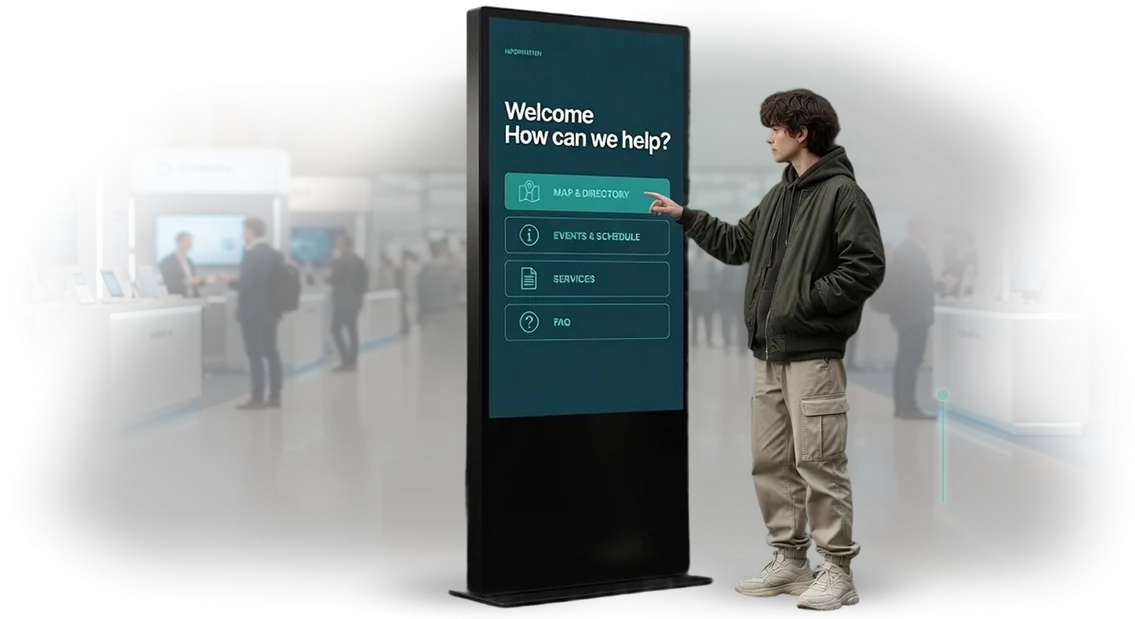
That is why an interactive kiosk for a cinema becomes the entry point to the space: it instantly answers the guest's main questions — where the hall is, how long it takes to get there, whether there is time for coffee or a food order.
Navigation in a cinema turns from a source of stress into a clear route, and the visitor takes control of their time again.
The effect for your business is obvious: fewer people late for screenings, fewer crowds at ticket offices and administrators, higher lobby throughput on peak evenings.
A satisfied guest is more willing to return, brings friends, and spends more on additional services — from popcorn to entertainment zones. Loss of visitors due to poor navigation stops being an expense item and becomes a growth point for average order value and loyalty.
We design solutions specifically for cinemas and entertainment complexes: we study the logic of people movement, decision points, and peak loads. On this basis we create clear scenarios that your staff can maintain without retraining.
By implementing such a kiosk, you are investing not just in a screen in the lobby, but in managing the guest's experience — from the first step to the moment they sit down in the seat.
Ask yourself honestly: how many guests do you lose every week because the right path was not shown to them in time? We know how to measure and address it.
What an interactive kiosk will do for your business
An interactive kiosk is not just a screen in the lobby, but a tool that solves several business tasks at once. Guests get lost in cinema complex zones, the queue at the ticket office eats up the time before the screening, and staff answer the same questions instead of selling.
We have put together a checklist to help you assess which tasks such a kiosk will solve specifically for you.
- [ ] Fast navigation. The guest sees a map of the complex, the route to the right hall, cafe, or parking lot — fewer late arrivals, more relaxed visitors.
- [ ] Upsell at purchase. When selecting a ticket, the kiosk offers popcorn combos, drinks, VIP seats, or a ticket for the next screening — the average order value grows without cashier involvement.
- [ ] Staff relief. The information kiosk answers typical questions about screening times, prices, and rules — administrators deal with guests rather than paper routine.
- [ ] In-the-moment marketing. The screen can show cafe promotions, giveaways, parking coupons — every contact with a guest carries an advertising message.
- [ ] Data for decisions. The kiosk records which services and films are searched most often — you rely on facts, not guesses, when planning your program and menu.
Tick the items that are currently costing you the most. If at least two match, an interactive kiosk will pay for itself through sales growth and time savings.
All that remains is to choose the format — wall-mounted or floor-standing, with or without ticket printing — and we will prepare a proposal for your complex.
Kiosk formats: which one to choose for your task
Kiosk formats differ not in design, but in the tasks they solve.
For a cinema or entertainment complex, it is important to separate guest flows: someone needs to quickly buy a ticket, someone needs to choose a film or find out the schedule, and someone is waiting for a screening and is open to additional offers.
A properly selected format reduces the load on ticket offices and increases the average order value.
| Format | Who it is for | What it gives the customer |
|---|---|---|
| Information kiosk | Guests looking for screenings, halls, promotions, route map | Relieves administrators, shortens the queue at the ticket office, helps guests find their way around the complex faster |
| Self-service ticketing | Viewers buying tickets without operator assistance | Reduces queues at peak hours, allows selling tickets 24/7 without extra staffing costs |
| Movie and entertainment ordering kiosk | Groups and families choosing a film, ride, or celebration | Increases the average order value through upsells of popcorn, drinks, and additional services |
There are no universal "best" kiosks. In a multi-screen cinema, self-service kiosks are usually placed near the entrance and information kiosks in the waiting area — so guests do not crowd in one place, and some purchases happen without a cashier.
If you have an entertainment center with different zones, a movie and ride ordering kiosk can become a separate point of sale. The guest chooses where to go and immediately pays for a package of services, and you get data on preferences for future promotions.
We help you choose a configuration for your flow and integrate kiosks with your cash register system and loyalty program. We work on professional equipment — kiosks operate stably even under high load during evening screenings and premieres.
How kiosk development works: 6 stages
We understand: for cinemas and entertainment complexes, kiosk downtime is lost sales. That is why we organized kiosk development so that each stage has clear development deadlines and an understandable result.
You can see where the project is, what is already done, and what you will get in the end — no "black boxes".
- Brief and task analysis. We meet with you, study guest flow, usage scenarios, and goals: ticket sales, navigation, loyalty programs. We document requirements and agree on deadlines.
- Interface prototype. Based on the brief, we create the screen structure and workflow logic. You see how a guest will interact with the kiosk, and we make edits before development begins.
- Design and content. We create an interface in your corporate style and prepare texts and multimedia: posters, film descriptions, hall map. Everything is adapted for quick comprehension.
- Development and integration. We build the system on professional equipment and connect it to your screening database and ticketing system. Payment, promo codes, and loyalty cards are configured.
- Testing and debugging. We test the kiosk in real scenarios: peak loads, payment failures, inaccurate touches. We bring it to stable operation so that guests do not stand in line.
- Launch and support. We install the kiosk on site, train administrators, and provide instructions. We stay in touch after launch: updates, remote diagnostics, and refinements as your tasks grow.
What is included in the delivery for cinemas
For a cinema or entertainment complex, an information kiosk saves visitors' time and relieves staff. For the system to be useful, the delivery must include everything — from equipment to content.
At our team we prepare a turnkey project: one contractor, clear stages, and transparent configuration.
Here is what is included in the standard configuration for cinemas and entertainment centers:
- Equipment and installation — stand, touch panel, protected enclosure, all fasteners, and connection.
- Software — a virtual concierge with showtimes, schedule, hall navigation, and movie search. The professional platform ensures stable operation without failures.
- Design and content — branded design, uploading of posters and trailers, and a convenient control panel for your marketer.
- Integration — integration with your cash register, CRM, and website so that prices and schedules update automatically.
- Remote management — monitoring kiosk operation and publishing changes without visiting the site.
- Warranty and service — installation, setup, staff training, technical support, and equipment replacement if necessary.
We support the project from the moment the contract is signed and do not leave after launch: we maintain the kiosk, update content, and consult your team. For you, this is a single point of responsibility — no searching for contractors piece by piece.
Case study: revenue growth with an interactive kiosk
Queues at the ticket office are the main enemy of both a cinema and an entertainment center. Guests spend 5-7 minutes buying tickets, are late for the start of the screening, and some simply turn around and leave. For the venue, this is not just an inconvenience but a direct loss of revenue and loyalty.
We solved this problem for the cinema chain KinoSfera: we developed an interactive kiosk that replaces the administrator desk for standard operations. The guest selects the film, screening, and seats, pays by card — without a queue and in 30-60 seconds. In addition, the kiosk offers combo sets, which immediately increases the average order value.
Project results
In the first month of operation, the kiosk recouped the costs of development and integration — after that it began to generate net profit. Here is what the interactive kiosk case study showed after six months:
- Service speed increased 5 times: instead of 5-7 minutes at the ticket office, about one minute at the kiosk.
- Share of self-service purchases reached 60% of all tickets sold during peak hours.
- Average order value increased by 15-20% due to automatic sales of popcorn and drinks at the time of screening selection.
- Sales growth for additional services reached 30%, because the guest sees the offer at the moment of purchase, not after it.
For the entertainment complex, this meant a steady flow of guests even during evening screenings: people stopped leaving because of queues, and the freed-up cashiers switched to complex questions and banquet reservations.
A repeat order is the best indicator
After six months, the client returned to us for three additional kiosks for their other venues. This shows that the project results were measurable and predictable: revenue growth, reduced staff load, and satisfied guests who come back again.
If your venue loses visitors at the ticket purchase stage, this is the case where one interactive kiosk changes the economics of the entire complex.
How to choose an interactive kiosk for your tasks?
Choosing a kiosk starts not with a model but with answering the question: what task does it solve in your cinema complex? For hall navigation, it is one thing; for selling tickets and popcorn, quite another; and for a loyalty system, a third.
The main criterion is the alignment of the usage scenario with the logic of your facility, so we select a configuration for a specific hall and visitor flow.
The first block of criteria is industry specifics and guests. The kiosk must be understandable from the first screen even to those visiting a cinema for the first time: without instructions, queues, or staff prompts.
Consider peak loads before screenings — the system must handle dozens of simultaneous actions without freezes or loss of entered data. This directly affects service speed and the atmosphere in the lobby.
The second block is practical tasks and integration. It is important that the kiosk can sell tickets according to your rate grid, accept payment, and display showtimes with current screenings.
Think through how it fits into overall navigation: helping find the right hall, showing time until the movie starts, and suggesting where to get popcorn. The solution must work together with your website, cash register, and loyalty program.
The third criterion is reliability and support. The complex operates daily from morning to night, so the equipment and server infrastructure are selected with a safety margin.
We are responsible for launch, staff training, and support throughout the entire lifecycle — you don't need to understand the technical details. As a result, you get a tool that saves guests' time and increases revenue without extra staffing costs.
Frequently asked questions about kiosk operation
Any owner of a cinema or entertainment complex asks the same questions before ordering kiosks: will the equipment break down on the busiest evening, how protected are payments and guest data, and how soon will the investment begin to pay off. Below are short answers to the most common concerns.
What happens if a kiosk goes down during peak hours?
Kiosks run on professional equipment designed for round-the-clock load. If a failure does occur, the system restarts automatically within minutes, and if needed, we connect remotely and restore operation right during a screening.
As a safety net, a guest can always be redirected to the ticket office — bookings and payments are not lost.
How secure is visitor data storage?
We build a secure server architecture: payment data and personal information are not stored on the kiosk itself but transmitted over encrypted channels. This meets industry requirements and reduces the risk of leaks. For guests, it is simply a fast purchase; for you, it is peace of mind and reputation protection.
When do kiosks pay for themselves?
The kiosk reduces the queue and frees staff for direct interaction with guests, so the growth in sales of popcorn, drinks, and additional services is noticeable within the first months.
Under a standard hall load, the investment pays off within one season, and after that, the kiosks operate as an additional sales channel with no increase in payroll.
After launch, we stay in touch: we help with updates, monitor load, and adjust scenarios to your program if necessary. The equipment is covered by a warranty, and setting up and calibrating kiosks for your showtimes takes minimal time. If you still have a question, ask it directly, and we will explain in detail how kiosks will fit into your specific complex.Order interactive kiosk development today
A kiosk in a cinema or entertainment center is not just a screen with a schedule, but a tool that shortens queues, tells visitors where to buy tickets and how to get to the hall, and also sells popcorn and participates in the loyalty program. A properly designed kiosk pays for itself through service speed and additional sales.
We develop turnkey interactive kiosks: we study your complex's tasks, design the logic, draw the interface, program, and launch. You don't need to understand the details — you get a ready-made system that works with your ticketing and cash register services.
What is included in a turnkey project:
- Audit of visitor flow and scenarios — we determine which functions your cinema specifically needs.
- Interface design in corporate style — understandable for guests of any age, with large buttons and hints.
- Development of logic for navigation, ticket purchase, and food and drink ordering.
- Integration with the ticketing system, cash register, and loyalty program — without manual operations.
- Launch and staff training so that the kiosk works from day one.
- Technical support and updates after launch — we monitor stability and make changes quickly.
To order a kiosk, simply leave a consultation request. We will calculate the cost of development for your tasks and propose launch timelines — usually from three weeks to two months depending on functionality.
Leave a request, and within a day you will receive a project plan with a cost estimate and work schedule. You can make a decision without unnecessary calls and meetings.