

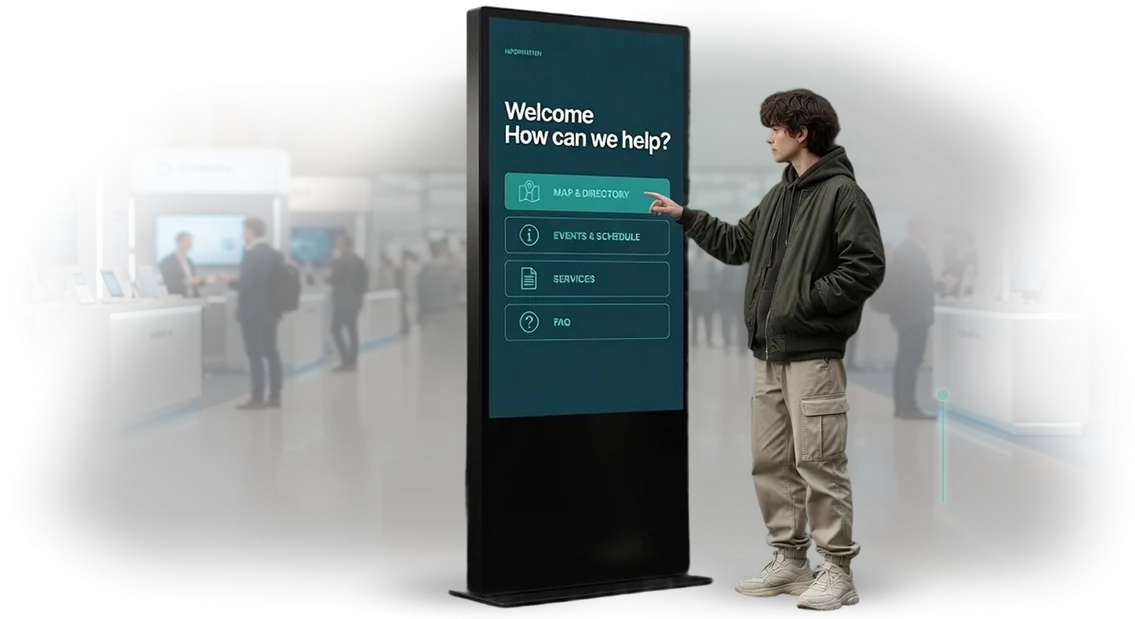
Kiosks for Oil and Gas Complexes: Why Do Clients Leave?
On vast oil and gas facilities, visitors easily get lost: several buildings, dozens of offices, strict access control.
Without on-site navigation, guests spend time finding the right department, arrive late for negotiations, and leave with a negative impression — as a result, you lose clients and partners without even knowing it.
Employees and contractors face the same problem every day: instead of working, they're figuring out directions, while safety requirements demand that people go straight to the right zone.
An interactive kiosk at the entrance solves the task instantly — it shows the route, locations of facilities, contacts of responsible persons, and does it without staff involvement.
We have been implementing such solutions at industrial sites for over 10 years — from rotational worker camps to administrative and amenity complexes — and we know how to turn a chaotic territory into a clear system.
What an Interactive Kiosk Gives Your Facility
Interactive kiosks on the territory of an oil and gas complex are not just information panels. For visitors and employees, they provide fast access to up-to-date data: route maps, schedules, regulations. For management, they are a tool that improves service quality without expanding headcount.
The first thing guests notice is speed. Instead of searching for the right office or specialist, it's enough to approach the kiosk and get an answer in a couple of touches.
The visitor saves on average 10–15 minutes, and the enterprise maintains its reputation as an organized site. Employees stop being distracted by recurring questions and focus on their core tasks.
Industrial complexes receive suppliers, contractors, and out-of-town specialists every day. Each has their own request — from getting a pass to finding a checkpoint. The kiosk provides the necessary information, shows the route, and reminds about safety rules. This reduces the risk of errors related to the human factor and makes service predictable.
A modern digital concierge builds the image of a technology-driven enterprise. It shows partners and guests that the company cares about people's comfort and implements relevant solutions.
Employees also appreciate the convenience — this positively affects the overall atmosphere and team loyalty.
The kiosk collects anonymized statistics: which sections are viewed most often, when the load is higher, which questions need clarification. This data helps improve navigation and service without surveys or lengthy approvals. Service development becomes clear and manageable.
As a result, the kiosk pays off not so much in money as in reputation and convenience. We design the interactive system taking into account the specifics of your facility — operating schedule, visitor flows, and safety requirements. You get a tool that works for your goals from day one.
Kiosk Formats for Oil and Gas Complexes: Selecting the Right Option
For oil and gas complexes, a kiosk is not just a screen but a working tool that relieves staff and speeds up access procedures.
A guest or employee doesn't need to find a colleague to learn the route to the laboratory or get a safety briefing — everything is available at the point of presence.
We offer three formats, each solving its own task. The choice depends on the installation location and usage scenarios: welcoming guests, navigation around the territory, information for employees, or safety awareness. Below is a comparison to help you choose the best option for your task.
| Format | Where to Use | What It Gives the Client |
|---|---|---|
| Floor-standing kiosk | Entrance area, administrative building lobby, waiting zone | Greets visitors from the first step, immediately provides a route map and on-site rules |
| Wall-mounted kiosk | Corridors, checkpoints, stands near elevators, checkpoint zones | Saves space and provides quick information about buildings, offices, and operating hours without creating queues |
| Built-in kiosk | Reception, safety desk, built-in niches | Works as part of the interior, doesn't draw attention, but is always available for recurring employee requests |
We adapt each format to your brand identity and scenario: from a simple reference guide to an interactive map with routes through buildings.
When selecting, we take into account lighting, foot traffic, and the level of protection against external impacts — so the kiosk operates stably in any conditions.
How Development Works: From Brief to Launch
Developing a kiosk for an oil and gas complex is a project with its own specifics: round-the-clock operation, different visitor requests, high reliability requirements. To ensure you're confident in the result, we've built a process of six stages — transparent and manageable.
- Brief — you describe what functions the kiosk should perform: navigation, virtual concierge, staff information. We clarify the details and record the requirements so each next step is based on your needs.
- Project plan — we agree on timelines, stages, responsible parties, and scope of work. You receive a plan with dates and milestones to plan your team's resources.
- Design and logic approval — we create a screen prototype: menu structure, visual style, texts. You see how the kiosk will look and work and approve the mockup before programming begins.
- Development and content — we build the interface, connect the necessary data, and upload content. Intermediate demonstrations allow changes at early stages rather than after delivery.
- Testing — we test the kiosk in conditions close to real ones: long operation, different user scenarios, load. We address feedback and bring the system to a stable state.
- Launch and support — we install the kiosk, train employees, and hand over documentation. We stay in touch for updates and technical support.
What's Included in Delivery: Complete Package for Your Facility
When ordering an information kiosk, you receive not separate parts but a complete delivery package — from the enclosure to employee training.
No self-assembly, no searching for subcontractors, no on-site "finishing touches": everything needed for launch at your facility is already included in the cost.
- Kiosk enclosure — durable industrial enclosure protected from dust, moisture, and temperature fluctuations. Suitable for installation in workshops, at checkpoints, and in administrative buildings.
- Software — a virtual concierge system with an intuitive interface: maps, department directory, safety instructions, contact search, and answers to frequently asked employee questions.
- Kiosk installation — we deliver, install, and connect the equipment at your site. All that's needed for launch is a power supply and local network access.
- Content — we populate the kiosk with your information: site map, service operating hours, traffic routes, enterprise news, occupational safety memos. You approve the materials before launch.
- Employee training — we conduct a short briefing for your team: how to update data, change information materials, and monitor the kiosk's operation.
The entire package is adapted to your facility's needs: additional modules can be added — for example, territory navigation or integration with an internal request system.
We support the project after launch, so the kiosk continues to operate stably and is updated along with your materials.
Case Study: How We Increased Loyalty at a Gas Facility
For a gas complex operator, we developed an interactive kiosk that became a virtual concierge for employees, contractors, and visitors.
Before that, guests spent a long time finding the right building, staff were constantly distracted by "how do I get there" questions, and some requests were lost in a paper log. A month after launch, it became obvious: the facility became calmer and more organized.
How It Happened
We conducted a series of interviews with duty shifts and identified which questions recur most often. Based on that, we built the kiosk scenario: a territory map, route plan, contact list, and safety briefing.
Instead of printed stands and verbal directions — a single touchscreen that answers 90% of standard questions on its own.
Results and Client Feedback
Following the trial period, the facility manager at GazEnergoService noted: "Visitors have stopped lingering at the entrance, and duty staff now have time for real tasks." The time to obtain information dropped from 5–7 minutes to 1–2, and the flow of repeated questions to staff almost halved. Together we conducted a survey among visitors — the share of positive ratings grew from 64% to 91%.
This result ensured not only guest loyalty but also client trust: a quarter later, we expanded the system to a second building and added a reporting function for the security service.
Now the facility runs on a well-tuned platform, and we receive requests from related enterprises that want the same level of service.
How to Choose a Kiosk Format for Your Needs?
To choose a kiosk format that actually works, start not with the appearance but with your facility's tasks. The same touchscreen terminal can greet guests in an administrative building, help employees find the right office, or verify access at an oil and gas complex checkpoint.
The usage scenario determines the screen size, enclosure type, and resistance to the external environment — so first define where and by whom the device will be used.
Key selection criteria are the audience, installation conditions, and scenario requirements. If the kiosk is installed outdoors or in a workshop, you'll need a protected enclosure with a bright screen; for an office lobby, a neat floor-standing terminal is sufficient.
Separately assess which functions will be primary: navigation, facility information, safety briefing, or visitor registration. The more accurately you describe these scenarios, the easier it is to choose a configuration without overpaying for unnecessary options.
Another point is the mounting method and connectivity. A stationary kiosk provides maximum capabilities: a large screen, integration with access control and HR systems.
A portable option is convenient for temporary events or when an information point is needed in multiple locations. Be sure to check whether there's power, internet, and a server cable nearby — this affects installation timelines and ongoing maintenance.
Expert advice: don't choose a kiosk from a catalog — instead, model a day in the life of an employee or guest at your facility. Walk the path from the entrance to the needed point and note the moments when they lack guidance. It's precisely these "bottlenecks" that an effective information system is built around.
We'll help you prepare a technical specification, select the enclosure type and software for your tasks, and ensure launch and support — so you get a kiosk that solves a specific problem rather than just standing in the lobby.
Frequently Asked Questions About Kiosk Development: Answers Before You Start
Clients from the oil and gas industry ask us about timelines, reliability, and integrating a kiosk into current processes. We answer common questions so you understand how the work will go.
Technical details are recorded in the contract — no surprises on site. Below are answers to the main concerns.
How long will development take?
A typical project takes 3–6 weeks after mockups are approved. The timeline depends on the number of scenarios and integration with your systems. Dates are fixed in the contract and we stick to them: a manager is responsible for the project.
Will the kiosk withstand facility conditions?
We use industrial enclosures and protected screens for temperature fluctuations and dust. Before launch, we test the equipment at your site to ensure the kiosk operates stably.
What warranty and support are provided?
We provide a warranty on equipment and work, with the first year of support included. Remote monitoring is available on request — in case of a failure, help arrives per the contract within a day.
How does it integrate with our systems?
We connect the kiosk to your internal directories, access control, and accounting systems. Data is provided in convenient formats. Integration is tested on a separate environment so the launch doesn't affect core processes.
Didn't find your question — write to us, and we'll discuss your task.Order an Interactive Kiosk for Your Facility
An interactive kiosk on the territory of an oil and gas complex is not just a map display. It relieves the dispatch and security services: employees, contractors, and guests find the right workshop, warehouse, or laboratory themselves in a couple of touches.
For you, this means fewer queues at checkpoints and the ability to direct staff to tasks that require qualifications.
Our team develops kiosks tailored to the specifics of restricted and industrial facilities: the interface is intuitive without training, the enclosure withstands outdoor conditions and heavy use. We handle design, mockup approval, and launch — you don't need to dive into technical details.
By ordering a kiosk from us, you get:
- fast navigation for employees and visitors — up to 30% fewer "how do I get there" requests;
- round-the-clock operation, including night shifts and rotational periods;
- project launch from two weeks — from brief to on-site installation;
- protected design that withstands temperature fluctuations and mechanical impact;
- branding in your corporate style — the kiosk looks like part of the infrastructure;
- remote updates of maps and information without a specialist visit.
Leave a request for a consultation — and we'll calculate the cost for your facility. To do this, click the "Order a Kiosk" button or write to us in a messenger. All you'll need is a site layout and a list of usage scenarios; we'll take care of the rest.
After the calculation, you'll receive a transparent estimate and a timeline proposal. The first consultation is non-binding, and you're under no obligation. We'll get in touch within one business day.