

Why Educational Centers Lose Prospective Students
Prospective students decide whether to enroll within the first minutes of visiting an educational center. If the lobby lacks clear navigation and the information desk is slow, a future student gets a negative experience before their studies even begin.
Inconvenience, queues, 10–15 lost minutes — and the person leaves for competitors who seem more attentive right at the entrance. Yet it is the first impression that determines whether an applicant submits their documents to you.
The loss of prospective students happens quietly: they simply do not return and do not leave an application.
At the same time, every student who never enrolls means not only lost revenue but also reputational risks: dissatisfied visitors share their impressions in reviews and social media.
The problem of an educational center often lies not in the quality of its programs but in chaotic navigation and long lines at the information desk.
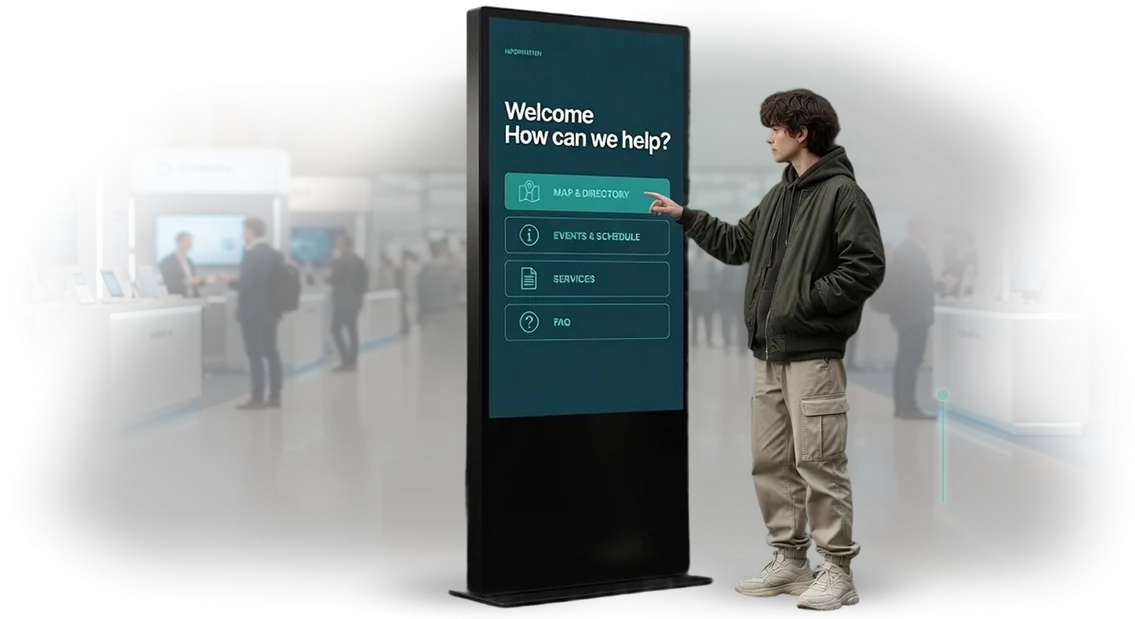
An information kiosk helps solve these problems — an interactive navigation system that shows the route to the right classroom, consultation schedules, and answers to frequently asked questions within a minute.
A virtual concierge takes the load off administrators and confidently guides a prospective student from the entrance to the necessary office.
By implementing such a tool, an educational center turns the first visit into a point of student attraction rather than a reason for refusal.
Educational centers that already use interactive kiosks report an increase in application conversion and visitor loyalty. No queues, no lost people — there is a clear scenario for a first introduction to the educational institution.
A compact device in the lobby works as a personal guide available at any moment and helps the center stand out from competitors.
Such care for visitors improves reputation and pays off not only during admission season: students remember the convenience and recommend the center to friends and acquaintances.
What an Interactive Kiosk Gives an Educational Center
Visitors Get Answers Within Seconds
Every day, dozens of people in an educational center ask the same questions: where is the classroom, how to sign up for a course, when is the next open house. The interactive kiosk responds instantly and always politely, without queues or waiting.
The visitor chooses the desired section themselves — schedule, training program, teachers, cost. This relieves tension during peak hours and helps prospective students feel more confident from their very first visit.
The Administrator Finally Handles Real Tasks
There is no longer any need to repeat the same information twenty times per shift. The kiosk handles standard inquiries, while the administrator focuses on what requires human involvement: career guidance consultations, document processing, and solving non-standard issues.
Relieving the administrator directly affects service quality. Staff now have time for thoughtful conversations with each guest instead of mechanical responses. As a result, satisfaction and the share of enrollments grow.
Interactive Navigation Eliminates Confusion
New students often get lost in the hallways and are late for classes. The kiosk shows the route to the required classroom on a floor plan — quickly and clearly. Fewer lateness incidents, fewer calls to the reception desk, and both guests and teachers feel calmer.
Navigation is easy to update when schedules change or classrooms are relocated. Information is always current, which removes another source of chaos.
The Brand Looks Modern and Tech-Savvy
A modern kiosk at the entrance is a signal: the center keeps up with the times and cares about people's comfort. Prospective students and parents pick this up instantly, and trust in the educational institution grows even before the first conversation with a consultant.
The same advantages work for open house events and functions: guests independently explore the programs, while organizers gain more time for meaningful communication with potential students.
Interactive Kiosk Formats for Your Task
Kiosk formats are not a question of design but of scenario. In an educational center, the same virtual concierge must work both in a bustling lobby for 500 people and in a quiet waiting area.
If the kiosk is placed where it can't be seen or it blocks the walkway, the investment doesn't pay off. The right format adapts to your traffic, space, and budget: floor-standing — for large open spaces, wall-mounted — for narrow corridors, and desktop — for the reception desk.
We select a format for your task rather than offering a "box" for the sake of a checkbox. All options run on the same professional equipment and handle the load equally reliably — the built-in touchscreen is designed for 24/7 operation.
The difference is in the method of placement, and therefore in guest convenience and the coverage you get without staff involvement.
| Kiosk format | Who it is for | What it gives the client |
|---|---|---|
| Floor-standing kiosk | Educational centers with high traffic: lobbies, open house days, exhibitions | Attracts attention from a distance and works as a standalone information station. Reduces the load on administrators and shortens the reception queue |
| Wall-mounted kiosk | Small spaces, corridors, waiting areas, elevator lobbies | Saves space and does not block walkways. Information is always visible — a visitor gets an answer even when the registration desk is busy |
| Desktop kiosk | Reception desks, consultation offices, course enrollment areas | Compact and easy to move. Answers frequently asked questions, schedules consultations, and frees staff from routine |
The main selection criterion is what the kiosk should do. A floor-standing format solves the task of navigation and engagement in high traffic. A wall-mounted format covers the need to "quickly orient" in a limited space.
A desktop format is a convenient replacement for paper brochures. In any case, you get a single system: one contact center with class schedules, teachers, and program enrollment.
To avoid mistakes, it is enough to assess two parameters: how many people pass through the placement point per hour and whether the guest has time to stop. The format is chosen based on these conditions.
Everything else — firmware, design, integration with your schedule — is already included in the work and does not depend on which kiosk you choose.
How We Develop a Kiosk for Professional Educational Centers
For a professional educational center, a kiosk is an assistant that routes visitor flows, relieves administrators, and increases prospective student loyalty.
We understand that developing a kiosk is a responsible step, because the first impression of the institution depends on it.
That is why we turn the process into a transparent sequence of stages with checkpoints: you always know what stage the project is at, what is ready, and what changes are possible without missing deadlines.
-
Brief and goals. We dive into your educational center's tasks: what information visitors need, how the kiosk will fit into existing services, and what metrics count as successful. We agree on functions that will bring real value and cut away the unnecessary.
-
Scenario analysis. We study typical situations: an applicant looks for a program, a student checks the schedule, a teacher finds a classroom. We build logic that speeds up each path and reduces the queue for information.
-
Interface prototype. We create an interactive mockup of the screens — you see the structure and logic before the main development. At this stage, it is easy to adjust the layout of sections and text so you don't have to redo a finished kiosk.
-
Development and design. We style the kiosk according to your brand and program the functionality. We work on professional equipment and proven tools, so the kiosk runs stably even under peak loads — during document submission days or open house events.
-
Testing. We test scenarios with real visitors of a professional educational center, fix shortcomings, and adapt the interface. You receive a testing report and see how the kiosk handles the assigned tasks.
-
Kiosk launch. We install the device, connect it to your systems, and train the staff. The checkpoint is stable operation from day one, without downtime or visitor complaints.
-
Support and development. We update content, add sections, and analyze usage statistics. You can expand the kiosk's functionality as your educational center grows and stay technically relevant.
What Is Included in the Interactive Kiosk Delivery
For an educational center, it is important to receive not just a terminal with a touchscreen but a working tool that relieves administrators and helps prospective students find their way without assistance.
Therefore, we put together a "turnkey" package — you don't need to buy or figure out anything extra. Everything, from hardware to staff training, is delivered together and configured for your tasks.
The standard delivery includes equipment, preinstalled software, UI design mockups, and content filling.
We handle the full cycle: we design the enclosure for your lobby, adapt texts and navigation to the structure of your programs and audience, and after installation conduct staff training — so your administrators and teachers can confidently use the system from day one.
What is included in the package:
- Touchscreen kiosk with a protected enclosure designed for 24/7 operation in high-traffic areas.
- Interface and design mockups — developed to match the center's brand style so the kiosk looks like part of the space and strengthens brand recognition.
- Software with a clear structure: a center map, schedule, information about courses, teachers, and events.
- Content package — assistance in preparing texts, structuring program data, and current contact information.
- Staff training — a short practical workshop for employees: how to update the schedule, add news, and manage sections without involving programmers.
- Technical support and warranty — remote support and system monitoring so the kiosk never sits idle due to failures.
This approach relieves management and administrators of routine: prospective students independently find answers to typical questions, and staff focus on live communication. Everything else comes in a single delivery package.
Case Study: A Kiosk for a College Increased Course Enrollment
A real example from our practice: for the professional educational center Perspektiva College we developed an interactive consultant kiosk. The task was simple — to relieve the admissions committee and not lose prospective students who call during peak days. Previously, some questions went unanswered, and course enrollment slowed down due to queues.
We launched the kiosk in the lobby and on the center's website. It now handles 80% of typical questions: schedule, program costs, admission requirements, documents. Live consultants are only involved in complex cases where a situation requires individual attention. For the educational center, this reduced staff workload and sped up responses by 3 times.
Implementation Results
The project paid for itself within 6 months — the kiosk turned a profit by reducing telephone call costs and increasing course enrollment.
During the first admission campaign season, more than 4,000 visitors used the kiosk, and every fifth person left contact information for follow-up. These are direct leads for the sales department.
A repeat order was not long in coming: after two semesters, the center ordered a second kiosk for its branch and a tablet version.
A successful project is not just numbers in a report but a living system that can be developed: adding new programs, changing schedules, and connecting online payment.
Why This Is Your Case
We are ready to adapt the same kiosk case to the tasks of your educational center. Importantly, we take on not only development but also support: content updates, scenario improvements, and analytics on requests. You get a tool that predictably generates applications and pays for itself within the first year.
How to Choose a Kiosk Format for Your Traffic
When the visitor flow in an educational center is small — up to a hundred people per day — a single compact kiosk at the entrance is enough. It helps answer typical questions, display schedules, and book consultations, relieving the administrator.
But if several hundred students and guests pass through the lobby daily, and a queue forms in front of the kiosk during peak hours, it is worth considering a more powerful format with multiple access points or dividing tasks between different devices.
The main selection criterion is not screen size but usage scenario. Calculate how many people request information during peak hours and which operations they perform most often: finding a classroom, checking the schedule, enrolling in a course, paying for tuition.
If there are many and varied actions, choose a kiosk with clear menus and fast response so that a visitor solves their task within a minute without creating a bottleneck.
For short inquiries, an information stand is suitable; for enrollment and payment, a full-fledged terminal with protected access is better.
The second criterion is placement location and potential for growth. In a narrow lobby, a bulky kiosk will block walkways, so it is better to consider a wall-mounted or floor-standing option with a compact enclosure.
Think about how the kiosk will fit into the interior and whether you can add another access point when traffic grows.
It helps if the software allows managing several kiosks from a single system: you update the schedule, add new programs, and change promotional materials without stopping the device.
The third point is content and its relevance. An educational center lives by class schedules, group admissions, and events, so the kiosk must be easy to update by your own administrator.
Choose a format where changes are made through a simple admin panel rather than through a programmer. Then the kiosk will remain a useful tool instead of becoming a display with outdated information.
The conclusion is simple: first determine your traffic and typical requests, then choose the format — from a compact stand to a multifunctional terminal.
We will help calculate the optimal configuration for your flow, design scenarios, and set up the system so visitors get answers within seconds and your staff handles fewer routine questions.
Answers to Questions About Development and Operation
Before launching a kiosk, a client always has practical questions: how long it will take, what about warranty, and who will update the information. We answer the main ones — without technical details, straight to the point.
How long does kiosk development take?
Usually three to four weeks: including interface design, design approval, and content filling. If you already have ready materials, we start faster. We fix the exact deadline in the contract so you can plan the launch without risk.
Is there a warranty and what does it cover?
Yes, the warranty on all work and equipment is valid for up to 12 months. During this period, we fix any kiosk failures free of charge and update the base software. After the warranty ends, you can subscribe to support — point-by-point or ongoing.
Is it difficult to update content without a programmer?
No. Management is built on a simple panel: you change the schedule, news, photos, prices — everything visitors need — yourself. Training takes one day, and access rights can be divided among staff. No technical skills required.
What happens if the kiosk breaks during operation?
The system is designed so that most minor failures are resolved automatically. We also see the device status remotely and connect to it ourselves when necessary. If hardware replacement is needed, we resolve it under warranty as quickly as possible — even on the same day.
You get not just "hardware with a screen" but a working tool that does not require constant attention from a technical specialist. We stay in touch after launch, so the information kiosk for your educational center runs reliably and does not distract staff from their main task — helping clients.Leave a Request for Interactive Kiosk Development
Leave a request — and within two days you will receive a cost estimate and a preliminary interactive kiosk mockup adapted to your educational center's tasks.
No lengthy approvals or technical details: we immediately talk about what matters to you — prospective student convenience, reduced administrative workload, and growth in applications.
We take on the project turnkey: from concept and design to delivery, installation, and content filling. You don't need to search for separate contractors — one contract, one party responsible for the result.
During the consultation, we will explain how the kiosk will fit into your lobby, how much time it will save your staff, and how it will increase visitor trust.
- Cost estimate within two days after your request
- Preliminary mockup aligned with the educational center's style and brand
- Consultation on formats, placement, and kiosk content
- Solution selection for the specific educational institution's tasks
- Warranty and support after launch
- Integration capability with class schedules and reference materials
Leave a request through the form on the website or by phone — we will call back within an hour, answer your questions, and record all the details.
We will start work immediately after approval and show the first result within a few weeks — so your visitors can start getting help from the kiosk as soon as possible.