

Why visitors to a rehabilitation center get lost at the front desk
The flow of patients and their loved ones at a rehabilitation center is almost never even: mornings are for admissions and procedures, daytime brings visits and questions, and evenings see another surge.
The administrator physically cannot simultaneously process documents, answer the phone, and explain where the right office is.
As a result, a person stands at the front desk, waits, gets nervous — and leaves with the impression that everything at the center is slow and disorganized.
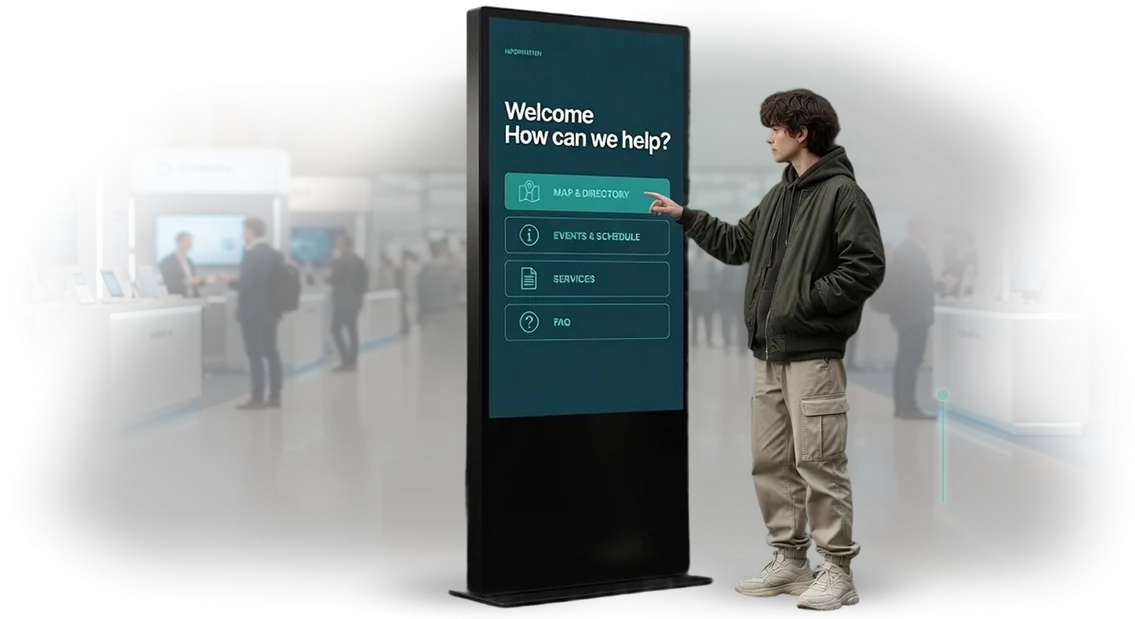
This is exactly the problem that software development for rehabilitation centers solves: an information kiosk for a rehabilitation center takes on routine questions — schedules, routes to offices, rules, specialists' working hours, appointment booking.
A virtual concierge for the clinic answers them immediately, with no queue and no involvement from the administrator, while navigation around the center for patients guides a person from the entrance to the right door along a clear route.
For a manager, this is not "just another screen in the lobby" but relief for the front desk and consistent service during peak hours. Staff switch to tasks where a human is truly needed: complex cases, accompaniment, working with families.
And the visitor gets an answer within seconds — and this directly affects whether they come back or recommend the center to acquaintances.
We build such solutions for a specific center: for its layout, schedule, rules, and tone of communication with patients. Let's discuss your task — we'll come back with an estimate and a plan.
What a center gets from software development for rehabilitation centers
Kiosk formats tailored to the center's tasks
An information kiosk in a rehabilitation center solves not just one task but several at once: it relieves the reception desk, helps patients and their loved ones navigate the building, and takes some of the questions off administrators' hands.
We select the format based on what matters most to the center right now — visitor flow, navigation, or information delivery.
A virtual concierge for the center takes on the initial contact: it provides the schedule of procedures, the appointment process, stay rules, and answers frequently asked questions at any time.
Interactive navigation for patients guides a person from the entrance to the right office, department, or waiting area — without staff accompaniment and without unnecessary inquiries at the front desk.
| Format | For whom | What it gives the center |
|---|---|---|
| Virtual concierge | Patients and relatives at the entrance | Less load on the reception desk, answers to frequently asked questions without staff |
| Navigation kiosk | Visitors in the lobby and on floors | Patients find the office themselves, fewer delays and "lost" people |
| Information kiosk | Patients in waiting areas | Schedule, services, rules — in a clear format and in multiple languages |
| Feedback kiosk | Center management | Collection of ratings and requests, showing what to improve in the service |
Developing kiosks for a specific task is not a template but a solution for a particular center: its layout, list of services, schedule, and style of communication with patients.
We design interfaces so that people of different ages and conditions can use them — large elements, clear wording, a minimum of steps to get an answer.
We work with professional equipment and well-tuned tools, so the kiosk runs reliably in daily mode and does not require constant attention from staff. Interactive kiosks is an area where we have accumulated experience in projects for medical and rehabilitation centers.
How we run a project: from the first conversation to kiosk launch
A kiosk project for a rehabilitation center is not "putting a screen in the lobby," but embedding a new communication channel into the live operations of the institution.
That is why we work in transparent stages: at every step, the client sees what has been done, what comes next, and when launch can happen. Below is the path our clients go through from the first conversation to ongoing support.
- Brief and immersion into the center's specifics. We discuss the task: who will use the kiosk — patients, relatives, visitors; what questions are most often asked at the front desk; what services and schedules need to be displayed. The outcome is a clear picture of exactly what the information kiosk should solve.
- Plan and scope approval. We lock down scenarios, section structure, staff roles, and acceptance criteria. The client receives a work plan with stages and approximate timelines — no surprises along the way.
- Prototype and logic approval. We show how a visitor will go from the first screen to the information they need. Revisions at this stage cost the least, so we approve the logic before implementation begins.
- Implementation and content. Our engineers build the interface, we connect schedules, directories, booking and notifications, and fill it with content together with your team. We work on professional equipment — the kiosk delivers consistent results under daily load.
- Testing on real scenarios. We run through typical situations: an elderly visitor, a person with visual impairments, a rush during reception hours. We eliminate rough edges before patients ever see the kiosk.
- Launching the virtual concierge. We install it, train staff, monitor the first days of operation, and adjust wording based on actual inquiries.
- Kiosk support. After launch, we stay in touch: we update schedules and sections, refine scenarios, and monitor stability. Most clients come back with new tasks — from a second kiosk to expanded functionality.
This order removes the main risk of implementation: the kiosk launches not "however it turns out," but for the specific load of the center. Describe your task — we will come back with an estimate and a plan for your institution.
How to choose a kiosk format for your center's tasks?
Choosing a kiosk starts not with the hardware, but with the question: which task of the center does it address?
If visitor traffic is high and the front desk constantly has a queue of questions like "where is the office," "how do I make an appointment," "who should I talk to" — you need an information kiosk that takes the routine off the administrator.
If what matters more is guiding the patient along the entire journey — from the entrance to the doctor's office — then we're talking about a virtual concierge with navigation and prompts. Identify the main pain point, and the format will choose itself.
Next, look at the specifics of the center. In rehabilitation centers, visitors often come with a companion, have poor spatial orientation, and need clear prompts and a patient interface.
The criteria for choosing a concierge here are simple: how quickly can a person with no preparation figure out the screen, will the system support large fonts and voice prompts, will the patient get lost if they make a mistake. A good solution adapts to people, not the other way around.
The third criterion is how the kiosk fits into your processes. It must work with the schedule, the patient database, and the center's internal systems, rather than living a life of its own.
Then the administrator sees the current picture, and the visitor gets the right answer on the first touch. Software development for rehabilitation centers takes these connections into account from the very start, rather than bolting them on later.
And lastly — the scale and budget of the process. You don't have to cover all tasks with a single device: you can start with one zone and expand coverage once the return becomes visible.
We help you go through this choice calmly: we analyze your traffic, specifics, and goals, and then propose a format that will pay off through staff relief and satisfied visitors.
Case Study: How an Information Kiosk Relieved the Center's Front Desk
A rehabilitation center approached us where front-desk administrators physically could not keep up with the flow of repetitive questions: where the right office is, how to sign up for a procedure, when the break is, how to get to the right building.
The queue at the entrance kept growing, and some patients and their relatives arrived early and waited a long time just to clarify the route.
We designed and launched an information kiosk with a virtual concierge — an interactive point that takes over navigation, scheduling, and routine questions.
Software development for rehabilitation centers here solved the main task: removing routine from people while not losing the human touch toward patients.
What Changed After Launch
In the first months of operation, the kiosk handled more than 12,000 inquiries, and the load on the front desk dropped by almost half — administrators switched to complex cases and in-person requests.
The share of questions about routes and schedules, which previously created the queue, shrank to a minimum: a visitor gets an answer within seconds without waiting.
Separately, I would note the repeat engagement: the center came back to us for an expansion — we added the procedure schedule and booking through the same interface. This is the best indicator that the solution truly works in daily practice.
| What It Was Like | What It Became |
|---|---|
| A queue at the entrance and busy administrators | Visitors find answers themselves in seconds |
| Routine questions took up staff time | People focus on complex tasks |
| Fragmented navigation across buildings | A clear route from the kiosk to the office |
The project relied on a well-tuned server architecture and professional equipment — this ensures stable kiosk operation without failures during peak hours.
We apply our experience in developing for clinics to other projects as well: the virtual concierge has already become a proven format for us, not an experiment.
What if the kiosk breaks down or becomes outdated?
Equipment fails for everyone — the question is not whether it will happen, but how quickly the kiosk gets back up and running and who is responsible for it.
That is why kiosk support is built into our service from day one: the warranty on the information kiosk covers both the hardware and the software, and a repair request is handled according to a defined procedure, not "when someone gets around to it." For a rehabilitation center this is critical: if the information kiosk or virtual concierge goes silent, visitors lose their navigation, and front-desk staff get pulled away by questions that the software is supposed to handle.
Obsolescence is the second most common fear, and it is solved even more easily. Updating the virtual concierge is part of the maintenance: you change the schedule, add services, adjust routes and texts — we make the edits without rebuilding the project from scratch.
Software development for rehabilitation centers is done in such a way that the interface and logic can be extended for new departments and scenarios rather than rewritten from the ground up.
What happens if the kiosk does break down after all?
We set out warranty obligations in the contract and take on diagnostics and restoration. You do not have to look for a third-party contractor and are not left with a dead screen in the lobby — support is handled by the same team that built the project.
What if our processes change? We have built in headroom for scenarios: new sections and roles are added as part of maintenance, without stopping the kiosk's operation.
What you get after placing an order:
- A warranty on the hardware and software with a clear procedure for requests
- Kiosk support for the entire service life, not just the first month
- Updates to the virtual concierge's content and scenarios based on your needs
- Training for staff on how to use the system and walkthroughs of typical situations
- A development plan: which features to add as visitor traffic grows
- A single person responsible for the project instead of a chain of intermediaries
Describe your task — we will come back with an estimate, a work plan, and support terms.
Stage timelines: how long each step takes
Timelines depend on how many scenarios the kiosk needs to cover: reference navigation around the center, booking an appointment with a specialist, class schedules, wellness questionnaires.
The more blocks there are and the more tightly they are connected to your internal systems, the longer the path. Below are rough estimates that we refine after discussing the task: you will have a kiosk project plan with clear milestones, not "in about a couple of months."
Kiosk development timelines shrink if you already have structured data on specialists, services, and schedules.
If the information is scattered across documents and employees' memory, we add time to collect and organize it, otherwise the kiosk will give visitors inaccurate answers.
We fix the implementation stages in the plan before the start: you know in advance what you will get and when, and you can plan the opening of the area or staff training.
Some work runs in parallel — filling the reference section starts while the interface is being developed, so the overall timeline does not grow linearly.
Describe your task — we will come back with an estimate and a plan for your center, with realistic timelines for each step.