

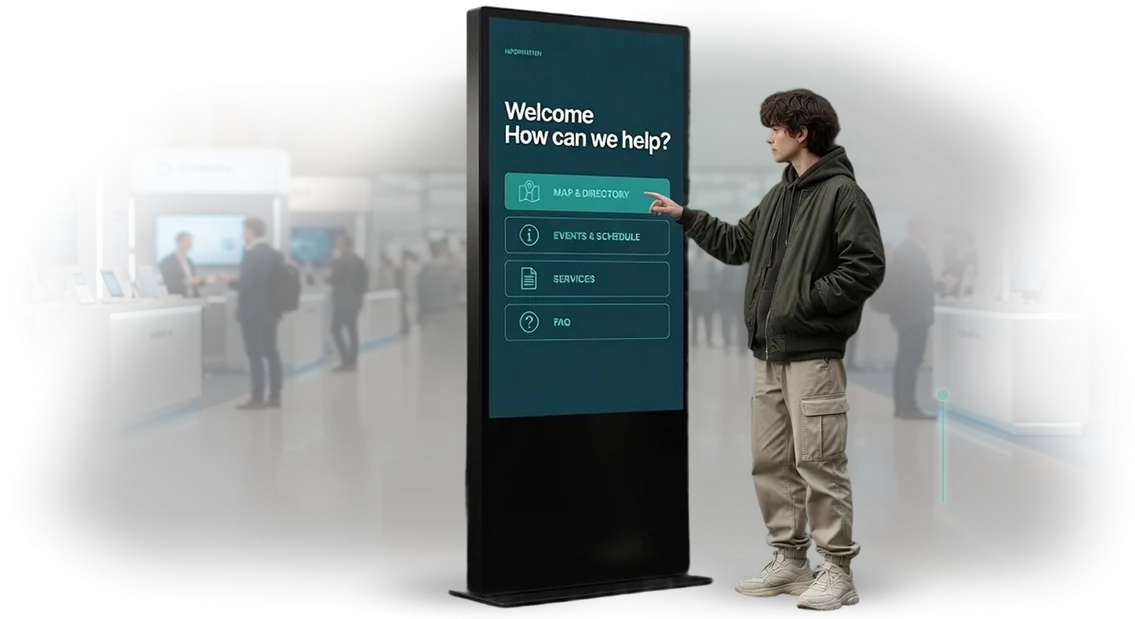
Visitors to Sports Centers and Stadiums Get Lost Without Navigation
A visitor to a sports center or stadium comes for a specific outcome: getting to a workout on time, finding their stand, meeting a coach. But large spaces, multiple entrances, and unfamiliar layouts turn the visit into stress.
People get lost, arrive late, miss the beginning of the session—and leave with negative feelings they associate with your brand.
This is especially acute on big event days: matches, tournaments, conferences.
When hundreds of guests are at the venue at the same time, reception staff physically cannot keep up with answering the same questions: where is the entrance, how do I get to a sector, where is the nearest cloakroom.
An information kiosk for a sports complex relieves this burden and gives the visitor an instant answer at any time.
Stadium wayfinding is not just signage—it is part of the customer experience. A guest who can easily find their way feels confident and rates the level of service positively.
They are less likely to be late, are more likely to use the club’s cafes and shops, and therefore generate more revenue per visit.
We address this pain point: we design interactive directory systems that help visitors find entrances, sectors, coaches, and service points within seconds.
The guest gets a clear route, your staff get fewer routine questions, and the business gets greater loyalty and repeat visits.
What an Interactive Kiosk Changes for Guests and Administration
An ordinary visit to a sports center starts with questions: where is the locker room, where is the coach, how do I pay. The administrator answers the same thing a hundred times, and at peak hours a queue forms.
An interactive kiosk removes this burden—guests find the answer themselves within 30 seconds, while staff focus on sales and personal interaction.
Such an information stand for visitors also changes the impression of the club. Guests see modern service rather than a stand with paper flyers—this increases loyalty and the desire to return.
For administration, it means a predictable flow of requests and more time for those who genuinely need help.
Benefits of an Interactive Kiosk for a Sports Center
- Speed. Map, schedule, rates, instructions—all within two taps. The guest does not wait for an answer, and the club does not waste staff time.
- Relieving the administrator. Typical questions are handled by the kiosk, and staff concentrate on memberships and non-standard tasks.
- Modern image. A technology-driven solution creates a sense of “a new level” and sets the club apart from competitors with ordinary stands.
We have been developing such kiosks for more than ten years: from small fitness clubs to large stadiums. We understand how guest flows work and configure the menu so that it covers 90% of typical questions from day one.
As a result, the administrator is no longer an “information desk,” and the guest gets fast, clear service. Both sides win: visitors come back, and employees work more effectively.
Information Kiosk Formats for Your Facility’s Needs
Sports centers and stadiums have large areas and different flows of people: someone needs to find a section, someone needs a schedule, and someone is looking for a cafe or an exit to the stands.
An information kiosk handles these questions without involving staff—the visitor gets an answer in a couple of taps, and the administrator handles only unusual requests. We use professional equipment and proven tools to keep the kiosk stable even on the busiest days.
Which Format Suits Your Facility
| Format | Who It’s For | What It Delivers |
|---|---|---|
| Floor-standing stadium kiosk | Spacious lobbies and entrance zones with high foot traffic | A prominent wayfinding point: facility map, match and training schedules, area maps |
| Wall-mounted panel for a sports complex | Narrow corridors, elevator lobbies, cloakroom areas | Saves space and provides local information about events, club services, and upcoming activities |
| Mobile tablet stand | Temporary points, promotions, seasonal events | Easily moved and reconfigured, no permanent space required in the project |
The format should match the size and foot traffic of the facility, so it is important not to guess but to calculate typical visitor scenarios in advance.
Formats can also be combined: floor kiosks at entrances, wall-mounted panels on each floor, and mobile stands for temporary zones or special projects.
We have already implemented such solutions for sports facilities and will help you choose a format that works now and can be easily scaled for new needs after the complex expands.
How an Implementation Project Runs from Brief to Launch
A sports center or stadium is a constant flow of guests who need fast wayfinding, schedules, and answers to questions. An information kiosk only delivers value when it is installed in the right place and handles the right scenario for each category of visitor.
That is why we structure kiosk implementation as a clear process: from brief to launch, with fixed installation dates and no surprises.
- Brief and visitor flow analysis. We study how guests move through the building, where queues and questions arise, and which zones need wayfinding. Based on this, we determine the installation location and the kiosk’s main scenarios: schedule, map, ticket purchase.
- Layout and menu structure development. We create a simple interface with large buttons and logical sections. Texts, service names, and visual style are agreed so that guests can use the kiosk without staff assistance.
- Review and revisions. We present an interactive prototype—the client sees what the screen will look like and what steps the visitor will take. Revisions are made quickly without affecting the overall launch date.
- Production and assembly. We manufacture the enclosure, configure the software, and prepare the content. At this stage you already receive an exact list of what will be installed and how it will work.
- Installation and configuration at the site. We install the kiosk at the agreed location, connect it to the network, and test all scenarios. We make sure the equipment does not block guest traffic and is visible from the main routes.
- Staff training. We conduct a short briefing for administrators and employees: how to turn on the kiosk, how to replace content, and what to do in an unusual situation. This removes dependence on the developer during the first month of operation.
- Launch and support. Together we test the kiosk in real conditions and under peak load. After launch, we stay in touch: we update schedules, change banners, and refine functions as the center’s tasks grow.
Thanks to this process, you get a working tool for wayfinding and reception relief from day one. Installation dates are fixed at the start of the project, and at every stage you know what happens next and when the result will appear.
What’s Included in the Delivery Package and Ongoing Support
Guests at a sports center should not have to get information through staff—they can simply walk up to the kiosk and, in a couple of taps, get the schedule, directions, or coach contacts.
We hand over a kiosk that is ready to work and that relieves the reception desk from day one while making service predictable.
The basic package includes everything needed to start, without hidden costs:
- Industrial-grade equipment — the vandal-resistant enclosure and screen are designed for constant-access operation, withstand high loads and temperature changes. For you, this means no downtime or breakdowns during the busiest hours.
- An interface tailored to sports facility needs — menu at start, class schedules, building maps, event listings. The client sees the structure and depth of navigation; the visitor finds the right section within 10 seconds without staff help.
- Content loading and management — the administrator can independently change schedules, news, and promotions through an easy-to-use panel, without contacting developers. You save time and always keep information current.
- Instructions for staff — short materials on startup, daily checks, and typical actions. Administrators and cashiers get up to speed within an hour, with no special knowledge or training required.
- Equipment warranty and fixed support — we remain responsible for the kiosk’s operation after launch: we handle scheduled maintenance and rapid recovery in emergency situations.
- Support and consultations — by phone or chat, during your facility’s working hours. If staff have a question, you are not left dealing with the problem alone.
Support After Launch
This package lets you focus on managing the sports center rather than on technology. The kiosk works by itself, content updates without your involvement, and we monitor service stability.
As a result, you get not just a stand with a screen but a tool that improves service quality and relieves your staff. If you need to expand functionality—for example, add workout booking—this is done within the existing support agreement.
Case Study: Wayfinding for an Ice Palace with 3,000 Guests a Day
During mass skating hours, the ice palace, with a flow of 3,000 guests a day, turned into a maze.
Queues at the information desk grew, parents lost their children in the corridors, and administrators explained the way to the locker rooms, ticket offices, and skate rental ten times over. That chaos increased staff pressure and ruined the impression of the visit.
Kiosk Implementation Case Study
We offered the client not another sign but an automated assistant.
We implemented a kiosk installation case based on an interactive touch terminal: guests choose a destination on the screen—locker room, box office, cafe, or ice rink exit—and immediately see a route on the building map.
The wayfinding system for the ice palace works without staff involvement and is clear even to first-time visitors.
Project Results
The project’s main results are measurable numbers and guest peace of mind. Queues at the information desk dropped by 40%, and most visitors stopped approaching the desk entirely: they find their destination through the kiosk within 30 seconds. Locker rooms and ticket counters are now located independently, freeing staff for real work.
After the first season, the client returned for a second phase: an additional terminal was installed on the second level, and the maps were updated for new leased areas. This confirms that wayfinding for the ice palace pays off every day, not just on launch day.
How to Choose an Interactive Kiosk for a Sports Facility?
When it comes to a sports center or stadium, a kiosk is not just a “screen with a menu” but a point of contact with thousands of visitors at peak times. A poor choice means queues on match day, lost cafe revenue, and dissatisfied guests who could not find their stand.
To avoid this, look at three things: facility foot traffic, installation location, and content logic.
Foot traffic determines speed requirements. On a weekday at a fitness club there are dozens of people; on game day there are hundreds and thousands. The kiosk must handle peak load and not freeze when a line forms.
Professional server architecture and polished software are not technical details—they are a guarantee that the visitor gets an answer in 10–15 seconds rather than angrily looking for a security guard.
Installation location drives design and protection. In a lobby or locker room, a compact floor-standing kiosk is enough. But near a stadium entrance, the equipment operates in outdoor conditions: temperature changes, dust, accidental impacts.
Here, vandal-resistant protection and an enclosure that lasts several seasons without downtime are essential. When choosing a kiosk, discuss its working conditions—otherwise repairs become a cost item rather than an investment in service.
Content is why the visitor approaches the screen in the first place. At a sports facility, the kiosk solves three tasks: helps locate a sector, shows training and class schedules, and informs about the club and merchandise store.
The menu must be obvious to every audience—from parents with children to older fans—with no learning required. A well-thought-out screen flow increases loyalty and reduces the workload on administrators.
Ultimately, the choice comes down to a simple principle: do not chase specifications and price, but understand what tasks the kiosk will solve specifically for you.
A properly selected kiosk pays off not through hardware but through visitors getting the information they need faster, staff not being distracted by routine, and the brand looking modern.
Start by documenting your facility’s real scenario—and base your decision on what guests need during the busiest hours.
Common Concerns: Durability, Safety, Updating Information
When information kiosks for sports centers and stadiums come up, we usually hear the same concerns: won’t the screen be broken, who updates the schedule, what happens if the kiosk fails on match day.
These are fair questions—the kiosk runs nonstop, stands in a crowded place, and guest flows and perceptions of the venue depend on its stability.
We have been designing these systems for sports facilities for over 10 years, so we answer briefly and to the point. Let’s go through the common fears one by one.
How do you protect the kiosk from vandals?
A housing made of impact-resistant materials, tempered glass, concealed cable routing, and vandal-resistant finishing are our baseline. For fan zones, we additionally reinforce mounts and protect the kiosk against moisture and dust. The kiosk survives crowds, accidental impacts, and even deliberate attempts to tear something off.
Who updates the kiosk content?
Content is changed without a programmer through a simple admin panel. A designated employee uploads a new schedule, event listing, stadium map, or banners within minutes—from any device with internet access. Updates appear on the screen immediately, not days later.
Is the kiosk reliable for 24/7 operation?
We use industrial components and server architecture designed for continuous operation. The system monitors the kiosk’s status and immediately notifies your facilities team of any failure.
In our projects, uninterrupted uptime is measured in months, and for repairs, fast module replacement is provided.
What if the kiosk does break down?
At launch, we provide a rapid recovery procedure and engineering support contacts. Under the contract, we support the facility, take the unit for diagnostics, or deliver a replacement. A sports facility must not sit idle—so we never hand over kiosks without a spare-unit reserve.
Get a Ready-Made Solution for Your Sports Facility
For stadiums and sports centers, fan comfort begins not with the match but with the simple things: where the entrance is, where the sector is, how to get to the parking lot or cafe. An information kiosk solves these questions without queues or extra strain on staff.
Instead of scattered equipment, you get a complete solution—a well-designed wayfinding point that works from day one.
We will prepare a full package for your facility and take the specifics of your space into account. In your request, you receive:
- a placement planogram based on fan flows and passage points;
- equipment composition for your budget and tasks—without unnecessary options;
- an interface matched to the stadium’s or club’s style;
- a working scenario: facility map, schedule, advertising, event listing;
- commissioning, testing, and staff training;
- support and content updates after launch.
To order a kiosk for a stadium or get a cost estimate, leave a request for a consultation. We will contact you, clarify the task, and prepare a commercial proposal with a planogram and an exact scope for your budget.
You will receive a clear action plan and implementation timeline—without overpayments or hidden extras.