

Insurance company clients expect instant answers — where to get them?
Insurance company clients expect instant answers — on the website, in the app, in the office. When a line builds up in the branch, the visitor starts looking for a solution through online channels: books another day, applies for a policy online, or leaves for a competitor. The branch loses a sale, and the client loses the sense of being cared for.
Waiting in line is the main irritant that ruins the impression even of a reliable company. That is why insurance companies increasingly place an information kiosk in their offices.
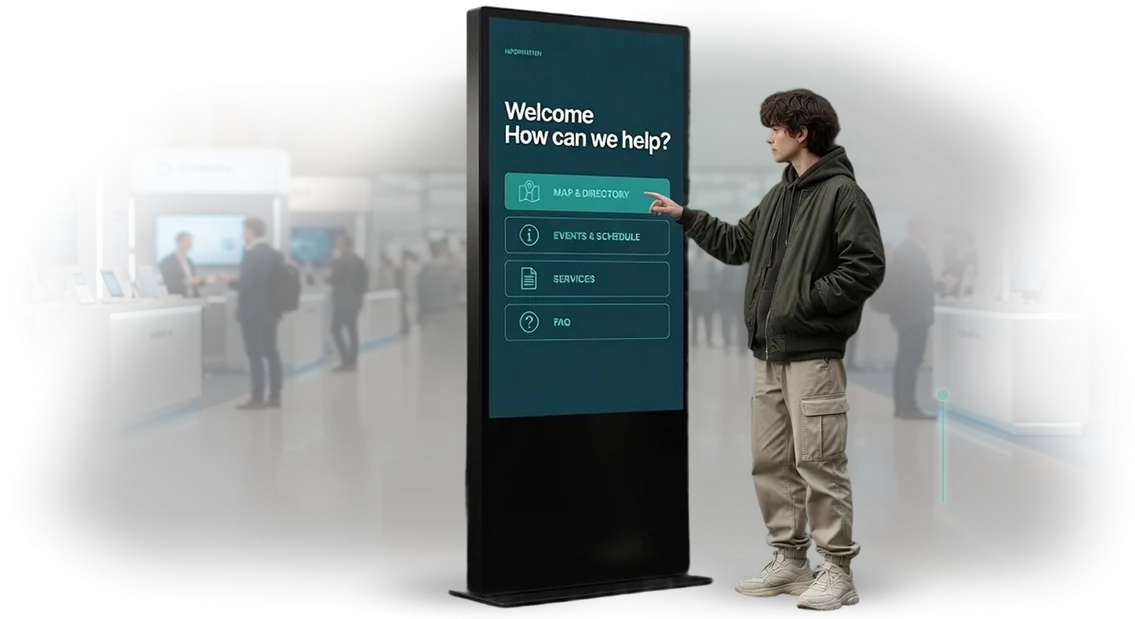
An interactive information kiosk lets visitors independently obtain a certificate, check the status of their request, learn product terms, and even leave a consultation request.
With such a kiosk, client service in the office becomes faster and more transparent. People spend minutes on simple questions instead of half an hour in line. Employees get distracted less by repetitive requests and devote more time to sales and complex situations.
The result — preserved visits, growth in successful sales, and loyal clients who come back again. We handle this task turnkey: design, develop, and launch interactive information kiosks integrated into your office processes.
What changes after implementing an information kiosk
Implementing an information kiosk in an insurance company's office changes the work of three sides at once: the client gets an answer in a minute, the employee is freed from routine, and management gets clear numbers. Below is what changes specifically.
For clients: speed and clear navigation
- Waiting time is reduced: standard questions (branch address, list of documents, request status) are resolved without a manager's involvement.
- The visitor does not wander around the office: an interactive map shows the right room or window, reducing stress and the number of late arrivals for appointments.
For employees: time for sales and consultations
- Managers stop answering repetitive questions — time appears for issuing policies and additional sales.
- The kiosk handles appointment booking and visit reminders, so working time goes to clients who generate revenue.
For management: transparent metrics
- The system records which questions are asked most often — ready-made material for improving products and scripts.
- Load statistics help optimize staff schedules and the number of windows during peak hours.
our team configures the kiosk to fit the insurance company's processes: from a basic reference system to integration with an internal scheduling system. The goal is for clients to feel the difference within the first week, and for you to see it in the numbers.
Check it yourself against the checklist: an answer without a line, an employee handling sales, a manager seeing the report. If at least one item does not work — this is not a full-fledged implementation.
Kiosk formats: desktop, floor-standing, and for events
In an insurance company, the client encounters the product in different places: in the head office, at a partner's location, at an exhibition or forum.
In each case, the kiosk should not just stand nearby but solve its task — reduce lines, relieve consultants, or collect leads with high traffic. Therefore, we select a specific format for your task: desktop, floor-standing, or mobile for events.
| Format | Where it works | What it gives the insurance company |
|---|---|---|
| Desktop kiosk | Sales office, partner network, reception desk | Fits compactly on a counter, takes up no extra space. Helps the consultant quickly show the product line, and the client — independently review the terms and leave a request without waiting for a manager. |
| Floor-standing kiosk | Head office, waiting area, lobby | Attracts visitors' attention, works as a permanent presentation of policies and programs. Relieves staff during peak hours and collects contacts without an employee's involvement. |
| Kiosk for events | Exhibitions, forums, conferences, city events | Mobile construction, easily mounted at a booth. In a few hours of interactivity collects hundreds of contacts, demonstrates new products, and helps you stand out from exhibition neighbors. |
All options are professional office equipment that we adapt to your premises: we consider dimensions, protection from dust and accidental damage.
The main thing is not the appearance of the enclosure, but how the kiosk fits into your sales process: guides the client through a scenario, records the result, and transfers data to the accounting system.
You get a single set for different locations: the same interface, corporate branding, and the ability to centrally update content on all kiosks at once.
We will select a format for a specific location — we will calculate the space, size, and load so that the kiosk becomes a working tool for your sales department, not just interior decoration.
How we launch a kiosk: the path from brief to first session
We structure our work so that you always know what stage the kiosk is at and what you will get in the end. You do not need to understand technical details: we handle the project turnkey, and you control the timeline, budget, and result.
The process is transparent and consists of six steps — from the first brief to the launch and support of the kiosk.
-
Brief and project approval. We discuss what questions the kiosk should solve: where it will stand, who will use it, what insurance company materials need to be shown. We record the requirements, timeline, and agree on the work plan.
-
Prototype and scenarios. We design the logic: main menu, answer search, virtual concierge, request submission. We present the mockup for approval — you make edits before development starts.
-
Kiosk development. We build the interface and connect the knowledge base: rates, contacts, office addresses, instructions. We set up a convenient panel so you can update information without a programmer.
-
Kiosk testing and launch. We check scenarios together with your employees and fix any issues. We install the kiosk at the site, train the staff, and help with the launch.
-
Kiosk support. We connect remote monitoring and technical support. If needed, we quickly update information, add new features and sections.
-
Analytics and improvement. We review statistics: which requests are the most frequent, how much time visitors spend at the kiosk. We use this data to improve scenarios and increase the kiosk's value.
This approach removes uncertainty: you know exactly what happens at each stage and when the kiosk will go live. And thanks to support, the device remains relevant and useful for insurance company clients.
What is included in the delivery and what you get in the end
When ordering a kiosk for an insurance company, it is important to understand: what will you receive at the final stage, and will there be any hidden work?
We structure the delivery so that the composition is transparent from day one — you see the full list, timeline, and documents before the start, and at the finish you get a working tool, not a "raw" mockup.
Here is what is included in the delivery set:
- Ready-made kiosk with preinstalled software — including the enclosure, screen, and fine-tuned software configured for your company. You do not need to purchase or refine anything.
- Content filling — menu structure, texts, icons, and navigation for typical client questions: insurance products, request submission, office addresses, contacts. We will prepare content from your materials or help systematize them.
- Admin panel for independent updates — you can change promotions, rates, and news without involving developers.
- Employee training — a short practical session for staff: how to turn on the kiosk, replace consumables, and update information. Your employees will confidently help clients.
- Documentation and instructions — clear operation and administration manuals, as well as a work completion certificate and closing documents.
- Kiosk warranty and technical support — during the warranty period, we quickly resolve issues, and if necessary, connect remotely or visit on site.
In the end, you get not just equipment, but a tool that reduces the load on staff and speeds up client service. No "surprises" at the final stage — everything needed for the launch is already included.
Case study: how we reduced waiting time in branches by half
For a major insurer with a branch network, we developed and launched an interactive kiosk that became a virtual concierge.
A client came to the office, selected the needed service on the screen — get a certificate, check the status of an insured event, book an appointment with a specialist — and immediately received an answer or a ticket with a queue number. This relieved the administrators and freed them for live consultations.
What changed for the business
Previously, employees spent up to a third of their time on standard questions and paperwork. The kiosk took over these tasks. Waiting time in the branch was cut in half, and staff gained time for discussing additional products — home, health, and travel insurance.
Some clients who previously left because of the line now wait calmly and manage to arrange more services in a single visit.
Results we recorded
An independent assessment was carried out by the company itself: they compared two identical branches — with and without a kiosk. In the branch with a kiosk, average waiting time dropped from 12 to 6 minutes.
Additional service sales grew by nearly a third in the first two months. The kiosk paid for itself faster than planned: the savings on routine covered the cost of implementation already in the first quarter.
A word about experience: this is not our first such case — our team has more than a dozen projects for banks, clinics, and government institutions.
We know how to integrate a kiosk into existing processes without breaking them, and how to make the interface clear even for those seeing a touchscreen for the first time.
That is why insurance companies get a working tool that reduces the load on staff and increases sales, not just a "screen in the lobby."
How to choose a kiosk format for insurance companies?
Choosing a kiosk for an insurance company starts not with the enclosure design, but with what tasks it will solve in a specific office.
There is no universal "best" format — there is the one most suitable for your scenario: visitor flow, floor area, and the client's target action.
The key criterion is the usage scenario. If a client must quickly get a policy or certificate without a line — that is one format. If you need to engage them in a dialogue and consult on a product — another. Below is a comparison of typical formats for insurance companies.
| Kiosk format | Typical scenario | What you get |
|---|---|---|
| Floor-standing touch kiosk | Office lobby, waiting area, MFC | Relieving the front office: clients independently obtain certificates, check policy status, and book appointments with a manager. Up to 60% of standard requests go "digital." |
| Wall-mounted kiosk (narrow enclosure) | Branches with limited space, partner sales points | Informing without taking up space: rates, service addresses, OSAGO calculator. Compactness while retaining full functionality. |
| Desktop consultation stand | Meeting rooms, personal manager zones | Personal product presentation: the manager and client see the screen simultaneously. Speeds up the sale of complex insurance products. |
Separately, it is worth considering a kiosk with a video consultant function — it covers the "live dialogue needed when no manager is on site" scenario. The client talks to a specialist remotely, and you get coverage of all office hours without expanding staff.
The main thing is not to pick a kiosk "by the picture," but to start from the business task. We will help determine the optimal scenario for your traffic, calculate the load, and propose a format that will pay off through reduced lines and higher sales conversion. Leave a request — we will calculate the economics for your branch within 1 business day.
Addressing common customer concerns
Even before the project starts, customers have logical questions: "What if the kiosk breaks down?", "Who will update the information?", and the main one — "When will it pay off?".
Our experience with insurance companies shows: these concerns are resolved at the design stage, not after launch. our team designs kiosks so that they work reliably for decades, and content is updated without involving programmers.
What if the kiosk breaks or is damaged by visitors?
We provide an official warranty on the equipment and software. For the duration of repairs, we provide a replacement kiosk — your information point does not sit idle for a single day. The enclosure with anti-vandal coating withstands active use in high-traffic locations.
How often and how difficult is it to update information?
Updating content takes minutes and requires no special knowledge. Your company employee changes texts, rates, and office contacts through a simple admin panel from any device.
No intermediaries and no requests to the IT department — the information in the kiosk is always up to date.
The most common question is payback. The kiosk works as a virtual concierge: it relieves front-office employees who currently answer the same questions about documents and office addresses up to 20 times a day. Staff spend the freed time on sales and client support rather than routine. For an insurance company, this means growth in the number of processed requests without expanding staff.Below are detailed answers to the questions we hear most often. If your scenario is not on the list, write to us — we will explain how a kiosk will solve your task.
Book a demonstration: brief, setup, launch, and support
Insurance business today is about speed and attention to the client. A visitor should not wait for a consultation in line: the kiosk instantly answers questions, helps calculate a policy, and book an appointment with a manager. We launch such kiosks turnkey — from idea to daily operation.
The demonstration shows the kiosk in action on your scenarios. You will see how a client uses the screen, what the pages look like, and where the information goes. This is not a mockup but a working prototype that is easy to adapt to your corporate style.
The launch process looks like this:
- You leave a request — we get back to you within one business day and clarify the tasks.
- We conduct a short brief: location, questions the kiosk must solve.
- We prepare a demonstration on your content: rates, services, scenarios.
- We agree on the launch plan: timeline, required equipment, and integrations.
- We customize the interface to your brand and service logic.
- We launch the kiosk and train your employees to work with it.
- We support after launch: update information, monitor stability.
Immediately after your inquiry, you receive:
- An individual kiosk scheme for your insurance company's tasks.
- A demo version on real services, not an abstract template.
- Fixed timelines and a transparent launch plan.
- Recommendations for placing the kiosk in the office or waiting area.
- Technical support at all stages — from brief to daily operation.
Leave a request for a demonstration — we will show how the kiosk speeds up service and increases client loyalty. You will get a clear launch plan with no prepayment and no unnecessary risks.