

Shoppers Leave Shopping Malls Due to Poor Navigation
A mall visitor doesn't want to think about how to get to the desired store — they want to quickly buy and leave comfortably. But when navigation in the mall turns into a quest with signs "right, then left", the customer loses up to 10–15 minutes in vain.
These minutes cost you revenue: some guests get annoyed and leave without buying, and some simply don't come back next time.
Losing customers due to poor navigation is not just lost profit today. It's a decrease in rental flow, weak spots in marketing, and a reputation as an "inconvenient" mall. When a visitor can't find a store, they blame not themselves but your venue.
And they share that experience with others — reviews and word-of-mouth work against you faster than you can react.
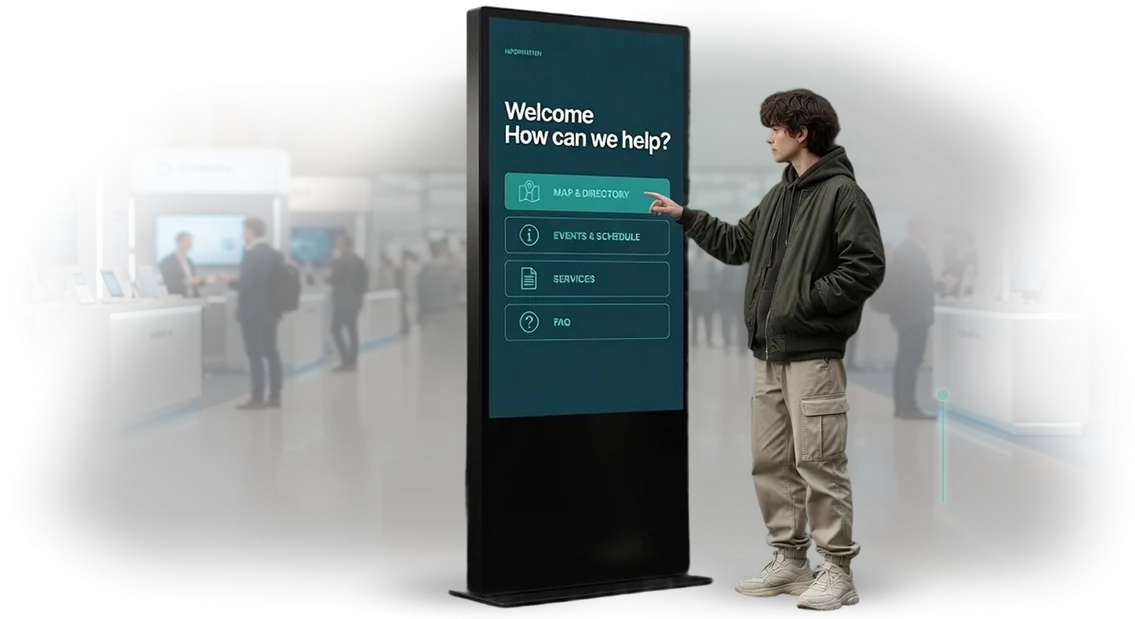
The solution is an interactive kiosk for the mall that makes navigation clear from the first second. The guest sees a map, selects a category or a specific brand, gets a short route, and immediately heads to their destination. Instead of irritation — confidence and loyalty.
The shopper spends more time in the center, manages to visit planned stores, and also notices the storefronts they pass by.
We have been helping shopping malls address this pain for over 10 years: we develop kiosks that fit the interior, run reliably, and require minimal staff attention.
Navigation in the mall becomes your advantage — visitors return, and tenants see real growth in footfall to their locations. We handle the entire process: from concept to launch and support, so you don't have to delve into technical details.
What an Interactive Kiosk Gives Your Business and Visitors
An interactive kiosk for a mall is not just a screen with a map and store list, but a full-fledged tool for managing guest impression.
For the visitor, it becomes a personal consultant: it will suggest the shortest route to the desired boutique, tell about current promotions, and orient them in an unfamiliar space.
Less time searching — more positive emotions, and therefore a higher chance the guest will come back.
For the business, the kiosk significantly reduces staff workload. Employees stop answering the same questions "where is the restroom?" and "how do I get to the exit?" — instead they handle customer service, floor control, and operational tasks.
This improves service quality and team efficiency without expanding headcount or additional training costs.
Visitor loyalty grows due to personalization. The kiosk can greet the guest by name, offer personalized discounts and bonuses based on their preferences and visit history.
When a shopper feels care, they are more willing to participate in the loyalty program, leave contacts, and recommend the mall to friends — this reduces the cost of attracting new guests.
Finally, an interactive kiosk for the mall becomes a channel for additional sales. Its screen can display information about new arrivals, deals of the day, and partner promotions that a visitor might miss with regular navigation.
Thus the kiosk turns into a point of sale that operates around the clock and requires no staff involvement, meaning it generates revenue even during low-traffic hours.
Implementing an interactive kiosk is a step toward digital transformation of the shopping mall, which pays off through increased loyalty, team relief, and additional sales.
We will design and develop a solution tailored to your mall's objectives so that it delivers measurable benefit to both guests and business.
Interactive Kiosk Formats for Shopping Malls for Any Task
Mall visitors are used to interacting with screens: checking a store location, finding a needed service, learning about events.
But different tasks require different approaches — what works well in a small boutique will be unnecessary in a central atrium where foot traffic is much heavier.
A properly chosen interactive kiosk format saves budget and delivers immediate results: fewer queues at the information desk, confident navigation, and increased visits to target locations.
To avoid overpaying for unnecessary functionality, it's worth clearly separating scenarios — a reference kiosk, a virtual concierge, or a combination of both in one enclosure.
Main Formats and Their Benefit for the Shopping Mall
| Format | For whom | What it gives the client |
|---|---|---|
| Reference kiosk | Visitors who need a quick answer: where a store is, how to get to parking | Relieves administrators, reduces time to find a location, lowers the flow of questions at the information desk |
| Virtual concierge | Active guests who plan their visit in advance and want to choose stores, cafes, entertainment services | Increases time spent in the mall, helps navigate special offers, raises the number of visits to specific tenants |
| Hybrid kiosk | Shopping malls where both quick navigation and engagement in promotions, events, and loyalty programs matter | One enclosure solves both tasks, saves space and simplifies maintenance, expands usage scenarios for different audiences |
Whichever format you choose, we make the kiosk turnkey: we design the interface to match your brand and objectives, install equipment, connect it to the analytics system, and support it after launch.
From the guest's perspective, it looks simple and clear — they get an answer in a couple of screen touches. From the mall manager's perspective, it's a manageable tool that actually relieves staff and helps tenants gain traffic.
How Kiosk Implementation Works: Stages from Brief to Launch
Kiosk implementation is not just equipment installation, but a structured process that saves your team time and guarantees a working result.
We handle the entire path: from the initial brief to regular content updates, so you always understand what stage the project is at and when it will benefit visitors.
- Brief and goals. We define the kiosk's tasks: store navigation, promotion information, service directory, or entertainment. We find out what traffic the mall has and what questions visitors ask most often — this forms the basis of the scenario.
- Analytics and plan. We prepare the structure of sections, workflow logic, and visual concept. You receive a clear plan with stages and deadlines to approve before development begins.
- Approval and adjustments. We show mockups and scenario descriptions. You make edits, we incorporate them — before work starts, not after everything is already assembled.
- Development and configuration. We populate the kiosk with your content, connect the mall map and, if necessary, integrations with external services. We use professional equipment and proven tools, so nothing "crashes" on the first day.
- On-site testing. We test the kiosk under real mall conditions: during high traffic, peak hours, taking into account footfall specifics. We eliminate possible issues before the official launch.
- Launch and training. We install the kiosk, configure it, and put it into operation. In parallel, we train your team — administrators and IT specialists — so they can handle basic issues independently.
- Support and development. We continue supporting the kiosk: updating content, adding new stores and promotions, monitoring stability. On request, we connect inquiry analytics — you see what visitors search for and improve service.
This order provides the main thing — a transparent process without surprises. You know what will happen at each stage and when the kiosk will start working to attract audiences and improve your shopping mall's service.
What's Included in the Package: A Clear List Without Technical Details
The customer should understand in advance exactly what they receive — without hidden items or technical details. The basic package includes everything needed for the kiosk to work from day one: from the enclosure and screen to software, installation, and staff training. Below is a clear list of what's included in the delivery.
- Kiosk equipment set. A reliable enclosure, a convenient screen, and accompanying elements selected for the mall's tasks: navigation, reference information, advertising materials.
- Kiosk software. A ready-made content management system that lets you change on-screen information yourself without hiring a contractor: create new pages, upload promotions, update the mall map.
- Kiosk installation. We deliver, install in a convenient location, connect to power, and check functionality. You receive a fully operational kiosk within the agreed timeframe.
- Staff training. We conduct a short workshop for administrators and marketing staff: how to turn the kiosk on and off, update information, and handle emergency situations.
- Personal account and technical support. Access to the management system and a communication channel with specialists: commissioning, consultations, and prompt resolution of issues during working hours.
- User guide. A clear instruction manual in Russian — even a new employee can understand any kiosk function within a day.
After installation and training, you receive not just "hardware", but a working tool to increase visitor loyalty. Staff can use the kiosk immediately, without a long adaptation period. This saves team time and ensures quick deployment in any retail location.
Case Study: Reference Kiosk in Gallery Reduced Queues Threefold
In a large shopping center Gallery, the information desk was failing to cope with the flow: at peak times, the queue grew to 10–15 minutes, and some guests left without getting an answer. Tenants were losing customers, and management was losing service ratings.
To solve the problem, we proposed not expanding the desk, but installing an interactive reference kiosk with a map, store list, and event board.
In two weeks, we gathered the brief, approved the navigation structure, and launched a pilot. The kiosk was placed in the main atrium, near the gallery entrance.
Within a month, it became clear: it not only relieved staff but changed visitor behavior — guests found their stores themselves, and only went to the live desk for questions requiring a dialogue.
What Changed After Launch
Queues at the information desk shrank threefold: peak waiting time dropped from 15 minutes to 3–4 minutes. The kiosk handles up to 120 inquiries per day — more than two administrators could process in a shift.
The average receipt in the gallery also increased: visitors began to visit stores outside their usual route more often, because the navigation suggested new locations.
The kiosk's effectiveness was confirmed by tenant figures. In the first months, visits to stores on the upper floors grew by 15–20% — guests rarely used to go there.
Advertising banners on the kiosk screen brought the gallery additional income: tenants bought slots for promotions and new arrivals, and this channel became permanent.
Why the Client Extended the Project
After the pilot, the gallery ordered two more kiosks — at the parking entrances and in the food court area. We updated the map, added an events section, and synchronized the kiosks with mobile navigation.
Information desk staff focused on live guests, while the kiosk handles routine requests. Six months later, we received a repeat order from another property in the chain — this time for a full navigation system.
This case shows: a reference kiosk pays off not by saving on staff, but by increasing traffic, sales, and visitor loyalty. Queues disappear, guests find stores faster, and tenants gain a new communication channel.
How to Choose an Interactive Kiosk for Non-Standard Tasks?
Choosing an interactive kiosk is rarely just a matter of picking from a catalog of ready-made models. In shopping malls, tasks are often non-standard: you need navigation to tenants, an event board, promotional offers, and feedback in a single scenario.
If you approach the selection as buying "hardware with a screen", you can easily get a kiosk that fits neither the interior nor the logic of visitor movement.
Proper kiosk selection starts with questions: where it will stand, who will approach it, and what action should be the result — finding a store, learning about a discount, or booking a service. The answers show what screen size, control method, and interface scenario are needed.
Then it becomes clear whether a standard model works or a non-standard kiosk is required — with a custom enclosure shape or expanded functionality.
For a shopping mall, development capability matters. A good custom kiosk allows you to change content, add new sections and integrations without replacing equipment: navigation today, loyalty program and traffic analytics tomorrow.
You shouldn't choose a "kiosk for today" but a platform that can be adapted to tenant needs and mall growth.
The criterion for "which kiosk to choose" for non-standard tasks is a combination of reliability, service, and flexibility.
A professional team will help prepare a technical specification, offer enclosure and interface options, and account for the specifics of your building and audience.
We have been doing this for more than ten years: selecting and developing interactive solutions for large complexes.
FAQ About Reliability and Maintenance of Interactive Kiosks
When a kiosk stands in a mall lobby, every minute of downtime means inconvenienced visitors and lost traffic. Nobody needs a structure that requires frequent repairs or constant supervision.
That's why kiosk reliability, warranty, and maintenance are written into our contract, not left as promises. Below are answers to questions that owners and managers of shopping malls ask most often.
What is the warranty on the kiosk?
The warranty covers both the hardware and the software. During the warranty period, maintenance and repairs are carried out at our expense — you pay neither for parts nor labor. The terms are fixed in the contract, so you know exactly what to expect.
How often is kiosk maintenance performed?
We recommend scheduled maintenance once a quarter: checking the touchscreen, enclosure, internal cooling system, and updating software. This is cheaper than unscheduled repairs and helps avoid downtime. You also receive the kiosk maintenance schedule in the contract.
How quickly is kiosk repair done?
The average recovery time is from a couple of hours to two days depending on complexity. For this, we keep a warehouse of spare parts and backup units so we don't wait for delivery. For a shopping mall, this means predictable operation and minimal downtime.
Order an Interactive Kiosk for Your Property Today
Every shopping mall visitor today expects a quick answer: where the needed store is, how to get to the food court, what promotions are active. If guests spend time searching, they get tired faster and leave without buying — and you lose revenue.
An interactive kiosk solves this problem: a visitor finds the desired location in a minute, and the mall itself gets a modern service that increases loyalty and collects useful analytics.
Leave a request — we'll advise you, calculate parameters for your property, and handle all stages: from interface development to kiosk installation and launch. As a result, you get a working solution without diving into technical details.
What you receive after ordering:
- Personal calculation for your property — we'll select the number of kiosks, their placement, and functionality based on the mall's traffic and layout.
- Intuitive interface for any audience — guests of all ages will figure it out in seconds, without training or staff prompts.
- Fast installation and launch — we'll prepare equipment and software, mount the kiosks, and verify operation before opening.
- Support at all stages — updating information, technical support, and consultations on service development after launch.
- A tool for revenue growth — the ability to show tenant promotions, promote new stores, and increase the average check.
- Clear reporting — find out which sections are in demand and how visitor behavior changes.
Don't put off the decision: submit a request today, and the very next day we'll show how the kiosk will fit into your shopping mall. Contact us by any convenient method — we'll tell you about timelines, cost, and integration options with your services.