

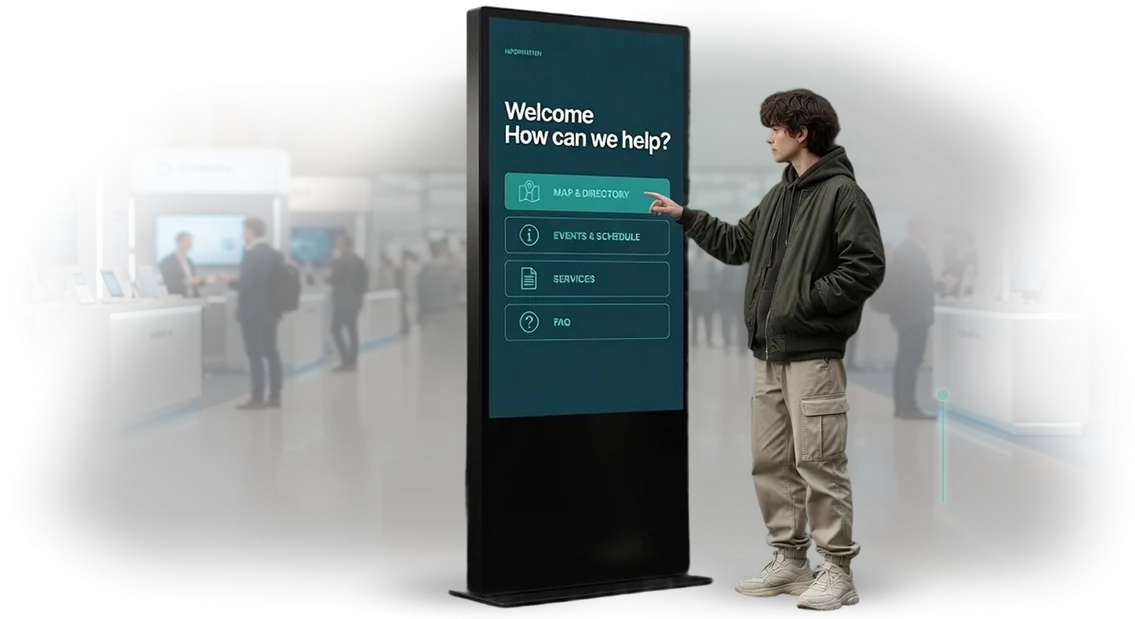
Universities and educational institutions lose applicants without kiosks
Applicants make their decision about where to enroll not based on rankings alone — the first impression of the campus is becoming decisive.
When they arrive for an open house or at the admissions office, prospective students want to get their bearings quickly: where the right building is, how to get to a classroom, where to get advice.
Without information kiosks, visitors are left alone with signs and confused staff — and the university loses an applicant who goes to a more modern and welcoming competitor.
Prospective students are lost imperceptibly: a person doesn't say they disliked something, they simply don't submit their documents. Parents and campus guests also remember not the content of a booth but how comfortable they felt.
Campus navigation is part of the visitor experience that directly affects an institution's reputation and the desire to return. When a university looks outdated, it also projects onto the perceived quality of education in applicants' eyes.
Interactive kiosks for universities solve this problem: with a couple of touches, visitors get a route to a building, event schedule, information about faculties, and admissions office contacts. Instead of queuing at security, they can resolve the issue quickly on their own.
This makes the campus clear and welcoming, and the university appear tech-savvy and modern. This approach increases loyalty among applicants and their parents even before documents are submitted.
We have already implemented information kiosks for educational institutions and know how to turn navigation into a university advantage. We help not just install screens, but build a navigation system that works to attract and retain applicants. The campus visitor experience becomes your competitive argument in the battle for students.
Benefits of interactive kiosks for universities
Every day, hundreds of people are at a university — students, faculty, applicants, and parents. They need to find a specific classroom, check the schedule, and clarify admission requirements. Staff answer the same questions over and over, while queues at the admissions office grow.
An interactive kiosk solves this problem: it works around the clock, answers common questions, and helps people find their way around campus.
Applicants get information about faculties and admission rules in a couple of touches — without searching for the right office or waiting in line.
For staff, this is a real relief: administrators and admissions office employees stop spending time on repetitive questions and focus on meaningful work. At the same time, the kiosk requires no constant supervision — everything updates remotely.
A modern kiosk is also a brand element. An unusual design and user-friendly interface are memorable, and students and guests share photos on social media. This gives the university additional reach and reinforces its image as a tech-savvy institution. The kiosk easily fits into the interior and can be made in the university's corporate style.
Information on the kiosk is always up to date: changes in the schedule or admission rules appear immediately after being updated on the server. This eliminates outdated paper notices and confusion.
We develop interactive kiosks tailored to universities' tasks, from navigation to admissions campaigns. We rely on professional equipment and adapt the interface to your style.
As a result, the university gets a tool that saves staff time, helps applicants, and boosts brand recognition.
Interactive kiosk formats for different university tasks
Different university tasks require different interactive kiosk formats: one thing is helping an applicant find their way around campus, another is relieving the admissions office during peak days, and a third is outdoor wayfinding.
We develop kiosks for a specific scenario rather than delivering a 'boxed' device with the same functionality for every case.
Main kiosk formats for a university
| Format | For whom | What it gives the client |
|---|---|---|
| Information kiosk in the lobby | Students, guests, prospective students | Instant access to the schedule, building map, and department contacts — without queues to the secretary or security guard |
| Virtual concierge at the admissions office | Applicants and their parents | Automatically answers common questions about admission, shows the required documents, helps book a consultation — reduces staff workload |
| Outdoor kiosk on campus grounds | Visitors, applicants on open house day, staff | Works in any weather, shows routes to buildings, classrooms, and the cafeteria — makes the university grounds clear and accessible |
These are not just information screens, but full-fledged assistants that solve specific problems: reduce queues, decrease the number of calls to the dean's office, and help new students adapt faster.
Touchscreen kiosks can operate in one of these formats or combine functions — for example, an information kiosk with the ability to book an appointment through a virtual concierge.
When designing, we consider who will use the kiosk and when: a first-year student on their first day, an applicant in a stressful situation, or a guest simply looking for a classroom.
That is why we offer not one 'universal' option but several formats and help you choose the one that covers a particular university's needs — from a single kiosk in the lobby to a network of outdoor navigation modules.
How kiosk development works: from brief to launch
Working on a kiosk for a university is not a 'black box' but a transparent process with milestones. We accompany you from the first brief to launch and beyond, so you get exactly what you need within the agreed timeframe. You always know who is responsible for what and can influence the outcome at every stage.
-
Brief and agreement. We discuss the kiosk's goals: what students, applicants, or visitors should find. We define the section structure, design, and functionality, and approve the budget and timeline. The result is a clear technical specification everyone agrees on.
-
Prototype and concept. We show how the interface will look and which scenarios it will cover. You make edits before development begins — saving time and budget. The prototype can be reviewed on a screen or directly on the kiosk.
-
Interface and logic development. We create user-friendly navigation, clear prompts, and integrations with schedules, maps, and reference information. We adapt the design to the institution's corporate style. You get access to intermediate versions and can leave feedback.
-
Kiosk testing. We check operation on real equipment: response speed, durability under continuous use, data accuracy. We involve future users to evaluate usability. We fix everything before visitors see the kiosk.
-
Project launch. We install the software, configure the equipment, and train administrators. Launch happens without disrupting the institution's operations — the kiosk starts working immediately.
-
Kiosk support. We provide post-launch support: update information, add sections, and monitor performance. You can always request improvements or extended functionality.
What is included in the interactive kiosk delivery
You receive not just a device, but a complete turnkey solution: the kiosk is already assembled, configured, and populated with your content. The package includes everything needed to put it into operation from day one — without hidden stages or unnecessary investment.
- Kiosk enclosure — a durable anti-vandalism structure that fits into the interior of any educational institution. The enclosure is adapted for 24/7 operation in areas with high concentrations of students and staff.
- Software — an easy-to-use information management system. Through it, you can change the schedule, announcements, navigation, and important notifications yourself. All updates happen without developers' involvement.
- Information content — during preparation, we develop the section structure, post the class schedule, exams, events, and building map. A student needs just one touch to find a classroom or see changes.
- Installation and connection — our specialists arrive, install the kiosk at the required location, connect it to the network, and verify that it works. The institution receives equipment ready for immediate use.
- Training and instructions — we conduct a short orientation for administrators: how to update schedules, add events, and handle unexpected situations. A simple illustrated guide is included.
- Warranty and support — after installation, we remain available: answer questions, help with content, and resolve issues promptly. This protects your reputation and relieves staff of extra burden.
As a result, your institution gets a working information service that saves students' and staff members' time, reduces the burden on the admissions office, and makes campus navigation comfortable.
You don't need to hire a separate specialist for maintenance — everything is already thought through and packaged into one bundle.
Case study: how a kiosk helped a university increase applicant flow
In the middle of the admissions campaign, a regional university faced a familiar problem: the admissions office could not cope with the flow of applicants and their parents. Queues of 20–30 people, repeated questions, lost documents — all of this consumed hours of staff time.
We installed an interactive kiosk in the main building's lobby — a digital concierge that became the first point of navigation for visitors.
Instead of standing in line, applicants and their parents found information about fields of study, passing scores, document deadlines, and booked consultations on their own.
Results seen by the admissions committee
The effect became apparent within the first weeks: the number of inquiries through the kiosk grew by a third compared with the same period last year, and average waiting time dropped from 12 to 4 minutes. Staff stopped answering the same questions and switched to individual work with applicants.
The kiosk did not replace live communication, but it reduced the burden and accelerated the admissions campaign. The share of repeat inquiries also grew: students returned to it to check details — the kiosk became a familiar tool for future students.
Frequently asked questions about developing kiosks for educational institutions
Here we've gathered answers to the questions most often asked before ordering a kiosk for a university or college. This will help resolve any doubts in advance — about timelines, warranty, maintenance, and what happens if the equipment fails.
What warranty applies to the kiosk and what does it cover?
We provide an official warranty on equipment and software — from 12 months. During this period, free equipment repairs and content updates are included. If a failure occurs during the warranty period, we restore the kiosk's operation at our expense.
What is the development timeline for an educational institution kiosk?
A standard project takes 4–6 weeks, from brief to installation and launch. If you need a simple information kiosk with a schedule and building map, we deliver even faster.
For a turnkey order with design and content, we typically plan for 2 months to meet the start of the academic semester.
Can the kiosk be integrated with a university system?
Yes, we connect the kiosk to your internal systems — schedule, e-admissions, classroom database, and faculty directory. Data is pulled automatically, so the information on the screen is always current, and staff don't need to update it manually.
Who maintains the kiosk after launch?
We take on full support: monitoring, updates, and replacement of consumables. You don't need a separate employee or technical service — our team handles all issues remotely and with on-site visits when necessary.
What happens if the kiosk breaks down?
The equipment is designed for 24/7 operation, but if a failure does occur, there is a procedure: you submit a request, and we diagnose the problem remotely. In most cases, we resolve it remotely or deliver spare parts within 1–3 business days.
While repairs are underway, we provide a replacement kiosk so students and applicants don't lose access to services.
If you have any other doubts, ask us directly — we'll reply within one business day. For a typical project, we'll prepare an estimate of timelines and warranty terms within one day.Order interactive kiosk development for your university
Submitting a request is the first step toward getting a kiosk that works for your admissions office, navigation, and university image. We handle everything from format to launch, and you get a clear plan and transparent budget.
What's included in the consultation:
- Kiosk request — you describe the task, we offer a solution for your building and budget.
- Format selection — floor-standing, wall-mounted, touchscreen, with anti-vandal enclosure — matched to your tasks and visitor traffic.
- Cost calculation — we lock the estimate before starting, with no hidden fees or unnecessary options.
- Integration consultation — we'll advise on how the kiosk fits into your infrastructure and what data is needed for launch.
- Feedback — within one business day after your request. You won't wait for weeks.
We have been working with universities for over 10 years, so we understand the specifics of admissions campaigns and academic processes.
The kiosk helps applicants independently find information about faculties, and students find schedules and campus maps, while easing the load on staff.
Leave a request — and we will prepare a proposal with a suitable format and cost estimate within 24 hours. After that, you decide: start the project or file the proposal away — no obligation.
How to choose a kiosk format for a university or college?
Choosing a kiosk format starts not with design but with questions: where it will be placed, who uses it, and what task it solves.
For a university and a college, these answers differ: an applicant needs a route across buildings, a student needs schedules and certificates, a guest needs campus navigation. That is why you first define the use scenario and only then look at the enclosure type and service life.
We have helped dozens of educational institutions select a configuration — and we've learned that there is no universal 'best' kiosk; there is one that suits your conditions.
The main criteria are installation location, load, and interaction type. In a high-traffic lobby, a floor-standing kiosk with a large screen is needed: it is visible from afar, withstands a stream of users, and doesn't get lost in the crowd.
For outdoor use, at an entrance, or in an open courtyard — an outdoor kiosk with a protected enclosure and anti-vandal glass. And if the kiosk must solve a single task — such as issuing certificates or showing a schedule — a compact touchscreen on a stand is enough. Budget and launch timelines depend on all of this.
| Format | Where to install | For whom and why | What it gives the client |
|---|---|---|---|
| Touchscreen (wall-mounted/stand) | Inside a building, near the dean's office or cloakroom | Students and visitors: certificates, schedules, contacts | Quick resolution of a single task, compactness, low cost |
| Floor-standing kiosk | Lobby, atrium, waiting area | Applicants and guests: navigation, faculty presentations, campus map | High visibility, interactive university presentation, queue management |
| Outdoor kiosk | Entrance to the grounds, courtyard, front steps | All visitors: 24/7 navigation, event listings, application intake | 24/7 access, weather resistance, modern institutional image |
Remember that usage load at an educational institution is higher than in an office: peak hours between classes, and sometimes even intentional abuse.
Therefore, when choosing, pay attention to the enclosure protection rating, screen type, and remote content update capability — otherwise, the device will need repairs in a couple of years.
We have covered these criteria in detail in an expert article about choosing kiosks for education — it also includes a checklist for vetting a supplier. If you'd like, we'll send it together with an estimate for your building.