

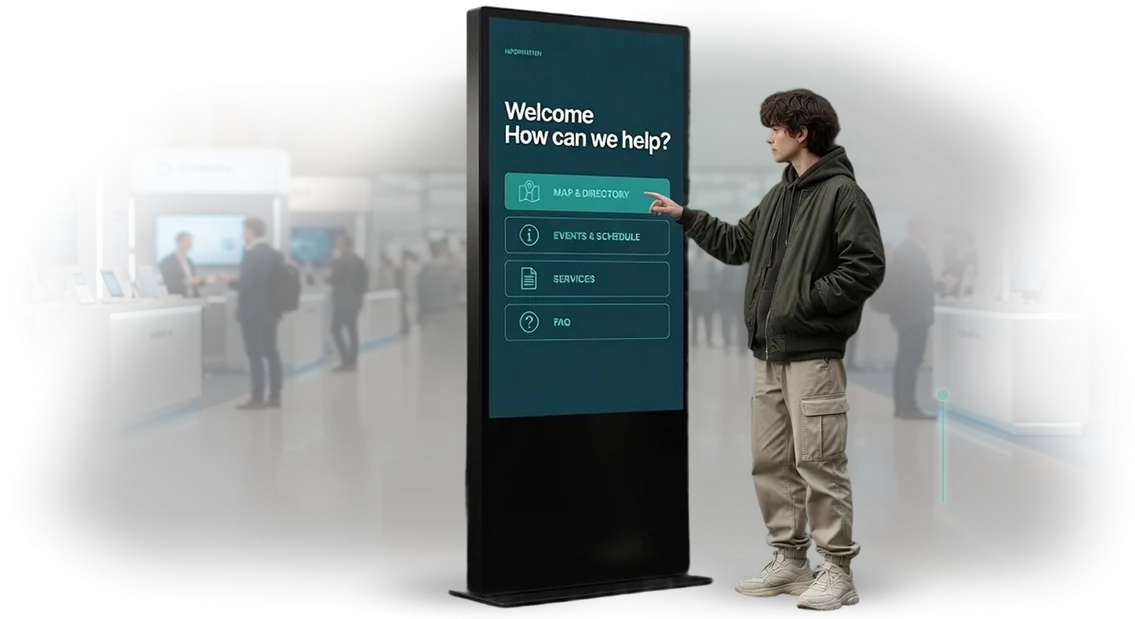
Lost Passengers at Railway Stations and Transport Terminals
Every day, tens of thousands of people pass through major railway stations, and a significant share of them are out-of-town passengers who have trouble navigating an unfamiliar space.
Lost passengers spend 10–15 minutes looking for the right platform, ticket office, bus exit, or waiting hall — and during peak hours this process drags on even longer.
The result: missed departures, stress, queues at information desks, and extra burden on staff who have to repeat the same thing dozens of times per shift.
The wayfinding problem at a station becomes especially acute during service disruptions or schedule changes: static signs no longer work, and public-address announcements are drowned out by the noise of the platforms.
Passengers get even more lost, the flow slows down, and the terminal begins to act like a bottleneck.
For the infrastructure owner, this is not only visitor dissatisfaction, but direct losses: lower throughput, extra hours for the information desk, and the risk of negative reviews that scare off new customers.
Traditional signage does not answer individual questions: "Where is the nearest ATM?", "How do I get to luggage storage?", "Which bus goes to the airport?". The solution — information kiosks that replace a live concierge at high-traffic points.
They provide an instant answer at any time of day, show a route through the terminal, provide up-to-date schedules, and help even a passenger with no experience using such devices get their bearings.
For railway stations and transport terminals, interactive kiosks are a way to reduce the flow of lost passengers, relieve staff, and increase visitor loyalty.
Instead of looking for a uniformed employee or studying a complex diagram, a passenger gets a clear prompt in a couple of taps.
Implementing such systems pays off through faster passenger movement, shorter queues, and a better travel experience — which in turn makes passengers want to return to your terminal.
What an Information Kiosk Brings to Your Facility
Passengers at a railway station or transport terminal are always in a hurry, and any question that has no quick answer means lost minutes and extra stress.
An information kiosk removes this problem: it instantly gives the schedule, departure platform, location of luggage storage, and the exit to the right transport.
As a result, the visitor gets the necessary information without queues, and your facility gains a reputation as a modern, caring space.
From a business standpoint, the benefit is obvious — the kiosk handles up to 70% of routine questions that used to be directed to duty staff.
Live employees stop spending time on repetitive inquiries and focus on what really matters: helping passengers with limited mobility, monitoring waiting halls, and resolving non-standard situations.
At the same time, the kiosk works around the clock — during peak hours and night shifts, when the number of staff is minimal.
A modern kiosk is also a tool for additional revenue. In pauses between passenger requests, the screen can show ads for local services, hotels, taxis, and cafés.
You get a new revenue stream that covers part of the equipment costs and turns the service point into a self-sustaining business process.
Finally, the kiosk affects passenger flow: it reduces crowding around information desks and display boards, making movement through the building more open and safer.
For the facility's business reputation, this is a plus — partners and government bodies see that the infrastructure meets modern requirements for transport hubs.
We design solutions with the actual load of a particular terminal in mind, so the kiosk works fast and causes no trouble even on the busiest day.
Investment in such a service pays off through optimized staff work and new advertising revenue, while passengers get exactly the level of comfort that makes them come back again.
Interactive Kiosk Formats for Railway Stations
Different zones of a railway station and transport terminal require different solutions. Somewhere you need a compact panel at the exit to the platform, somewhere else — a protected freestanding kiosk outdoors.
A properly chosen kiosk format shortens the queue at the information desk and makes navigation self-explanatory without staff involvement.
| Kiosk format | Where it works best | What tasks it covers |
|---|---|---|
| Freestanding touch kiosk | Waiting halls, near ticket offices and exits | Helps passengers independently find the right route, schedule, location of luggage storage, and station services. Reduces the load on the information desk and speeds up service. |
| Wall-mounted kiosk | Passage areas, corridors, narrow spots near escalators | Saves space and provides a quick "on-the-go" reference: nearest departure, platform number, travel time. Ideal for high-traffic places where every square meter matters. |
| Outdoor kiosk | Station squares, entrance groups, public transport stops | Works in any weather and around the clock. Informs about train and bus arrivals and departures, as well as how to get to the city. Passengers receive up-to-date data before even entering the building. |
We adapt each of these formats to the specific location and the transport hub's brand identity. The interface remains equally clear on all devices — the passenger sees familiar navigation and does not waste time learning a new screen.
The choice of format depends on traffic, available space, and usage scenarios. We help determine the optimal configuration at the audit stage and give recommendations on how the same content works on a freestanding kiosk, wall-mounted panel, and outdoor kiosk. This allows you to cover all key passenger touchpoints without duplicating development costs.
Stages of Kiosk Creation: From Idea to Launch
For railway stations and transport terminals, the order of work is especially important: passengers should not have to wait, and staff need to quickly understand the new system. We have built the process so that you control every stage and understand the timeline. A typical project takes 4–6 weeks — from brief to launch, including approvals.
- Brief and task analysis. We dive into the specifics of your facility: which questions passengers ask most often, where queues occur, and which scenarios need to be covered. The output is a technical specification that both a manager and a developer can understand.
- Interface design. We draw a prototype: how a passenger will find the schedule, route, or reference information in 2–3 taps. We align the logic so the kiosk is convenient to use even without instructions.
- Development and integration. We program the system: schedules, maps, navigation, reference data. We connect it to your data sources so that the information updates automatically — without manual intervention.
- Testing in real conditions. We check the speed of operation, peak-hour load, and resilience to non-standard situations. We fix everything before a passenger ever sees the kiosk.
- Installation and launch at the site. We mount the equipment, configure the system, and train the staff. We hand over the kiosk fully ready for operation.
- Support and development. We stay in touch after launch: update content, add features, and monitor stability. If needs change, we promptly finalize.
This process makes the project predictable: you know in advance what you will receive and participate in key decisions. The result — a reliable kiosk that helps passengers and reduces the load on the information desk.
What Is Included with the Kiosk
When you order a kiosk, it is important to understand that you are getting not just a body with a screen, but a complete working solution. We assemble a turnkey package: from the enclosure to training materials for the staff. Below is what is included in the standard delivery.
- Enclosure and hardware — a durable enclosure that withstands passenger-flow loads, with dust and moisture protection. Inside — professional components that operate 24/7 without failures.
- Software — a kiosk management system with an intuitive interface. The customer is able to change content and monitor device operation remotely.
- Content and data — we develop the menu structure, texts, diagrams, and visual prompts. Everything a passenger needs: schedules, display board, map of the area, information about services.
- Integration with station systems — the kiosk connects to your schedule databases, arrival/departure boards, and other data sources. The information on the screen is always current, without manual updates.
- Installation and commissioning — our specialists install the kiosk at the right point, configure the network, and test all operating scenarios so that you receive a working device from day one.
- Staff training — we hold a short training session for your employees: how to change content, resolve typical issues, and what to do in an emergency.
- Warranty and support — the kiosk comes with a warranty, and for the entire service life you can count on consultations and technical assistance.
As a result, you receive a kiosk that is fully ready for operation, not a set of components. There is no need to buy anything extra, configure, or assemble — just place the device in the hall and plug it in.
Case Study: How a Kiosk Changed Wayfinding at a Railway Station
For a large railway station with a flow of more than 30,000 passengers per day, we developed interactive information kiosks.
The client — station infrastructure operator TransVokzal — faced a situation where the traditional information window could not cope with the load: during peak hours the queue reached 15–20 people, and finding the right train took up to five minutes.
The problem was not only speed but also the quality of service. Tired employees responded in a uniform way, and passengers with children and luggage lost their bearings in the huge building.
The station management wanted to relieve the staff and give passengers an independent navigation tool that works reliably around the clock.
We installed terminals at key points: near the main entrance, next to the ticket offices, and on the platform. The kiosks show routes to the required platform, schedules with real delays, and tell passengers where luggage storage, display boards, and exits are located.
A passenger chooses a destination and receives a route map in their language — without queues and stress.
We measured the results three months later. The average time to find information dropped from five minutes to one, and the queue at the information desk decreased by 70%. The passenger satisfaction index grew from 3.8 to 4.6 points on a five-point scale. Employees were finally able to handle non-standard requests instead of endless repetition.
Six months later, the operator ordered ten more kiosks for neighboring stations — which shows that the system pays off and scales. We continue to support the project: update schedules, add new points of interest, and monitor uninterrupted operation. For passengers, the station became simpler; for the client, more efficient.
Common Questions and Customer Concerns
Before installing an interactive kiosk at a station, customers have typical concerns: the installation process, content updates, breakdowns, and payback period. We answer each of them.
Is the kiosk difficult to install and will the station have to be shut down?
Installation takes one to two days and is carried out during the lowest-traffic hours. We prepare the site in advance — you do not need to stop the terminal's operation.
How do we update content when information changes every day?
Updates are done remotely through a simple control panel. You change schedules and materials yourself, without a programmer. If necessary, we integrate the kiosk with your ticketing system.
What if the kiosk breaks down?
The monitoring system will report a malfunction before passengers notice it. During the repair, we provide a replacement kiosk, and the warranty and service contract cover all the equipment.
When will the kiosk pay off?
The kiosk reduces the load on the information desk, brings revenue from advertising and additional services, and speeds up passenger service. The payback period is usually 1–2 years; we make an exact calculation for your terminal.
Get a Cost Estimate for Your Kiosk
A railway station and transport terminal is a place where a passenger needs a quick answer: where is the platform, the ticket office, the exit, how to buy a ticket. When information is lacking, queues appear at the information desk, and staff get distracted from work.
An interactive kiosk with a virtual concierge solves this: the passenger finds the answer in a couple of taps, employees handle important tasks, and the quality of service grows.
We design the kiosk for your facility: we take into account passenger flow, typical routes, and frequent questions. It is important that the kiosk is convenient for both young people and elderly passengers, so we choose a large font, a simple interface, and clear navigation. You get a ready-made turnkey solution — from idea to launch and support.
To help you understand exactly what you will receive, submit a request — and we will prepare:
- An engineer consultation: we will discuss the tasks of your station and suitable functions.
- A selection of the kiosk format: size, enclosure, wall-mounted or floor-standing option.
- A cost estimate for your facility: a transparent budget with no hidden charges.
- A timeline assessment: project stages from design to launch.
- Placement recommendations: where the kiosk will be most convenient for visitors.
- A support proposal: maintenance, information updates, prompt repairs.
It is non-binding. For a cost calculation, a short conversation is enough — by phone or in writing. We work remotely, so we will organize the project in a format convenient for you. Submit a request — get a cost estimate for your kiosk and an action plan within one business day.
How to Choose the Right Kiosk Format for Your Facility?
The choice of a kiosk for a railway station or transport terminal starts with the question: what task will it solve for the passenger? If the main goal is to quickly find your way around the facility, a compact touch terminal with a map and exit search is enough.
If the kiosk must issue tickets or check passengers in for a departure, a model with additional modules and a protected enclosure will be required.
The second criterion is placement conditions and the intensity of passenger flow. In passage areas with large crowds, you need a large screen that is easy to read from a distance, and a shock-resistant structure that withstands continuous use.
In waiting areas, you can install more compact kiosks with additional services — phone charging, call for help, or taxi booking.
The third step is to think through the interaction scenario. Passengers are of two types: those in a hurry and those waiting. For the former, it is important to get the necessary information in one or two taps — so the interface should be as simple and logical as possible.
For the latter, extended sections are useful: diagrams, a service directory, and information about venues. It is at this stage that the screen format, fonts, and menu structure are selected.
The answer to the question "which kiosk to choose" is always based on three factors: the tasks of the passengers, the facility's throughput, and the cost of maintenance.
For a large station with high traffic, vandal-resistant terminals with large screens are optimal — they are visible, reliable, and do not require frequent repairs.
For a small terminal, one compact kiosk with a basic set of functions is sufficient — this reduces costs and speeds up payback.
To make the kiosk selection easier, conduct a short audit of the facility: observe passengers, analyze the most frequent questions to the staff, and review the statistics of inquiries at the information desk.
Based on this data, we will offer a suitable model, configuration, and a test scenario with real users. That way, you will not overpay for excessive functionality and will get a kiosk that really helps people and relieves the staff.