

Why Guests Get Lost in Exhibition Centers and Conference Halls
A large exhibition center is a city in miniature: several floors, dozens of pavilions, hundreds of booths. A guest arrives with a busy schedule, but within half an hour is spending time looking for the right hall instead of meeting exhibitors.
Ordinary signs don't help when only minutes remain before a session starts and the target booth is two walkways and a staircase away.
A lost visitor is a direct loss of revenue. They never reach the booth, miss the presentation, and leave no contacts. The organizer receives negative feedback, the exhibitor sees fewer business conversations, and the overall ROI of participation declines. Guests remember the inconveniences first, not the value of the event.
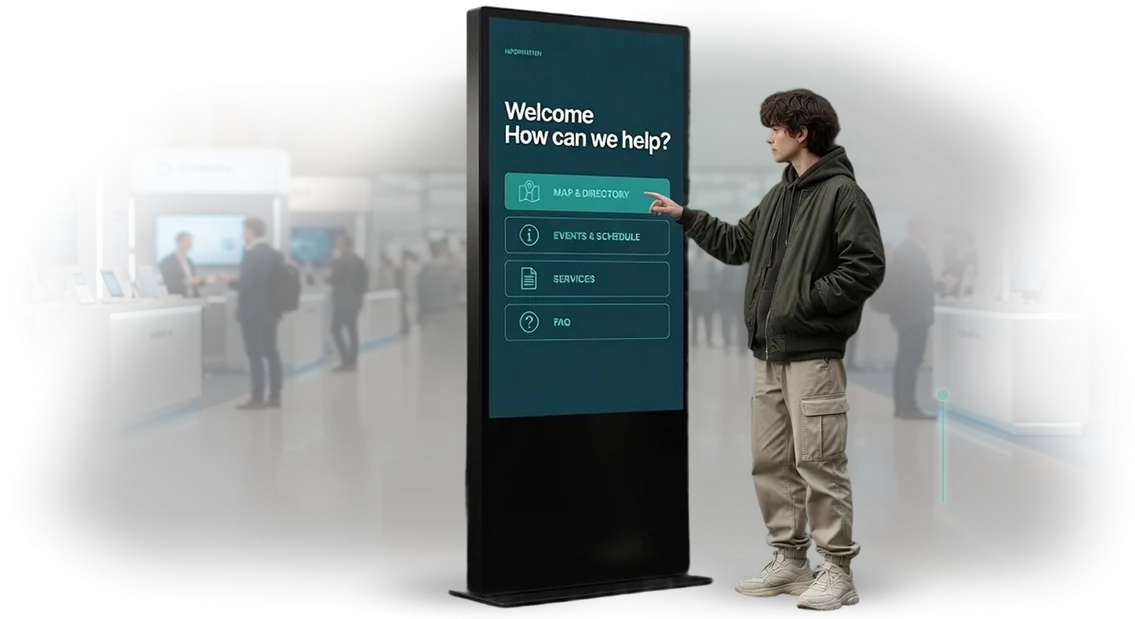
An interactive kiosk solves this problem systematically. A directory kiosk at the entrance and at traffic intersection points launches exhibition navigation: it shows a map, plots a route to the booth, and displays the session schedule.
A guest spends seconds instead of minutes finding their way and saves energy for business conversations.
Wehave been building such solutions for exhibition centers and conference halls for over ten years. Our navigation software runs on professional equipment, so the client gets a stable result during the busiest hours of an event.
You give the guest a clear path, and we handle navigation completely: the guest reaches the booth, the exhibitor gets a conversation, and the organizer gets a satisfied audience.
What Benefits an Organizer Gets from Interactive Kiosks
Guests get lost in large pavilions, arrive late to sessions, and waste time searching for the right booth. An interactive kiosk works like a virtual concierge: it shows the route, current schedule, and key areas in a couple of taps.
Visitors stop looking for the information desk and find their own way to the destination, which reduces staff workload and makes navigation truly convenient.
For the organizer, a kiosk is also a source of valuable analytics. While a guest looks for a session or speaker, the system records their queries: which topics are in demand, which pavilion draws more attention.
You get data without surveys or questionnaires; it helps you position booths, adjust the program, and plan future events.
Another benefit is image. Modern touchscreens with a live map and branded design emphasize the venue's technological sophistication. Guests remember such details, are more willing to share impressions, and see the organizer as someone who cares about comfort. This boosts reputation long after the exhibition closes.
Kiosks also handle operational tasks: they display section announcements, important notices, and route maps to meeting rooms. You can update the schedule or add an urgent message with a single click, without reprinting posters or briefing staff. The information is always up to date, and guests feel the event is managed professionally.
In the end, the kiosk becomes the hub around which navigation, analytics, and the event experience are built. Visitors spend less time searching and more time on useful contacts, while the organizer gets clean statistics and a flexible communication tool.
For exhibition centers and conference halls, this is a tangible advantage that strengthens participant loyalty and increases the value of return visits.
Kiosk Formats for Different Tasks in Conference Halls
In exhibition centers and conference halls, a kiosk should solve a specific task: help guests find their way, speed up registration, or explain the program. A universal device often loses to a specialized format — guests find what they need faster, and organizers save staff time.
When selecting a format, we start from your event's scenario. Below is a comparison of the typical solutions we use in projects.
| Format | Who it's for | What it gives the client |
|---|---|---|
| Touchscreen concierge kiosk | Visitors who need navigation help | Reduces load on the information desk; guests find the hall or booth themselves using the map |
| Floor-standing schedule kiosk | Conference participants | Quick check of program and speakers; fewer late arrivals and fewer questions for staff |
| Wall-mounted terminal | Organizers, event partners | Compact directory of areas, partners, and sponsors without taking up valuable floor space |
| Mobile kiosk on wheels | Registration and announcements in the lobby | Flexibility: can be moved according to visitor flow, used in different areas and halls |
This structure covers the main needs — from navigation and scheduling to partner information — without overpaying for unnecessary features. For each project, we recommend a specific set of formats and number of devices.
For over 10 years, our team has been helping clients select and implement kiosks for exhibition venues. We will analyze your scenarios and propose a format that pays off by reducing staff workload and increasing guest satisfaction.
How Kiosk Development Works: From Brief to Launch
We structure the process so you always know what stage the project is at and what you will get as a result. Each step is coordinated with you, and kiosk development ends with a turnkey launch, including staff training and instructions. Here is how it works.
- Brief and task immersion. We discuss where the kiosk will be placed, who will use it, and what information it should provide. Based on this, we define the logic of the future virtual concierge: reference sections, map, schedule, contacts.
- Prototype and layout approval. We create an interactive prototype of the screens, so you see the structure and navigation before development begins. We approve the layout, and make edits to texts, colors, and element placement before resources are invested in programming.
- Design concept. We develop a visual design that fits your space and brand style. We approve the look and move to the technical part, so the kiosk looks natural in the lobby or exhibition.
- Development and content. We program the kiosk logic, connect databases, schedules, and other information sources. You receive intermediate versions for testing on real equipment and see how the system behaves in use.
- Testing and debugging. We check scenarios that visitors may encounter, from accidental touches to unexpected situations. We make sure the kiosk works stably even with high visitor traffic, and only then prepare for launch.
- Launch and support. We install the software on the kiosk, configure remote monitoring, and train your staff on basic operations. After launch, we stay in touch: update content and quickly resolve any issues, so the kiosk delivers value from day one.
What's Included in the Delivery: Kit for Your Event
The delivery kit is designed so you get a working turnkey tool for your exhibition center or conference hall. Nothing else needs to be purchased — just unpack, plug in, and launch.
- Touchscreen terminal in a protected enclosure — designed for high visitor traffic in exhibition centers and conference halls. Resistant to accidental impacts and failures, operates continuously all day.
- Software with a branded interface: venue map, event program, exhibitor information. Content upload takes minutes, and guests quickly find the right booth.
- Remote management system: update the schedule, add special offers, and urgent announcements right from your laptop, without visiting the venue.
- Administrator panel for your team: change information with one click, track the number of touches and popular sections to understand what interests visitors.
- Complete mounting kit: brackets, cables, wiring. Everything fits for installation in the lobby, registration area, or at a booth — only a power outlet is needed.
- Staff instructions in Russian: how to turn on the kiosk, replace content, and restart it if an error occurs. Plus a checklist for quick checks before the event starts.
- Video training and live consultation on launch day: we help if any question arises. You stay in touch with our engineer throughout the event.
With this kit, the kiosk will deliver value from the first minute: it will ease the registration desk, help guests navigate, and collect useful statistics. All that's left is to choose a design and send us your materials.
Real Case: How Kiosks Improved Navigation at a Forum
At one of the major industry forums, we faced a typical challenge for large venues: more than 2,000 participants, 40 parallel sessions, and several exhibition halls.
Guests constantly lost their way, organizers spent staff effort on repetitive directions, and lateness to the business program became the norm.
We deployed a network of interactive kiosks with the venue map, session schedule, and list of exhibitors.
The «Innovatsii i gorod» venue provided detailed floor plans, and we adapted the interface for different visitor roles: participants saw routes to their rooms, speakers to their meeting rooms, and exhibitors to their booths and dining areas.
Results over the forum's two days: 4,800 kiosk interactions, average time to find a hall dropped from 7 to 2.5 minutes, and the load on the information desk fell by 60%.
The number of late arrivals for sessions dropped almost threefold — guests arrived on time, and volunteers were no longer distracted from helping participants.
This case showed that navigation kiosks solve not only a logistics problem but also influence the impression of the event.
After the forum, the client returned to us to expand the network for the exhibition center's ongoing operations: the same kiosks are now used at all subsequent events, and navigation has become part of the venue's brand identity.
For the organizer, this means predictable visitor flow, less team stress, and a reason for guests to return.
Common Organizer Concerns and Answers
Before ordering an interactive kiosk, organizers usually have the same concerns: what if the technology fails at a critical moment, installation takes too long, or costs don't pay off.
These are fair questions, especially if you've already had negative experience with unprofessional contractors. But these risks are mitigated already at the design stage.
What if the kiosk breaks down on the day of the event?
We use professional industrial-grade equipment designed for uninterrupted operation throughout the day. We provide a backup communication channel and remote monitoring: the engineer sees the kiosk's condition in advance and resolves the issue before guests notice it.
In case of an on-site emergency, a technician is on duty, and we bring replacement equipment within a couple of hours.
How long does installation and setup take?
Everything is connected and tested a few hours before opening. We agree on the placement layout in advance and install without interfering with the venue's infrastructure: all you need is a power outlet and internet access via cable or wireless network. After launch, we stay in touch and monitor performance on the first day.
How does the kiosk pay off and will it save budget?
The kiosk handles routine guest questions: navigation, schedule, information. This reduces the load on the information desk and lets you avoid expanding staff even during peak hours.
For the organizer, this means shorter queues and higher visitor satisfaction, which leads to more repeat business and recommendations. We will prepare a cost-saving estimate tailored to your event.
Below, we've gathered a few more answers to common organizer questions — about guarantees, maintenance, and usage scenarios.Order Kiosk Development for Your Needs
Submit a request, and within one business day you'll receive a preliminary cost estimate for your individual project. We work on a turnkey model: we handle task analysis, scenario design, development, content, and launch, so you won't need to coordinate multiple contractors.
Immediately after ordering, you receive:
- A personal project manager — they gather requirements, answer questions, and keep you informed at every stage.
- A preliminary work plan and timeline: you understand when the kiosk will be ready and what will be required from your side.
- A transparent cost estimate for your scenario — no hidden fees or unexpected surcharges at the end.
- An interface prototype and guest navigation logic before the main development starts — you see the result in advance.
- Recommendations for placing the kiosk in the exhibition center or conference hall space.
- Post-launch support: we'll help update content, add new speakers, and refine features for future events.
After the request, design begins: we clarify details in a short brief, define the tasks, and move to implementation. You regularly receive progress reports, from the first mockup to final testing before handover.
Order kiosk development for your needs, and within a few weeks visitors will be able to independently find the right booths, sessions, and navigation points. This reduces staff workload, cuts queues at the information desk, and improves the overall event experience.
How to Choose the Right Kiosk Format?
The choice of kiosk format depends on the task it solves in your space. A touchscreen directory terminal and a virtual concierge are not competitors but different tools for different scenarios.
It's important to understand what you expect: fast navigation for a large visitor flow or personal assistance for guests attending a complex event.
A touchscreen kiosk is ideal when many people pass through an area and each one needs to find the right hall, booth, or schedule within 30 seconds. It works without queues, never gets tired, and is always available.
It's the choice for high-traffic exhibition centers where the main goal is to relieve the information desk and give guests independence.
A virtual concierge suits situations where the visitor needs a live dialogue: suggesting a route based on personal preferences, answering a non-standard question, or talking through the program in a conversational format.
This format creates the feel of personalized service and is especially good at conferences, forums, and private events where status and guest care matter. It also helps collect feedback and route requests to the team right away.
If you're unsure, look at two of your typical visitors. One is in a hurry and wants to find the answer themselves — they need a touchscreen kiosk. The other is a first-time attendee who wants to be guided by the hand — for them, a virtual concierge.
Often the best solution is a combination: touchscreen stands at key points and a concierge in the lobby or waiting area. We customize both formats to your brand style and space logic, and most importantly, we help you decide before development starts.
Rely not on trends but on guest behavior and event goals. We offer an analysis of your situation: we'll show which format will deliver more value — faster flow, higher loyalty, or staff time savings. All you have to do is make the decision; we'll take care of implementation and support.