

A factory loses dozens of hours to queues: how to fix it
Every day at the factory starts the same way: dozens of employees and visitors crowd at the checkpoint, drivers wait to be processed at the warehouse, and specialists step away from their work to figure out who is scheduled to see whom.
On a monthly scale, this adds up to far more than minutes — it's hundreds of lost person-hours, shifted shifts, and frayed nerves that nothing can compensate for.
And the problem isn't just speed. Without a transparent system, it's hard to tell who has already arrived, who is waiting, and who never showed up.
Dispatchers and secretaries waste time on phone calls and paper-based approvals, while the shop floor manager only learns about delays after the fact. Queues become the bottleneck through which the entire rhythm of production must pass.
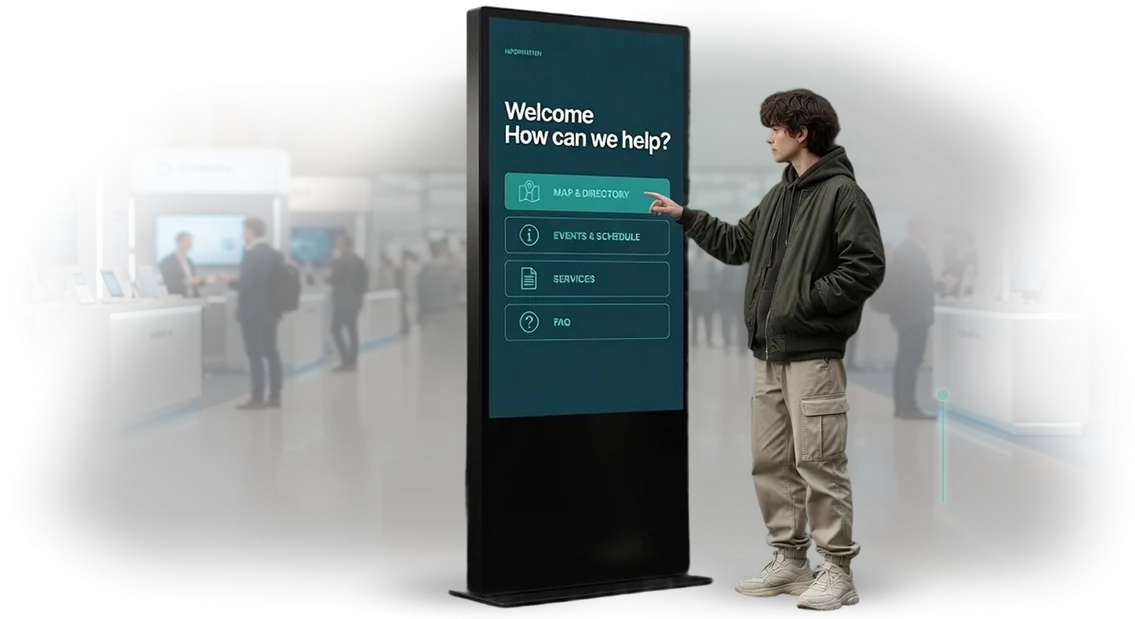
An interactive kiosk with an electronic queue solves this at the system level: visitors check themselves in at the checkpoint, select the specialist they need, and see their number on the screen.
The appointment with the specialist happens automatically, the employee receives a notification and can see who is coming and when. The queue stops being chaos — it becomes a manageable process with a predictable waiting time.
Factory automation doesn't start on the production line — it starts with the people who pass through these points every day. By removing queues at the entrance and at the warehouse, you give employees back hours of working time and take away unnecessary stress.
Implementation takes days, and the effect is felt from day one — this isn't modernization for the sake of technology, but a tool that immediately relieves your staff.
What interactive kiosks bring to manufacturing
The checkpoint is the tightest bottleneck at any manufacturing site. Employees come on shift, contractors wait for passes, drivers check in to enter the facility. Every hour of waiting here is lost working time and frayed nerves.
An interactive kiosk for the factory turns an unruly crowd into a predictable process: visitors choose the purpose of their visit, get a queue number, and reach the right employee without unnecessary questions.
With this solution, queues shrink on their own — the system shows who is next, and the guard or secretary is no longer the single point of entry. Processing takes minutes instead of dozens of minutes of waiting.
Management immediately sees the business value of the kiosk: fewer idle times, faster work with suppliers or contractors, and fewer conflicts at the checkpoint.
The second important benefit is fewer human errors. When visitors enter data themselves by following on-screen prompts, illegible entries, missed signatures, wrong vehicle numbers, and mixed-up shifts disappear.
All information enters the system automatically and becomes available for review right away. The factory gets a single source of truth instead of scattered paper logs.
Finally, the kiosk provides complete visitor tracking — control that previously required manual work and was not always accurate. You always know who was on site, at what time, and who they were heading to.
This data helps improve security, optimize guard operations, and make management decisions based on numbers rather than guesses.
Implementing an interactive kiosk is an investment in order at the production site that pays off in the speed, accuracy, and transparency of every working day.
Kiosk formats for factory tasks: comparison
Every point at a factory operates at its own pace: the checkpoint is overloaded during peak hours, the warehouse lives by work orders, and the canteen — during the lunch break.
A one-size-fits-all kiosk falls short because its interface and logic don't account for the specifics of each location. We've broken down the formats to match typical factory tasks — you pick the scenario you need or combine several points into a single system.
Below is a comparison of the formats we most often deploy at industrial sites.
| Format | Who it's for | What it gives the client |
|---|---|---|
| Checkpoint kiosk | Security, HR department, employees and visitors | Electronic queue for pass processing, fast guest registration, fewer crowds at peak hours |
| Warehouse kiosk | Storekeepers, supply specialists, drivers | Material request processing without paper waybills, movement tracking, fewer errors |
| Canteen kiosk | Shop floor workers, canteen management | Ordering meals for a shift, electronic queue at peak times, hot meals without long waits |
| Shop floor kiosk | Foremen, team leads, workers | Shift schedules, work standards, equipment repair requests without a trip to the dispatcher's office |
| Medical unit kiosk | Medical staff, employees | Scheduling medical checkups, electronic queue at the office, work clearance marking |
All formats run on a single electronic queue and appointment platform, so no data is lost: a request created at the checkpoint is visible at the warehouse, and a mark from the medical unit makes it into the shift log.
Adapting the interface to a specific location takes little time — you get a unified system with no duplicate data entry and no manual reports.
The main value isn't the enclosure and the screen — it's the scenario for each zone of the factory. We match the format to your process and show how the kiosk reduces the load on staff and speeds up employee flow.
How development works: from brief to launch
We don't offer an off-the-shelf product — every kiosk at a factory solves its own task: electronic queue, appointment booking, site navigation, or an information desk for employees.
To make sure the result is genuinely useful, we start with a short brief and walk through every stage with you — from idea to production launch.
-
Kiosk brief. You tell us what task the device will solve: how many visitors pass through daily, which scenarios are needed, and who will use the kiosk. We document the requirements and propose an interface concept.
-
Plan and cost estimate. We agree on timelines, scope of work, and delivery milestones. You get a clear plan: what we're doing, when we show intermediate results, and what we need from you at each step.
-
Layout and logic approval. We show a prototype of the screens: how booking, queue, and navigation look. You make edits before development starts — this saves time and avoids rework at the final stage.
-
Development and integration. We build the interface, connect the appointment database and, if needed, integration with your accounting system. We work on professional hardware — this ensures stable operation on the shop floor or at the checkpoint.
-
Testing on your scenarios. We test the kiosk under real conditions: load, response speed, and interface clarity for different age groups. You receive a test report and a list of refinements if any are needed.
-
Launch and support. We install the kiosk, train your staff, and hand over the manual. After launch, we stay in touch: we update content, refine scenarios, and make sure the device runs without failures.
This process is clear and transparent: you always know what stage the project is at and stay in control of the result. On average, it takes 3–4 weeks from brief to launch — depending on the complexity of the scenarios and the need for integration with your systems.
What's included in delivery: the complete kit
We've put together the kit so that the client doesn't have to buy anything extra or arrange additional setup with subcontractors.
Everything needed to launch a kiosk at a factory — from the enclosure to employee instructions — comes in one package with a single point of responsibility.
- Hardware and enclosure. The hardware built to work on the factory floor: a durable enclosure, protected screen, stable network connection. No need to source hardware separately or wonder who answers if something fails.
- Software. Electronic queue and appointment booking, ready to run on your kiosk. The interface is clear to visitors even without training — the first requests come in from the very first minute after installation.
- Setup for your scenarios. We adapt the screens and logic to the types of visits you handle: passes, certificates, foreman check-ins. Employees receive clear call notifications.
- Accounting system integration. The built-in 1C module transfers appointment and request data into your system without manual entry. The queue at the kiosk and the rest of your accounting picture are part of one process.
- Manuals and staff training. Quick-reference guides for the operator and administrator, plus simple role setup. Your people won't have to figure out the technology — they just follow a few simple steps.
- Warranty and support. A dedicated person is responsible for the hardware and updates. If something needs attention — you know who to call instead of hunting for whoever "built this kiosk."
The result: one contract, one point of contact for any questions, and a kit that can go live immediately after installation. All you have to do is plug the kiosk in and tell your employees: "We're in business."
Case study: how a kiosk reduced downtime at a manufacturing site
We built a kiosk for the processing office at the Tochmash machine-building plant.
Workers and foremen were losing time getting tickets and marks in paper logs: the morning shift created a 15–20 minute queue, and when the line stopped, every minute of waiting turned into machine downtime and an unfulfilled plan.
The problem wasn't the people — it was how the process was organized. Requests were written by hand, some entries were lost, and typos appeared in documents. We replaced that process with a digital kiosk with an electronic queue and shop-floor appointment booking.
An employee selects the department they need, gets a ticket, and immediately sees how many people are ahead. The operator also sees the flow in advance and manages to prepare paperwork without making the worker wait.
Results after launch
Peak-hour waiting time dropped by half — from 15–20 minutes to 5–7 minutes. Errors in request processing fell by 80% because data was no longer copied by hand. Paper logs at the site were fully eliminated.
The most important result for production: equipment downtime caused by waiting dropped by 6–8 hours per month. For a factory's rhythm, that's two or three additional working shifts without extra spending on machines or staff.
As a result, the client extended the kiosk maintenance contract and ordered two more terminals for neighboring workshops.
The efficiency metrics made it into the company's internal report, and the project itself is now used as a benchmark when rolling out digitalization at other sites.
FAQ: what if the kiosk breaks down or needs modifications
Production doesn't pause: if an information kiosk stops at the checkpoint or on the shop floor, queues back up, the shift rhythm is disrupted, and people lose time. For a factory, that's not a "minor technical issue" — it's lost working time. That's why device reliability is a baseline requirement of the project, not an option.
We design kiosks for 24/7 operation in shop-floor conditions: a protected enclosure, stable power supply, and automatic restart after a failure.
If the electronics fail, the kiosk returns to working mode on its own — no need to wait for a technician to start taking appointments again.
All equipment is covered by a warranty, and maintenance is included in the project. You can submit a request by phone or through your personal account — an engineer will call you back within one business day. We make refinements remotely or visit the site so the kiosk never has to stop working.
What if the kiosk breaks down in the middle of a shift?
That's what the replacement procedure is for: while repairs are underway, we provide a replacement unit or enable a temporary booking mode via tablet. Production downtime is kept to a minimum, and the process never stops.
Who monitors the kiosk after launch?
We do. We set up remote monitoring and scheduled checks to catch issues before they affect employees. Updates and backups are on our side too.
Can the kiosk's functions be changed after six months?
Yes. We add new sections, change the booking flow, and connect additional kiosks or integrations with the factory's accounting systems. This is a standard refinement, not "rewriting the project from scratch."
How to choose the right kiosk format for your factory?
At a factory, a kiosk can handle different tasks: queue registration, shop-floor information, access control, meal ordering.
So choosing a kiosk doesn't start with the model — it starts with the question "what kiosk does the factory need." A terminal that's too large will take up space at the checkpoint, and a compact stand in the workshop will create a queue.
To avoid mistakes, assess three things: who will use the kiosk, how often and under what conditions it will operate, and which task needs to be solved first. Also consider who will maintain the kiosk — that affects the choice too.
These answers determine the dimensions, enclosure protection, interaction method, and even the software. During a consultation, we ask these questions, show suitable formats, and explain why we recommend them — rather than just walking through a catalog.
Choosing the right kiosk determines whether the system will take root at the factory. If the terminal is inconvenient for workers, it will remain a display stand instead of a tool. If a guest kiosk responds slowly, visitors will start looking for someone in uniform. That's why we match the format to the task, not the other way around.
For every typical task, we have ready-made solutions: a floor-standing terminal for the waiting area, a wall-mounted one for the checkpoint, and a compact one for the workshop. We help you choose the right option with no hidden costs, and we get the system running from day one. Get in touch — we'll tell you which kiosk fits your production.
Submit a request: get a cost estimate and technical specification
A factory never stops, so every minute of downtime is expensive. Queues at the checkpoint, outside a specialist's office, or in the canteen are not just employee and visitor dissatisfaction — they're lost working time.
An interactive kiosk with an electronic queue solves this: people book themselves in, and the dispatcher sees the flow in real time and manages the load.
To get a clear result without unnecessary back-and-forth, start with a request. After you reach out, we'll analyze your situation and come back with ready-made materials for your decision.
What you receive after submitting a request:
- a development cost estimate for your factory — based on the number of installation points, integrations, and operating modes;
- a technical specification listing the kiosk's functions: appointment booking, electronic queue, schedule display, access control;
- an implementation plan with stages and timelines — from setup to commissioning;
- recommendations on kiosk placement based on foot traffic and visitor volume per hour;
- answers on integration with your pass system or time tracking;
- terms of technical support and future development: schedule updates, reporting, adding new functions.
Submit your request — within one business day you'll receive a cost estimate and technical specification so you can launch the project without delay. You'll see which tasks the kiosk will solve at your factory and can evaluate the effect before development even begins.