

A Cosmetology Clinic Loses Clients Due to Queues
Every day, the same scene plays out in the lobby of a cosmetology clinic: a patient arrives for her appointment with the cosmetologist, but instead waits at the front desk for 15–25 minutes.
The receptionist is torn between incoming calls, paperwork, and answering questions — and still can't keep up. The visitor looks at her watch, gathers her things, and leaves without the treatment. This isn't a one-off inconvenience but a regular pattern that directly hits revenue.
Queues at a clinic aren't just about inconvenience. They mean lost money and a damaged reputation. A client who was kept waiting is unlikely to return and will very likely share her negative experience with friends.
At the same time, it often happens that the schedule has free slots, but the patient doesn't know about them, and the receptionist simply doesn't manage to offer a convenient time. The point of contact that should retain clients turns into a source of irritation.
A separate pain point is booking a cosmetologist appointment when it can't be done quickly and independently. The patient sees that she needs to come at a certain time, but can't figure out when exactly the specialist will be free.
Attempts to get through by phone, messaging in apps, clarifying details over the phone — all of this creates a barrier before the visit and hands the client to the clinic next door, where the barrier is lower.
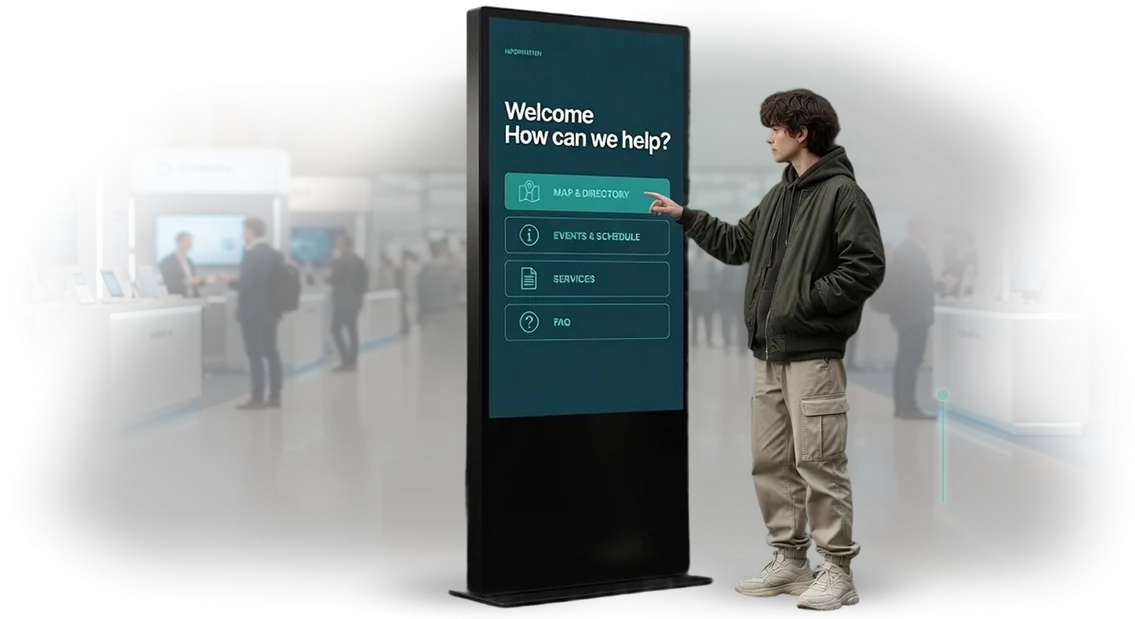
That's exactly why a cosmetology clinic needs an interactive kiosk. It takes over the flow of bookings, showing the current schedule and free slots, and letting the patient choose a convenient time without the receptionist's involvement.
The patient stops waiting, the lobby queue shrinks, and staff focus on courteous service instead of juggling calls. The visitor gains control over her time; the clinic keeps its bookings and happy guests. The kiosk eliminates the pain point that every day costs the clinic its clients.
5 Advantages of Interactive Kiosks for a Clinic
At a cosmetology clinic, patient flow is rarely even: mornings and evenings are peak times, when the receptionist answers calls, processes bookings, and greets guests all at once. At such moments the queue grows, and clients get annoyed even before their appointment.
An interactive kiosk for the clinic relieves this tension — the patient chooses a convenient time herself, without distracting the staff.
The first advantage is speed. Patient self-service takes less than a minute: the screen shows free slots, the client selects a specialist and procedure, and gets confirmation on the screen or on her phone.
There's no need to wait until the receptionist is free — booking happens without pauses or mistakes tied to the "human factor."
The second is relieving the receptionist. Manual operations — entering data into the log, searching for free time, confirmation calls — move to the kiosk.
Instead of mechanical work, the employee focuses on live communication with patients, consults about services, and resolves non-standard questions. This reduces staff turnover and improves service quality.
The third is loyalty. A modern kiosk looks like care for the client's time: no queues, no sense of chaos. A convenient interface and instant booking create the impression of a tech-savvy clinic that people want to return to and recommend to friends.
Patients note that managing their visit independently is more comfortable than depending on someone else's schedule.
In addition, the kiosk works without breaks and doesn't get tired: booking is available even while the patient waits for an appointment, and data immediately enters the clinic's system — without duplication or "forgotten" visits.
This format improves schedule occupancy and reduces no-shows, because the patient chooses a convenient time herself. As a result, the kiosk pays for itself through denser scheduling and freed-up staff time, and it builds the image of a clinic that keeps pace with the times.
Interactive Kiosk Formats for a Cosmetology Clinic
A cosmetology clinic handles a flow of different patients: someone has come for a treatment, someone wants to learn about new services, and someone is in a hurry and values every minute.
An interactive kiosk takes part of the routine off the receptionist and speeds up service, but for it to really work, the format must match your space, flow, and scenarios.
That's why, before launch, we discuss where the equipment will be placed and what the patient should be able to do in 30 seconds: book an appointment, get information, or check in for a visit.
The choice of format depends on this — from a compact wall-mounted screen to a full-fledged self-service station.
Format Comparison
| Kiosk format | Who it suits | What it gives the clinic |
|---|---|---|
| Floor-standing booking kiosk | Clinics with a busy reception area and a flow of 30+ people per day | Self-service procedure booking, shorter queues, reduced receptionist workload |
| Wall-mounted information kiosk | Small clinics with limited space | Exploring services and prices without staff involvement, presenting promotions |
| Self-service station | Clinics with several treatment rooms and a schedule | Quick visit check-in, booking with the right specialist, clinic navigation |
This doesn't mean you have to choose just one. In a single clinic, we often combine a floor-standing booking kiosk and a wall-mounted screen in the waiting area — so the patient gets the information she needs at any point.
The main thing is to define the task, and we'll help you choose the optimal format, configure the interface, and connect it to your booking system.
How the Interactive Kiosk Implementation Works
Kiosk Implementation Stages
For a cosmetology clinic, kiosk implementation takes two to three weeks. We don't deliver a "raw" product — each stage of kiosk development ends with an intermediate result that you can see and approve. That way you control the process and know exactly what you'll get at launch.
- Brief and process audit. We analyze how clients currently book, where queues arise, and which services are requested most often. This lets us make the kiosk menu convenient for your clinic specifically.
- Layout and menu structure. We design the screens: service selection, specialist, date and time, booking confirmation. We account for your brand identity and familiar navigation logic.
- Prototype and testing. We show a working prototype on a demo stand. We test the scenarios: booking at the first touch, changing a booking, printing a ticket. You see how the kiosk will work live.
- Development and integration. We connect the kiosk to your client records system — data about new bookings instantly appears at the receptionist's side. This eliminates manual transfer and errors.
- Kiosk installation. We mount the stand, set up the touchscreen and the printing module. We verify operation under real conditions: lighting, accessibility, sound volume.
- Launch and training. You accept the work; receptionists get a short briefing and a quick-reference card. The kiosk launches without interrupting booking — clients can book themselves from the very first day.
- Support and development. After launch, we monitor stability, update the menu for new promotions and services, and, when necessary, promptly make a service visit.
This workflow helps avoid surprises during kiosk installation and delivers a system that truly relieves the receptionist and speeds up client booking.
What's Included in the Interactive Kiosk Delivery
You get a ready-made turnkey solution — from equipment to receptionist training. No self-assembly, no hunting for subcontractors, no compatibility disputes: the kiosk arrives, gets installed, and goes live within the planned timeframes.
The standard delivery includes:
- Stand and touchscreen — a vandal-resistant enclosure that fits into the clinic's interior and withstands heavy use in the reception area.
- Preinstalled electronic queue and booking software — an interface with your specialists' schedules, service selection, and time booking without the receptionist's involvement.
- On-site installation and connection — an engineer comes to the clinic, installs the kiosk, sets up the connection to your system, and verifies all scenarios.
- Configuration for your services — we load the list of procedures, prices, and doctors' schedules so visitors immediately see current information.
- Staff training — a short tutorial for receptionists: how to accept payment, handle non-standard situations, and help guests with booking.
- Documentation package and warranty — we provide closing documents, an operating manual, and a warranty on the equipment and software.
- Technical support — phone and remote assistance for the entire period of kiosk operation, including updates and consultations.
So you get not just a device but a working tool that, from day one, relieves receptionists and speeds up client booking. All you have to do is plug the kiosk into the outlet — we've already thought through the rest.
Case Study: How We Doubled Bookings
Patient flow at a cosmetology clinic was growing, but booking was done by phone and manually at the reception desk. The receptionists couldn't keep up with calls, queues stretched to 15–20 minutes, and some clients left without booking the procedure they needed.
We installed an interactive kiosk at the clinic with an electronic queue and self-booking program based on the MedSoft platform — our partner in medical facility automation.
Patients choose the specialist and time themselves, see free slots, and receive a ticket without the receptionist's involvement. The program suggests the nearest convenient time and helps distribute the load evenly across treatment rooms.
Implementation Results
In two months, bookings doubled: from 40 to 80 procedures per day. Average queue waiting time dropped from 15 minutes to 4–5, and patients stopped leaving without a booking — about 20% of visitors booked their next visit right at the kiosk.
What Changed for the Clinic
Receptionists stopped spending time on manual booking and calls — up to 3 hours per day were freed up for live communication with patients.
The share of repeat visits grew by a third: the next procedure can now be confirmed with two screen touches, and patients don't need to call and wait on the line.
Six months later, the clinic came back to us: it ordered a second kiosk for a branch. We launched the repeat project in 10 days — with the same result: booking growth and relieved receptionists from the first weeks of operation.
Answers to Frequently Asked Questions About Kiosks
Our clients — heads of cosmetology clinics — often ask the same questions: what if the kiosk breaks, will it be hard for the staff, and when will it all pay off. We've gathered the three main concerns and answered them briefly.
What if the kiosk breaks down in the middle of the workday?
The kiosk is not just a screen but a full-fledged software system for the electronic queue and booking at a cosmetology clinic.
We provide a warranty on the equipment and software and also set up remote monitoring: if something goes wrong, our team will see the problem before patients do.
In the event of a failure, the receptionist can switch intake back to the regular booking process — the system allows this. Most issues are resolved remotely in a few minutes, without an engineer's visit or stopping the clinic's operation.
Is it difficult for staff to learn to work with the kiosk?
The interface is designed so that even those who see a touchscreen for the first time can use it. Staff only need to learn the basic actions: start a shift, print a report, help a guest in a non-standard situation.
Training takes one to two hours, including setup and a review of typical scenarios. The receptionist has to enter less data manually, which frees up time for communicating with patients instead of routine.
How long does it take for the kiosk to pay for itself?
The payback period directly depends on the clinic's load and how quickly guests get used to self-service.
As a rule, a noticeable effect appears within the first few months of operation: the queue shortens, there are fewer booking errors, and the receptionist manages to process more patients.
The savings come from staff time, fewer missed bookings, and higher treatment room occupancy. We advise on how to measure the effect in each of these areas so you can see concrete results.
If you're considering a kiosk for a cosmetology clinic but have doubts about any of these points, write to us. We'll explain exactly how it works in your clinic's conditions and help you make a decision without overpaying.Submit a Request for Interactive Kiosk Development
You already know what the queue looks like at peak hours: clients get nervous, the receptionist gets distracted by booking instead of live communication, and some visitors leave without an appointment.
An interactive kiosk solves this problem — it takes over the routine of the electronic queue and booking, while your staff focuses on service quality. We handle kiosk development turnkey: from the interface to integration with your system.
Submit a request for kiosk development — and we'll offer a solution that fits your clinic's workflow. After your inquiry, we'll clarify the tasks, recommend the optimal configuration, and show options on real projects. What you get as part of the order:
- An electronic queue and repeat-visit booking right in the lobby — without the receptionist's involvement.
- A clear interface that even older clients can easily master: a minimum of buttons, on-screen hints.
- Integration with your CRM or records system — booking data immediately reaches the specialist.
- Brand customization for the clinic: colors, logo, booking steps tailored to your services.
- Receptionist training and instructions for working with the kiosk — staff will use it from day one.
- Warranty and technical support: if anything happens to the equipment or software, we'll quickly resolve it remotely.
To order a kiosk for your cosmetology clinic, fill out the form on the page or call us — a manager will respond within an hour during business hours. We'll record your requirements, prepare a commercial proposal, and plan the work so as not to interrupt patient intake.
Submit your request — it takes a couple of minutes, and your staff and clients will feel the savings in time and nerves right after launch.
How to Choose the Kiosk Format for Your Clinic's Tasks?
There's no universal "best kiosk" — the choice of format depends on how many visitors pass through the clinic daily and what tasks you want to solve.
For a small clinic with one receptionist, a compact tabletop terminal is enough to speed up booking and relieve peak load.
If dozens of patients pass through the reception every day, it's worth considering a floor-standing station — it's more visible, more convenient for interaction, and pays off faster thanks to staff time savings.
At the same time, the key question isn't "which kiosk to buy" but how it will integrate into your processes.
It's important that the terminal works in tandem with your CRM and booking system: then the schedule updates automatically, and the receptionist sees the current picture in real time.
We implement integration at the server architecture level, so for the patient the process looks simple: chose a service, picked a convenient time, confirmed the booking — and received a notification on the phone.
Also pay attention to the usage scenario: a self-booking kiosk should be intuitive and guide the patient by the hand. Your clients are predominantly women; many come after work, tired, with a phone in hand.
A screen with large buttons, clear navigation, and hints at every step is not a luxury but a condition for the kiosk to actually be used rather than bypassed. We design the interface for your audience and adapt it to the clinic's brand.
The enclosure design also matters: a floor-standing kiosk should fit into the reception interior, not look like a foreign technical device. A wall-mounted option saves space but means the patient will interact while standing.
We help you choose not just a device but a solution that will underscore the clinic's status and increase visitor loyalty.
If you're not sure which format is right for you, we invite you to a consultation. We'll analyze the patient flow, receptionist workload, and current booking processes, then propose an option that will pay off in the shortest time. Submit a request — we'll find a solution for your clinic's tasks within one business day.