

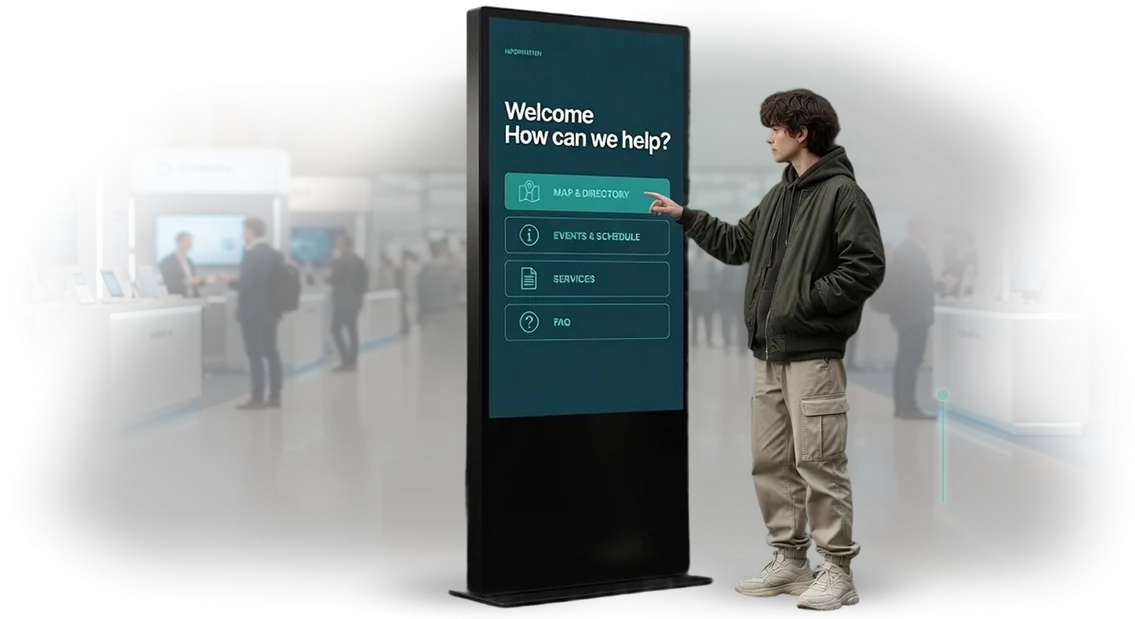
Queues in an Entertainment Center Devour Profit
An entertainment center is a place people come to for emotions and vivid impressions. But when queues build up at ticket counters, attractions, and food courts, joy turns into irritation.
Visitors are not willing to wait: some leave without getting their turn, and those who stay end up in a spoiled mood and are unlikely to return.
Every lost guest is not just revenue not earned in the moment — it is also a blow to the entertainment center's reputation. An unhappy visitor will tell dozens of acquaintances about the long wait, and on social media, even more. This is how queues quietly eat away at profit and turn potential loyalty into negative advertising.
At the same time, the problem is often not the number of guests but how the flow is organized.
People crowd in one place, while another zone is free; some people queue twice because of unclear navigation; staff spend time on manual crowd control instead of interacting with visitors.
We help entertainment centers bring order to these processes. The electronic queue and appointment system distributes the load evenly, suggests the optimal visit time to guests, and reduces actual waiting.
Staff stop being "traffic controllers" and return to their main task — hospitality and service.
The result: more satisfied guests, a higher average receipt, and a larger share of repeat visits. Queues at an entertainment center cease to be a bottleneck, and profit grows because every visitor gets maximum positive experiences and is ready to recommend you to friends.
What Interactive Kiosks Will Give Your Guests and Business
Visitors to an entertainment center come to relax, not to stand in lines. Interactive kiosks take over the routine of booking, payment, and service selection — the guest spends a few minutes on the process instead of ten, while your administrator's desk is freed up.
Fewer queues mean higher loyalty. A guest who quickly gets to an attraction or area is more likely to return and recommend the center to friends. The kiosk works without breaks or days off, so during peak hours you serve more visitors without extra staff.
A user-friendly interface prompts the guest on what to choose: a cost-effective package for several attractions, a paid upgrade for priority entry, or a service they did not know about.
This directly increases the average receipt — the system offers options that people do not see when interacting face-to-face in line.
For the business, this means transparent statistics: which services are chosen more often, and what time the load is highest. You make decisions based on data, not guesses, and respond to demand faster.
For example, kiosk data may show that group attractions are ordered more often in the evening — which means you prepare additional staff in advance and increase throughput.
Interactive kiosks pay off through higher revenue and savings on personnel. Guests are happy, employees are busy with real tasks, and you get a manageable tool that works for your image and profit.
Kiosk Formats for an Entertainment Center
In an entertainment center, each kiosk format solves its own task: one helps guests find their way, another speeds up booking, and a third removes chaos from queues.
Instead of buying a universal solution "just in case," we select a format to match your operational model — and this is immediately visible in zone occupancy and visitor satisfaction.
| Format | For whom | What it gives the client |
|---|---|---|
| Information kiosk | Guests visiting the center for the first time | Reduces the load on administrators, helps visitors navigate zones and services |
| Booking kiosk | Centers with session schedules: cinema, bowling, quests | The guest chooses a time, pays, and goes to the zone without a registration desk |
| Electronic queue | Attractions, ticket counters, high-traffic zones | Removes the crowd at the entrance, distributes the flow, shows waiting time on a display |
Format selection begins with an analysis of your tasks: where queues most often form, which services require advance booking, and what information guests ask for every day.
After that, we propose one or several kiosk types — they often complement each other, for example, a booking kiosk with electronic queue functionality.
The key thing the client gets is not "hardware for the sake of hardware" but a measurable result: less fuss, higher attraction throughput, and more time for staff to interact with guests. Choosing a format is part of an overall scheme that we work out in detail and support after launch.
How the Project Works: From Brief to Launch
We follow a clear procedure so you can see the status at every step and understand what is happening with the project. No "black boxes": you always know at what stage the kiosk is, when the designs will be ready, and when installation will begin.
- Brief and task audit. We record which scenarios are needed: queue booking, session schedules, zone maps, promotions. We ask clarifying questions so the kiosk solves exactly your task — rather than being a "kiosk for the sake of a kiosk."
- Plan and estimate. We agree on timelines, scope of work, and areas of responsibility. You receive a schedule with key milestone dates and an understanding of what is included in the cost and what is not.
- Design concept and approval of layouts. We show 2–3 visual style options tailored to your interior and audience. After selection, we draw up all screens, and you approve them before development starts so there are no surprises later.
- Development and configuration. We build the logic: queue booking, integration with your CRM or schedule, statistics export. We adapt the interface for a touch screen — so it is convenient for children and adults alike, including people with limited digital literacy.
- Testing on real scenarios. We check how the kiosk behaves under peak load, when a customer lingers, and when the connection drops. It is important that no guest gets lost or leaves without booking.
- Launch and staff training. We install the kiosk and configure it for your network and ticket or coupon printing. We train administrators: how to open a shift, resolve a typical issue, and view reports.
- Post-launch support. We stay in touch and update content on your request — for example, changing the schedule or adding a new attraction. This keeps the kiosk current without bringing in a contractor from scratch.
Each stage ends with a concrete result that you personally approve. This prevents situations where "we wanted the best but got the usual outcome." The final timeline is fixed in the contract — kiosk launch happens on schedule, without disrupting an opening or an event.
What Is Included in a Turnkey Kiosk Delivery
When a guest at an entertainment center stands in a physical line to an attraction, they spend time that could have been spent playing.
Automated booking through a kiosk removes the chaos at the entrance and gives the guest a clear scenario: choose a service, pay, and receive an invitation for the desired time.
We take on the entire cycle — from equipment selection to training your employees. What you get is a working kiosk that integrates into the center's processes from day one, not a "kit" that your own team has to assemble and configure.
Turnkey Delivery Package
Everything you need to launch comes in a single list:
- Touch kiosk with a vandal-resistant enclosure — professional equipment designed for round-the-clock operation in a high-traffic area.
- Electronic queue and booking software — guests independently select a service ("karting," "laser tag," "VR zone"), see available slots, and reserve a convenient time.
- Custom design layouts — interface design in your center's style, with your logo and corporate colors.
- Cashier and CRM integration — booking data automatically flows into your system, eliminating manual entry and administrator errors.
- Installation and on-site configuration — an engineer visits your location, connects the kiosk, and verifies all scenarios.
- Staff training — your administrators receive a clear guide and a short session: how to accept payment, reschedule a booking, and handle an unusual situation.
- Warranty and support — official warranty on equipment and software. In the event of a failure, we connect remotely or visit the site within an agreed time.
Why This Is More Profitable Than Assembling a Solution Yourself
When a kiosk is delivered turnkey, you do not spend time fitting together parts from different suppliers.
We have already verified equipment and software compatibility, tested scenarios under real loads, and hand over a system that is ready to receive its first guests on launch day.
The warranty in this case is not just a piece of paper — it is protection for your business against downtime. If the kiosk stops working on the day of a children's party, you lose not only the attraction bookings but also guest loyalty.
That is why the contract specifies the support team's response time and the equipment replacement procedure.
Case Study: How Kiosks Reduced Waiting by 40%
In entertainment centers, the queue is the main enemy of revenue. While guests wait in line at the administrator for a ticket or an attraction booking, they are not spending money inside and have time to sour their mood.
This is exactly the pain point we addressed in a project with the family entertainment park chain "Park of Wonders" — where the line at the entrance on weekends stretched to 20–30 minutes.
How It Was
The client came to us with two key areas: attractions and a banquet hall. The main problem was that during peak hours, 30–40 people accumulated at the counter: some needed tickets, others needed bowling reservations, and still others needed consultation about an event. The administrators physically could not keep up, and guests left or lost interest.
We installed information kiosks in the lobby with an electronic queue and a booking module. Visitors choose a service themselves, see the approximate waiting time, and immediately receive confirmation — without staff involvement. The administrator only steps in for unusual situations and cash payments.
Numbers That Speak for Themselves
One month after launch, waiting time during peak hours dropped by 40%. The number of successful bookings for the banquet hall and lanes grew by a third — booking became available even when the front counter was overloaded.
Guests stopped leaving "without getting their turn," and administrators began handling the flow calmly without constant overtime. The project paid for itself in two months, and six months later the client ordered additional kiosks for a second branch. A repeat request is the best indicator that the system works for the business.
How to Choose the Optimal Kiosk Format?
Choosing a kiosk starts not with technical specifications but with business tasks.
For an entertainment center, the main question is what exactly the kiosk should solve: speed up electronic queue booking, sell attraction tickets, assist with navigation, or relieve the administrator during peak hours. The answer determines the format, functionality, and cost. So first define the use scenario, and only then compare models.
The second criterion is floor area and placement. In a lobby with high foot traffic, a floor-standing kiosk with a large screen that attracts visitors' attention is convenient.
For installation near an information desk or in a waiting area, a compact wall-mounted option is suitable — it does not take up useful space and does not obstruct the flow of guests.
Think about how the kiosk will fit into the interior and whether it will create queues in narrow passages.
The third criterion is budget and growth prospects. A simple model covers the current task, but if in a season you want to add food sales or event booking, you will need a more flexible system.
The optimal choice is a kiosk that allows additional functions to be installed without replacing equipment: this is cheaper than buying a new unit with every expansion.
The bottom line is simple: choose a format for the scenario, space, and budget, not from a catalog. We help clients go through this path — from task analysis to delivering a ready-made solution that pays off through lower staff load and faster visitor service.
If you are hesitating between formats, send us a floor plan of your center — we will suggest the optimal option and calculate the preliminary benefit.
Answers to Frequently Asked Questions About Implementation
Every entertainment center owner, before implementing a booking kiosk, asks the same questions: what happens if the equipment fails at peak hours, who will monitor its operation, and when will the investment begin to pay off. These are normal doubts — they affect peace of mind at the site and staff workload.
We have worked with such projects for years and know: an interactive kiosk pays off not because it is fashionable, but because it removes routine from administrators and speeds up guest service. Below are answers to the most common questions so you understand how everything works in practice.
What happens if the kiosk breaks down on the busiest day?
For this, we set up remote monitoring in advance: the system notifies us of a failure before guests even notice the problem. In most cases, the issue is resolved remotely, without a specialist visiting the site.
If physical intervention is required, we use professional equipment with fast replacement of components — this approach minimizes downtime.
In addition, during repairs you can always return to regular booking at the administrator's desk. The kiosk does not block operations — it enhances them, but does not make you a hostage to technology.
Is the kiosk difficult to maintain? Does it need a dedicated employee?
No, a dedicated employee is not needed. The kiosk is designed so that entertainment center staff spend minimal time on it: the shift administrator refills the receipt paper and, if necessary, wipes the screen. Everything else — updates, backups, error monitoring — is handled by us remotely.
For your team, this means zero additional tasks on the checklist. The system itself will indicate if attention is required, and administrators will continue focusing on guests rather than equipment setup.
How quickly will the kiosk pay off?
The payback period depends on the center's load, but on average clients see results in the first months of operation.
The kiosk reduces the queue at the entrance, speeds up booking for attraction zones, and lowers the load on the front desk — this allows you to receive more guests without expanding staff.
Savings come from three things: less administrator time per booking, fewer errors when creating reservations, and higher throughput during peak hours. If your center receives hundreds of visitors a day, the difference is noticeable within the first week.
Will the kiosk be clear to guests of different ages?
We design the interface using the principle of "three steps to the desired action": choose a service, select a convenient time, confirm — and done.
The on-screen logic mirrors how guests are already used to booking through an administrator, so both adults and children will figure it out without prompts.
If a guest still has a question, there are always hints on the screen and a button to call an administrator. The kiosk does not create a barrier; it becomes another entry point — fast and clear.
If you still have doubts about implementation, send us a description of your center, and we will propose a solution suited to your foot traffic and service format.
Shall We Discuss Your Project? Leave an Inquiry
Visitors to an entertainment center do not forgive long queues: every extra minute of waiting is lost emotions and lost revenue.
An information kiosk with an electronic queue and booking solves this problem, but only when the system is designed around your specifics: attraction types, hourly load, and guest behavior. That is why we start not with development but with an analysis of your situation.
We do not send "just a price list." Leave an inquiry for a kiosk — and within one business day you will receive:
- Consultation. We will identify where visitors are currently lost and how to speed up attraction boarding — without changing your team.
- Cost calculation. A transparent estimate for your scale and feature set: session booking, coupon printing, queue status display. No hidden fees.
- Interface prototype. A screen map and kiosk workflow logic before development starts — you see the result in advance, not "just on paper."
- Launch plan. Stages, timelines, and responsible parties. You always know when the kiosk will be operational and what is needed from your side.
- Integration recommendations. We will show how the kiosk will connect to your cash register, loyalty system, and visit tracking.
This places no obligation on you. Even at this stage, it is clear how the kiosk will reduce queues, increase attraction zone throughput, and raise the average receipt.
Leave an inquiry now — within one business day we will conduct a consultation on your project and prepare a cost calculation. After that, all that remains is to make the decision.