

An Exhibition Center Without an Electronic Queue Loses Visitors
Organizers invest in attracting guests, but long queues at popular zones negate these efforts. A visitor who has stood at a booth for ten minutes grows tired, skips neighboring booths, and leaves with the feeling that the exhibition is overcrowded.
As a result, coverage falls, and booths fail to collect the leads participants came for. An exhibition center without an electronic queue loses both guests and repeat renters.
Add to this exhibition navigation: in a large pavilion, even an experienced guest wastes time searching for the right zone. Some visitors simply skip the booths that interest them because they don't understand where those booths are or how to reach them.
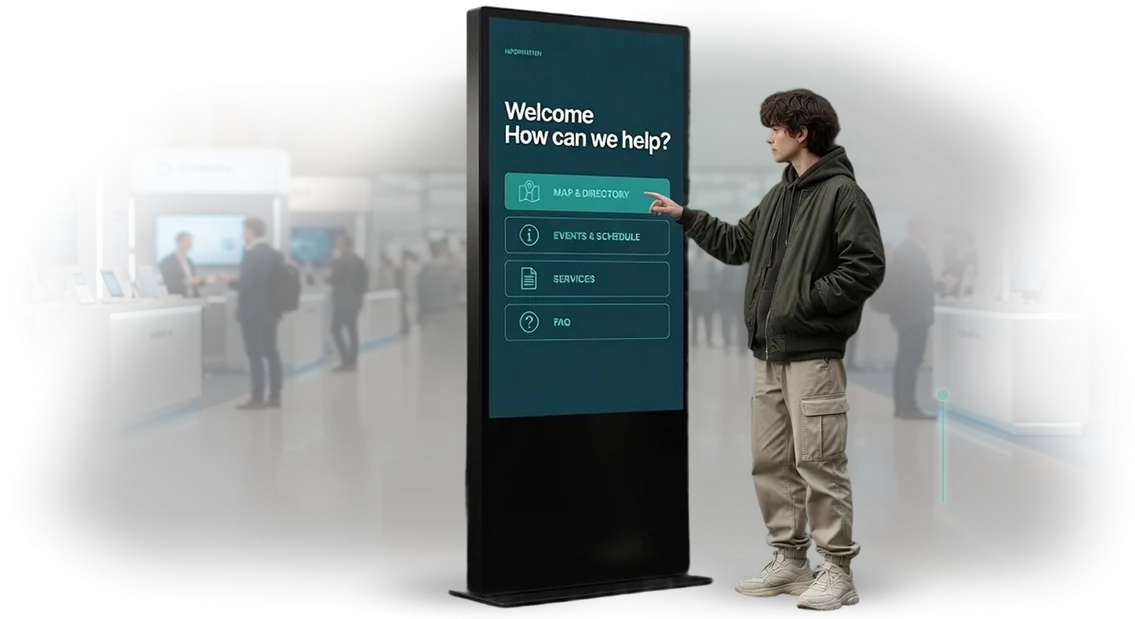
An interactive kiosk solves both problems — it helps visitors find their bearings and immediately shows where the fewest people are right now.
An electronic queue and booth booking turn spontaneous crowds into a manageable flow. A guest approaches the kiosk, selects a point of interest, books a time or takes a ticket — and calmly continues their tour.
Queues no longer accumulate in one place: the load is distributed evenly across booths, and every visitor manages to book time with the booths that truly matter to them. They spend their free time viewing rather than standing around waiting.
For the organizer, this is a measurable result: more booths visited, higher average time at the venue, fewer lost visitors. Booking and route data show which zones attract attention — the foundation for planning the next event. We help launch such kiosks turnkey: from configuring queue logic to analytics for your team.
What Electronic Booth Booking Without Paper Lists Delivers
Registration Speed Without Paper and Queues
Instead of searching for a list at the counter and waiting for an administrator to become available, visitors book themselves through a touchscreen kiosk in 30-60 seconds. They choose a booth, a convenient time, leave their contacts — and immediately receive confirmation.
Booth staff are unburdened: no more paper logs and manual data rewriting. Our team have been implementing such kiosks for many years, so booking automation integrates into exhibition operations without failures or downtime.
More Booth Visits
When booking is electronic, visitors find it easier to plan their route. The kiosk suggests open windows, and unoccupied slots are visible immediately. As a result, booths receive more visits, and contacts missed because of paper lists simply disappear.
Booking encourages visitors to actually reach the booth: the guest has confirmation and a reminder. This is a direct increase in coverage — everyone who books becomes a real visitor, not a random passerby.
Guest Loyalty
Guests tire of jostling and paperwork. Electronic booking shows that the organizer cares about their time. A modern kiosk in an exhibition center is an element of comfort that improves the overall impression.
After visiting the exhibition, the guest is left with a positive experience they willingly share with colleagues. This affects the venue's reputation and the desire to return for the next event.
Statistics for Reporting
The system itself collects data on every booking: which booths are chosen most often, during which peak hours, and how many visitors actually arrived. The organizer needs only one click — and the attendance export is ready for the report to the client.
This data helps plan the next season: set priorities, distribute flows, and demonstrate work efficiency. No manual calculations and no human-factor errors.
Kiosk Formats for an Exhibition Center: Comparison
An exhibition center handles uneven flows: in the morning everyone arrives for the opening; an hour later, interest redistributes across the booths.
If booth booking and the electronic queue are not automated, a live queue piles up at the administrator, guests waste time, and leave without contacts. Each kiosk format has its own task: one relieves the counter, another provides a personal approach.
Let's compare the three formats most commonly chosen for exhibition centers. The table is a hint as to which option is right for you.
Format Comparison
| Format | When to Choose | What the Customer Gets |
|---|---|---|
| Self-service touchscreen kiosk | Flow of 100+ guests per day, need to eliminate queues at the counter | Visitors book a booth or join the electronic queue themselves; the administrator handles only complex requests. Guests don't leave, booth occupancy grows. |
| Administrator counter with electronic queue | Medium-sized venues where personal contact and guest assistance matter | One staff member manages booth bookings, sees real-time occupancy, and calls guests to the right booth without shouting or paper tickets. |
| Mobile registration via tablet | Multiple entrances, off-site events, or a large exposition | Mobile administrators book guests right in the hall without being tied to a counter. Queues dissolve on their own, and organizers get a complete attendance picture. |
Most often, exhibition centers combine a touchscreen kiosk and an administrator counter: the kiosk absorbs peak load, the counter handles individual scenarios. We design a package for the size of your venue, configure the electronic queue, and launch booth booking turnkey.
The Kiosk Creation Process in 6 Steps
A kiosk for an exhibition center must work from the first day of the exhibition. We structured the process so that you control every stage and receive a finished system without surprises. Below is the path from brief to support during the event days.
- Brief and scenario. We capture the tasks: hall navigation, session schedules, booth booking. We discuss visitor flows and typical guest questions. We agree on the screen logic.
- Design and interface. We draft a prototype; you approve layouts and visual style. We account for the center's brand identity and make the interface clear for guests of any age.
- Interface sign-off. We show an interactive prototype on a real screen and test scenarios: booth search, session booking, ticket retrieval. We make revisions before the final version is signed.
- Project implementation. We assemble the system, connect the booth database and schedules, and configure the electronic queue and booking. We verify the chain "guest arrives → chooses a booth → gets a ticket → attends the meeting."
- Kiosk testing. We run tests at the venue: response speed, behavior under bright light and high visitor flow, and stable ticket printing. We fix issues before the opening so the first day has no failures.
- Launch at the exhibition. We deliver the kiosk, install it, and run a final check an hour before the start. We train the staff and keep an engineer available for the entire event.
What's Included in the Delivery: Package for the Event Team
Technically, the kiosk is only the tip of the iceberg. To ensure the electronic queue actually relieves the registration counter and doesn't create new headaches, the customer receives a complete working package, not just a device with software.
Deploy the system from day one — and the team greets guests instead of fighting the crowd. The delivery package includes:
- Electronic queue module — visitors book, take a ticket, and calmly wait for their call; staff see a live picture rather than chaos at the counter.
- Administrator screen — real-time queue management: switching windows, redirecting flows, monitoring staff workload. All changes — without stopping the kiosk.
- Ticket printing — automatic issuance of numbered tickets with the necessary information: zone name, window number, waiting time. The guest doesn't get lost in the space but follows a precise route.
- Attendance data export — after the event, a report remains: how many visits, at what peak hours, and how load was distributed across counters. This is an argument for the next client and a reason to optimize logistics.
- Staff training — a 2-hour training session for administrators and the registration counter: shift setup, system startup, handling non-standard situations. Staff works confidently from the first shift.
- Technical support during the event — configuration for the venue layout, remote monitoring, and rapid response so any failure is resolved in minutes rather than disrupting the schedule.
This is not just "hardware with software" but a well-built process: the guest gets a ticket → the system guides them → the administrator controls flows → you get data and peace of mind.
Case Study: How We Cut the Queue in Half
At the PromExpo exhibition center, registration was the main bottleneck at a major industry forum. At peak hours, the queue stretched to 20–30 minutes, some guests left without badges, and organizers lost accurate attendee data. Management approached us with the task of speeding up the flow without increasing staff.
What We Did
Several kiosks with an interactive registration program were installed before the entrance: the visitor selected their organization from a list, entered contacts, and received a badge in 1–2 minutes.
On-screen prompts guided the guest step by step, so administrator assistance was needed only in rare cases. The system distributed the load between kiosks automatically — when people accumulated, some visitors were automatically redirected to free counters.
The Result
Over two days of operation, the load on the registration zone dropped by half, and the number of successfully registered visitors grew by a third.
Average waiting time fell from 25 to 10 minutes, guests stopped leaving without badges, and organizers gained accurate statistics for every flow. The kiosks paid for themselves at that very event, and the exhibition center ordered them for permanent navigation.
We use the same approach in permanent exhibitions — it works equally well at one-off forums and in daily visitor flows.
How to Choose the Right Electronic Queue Format for Your Exhibition?
Choosing an electronic queue format starts not with technical parameters but with three questions: how many visitors pass through the exhibition during peak hours, how many zones or booths need booking, and what data you want to obtain after the event.
There is no universal solution — a properly selected system saves hours of waiting and increases the throughput of every exposition.
Our experience shows that most exhibitions benefit from a flexible scenario where the number of flows can be changed on the fly, rather than from a rigid scheme built for a single scenario.
The scale of the event determines the core logic. If the exhibition occupies several halls and each booth has its own live queue, it's worth considering multi-threaded booking, where the visitor chooses a zone and time while screens show the current load.
For compact expositions or business formats, a single electronic queue with tickets and waiting-room notifications is sufficient.
What matters here is not the size of the equipment but how easily a guest can get their bearings in a few seconds: the fewer actions before getting a ticket, the higher the conversion into viewing the exposition.
The specifics of the exposition dictate their own rules. If you have interactive booths where each visitor spends 5-10 minutes, the queue should be slow and predictable — with an accurate waiting time.
For quick consultations or short demonstrations, a "live" queue without slot booking is more effective.
A separate case is zones with limited capacity, such as VR attractions or masterclasses: they need booking with confirmation so people don't gather in a dense crowd and create a bottleneck.
Finally, statistics requirements. Even a simple electronic queue provides data on peak loads, average visit duration, and the most in-demand zones. These figures become the basis for planning the next event and for negotiations with space renters.
If you need per-flow reporting or integration with a visitor accounting system, the format is chosen based on these metrics, not the other way around.
We select a scheme for your exhibition in one briefing: we record the scale, the number of concurrent flows, the specifics of the exposition, and the metrics you need.
Next, we design a scenario that visitors navigate without staff prompts, and you get a transparent picture of each zone's load. Start with the question "what should visitors do in the queue" — and everything else will fall into place around it.
Frequently Asked Questions Before Ordering a Kiosk
Before ordering a kiosk for an exhibition center, the same questions arise: will the hardware withstand peak load, will we make it in time for the opening, can we rent the device, and what happens if something goes wrong.
We — our team — hear them from every client and answer honestly because we have been working on such projects for more than 10 years.
What happens to the kiosk on a peak-load day when the queue is long?
Kiosk reliability is a core requirement we build in at the configuration stage. The software is tested under a high visitor flow, so even at maximum load the device works without freezes or delays.
We have dozens of high-traffic projects behind us — thousands of requests per day. For us, peak load at an exhibition is not an exception but standard operating mode.
What are the implementation timelines?
From scenario approval to launch usually takes two to four weeks — the exact time depends on the feature set. If the exhibition date is already fixed, we deliver the project in stages and open on time.
Implementation timelines are fixed in the contract, and we are responsible for the result.
Can we rent a kiosk instead of buying it?
Yes, kiosk rental is a working format for one-off events. You receive a ready device with configured software for the required period, and we handle launch and support.
This is convenient when you need to test the solution before a purchase or hold an event without capital expenditures.
What support will be available during the exhibition?
For the entire duration of the event, a duty specialist is assigned to you. They monitor the kiosk's condition, respond to failures, and make changes as the event progresses.
Support at the exhibition is included in the contract — you are not left alone with the equipment and receive a solution within minutes.
Get a Project Estimate for Your Event
Every exhibition organizer knows how hard it is to keep visitor flow at the right pace. Queues at booths, lost guests, missed contacts — all of this quietly eats away at the event's time and budget.
We help turn chaos into a manageable route that increases exposition coverage and participant satisfaction.
Leave a request for a kiosk — and we will send you back a project estimate for your event. You will receive not an abstract cost sheet but a clear plan with figures and timelines tied to your tasks and budget.
What You Will Get After Your Inquiry
- Electronic queue cost estimate — matched to the scale of your exhibition center: from a single info kiosk to a network of kiosks with centralized management.
- Format selection for your scenarios — session booking, an electronic queue for booths, zone navigation, and collection of visitor leads.
- Clear implementation timelines — we state the launch date before work begins and fix it in the contract.
- Turnkey options or a separate stage — you choose the scope: software only, equipment with setup, or full support during the event days.
- Experience for events of your scale — we have worked with forums, conferences, and exhibitions where every visitor minute matters.
An organizer consultation takes 15–20 minutes — enough to assess your task and propose a solution without unnecessary expenses. We're available at every stage: from the first brief to the post-event report.
Fill out the short form — and within one business day we will send you a project estimate, and if necessary, get on a call to discuss the details. Make your visitor flow manageable at your next event.