

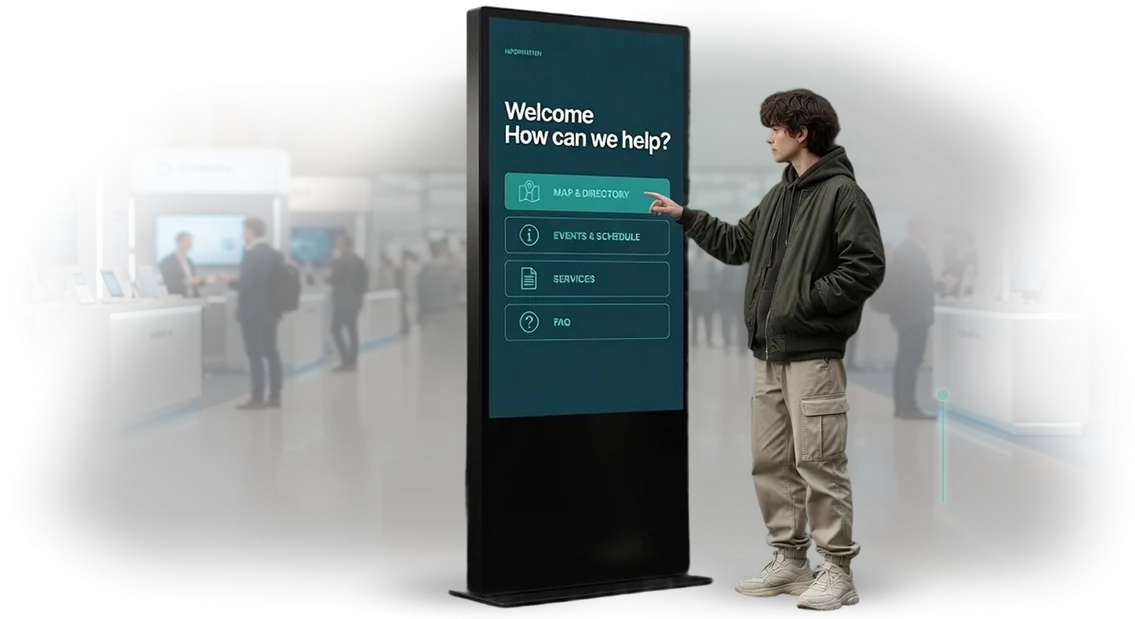
Interactive display case for museums: why it matters
Visitors come to a museum for experiences, not just facts. A classic display case with a static exhibit holds attention for a few seconds, then the gaze moves on, and the person leaves the hall without truly feeling the collection.
An interactive display case for museums changes the rules of the game: it turns viewing into a live dialogue between the guest and the exhibit. Visitors choose what to look at, in what order, and how deeply to dive into the subject.
Such engagement directly affects the experience. Instead of passively walking through the halls, visitors linger at display cases, study details, compare eras, and launch hidden scenarios.
The museum exhibition starts to work like a story that the guest lives through rather than just reads from a label. This creates emotions, and emotions are the main reason people return to the museum again and recommend it to friends.
For the museum itself, interactive display cases are not a tribute to fashion but a practical growth tool. The average time spent in the halls increases, the share of repeat visits grows, and a natural reason for coverage in social media and city media appears.
A modern museum where exhibits can be viewed, rotated, and brought to life clearly wins the competition for guest attention, especially among younger audiences.
Importantly, this format does not turn the exhibition into an amusement ride. We design interactive display cases to enhance the scientific value of the collection rather than replace it.
Interactive mechanics — augmented reality, gestures, touch — work to reveal the exhibit, not to its detriment. Guests gain in-depth, structured knowledge, while museum curators get a tool that presents complex material with care.
We have already implemented similar projects for cultural spaces and know how to integrate interactive display cases into an existing route without rebuilding the halls.
We will show with examples how a museum exhibition comes alive and begins to speak to each visitor in their own language. We will explain how quickly the investment pays off and help you choose the scenario that suits your museum.
What you get from an interactive exhibition
An interactive exhibition is not just technological decoration but a tool that changes visitor behaviour and delivers measurable results for the museum. Here are the key benefits you receive.
Increased engagement and time at the display case
An interactive display case turns passive viewing into live exploration: visitors choose their own scenario, discover details, and get instant feedback. This holds attention 2–3 times longer than a static stand, and each exhibit gets the chance to tell its story.
Interactivity engages children and adults alike, increasing the time spent across the entire exhibition.
More repeat visits
Renewable content, seasonal scenarios, and game mechanics create reasons to come back and bring friends. The museum builds a loyal audience that ensures a steady flow of visits and revenue.
Loyal guests see the museum as a place where there is always something interesting and return again and again.
Greater museum brand recognition
Vivid interactive solutions become a reason for photos and social media posts, expanding reach without an advertising budget.
For example, in the project for the City History Museum, the number of social media mentions grew several times after the launch of the interactive display case. This brought new guests through recommendations and strengthened the museum's position in the information space.
Additional benefits for the exhibition
Interactivity collects anonymised interaction statistics: which topics interest visitors, which scenarios are triggered most often. This data helps improve the exhibition and plan new projects.
In addition, interactive formats are easy to adapt to temporary exhibitions, making the museum responsive to current topics.
Interactive display case formats: from simple to complex
Each museum solves different problems: some need to quickly introduce guests to an exhibit, others need to keep a child at the display case, and still others need to create a full immersion effect.
The format of an interactive display case determines how visitors interact with the content and what benefit the museum gains from it. So you should not choose "the most modern option" but rather the mechanic that solves the specific task of a hall or exhibition.
The more complex the format, the higher the engagement, but at the same time the requirements for content and support grow. We have divided typical scenarios into levels — from compact touchscreen kiosks to projection complexes.
This helps the museum see what result each option delivers and where the reasonable limit of investment lies.
| Format | Who it's for | What it gives the client |
|---|---|---|
| Touchscreen kiosk | Individual visitors, quick reference | Relieves the burden on staff, provides access to photos, videos and descriptions with a single touch |
| Interactive panel | Families with children, small groups | Game mechanics and quizzes hold attention for 3–5 minutes, increase interest in the exhibition |
| Projection solution | Exhibitions with a presence effect | Full immersion without physical contact, creates a "wow" effect and improves memorability |
| Combined display case | Large halls and temporary exhibitions | Several scenarios in one space: film, game, augmented reality — for different audiences |
In our work, we always rely on the museum's goals rather than a ready-made template. We advise which format will deliver maximum reach within the budget, where several mechanics can be combined, and how to make the display case convenient for visitors of all ages.
As a result, the exhibition starts working without a guide: guests stay longer at the object, share their impressions, and come back again.
How the work on the exhibition proceeds
A transparent process is the key to a manager's peace of mind. You always know what stage the project is at, what has already been done, and what comes next. Most failures happen because of misunderstandings, so we record all decisions immediately.
We work remotely, but if necessary, we visit the site to measure the space and clarify details. Our Turnkey Exhibition methodology includes seven steps — from brief to support.
-
Brief and interview. We collect the exhibition's objectives, the visitor profile, hall constraints, and curators' wishes. We visit the site or request floor plans.
-
Concept and scenario. We propose 2–3 interaction options for the interactive display case. We describe what the guest will see, what actions they will take, and what information they will receive.
-
Project approval and budget. We fix the timeline, scope of work, and cost with all revisions included. You receive an accurate estimate with no hidden charges.
-
Content production and installation. We prepare graphics, texts, audio and video, and assemble the equipment. We show intermediate mock-ups and make corrections before launch.
-
On-site testing. We check performance under real lighting, noise, and visitor flow conditions. We eliminate issues and refine the interaction to perfection.
-
Launch and training. We train staff on the main actions and hand over instructions and support contacts. From this point, the exhibition operates autonomously.
-
Support and development. If desired, we update content, add new features, and monitor stability. You are never left alone with the technology.
Delivery set: what is included in the project
It is important for the client to understand: the project price is not just the kiosk itself but a complete turnkey solution.
We include everything needed in the delivery so the display case starts delivering value immediately after installation and your staff do not have to figure out the settings on their own.
- Software. We install the content management system, licences, and updates. You do not need to buy anything extra or hire outside contractors.
- Content for the display case. We develop the content for the exhibition: texts, images, videos, animation. The content is adapted for touch control so visitors find it convenient.
- Equipment and installation. We select a reliable touchscreen kiosk for the museum's needs, deliver, and install it. We carry out setup, connection, and on-site testing.
- Staff training. We conduct a briefing for your employees: how to switch on, change materials, and resolve simple issues. The training takes an hour to an hour and a half — nothing extra.
- Warranty and technical support. We provide a warranty on the equipment and software. We are available by phone and email, and if necessary, we visit the site or solve the problem remotely.
- Documentation and instructions. We hand over clear operation guides and a maintenance schedule so any employee can quickly find the answer.
This approach allows you to focus on the content of the exhibition rather than the technology. After project delivery, we stay in touch: we help with content updates and further development of the display case.
Case study: how we increased time at the display case
Let us tell you about a real project we completed for a museum with a rich historical collection. Previously, guests quickly walked past the stands and stopped only at the largest exhibits, while the average time at the other display cases did not exceed a minute.
The museum staff wanted to give visitors more context, but the space did not allow for extended texts.
We proposed an interactive display case for the museum: a touchscreen next to the exhibit that complements the physical object with history, images, and navigation.
The task was not just to install technology but to hold the guest's attention and help them immerse themselves in the material. We completed the project in four weeks, including interface design, content production, and equipment setup.
Quick result — for the manager
Here are the figures we obtained two months after launch:
| Metric | Before the project | After launch |
|---|---|---|
| Average time at the display case | about 1 minute | 4–6 minutes |
| Share of visitors stopping at the exhibit | ~40% | up to 85% |
| Number of return visits to the display case per day | 8–10 times | 20–25 times |
| Tour requests after a visit | rare | 30% more frequent |
For the museum, this means guests are learning more about the collection and are more willing to return. For the department, it is a clear metric of value: the interactive kiosk paid for itself in the first months thanks to growing interest in paid tours.
By agreement with the museum, we handed the team a tool for updating content independently: they change exhibit descriptions, add temporary exhibitions, and upload new images without involving developers. Guests see up-to-date information, and the museum saves time and money on ongoing modifications.
The first project showed that an interactive display case for a museum is valuable not in itself but as an attention-management tool: it increases the depth of viewing, raises satisfaction, and delivers measurable value to the development department.
Since then, we have created several similar solutions for other venues, and the museum has become our regular client.
How to choose a format for your museum's needs?
There is no one-size-fits-all format — an interactive display case for a museum must solve specific tasks. So first, together with you, we define three parameters: what the exhibition should deliver, who its main audience is, and what budget is allocated for launch.
If the main goal is to attract new visitors and generate interest on social media, we choose a vivid scenario with large imagery and an unusual presentation. Such a display case becomes a photo opportunity and encourages repeat visits.
If the task is educational, we focus on depth: a sequential narrative, knowledge checks, and additional materials.
The audience also determines the format. For children's groups and family visits, simple controls and instant response are essential — a child should not have to figure out the interface.
For an adult and professional audience, we leave more text, documentary facts, and the opportunity to explore the topic at their own pace.
The budget affects the scale but not the quality: even one compact display case can deliver a measurable result. It works without breaks, serves the visitor flow without extra staff, and takes some of the load off the guides.
The investment pays off through increased reach and repeat visits, and if necessary, the exhibition can be expanded gradually.
We offer to discuss the museum's objectives and choose a format that fits the budget and will be convenient for your guests. Our engineers will prepare a scenario, estimate the timeline, and show how the display case will work in practice. Write to us — we will find a solution for your exhibition.
Frequently asked questions before ordering
Before ordering an interactive display case, museums have the same concerns: will it be difficult to operate, will deadlines slip, how reliable is it, and how will the display case fit the interior. We answer these questions based on experience from dozens of projects.
Is the display case difficult to operate?
We build the structure from industrial components designed for long-term operation. The display case starts on a schedule and works without constant supervision. Content is updated in a few minutes — without a programmer.
How long does production take?
A typical project takes 3–4 weeks after approval of the mock-up. We fix the deadlines in the contract and show intermediate results at every stage.
How reliable is it?
We use proven solutions that have been tested in museums and public spaces. We provide a warranty and stay in touch after launch: we help with maintenance and refinements.
How will the display case fit the museum's style?
We adapt the appearance to your interior: materials, colour, shape, lighting. The display case can become a natural continuation of the exhibition or an art object.
Didn't find your question? We will send a detailed answer and a preliminary estimate for your tasks.Ready to discuss a project? Leave a request
Tell us about your task — we will discuss your task and prepare a cost estimate for an interactive display case for the museum. It is important for us to understand your goals: how many visitors, which exhibits, what effect you want to achieve. This allows us to propose a solution that will pay off and work for years.
An interactive display case for a museum solves several tasks at once: it holds attention, increases engagement, and gives visitors a reason to come back.
Our team will help you choose the right format — a touchscreen panel, a projection zone, or a large screen — and adapt the concept to your exhibition and budget.
By leaving a request, you receive:
- a consultation with the project producer and engineer — we will discuss how interactivity can strengthen the exhibition and make it clearer for different age groups;
- a cost and timeline estimate for your budget — no hidden charges, no imposed options, and no surprises at the installation stage;
- examples of interactive display cases for museums and exhibitions — see how they look in action and what tasks they solve;
- a clear work plan: from concept and sketches to launch, team training, and acceptance;
- a warranty on the work performed and support after launch — the display case will work on opening day and beyond.
Leave a request — we will respond within one business day. You will receive concrete figures and recommendations, not general words. If needed, we will hold an online meeting and answer your team's questions. Then you decide: we move into implementation or you keep the finished estimate.