

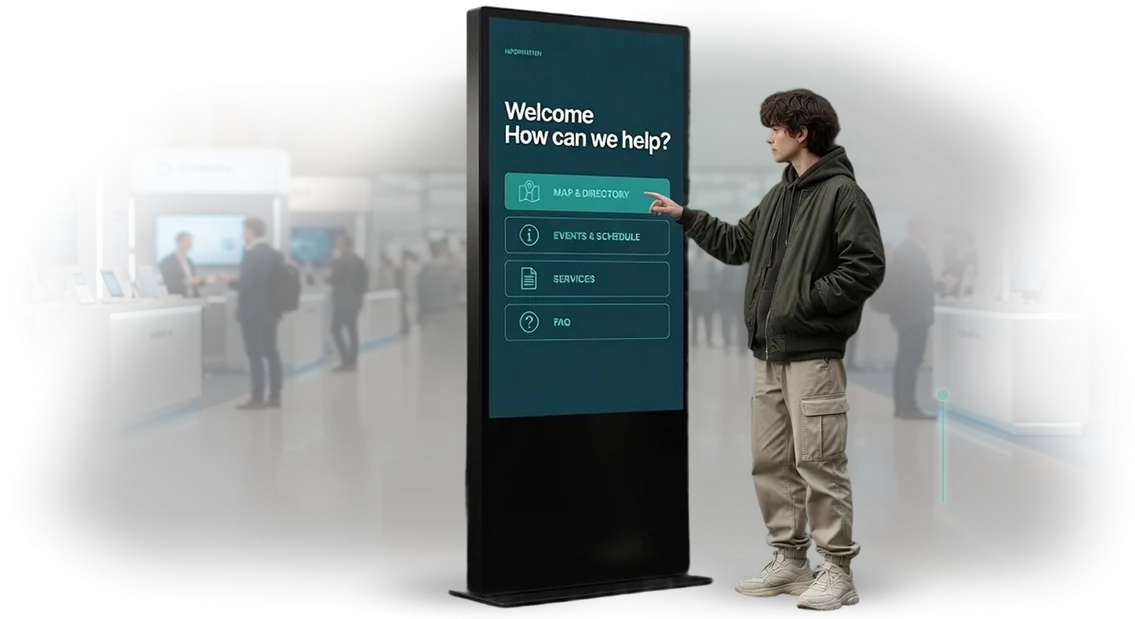
Interactive museum kiosk: why visitors walk past
A visitor walks through the hall, pauses at a display case for a few seconds, and moves on.
A familiar scenario in many museums: the exhibition is assembled, but visitors' attention scatters — the information on placards is overloaded, and static exhibits don't inspire anyone to linger.
As a result, the museum exhibition loses its most important resource: the genuine interest of visitors.
The problem turns into measurable losses: guests spend less time, remember less of the content, and return with friends less often. For the museum, this means lower attendance, a weaker flow of repeat visits, and less recognition.
The modern guest is used to interactivity — they expect a dialogue, not one-way viewing. Tour guides can't answer everyone, and paper labels don't explain the context.
This is exactly where interactive technologies in museums are needed: they turn passive viewing into active exploration. An interactive museum kiosk helps guests choose their own route, dive into the details of exhibits, and get answers to their questions. Visitor engagement grows naturally — through curiosity and play, not through force.
We've been developing such solutions for over ten years and know how to integrate them into an exhibition carefully and effectively. Our interactive kiosks deliver measurable results: longer average dwell time, more positive reviews, and eager recommendations.
The museum gets a digital companion that works toward its goals — from educational programs to increasing revenue from additional services.
Five measurable improvements after introducing a digital assistant
First, the museum gets measurable attendance growth: the digital assistant holds visitors' attention one and a half to two times longer, and engaging scenarios encourage photos and social media posts. This brings in new guests without additional advertising costs.
Second, the exhibition becomes memorable. Guests remember not only rare objects but also the stories connected to them.
The digital guide reveals each exhibit in greater depth than a regular label, and after the visit, guests walk away with a complete impression of the collection.
Third, the digital guide takes over routine questions and part of the tour workload. A single assistant serves several visitors at once, answers frequently asked questions at any time, and frees up staff for signature tours and guest care. This lowers the cost of guided tours and improves their quality.
The fourth improvement is audience behavior data. The museum sees which spots attract more attention, which themes strike a chord, and which ones don't work.
Based on this data, it's easier to refresh exhibitions and plan new projects informed by real interest rather than assumptions.
Finally, fifth, the digital assistant pays for itself within the first months and then works like a permanent employee without vacations or days off.
In the end, the museum gets measurable growth in engagement, repeat visits, and reputation — and the digital guide becomes a center of attraction that sets your museum apart from the rest.
Multimedia kiosk formats for museums and exhibitions
A museum visitor decides in the first minutes where to go and what to see. Paper maps overload attention, and lines at the ticket desk take time away from exhibits. An interactive kiosk turns the entrance into a guiding moment and makes the exhibition a living story.
A modern interactive museum kiosk comes in many forms: from a compact touchscreen terminal at the entrance to a large multimedia panel in the hall. The choice of format determines the guest scenario — quick reference, deep immersion, or shared play. Below are the typical configurations and who they suit.
| Format | Who it's for | What it gives the client |
|---|---|---|
| Touchscreen kiosk | Entrance, ticket desks, lobby | Quick navigation and ticket sales, less strain on staff |
| Multimedia terminal | Permanent exhibitions, large exhibits | Video and audio guide, deeper story — guests stay longer |
| Interactive panel | Temporary exhibitions, education | Flexible content: easy to update for a new exhibition |
| Touch table | Children's zones, team activities | Play and shared discovery — visitors return more willingly |
Which format should you choose as a foundation? It depends on the size of the halls, the collection, and visitor flow.
Our engineers help with the choice at the brief stage: we analyze the zones, contact points, and visitor movement patterns, then offer a solution that fits the budget and is easy to develop together with the museum.
This way, the kiosk becomes an independent element of the exhibition and boosts interest in the collection.
How the project progresses: from brief to launch and support
The development stages of an interactive museum kiosk are structured as a transparent process: you always understand what happens at each step, what result you get, and what it costs. No "black boxes" — only agreed-on stages, clear reports, and checkpoints.
- We run a kiosk brief: we discuss the museum's goals, visitor profile, installation location, and expectations for the project. You tell us about your exhibition, and we propose usage scenarios and preliminary timelines.
- We agree on the concept: screen structure, navigation, visual style, and content. We lock in the cost estimate and schedule so the project launch is predictable in both money and time.
- We design the interface and content: we develop scenario logic, adapt texts for different age groups, and work out how a visitor can quickly find what they need.
- We build and test the kiosk: we assemble the software side, configure the equipment, and verify resistance to long-term failure-free operation, ease of control, and clarity for guests.
- We launch the project: we install the kiosk in the museum, adapt it to the conditions of your space, train the staff, and test performance with real visitors.
- We hand the kiosk over for operation and stay on for support: updating content, monitoring stability, and refining scenarios based on usage statistics.
At each stage, you get a clear deliverable: from a navigation diagram to a working kiosk. This lets you control the budget and timeline, and the final launch goes off without surprises.
What's included in the ready-made solution for your exhibition
When you order an interactive museum kiosk, you get not a "box with a screen" but a complete visitor touchpoint. We handle the entire journey: from gathering materials to the moment the first guest touches the screen.
You don't need to hire additional contractors or figure out technical details — everything is already configured and tested.
The final package includes:
- Content preparation for the exhibition: adapting texts, selecting images and videos, and creating a clear navigation structure for halls and exhibits.
- Museum-style design and interface: screen design aligned with the corporate identity, visitor age groups, and the lighting conditions of the hall.
- Hardware installation and connection: placing the kiosk at the right spot in the exhibition, concealed cabling, and protection from dust and rough handling.
- Software content: a content management system that lets your staff update exhibition announcements, opening hours, and exhibit descriptions themselves.
- Commissioning: testing all scenarios — from startup on opening day to kiosk behavior during peak traffic hours.
- Staff training: a short session for attendants and administrators on how to power the kiosk on, restart it, and replace materials without calling an engineer.
- Instructions and warranty: a clear operation manual and technical support from our team after launch.
After project handover, the museum gets a self-sufficient tool: staff can change the content, add new highlights to the exhibition, and track touch statistics.
This is not a one-time delivery but a solution that works toward your results — and we stay in touch to quickly resolve any issue without stopping the kiosk.
Case study: exhibit hall attendance growth after implementing the solution
For the City History Museum, the key problem was the modern exhibition hall: visitors walked through it in a couple of minutes without stopping at the displays.
Management saw that the exhibits' potential wasn't being realized and that guests' interest was drifting to other venues. We suggested not changing the exhibition but adding an interactive kiosk that turns viewing into a lively dialogue with history.
What changed after launch
The kiosk was placed in the center of the hall and filled with scenarios that visitors choose themselves: "how the city lived a hundred years ago," "find your house on the old map," "what the museum archives hide." Guests started coming up in families, debating facts, taking photos in front of the screen, and sharing their discoveries on social media. That was exactly the goal — not just to show information but to draw the audience into the process.
The numbers the client saw
In the first two months, hall attendance grew by 45% — while the museum's overall visitor flow remained almost unchanged. The average dwell time in the hall increased from 4 to 17 minutes, and the number of visitors who returned to the hall a second time during the day tripled.
The museum director noted that guests now bring friends and relatives themselves to show them "that screen by the entrance."
The economic effect was also measurable: thanks to growing interest in temporary exhibitions, the museum increased ticket and souvenir sales by 12% in the first quarter alone.
For us, this confirms a simple rule: when an information kiosk responds to people's real interests, it stops being "technology in the corner" and becomes part of the museum experience.
Since then, the client has recommended our solution to two other venues, and we use this experience as a foundation for cultural-sector projects.
Frequently asked questions about deployment and maintenance
Before deploying an interactive museum kiosk, clients ask the same questions: timelines, warranty, maintenance. We answer the key ones — so you can picture the process before signing the contract and avoid unpleasant surprises.
The questions below are the most common, and the answers are based on real museum projects. If you don't find yours — write to us and we'll clarify the details personally.
How long does kiosk deployment take?
A standard project takes 2-4 weeks. This includes structure approval, interface development, testing, and installation. The timeline is fixed in the contract and doesn't change during the process.
What warranty covers the kiosk and software?
We provide a 12-month warranty on all hardware and software. In case of a failure, we resolve the issue remotely or with an engineer visit at no cost to you.
What's included in the price?
The base price covers design, development, delivery of the kiosk with its enclosure, installation, and museum staff training. Custom design, content, and integrations are paid for separately.
How is the kiosk maintained after launch?
We offer a regular service agreement: performance monitoring, content updates, and preventive maintenance. This keeps the kiosk running smoothly without downtime.
What happens if the kiosk breaks down?
You contact us — most issues are resolved remotely. If needed, an engineer will visit the site, and we'll provide a replacement kiosk while repairs are underway.
Still have questions? Write to us — we'll prepare an estimate tailored to your goals and timeline.How to choose the device format for your project's specifics?
There's no single "right" format for an interactive museum kiosk — there's a format that fits your specific project. One museum needs a floor-standing station for school groups; another needs a compact wall-mounted solution next to an exhibit.
The selection starts with questions: how visitors move through the hall, how many people access information at the same time, and what content you plan to show.
Equipment selection is a compromise between exhibition goals, space, and budget. We account for mounting height, lighting, visitor flow, and interior design. Vandal-resistant enclosures work well for high-traffic halls, while thin wall-mounted panels suit intimate exhibitions.
Specific requirements often come up: accessibility for people with disabilities, protection from damage, and quick content replacement. These details determine whether the kiosk will still be convenient after a year of operation.
Our engineers regularly work on museum and exhibition projects and anticipate such scenarios in advance.
An individual solution at the scenario level also matters.
We put together the "enclosure + screen + software" combination that reflects the exhibition logic: a sequential story about an object, free search through the collection, a quiz for children, or a multimedia guide.
The visitor gets an intuitive interface, and the museum gets a tool that easily integrates into tours.
In short: we help you navigate kiosk selection, suggest options for your objectives, and show how each one will behave in your specific hall. This saves you from rework after installation and ensures the equipment works for the museum.
Order development and get a turnkey project
When a museum orders a turnkey project, it gets not just a device but a complete solution that works from the first day after installation. We handle all stages — from preliminary analysis and concept to launch and ongoing support.
You won't need to deal with the technology or coordinate multiple contractors: all the work happens within a single team.
What a turnkey project includes:
- Consultation and audit. We start by discussing your goals: whether the kiosk is for navigation, education, or guest entertainment. We study the specifics of the exhibition and visitor flow to choose the right scenario.
- Design concept and interface. We create a clear screen that fits harmoniously into the museum space. We account for the audience's age and the exhibition's style.
- Content filling. We write texts, select images and videos, and develop virtual tours and routes. Content is easy to update when the exhibition changes.
- Equipment and installation. We select reliable touchscreen panels suited to your museum's workload. We install everything on site, configure it, and test the operation.
- Staff training. We provide a short briefing: how to start the kiosk, assist a guest, and replace materials. Your team will get up to speed quickly.
- Warranty and support. We answer questions, monitor stable operation, and update the system on time. You can always reach out to us.
- Transparent plan and timeline. We agree on the stages and set dates in the contract. You know exactly when the project will be ready and what will be done.
- Analytics collection. The kiosk can track exhibit popularity and guest interest — this helps develop the exhibition based on data.
We've already completed dozens of projects for museums and galleries — from small local history museums to large venues with millions of visitors. This experience lets us avoid typical mistakes, deliver work exactly on time, and not spend your budget on experiments. You don't need to look for specialists separately: one team covers all your tasks.
Ordering an interactive museum kiosk means entrusting the creation of a complex system to experienced professionals and being confident in the result.
Submit a consultation request: we'll get back to you within one business day, answer your questions, and propose a solution tailored to your exhibition and budget. Click the button — and we'll start discussing your project.