

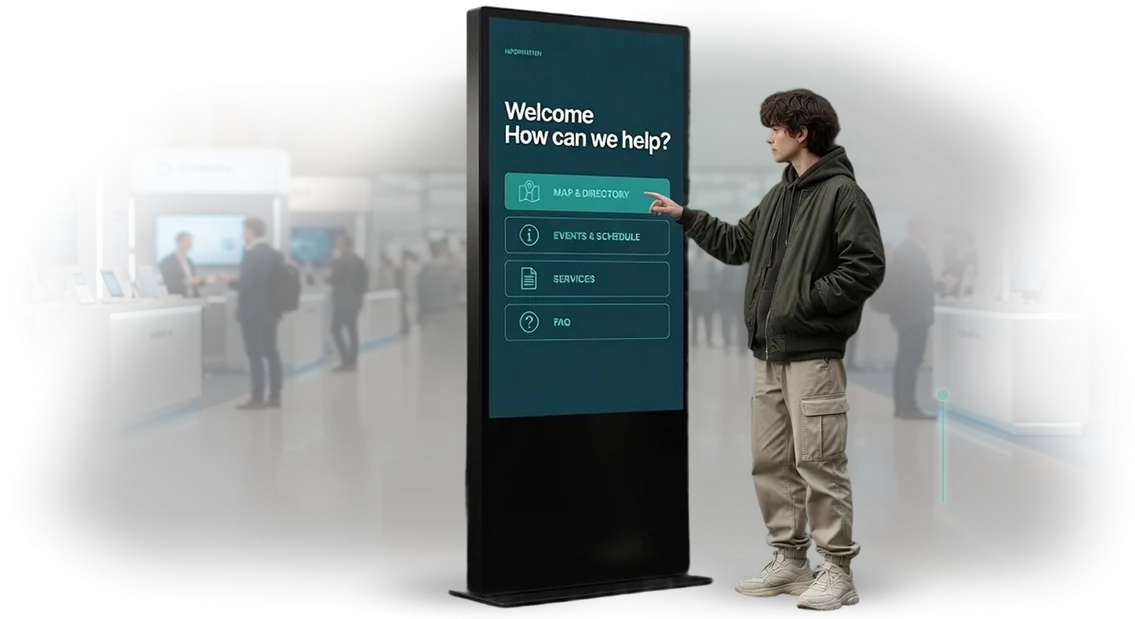
An Interactive Table for a Museum: How to Stop Falling Attendance
The modern visitor comes to a museum for an impression, but often gets only display cases with labels.
After fifteen minutes, they have already lost interest, quicken their pace, and leave with a feeling of “been there, seen that.” The exhibition itself remains the same — only guests’ expectations change.
The decline in attendance begins imperceptibly: first the time spent at the museum shrinks, then ticket sales drop, and soon word of mouth disappears.
The museum stops being a place people want to return to, and loses ground to parks, quest rooms, and shopping malls, where visitors again feel like participants in events rather than outside observers.
An interactive table for a museum brings back that engagement. Instead of “look and read,” the guest gets action: they themselves uncover layers of history, compare exhibits, search for answers, and see the result of their choices.
People linger at the object several times longer, remember the emotion, and talk about it after the visit — exactly what turns a one-time visit into lasting interest in the museum.
We have already helped museums solve the problem of outdated exhibitions by turning stands and display cases into lively interactive solutions for the museum.
Our engineers select equipment and interfaces to match the specific venue, and the museum gets not just technology but a working tool for increasing attendance and guest loyalty.
What the Museum Gets from Interactive Technologies
Growth of Visitor Interest
An interactive table turns exploring museum collections into a lively dialogue. Visitors choose what to look at: they open rare exhibits, browse historical documents, compare eras, and read the stories behind the objects.
This approach holds attention several times longer than a static display case — guests stop skimming and begin to truly study the exhibition.
Longer Visit Time
When visitors can control the process themselves, they stay at an exhibit for minutes instead of seconds. The average time spent in the museum grows by 30–50%, while the average spend at the café and gift shop also rises.
This benefits the museum: the same floor space and staff generate more revenue, and the flow through the halls becomes more balanced.
Repeat Visits and Museum Recognition
An unusual interactive experience is easy to remember and makes people want to share it. Visitors photograph the screens, post the images on social media, and tell their friends — the museum receives free exposure and attracts new guests.
Over time, the interactive zone becomes the space’s calling card: people return to see updated scenarios and show them to friends.
Benefits of Interactivity for the Museum
An interactive table solves several tasks at once: it removes barriers to understanding complex topics, gives guests a sense of participation, and frees staff from repetitive explanations.
By adapting materials for different audiences — from schoolchildren to foreign tourists — the museum broadens its audience and remains in demand even on weekdays.
Formats for Engaging Visitors with the Exhibition
A visitor walks through a hall in 10–15 seconds if an exhibit simply lies in a display case. An interactive table holds attention 5–10 times longer — the guest begins to interact with the object, examine details, and get drawn into the exhibit’s story.
The right format should solve a specific task: show volume, tell the story of a discovery, or turn learning into a game.
Below are the typical formats we select according to the museum’s logic and audience behavior.
| Format | For whom and for what task | What it gives the visitor |
|---|---|---|
| Interactive table | Halls with group tours, families with children | Collaborative exploration of maps, artifacts, and timelines; several visitors interact simultaneously |
| Touch kiosk | Individual visitors, targeted navigation and information | Fast access to exhibit descriptions, routes, and additional materials in a few touches |
| Wall or exhibit projection | Large halls, atmospheric zones, event reconstructions | Immersion in the atmosphere of the era without physical contact; visually expands the space |
| Interactive display case | Valuable and rare exhibits that cannot be touched | “Virtual touch”: rotating the object, zooming into details, exploring the internal structure |
Each format covers its own task for the hall. If you need to hold children’s attention, we choose game scenarios on an interactive table. If an exhibit requires care but also contact, we install a projection or a display case.
That is why we do not “sell one kiosk” — we select a composition of formats to fit the entire exhibition route.
As a result, every hall “works” for the visitor in its own way, and the overall route becomes coherent and memorable.
In addition, all technology is combined into a single system: our team configures scenarios and controls so museum staff can easily change content without programmers.
How the Project Goes: From Idea to Launch
We understand that for a museum, an interactive table is not just technology but a way to hold visitor attention and make the exhibition alive. So the process is structured so you can see at every stage what you are getting and what it costs — without “black boxes” or surprises.
- Brief and immersion. We briefly study your exhibition, audience, and goals. One meeting is enough to understand what content will interest your particular guests.
- Concept and scenario. We propose a structure: which objects to show, the navigation logic, how the visitor will interact. You receive a clear document, not a technical description.
- Approval. We lock in timelines, scope of work, and cost. Changes are made before launch, when it is easy and quick — without extra invoices at every step.
- Production and installation. We build the table, place the equipment in the hall, and adjust it to the lighting and layout. We check everything on site so nothing obstructs the flow of visitors.
- Launch and training. We run test operations, configure content, and teach your staff to launch interactivity, change materials, and resolve simple issues.
- Ongoing support. After launch, we stay in touch: refresh content, add new exhibits, and monitor stable operation. You focus on the exhibition, not the technology.
What Is Included in Delivery and Support
An interactive table for a museum needs to work every day and not distract staff from their main job. We take on the whole cycle: delivering the interactive equipment, installing it, filling it with content, and supporting it. After that, you get a working exhibit and a team that quickly resolves any issues.
- Delivery and installation — we bring, mount, and configure the interface to suit the hall’s features and lighting. You get a ready-made attraction point for visitors on opening day.
- Content management — we adapt museum materials to the table format: texts, videos, interactive models. When the exhibition is updated, we upload new materials without downtime.
- Staff training — we conduct training for attendants and administrators: how to start a tour, switch modes, and handle minor issues on site. We record the training and leave a reference guide for new employees.
- Warranty and service — official warranty on equipment, scheduled checks, and repairs according to a clear procedure. We minimize table downtime so visitor interest is not lost.
- Content support — we update the exhibition as new exhibits arrive, adding descriptions and scenarios. Just send the materials — and they appear in the kiosk.
- Technical support — a hotline for staff, remote diagnostics, and on-site engineer visits when needed. We keep the average response time within one working day.
- Visitor analytics — we collect anonymized data on the number of sessions and interaction time. These figures show which exhibits attract more interest and how to improve the flow through the hall.
Case Study: Engagement Growth After Implementation
For the Museum of City History, we built an interactive table that completely changed visitor behavior. Previously, guests lingered at display cases for 30–40 seconds and left; after implementation, the average time at the exhibit grew to 3–4 minutes.
People began interacting with maps, archival photos, and tasks — the exhibition ceased to be “glass you look at.”
Within a month, the museum noticed a rise in engagement: repeat visits increased by a third, and on weekends a queue constantly gathered around the table.
During peak hours, more than 80 people tried it over two hours — even though almost no one previously stopped at these same display cases.
Result for the Museum
- Contact time with the exhibition grew 4 times.
- The share of repeat visits rose by 30% in the first quarter.
- Staff received simple statistics: which scenarios are more popular, where guests linger longer, and what raises questions.
The interactive table paid for itself through higher ticket sales and the new children’s workshop format. Six months later, the museum ordered a second table for the children’s hall — the best sign that the first project delivered real value, not just adorned the lobby.
How to Choose the Right Format for Your Exhibition’s Task?
Choosing an interactive format starts not with technology but with a question: what should the visitor do — get information, examine a detailed 3D model, play with children, or leave an impression on the group?
The answer determines whether it will be a vertical panel at the entrance, a horizontal table, or a full multimedia zone. Getting this right matters: a poor format turns an expensive exhibition into an empty corner that guests walk past.
The key criterion is audience behavior. An interactive table for a museum is ideal for collaborative study: 3–6 people gather around it, discuss, browse a map, or compare exhibits. A vertical kiosk works better for quick individual navigation or queues at the entrance.
Take a sober look at your hall: is there a place where a group can stand for 5–10 minutes without blocking the main route? If space is limited and flow is high, choose compact solutions; if there is a spacious area, a table will become the center of attraction.
The budget dictates not the “fanciness” of the technology but the depth of content. A large multi-touch screen with high-quality graphics makes sense when the exhibition is designed for repeat visits and longer engagement. More mobile structures are better for quickly changing exhibitions.
Our engineers tailor the configuration to the hall’s size and exhibition materials, and we tailor it to your budget: we help you see where a simple solution is enough and where it is worth investing in a large-scale installation.
The main thing is not to pick a format by eye but to base it on your guests’ behavior. Send us a floor plan and an audience description — during the consultation we will offer 2–3 suitable options with an estimate of cost and outcome. You will receive not an abstract catalog but a concrete solution for your exhibition.
Frequently Asked Questions About Development and Implementation
The fear of implementing an interactive table is usually connected not with technology but with uncertainty: will we make it in time for the exhibition opening, what happens if something breaks, how often will we need to change content, and will the project “hang” after a year.
Let’s cover the most common questions — honestly and based on experience from a dozen museum projects.
What are the real development and implementation timelines?
A standard project takes 2 to 4 weeks from the moment mockups and scenarios are approved. This includes assembly, software setup, installation, and on-site testing.
If you need a custom housing or complex integration with an existing system, the timeline increases, but we lock it in the contract and take responsibility for delays.
For urgent openings, we have an accelerated format: a basic solution on standard equipment can be launched in 7–10 days. Quality and stability do not suffer — only the time for individual design refinements is reduced.
What happens if the equipment breaks down? Do you offer a warranty?
We provide a warranty on all equipment and work — from 12 to 24 months depending on the components. During this period, we will replace faulty parts or the table itself if repair is not possible. We respond within 1–2 business days: we come, diagnose, and fix the problem.
Importantly, we use industrial components designed for round-the-clock operation in public spaces. That is why breakdowns are rare, and “freezes” are resolved by an automatic system restart outside working hours.
How often and how difficult is it to update content on the table?
Updating content does not require a programmer. A museum administrator can change texts, images, videos, and 3D models through a simple admin panel. Replacing an exhibit or adding a description takes 5–10 minutes, not a week.
We set up scheduled auto-updates: content loads from your server or cloud storage. This is convenient if the museum has several tables — changes apply to all of them immediately. A built-in versioning system lets you roll back to the previous state if something goes wrong.
What are the project risks and what about compatibility with other equipment?
The main risks are external: power outages, mechanical impact from visitors, content becoming outdated.
We cover these with an impact-resistant housing, a built-in uninterruptible power supply, and a modular architecture that allows components to be replaced without changing the whole table.
Compatibility is built in at the API level and through open data formats. The table connects easily to museum systems — ticketing, audio guides, smart building platforms.
If you later want to add new functions, such as a touch panel for multiplayer games, you will not have to redo the project from scratch.
If you have any remaining questions, ask us directly, and we will prepare a custom timeline and cost estimate for your museum.Book a Consultation
Tell us about your museum’s goals — and we will prepare an interactive solution estimate for your exhibition, budget, and visitor flows.
At the consultation, you will receive not general words but concrete implementation options: what to install, which format to choose, and how it will affect guest engagement.
A consultation is a working step toward the project, not an obligation. We will review your case, show examples from museum practice, and propose a solution that pays off through visitor interest.
What you get from the consultation:
- An estimate of the cost of developing interactivity for your museum — from a turnkey format to phased launch.
- Scenario recommendations: what suits your audience best — game mechanics, educational stories, or a combined format.
- Timeline assessment: when the interactive can go live and how long each stage will take.
- Integration options with the exhibition — how the table will fit into your existing hall without creating queues.
- A content plan: who prepares the materials and what volume is needed for launch.
- Answers to questions about support and updates — the interactive must run smoothly and without failures during peak hours.
The consultation lasts 30–40 minutes and takes place online or at your venue. It is non-binding — you get an expert assessment and can confidently compare us with other contractors.
Leave a request — and we will prepare an interactive solution estimate specifically for your museum. We will start with a short conversation about your goals and visitors, and then show you how to make the exhibition memorable.