

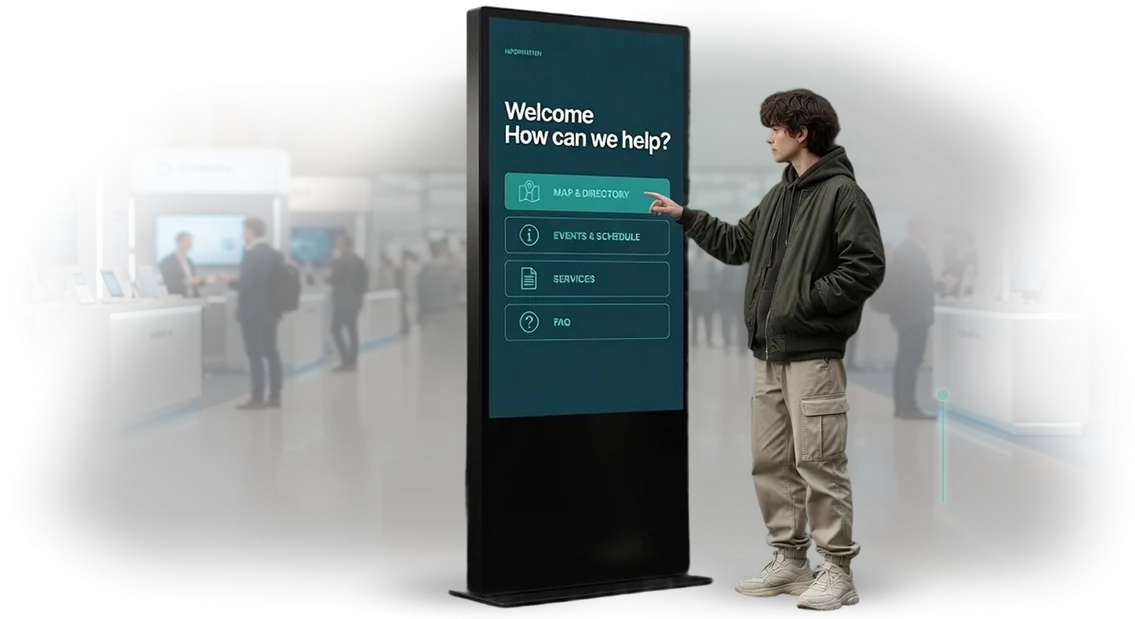
Customers Are Defecting to Competitors with Embedded Linux Kiosks
Your customers are used to the speed and convenience of their phones, while outdated kiosks with sluggish interfaces and monotonous menus only cause irritation.
Such service doesn't just disappoint — it pushes visitors to look for alternatives: switching to a competitor's website, using another brand's mobile app, or simply leaving without a purchase.
A terminal on Embedded Linux is a modern platform for interactive kiosks that lets you update logic and design without replacing hardware. But if your kiosk runs on outdated internals, every interaction becomes a test of customer patience.
Surveys show that more than half of shoppers don't return to a location where they had to wait a long time for the terminal to respond or struggle through confusing prompts.
Outdated kiosks silently eat away at your revenue: they don't remember customers, don't suggest complementary products, and don't collect data for repeat sales. Competitors who have already upgraded their kiosks get more orders from the same foot traffic. Simply because their interface is clear and service times are dramatically shorter.
We close the gap: we design and implement interactive kiosks on Embedded Linux for your tasks — from catalogs to navigation. The result is fast response, vibrant design, and an interface that guides visitors to the right action instead of scaring them off. Guests stay with you, and repeat visits become the norm.
Benefits of a Modern Interactive Kiosk
A modern interactive kiosk is not just a screen with a menu — it's a full-fledged customer communication channel. It works without breaks, takes over some staff functions, and makes brand interaction fast and intuitive.
For business, it's both a branding tool and a way to hold shopper attention at the moment of decision.
Attention is the first step to a sale. A bright touchscreen catches the eye and makes a guest linger for a few minutes. During that time, they can browse the assortment, see promotions, and build an order.
This engagement format is remembered better than ordinary advertising: the person takes part in the process themselves, so they trust the brand more.
The kiosk directly affects the average check. The interactive catalog suggests complementary products, new arrivals, and attractive offers right when the customer is choosing their main purchase. It works like an experienced consultant who never forgets to offer an extra service. As a result, every purchase becomes a little bigger — without expanding the sales team.
Convenience and personalization build loyalty. The kiosk remembers the preferences of regular visitors, recommends products based on past orders, and speeds up service. The customer doesn't need to stand in line — a couple of screen touches is enough.
It's exactly this kind of experience that makes people want to come back, so the share of repeat visits and overall brand recognition grow.
For a kiosk to deliver value every day, a stable technical foundation is important. Our team use a well-tuned platform based on Embedded Linux — it ensures instant interface response and protection against failures even during peak hours.
You get a solution that won't let you down on the most demanding day: no freezes, no data loss. All you need to do is monitor content and analytics — the smart assistant takes care of everything else.
Kiosk Formats on Embedded Linux for Different Tasks
The kiosk format is not a design question, but a decision that determines how visitors will use your content. Wall-mounted or floor-standing construction, vertical or horizontal screen, mounting method — every detail either strengthens the scenario or works against it. We've put together the main formats and their tasks so you can more easily choose the right option.
| Kiosk format | Best for | What it gives the customer |
|---|---|---|
| Wall-mounted kiosk | Reference information, mall navigation, product catalog, appointment booking | Saves space, highly visible, convenient for quick requests. Visitors find the information they need on their own, without waiting for a consultant. |
| Floor-standing terminal | Waiting areas, museums, exhibitions, high-traffic locations | Attracts attention with a large screen and full-height body. Handles high loads and enables impressive scenarios: photos, video, animation, interactive quizzes. |
| Exhibition kiosk | Company presentation, product showcase, collecting contacts and leads | Makes your booth stand out from the neighbors, helps tell the key story in 2–3 minutes, and collects leads with QR codes and visitor contacts. |
| Store kiosk | Product availability check, extended descriptions, self-service ordering, online payment | Increases the average check and relieves staff. The customer gets complete information without a queue and doesn't leave due to misunderstanding. |
All formats run on the same stable Embedded Linux platform, so the kiosk works without freezes or reboots even under round-the-clock load. This is critical when the terminal is the face of your brand and revenue or visitor impressions depend on it.
Whichever format you choose, we adapt the construction, interface, and logic to your task. We'll advise what works best for a specific location and make sure the kiosk informs, sells, and stays memorable.
How Kiosk Development Works: From Brief to Launch
A transparent process means you understand at every step what's happening and how long the project will take. We've divided kiosk development into six stages — from brief to launch. You always know which stage the work is at, what's already done, and what still needs approval.
- Brief and task audit. We hop on a call or meet in person to discuss where the kiosk will be located, who its main audience is, and what tasks it should solve. We record expectations on timelines and scope of work.
- Technical specification approval. Based on the brief, we prepare the spec: screens, behavior scenarios, integrations with your systems. You see the document before development starts and approve it — this is the foundation that protects against unexpected revisions and unnecessary costs.
- Interface and logic design. We map out user scenarios: how a visitor will interact with the screen, which sections they'll see, and how quickly they'll find what they need. We approve the mockups before the first line of code is written.
- Terminal application development. We build the application itself: we work on professional hardware and proven tools so the kiosk runs stably without freezes. You get intermediate builds for review and feedback.
- Terminal testing. We test on a real device: touches, response speed, content updates, behavior in abnormal situations. We fix all issues before installation, not after user complaints.
- Launch and support. We deliver, install, configure, and train your team. After launch, we stay in touch: we update information, refine features, and monitor that the kiosk runs without interruptions.
This sequence eliminates surprises: you don't pay for "sudden" extra work, and we don't guess what you really need. In the end, you get a working kiosk within the agreed timeframe — and a full understanding of how it works.
What's Included in the Delivery: A Package for a Confident Start
You don't just get a kiosk with installed software — you get a fully ready-to-work solution. We've put together the package so that launch happens in one day, without crunches or involving developers. Below is the full scope of delivery, so you know exactly what you're paying for.
- Delivery of the kiosk itself — a device with a touchscreen, selected for your space and tasks: from a floor-standing unit to a wall-mounted version. The optimal configuration is discussed at the brief stage.
- Software license — no time limits or limits on the number of updates. You pay once instead of renewing a subscription monthly.
- Installation and content setup — we'll load the menu, catalog, interactive maps, or questionnaires and verify content updates. By handover, all that's needed is to press the power button.
- Staff training — a short briefing for your employees and instructions in plain language. An intern can administer the kiosk: change banners and prices without calling developers.
- Hardware warranty — from 12 months. During this period, we'll replace the unit or components if a manufacturing defect occurs.
- Technical support — by phone, email, or messenger, with responses during business hours. We diagnose remotely and, if needed, visit the site.
- Training materials — videos and instructions on changing content and working with session reports. Useful when new employees join.
All package elements are included in the cost — no hidden payments like "pay extra for the license" or "setup not included." After signing the acceptance certificate, you get a working service, not a half-finished product. All that remains is to plug it in — then the kiosk starts driving revenue and visitor loyalty.
Case Study: Interactive Map for a Shopping Mall
Shopping mall visitors are real people who want to quickly find the right store and not waste time wandering the floors. If a guest can't find their bearings in a couple of minutes, they get irritated and often leave without buying.
Paper signs and maps at the entrance no longer work: they go out of date, tear, and don't show current promotions.
We suggested replacing them with interactive kiosks featuring a mall map. A person taps the store or category they need on the screen — the system builds the shortest route, shows travel time, and offers tenants' promotions along the way.
For the visitor, it's convenience and time savings; for the owner, it's a tool for managing guest flows.
Results of Implementation
At the Galereya shopping mall, we measured real results after launching the interactive map. Visitor dwell time increased by 27%, and visits to the upper floors — by 18%.
The number of inquiries at the info desk dropped nearly by half, because guests started finding answers on their own. The map also became a sales channel: every fourth user clicked through to tenants' promotions.
These figures aren't the "average temperature in the hospital" — they're data from the kiosks themselves and traffic analytics. This interactive map increased foot traffic to the mall, raised satisfaction, and brought tenants additional visitors. Two months later, the center ordered an expansion of the system to new zones.
Such a map pays off not only through future rent growth. It provides a measurable increase in reach and conversion for all residents. If visitors get lost in your shopping mall and tenants complain about empty upper levels — this is the exact case worth replicating.
How to Choose an Interactive Kiosk Format for Your Tasks?
Choosing an interactive kiosk format starts not with the screen and enclosure, but with a question: what task will it solve in your business? One thing is an information stand in a lobby, where a guest finds the right office in 30 seconds.
Another is an appointment terminal with payment acceptance and confirmation output. A third is an entertainment zone at an event that holds attention. Each task requires its own enclosure, screen size, and interface scenario.
Then we look at the specifics of the business: where the kiosk will stand, who uses it — employees, customers, or random visitors — and how often information is updated.
For a busy location, fast response and protection against freezes matter; for a 24/7 terminal — stability and remote management; for events — mobility and quick setup. A mistake at this stage translates into lost customers and downtime.
We work on the Embedded Linux platform — this ensures predictable, failure-free operation even under continuous use. Such a solution is easily adapted to non-standard scenarios: custom screen sizes, specific output formats, integration with your accounting systems. For you, this means fewer delays for customers and minimal maintenance costs.
So the right path is not to choose a kiosk from a catalog, but to discuss the task first. We provide a kiosk consultation: we analyze requirements, recommend the optimal format, and, if necessary, design and manufacture it for the specifics of your business. You get a terminal that solves your task from day one and requires no rework.
Frequently Asked Questions About Kiosk Development and Support
Clients ask the same things: when the kiosk will be ready, whether it will fail on event day, and how to update content. An interactive terminal works in full view of visitors, so any failure hits the brand. We remove these doubts before the start.
our team builds kiosks on a well-tuned Embedded Linux platform and industrial components — hence realistic timelines, warranty, and support.
How long does development take and how much does it cost?
A typical project takes 4–6 weeks after mockup approval. The cost depends on the screen, enclosure, and scenario; we fix the exact estimate and deadlines in the contract.
How reliable is the kiosk and what about the warranty?
We use components with a safety margin, so the terminal works stably all day long. The hardware comes with an official warranty.
How does support and content updating work?
We update information remotely, monitor operation, and quickly fix issues. For the software part, we provide a maintenance schedule.
If you still have questions about a specific project — ask them at the brief. We'll explain how the kiosk fits into your operations and what results you'll get.Order Turnkey Interactive Kiosk Development
By ordering turnkey interactive kiosk development, you get a ready-made solution that can be installed and used immediately. We take on the entire cycle: from idea to launch and technical support.
All you have to do is accept the result and watch the terminal benefit customers and simplify staff work.
Submit a request for a cost estimate — and in response you'll get:
- Accurate cost and timelines for your task, without hidden fees or asterisks.
- Recommendations on hardware and software configuration based on your usage scenario.
- An interface design mockup that is clear for both your customers and staff.
- A prototype of the future system — you'll see how the kiosk works before development starts.
- A project roadmap with stages, timelines, and owners for each item.
- Warranty on hardware and software, plus after-sales support.
We have already implemented more than 60 interactive terminal projects for retail, museums, business centers, and government institutions.
The reliability and stability of every solution is ensured by a well-tuned platform based on Embedded Linux, but you don't need to understand technical details — we translate the task into the language of business results.
We work remotely across the country and beyond, so your location won't prevent you from getting quality development. Leave a request on the website or call us — within one business day we'll calculate the cost, answer questions, and offer the optimal solution for your task.