

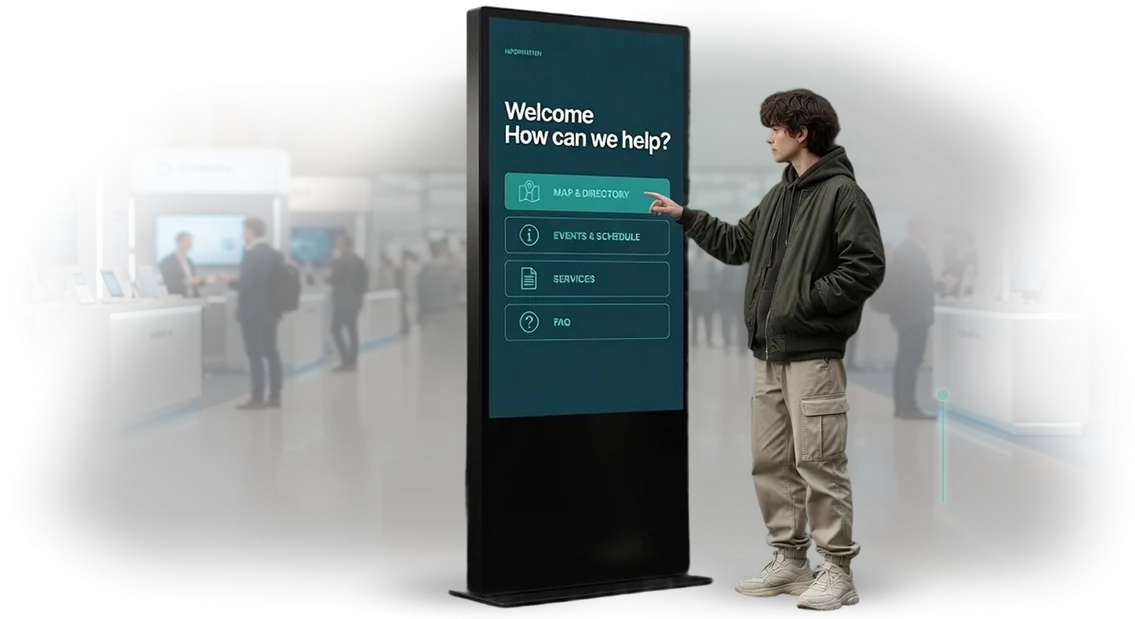
Real estate agency clients leave — the kiosk brings them back to the office
While a visitor waits for a manager, they get tired of a stack of paper brochures and flipping through a catalog at the counter.
After five minutes of waiting, attention wanders, and after ten — the person is already scrolling a feed on their smartphone, having forgotten why they came.
This is how an agency loses a client before the conversation even starts: interest fades, no contact is captured, the visit ends up being wasted.
An interactive kiosk for real estate solves this problem. The guest selects the district, budget, layout, and house type themselves — and within a minute gets a selection of suitable options on the screen, instead of from a "let's see what comes to mind" conversation.
A touchscreen kiosk in the agency turns waiting time into engagement: the person browses listings, compares photos and prices, saves favorites. By the time they talk to the realtor, they have already made half the decision and are ready to act.
Losing clients at the office is not about bad managers, but about an outdated way of presenting information. The screen shows properties the way modern buyers are used to perceiving them: visually, quickly, without pressure.
The agency stops looking like an office full of papers and starts being perceived as a tech-savvy partner where everything is transparent and convenient.
The key point — the kiosk works during peak hours when managers are busy and doesn't require their involvement for the initial consultation. A visitor doesn't walk out after ten minutes of waiting, because there is something to do and explore.
And the realtor gets a ready-made selection and the contact of a client already interested in specific options — instead of the "so, what would you like?" conversation.
We address this need: we design an interface that anyone can understand without training, customize it to the agency's catalog, and get the kiosk up and running quickly.
Implementation doesn't require restructuring business processes — just add a screen to the office, and it will start bringing back clients who previously left because of boring presentation.
What an interactive kiosk gives your agency
A real estate office visitor is a person with a request and doubts. Paper catalogs and a monitor with the website require manager assistance and quickly become boring.
An interactive kiosk turns exploring listings into a live presentation: the visitor browses the catalog themselves, compares districts, layouts, and photos — like in an app: easily and visually. They don't wait for an agent to become free but immediately dive into the offers.
The longer a buyer stays in the office, the higher the chance of converting interest into an inquiry. The kiosk holds attention: the person studies options, returns to the ones they liked, saves the selection.
The manager gets ready-made contacts and an understanding of the request, instead of spending half an hour explaining the basics. This means more engagement and less routine — the agent focuses on the deal, not on showing a screen.
The kiosk catalog is always up to date. Listings sync with your database, so sold apartments and outdated prices never appear on the screen — the typical pain point of standard signs and printouts.
The visitor sees an honest picture, and the agent is confident that every presentation starts with accurate information.
What's more, the kiosk works without days off: even when a manager is busy with other clients, the kiosk keeps presenting your listings and collecting inquiries.
A modern touchscreen kiosk builds trust in the agency even before a conversation with the realtor. The client perceives the company as tech-savvy and reliable, and exploring listings on their own creates a sense of comfort and choice without pressure.
This works for your image and leads to repeat inquiries, because the client remembers not just an office, but a place where they felt at ease and everything was clear.
Interactive kiosk formats for real estate agencies
At a real estate agency, every visitor expects a quick answer: what properties are available, where they are, how much they cost, how they differ. While the manager gets distracted by yet another repeated presentation, the potential buyer browses competitors' websites.
A touchscreen kiosk removes this burden — the client explores the database themselves, while the staff handles live negotiations and closing deals.
We offer several kiosk formats that fit into different work scenarios: from a quiet sales office to a busy exhibition or a high-footfall street. Below is a table to help you quickly choose the right option for your task.
| Format | Who it's for | What it gives the client |
|---|---|---|
| Sales office kiosk | Clients who have already come to the office, and managers who need to quickly present the property database | The visitor independently browses apartments, houses, and commercial spaces, filters by district, price, and area. Frees the manager from routine presentations — time for live negotiations and deals |
| Floor-standing kiosk | Real estate exhibitions, open house days, residential complex presentations | Attracts attention at the booth, works without staff involvement. In a couple of minutes the guest gets familiar with the project, layouts, and promotions — more interested contacts and fewer lost visitors |
| Showcase with listings | Office display window, high-footfall location, street (in a protected enclosure) | Works like a display window: catches passersby's attention, shows current listings and a phone number even outside working hours. Increases the flow of inquiries without additional advertising |
Each format uses the same interface and property database — you fill the catalog once, and then it syncs with all the kiosks. This simplifies updates and ensures that both in the office and at the exhibition, clients see equally current information.
How the kiosk launch goes from brief to installation
Launching a kiosk for a real estate agency is not a one-time purchase, but a well-structured process. We handle all stages: from the initial brief to installation and staff training.
You don't need to dig into technical details — you get a working tool within the agreed timeframe. A standard project takes 2–3 weeks, and at every stage you know exactly what is happening and what comes next.
- Brief and task analysis. You tell us about your goals: which properties to show, who your audience is, which features matter. We study your database and propose the optimal kiosk structure.
- Prototype and scenario. We create a screen map and navigation logic. You see how a visitor will search for an apartment, house, or commercial space, and make edits before the design starts.
- Design approval. We develop a visual style for your brand: colors, fonts, and styling for property cards. You approve the mockup — and we move on to development, with no surprises at the final stage.
- Development and content. We build the interactive interface, upload property information, and configure filters and search. You get a test version you can review on a computer or tablet.
- Testing and debugging. We check performance on the touchscreen: response speed, display accuracy, and usability for users of different ages. We fix any issues before installation, so everything works flawlessly on launch day.
- Installation and launch. We install the kiosk in your office or at the exhibition, configure the equipment, and train the staff. You get a fully ready tool that starts delivering value immediately.
- Support and updates. We update the property database, add new features, and help with technical questions. The kiosk runs reliably while you focus on sales.
What's included in the kiosk delivery and setup
When you order an interactive kiosk for a real estate agency, you get a turnkey solution — from hardware to launch. We handle configuration, content, and support, so your managers deal with clients rather than technology.
Everything you need is already in the package: all that's left is to turn on the kiosk and start presenting properties.
The standard package includes:
- Touchscreen kiosk with a protective enclosure — designed for continuous operation in an office, at an exhibition, or in a display window, withstands heavy use.
- Interface with a property catalog — apartments, houses, commercial spaces: filters by price, district, and area, layouts and photos in a couple of taps.
- Brand customization — logo, corporate colors, contacts, promotional offers. The kiosk looks like part of your office, not a third-party gadget.
- Property catalog updates — we agree on the frequency and update the database remotely. Clients always see current options, and managers don't waste time on manual entry.
- Staff training — a short hands-on session, after which employees confidently help visitors and use the kiosk in sales.
- Technical support and warranty service — we connect promptly to resolve any issue, and replace equipment if needed without long pauses.
All refinements and updates are performed remotely, so the kiosk stays current without a specialist visiting. You get not just a screen with information, but a tool that speeds up property presentations, increases visitor engagement, and relieves managers during peak hours.
Case study: a kiosk at a developer's office increased time spent with buyers
When a buyer comes to a developer's office, they have 10–15 minutes to get familiar with the project.
Regular brochures and models don't hold attention: eyes glide over layouts, the manager rushes to cover the essentials, and after leaving, the client remembers only a couple of options. As a result, there is interest, but inquiries aren't collected.
We solved this problem for Stolitsa Development, a residential neighborhood developer in Minsk. Instead of a stand with paper layouts, we installed an interactive kiosk with an apartment catalog, 3D floor plans, and option comparison. Results from the first month:
- Average time at the kiosk grew 3 times — from 1.5 to 4.5 minutes. The buyer studies layouts on their own instead of waiting for a manager to become free.
- 1,700+ apartment views — 5 times more than interactions with paper catalogs over the same period.
- 214 inquiries through the kiosk — every fifth became a meeting, and some sales proceeded without manager involvement at the selection stage.
The key thing the commercial director notes is that buyer behavior changed. Buyers stopped leaving after the standard tour; they start comparing options and getting involved in the process. Below is the developer's testimonial:
"Before, clients looked at two or three options and said 'we'll think about it.' With the kiosk, they study 10–15 layouts, shortlist the suitable ones themselves, and come to the manager with specific questions. For us, this means higher-quality inquiries and more deals."
For the business, this means direct benefits: higher conversion from visitor to inquiry, less load on managers, and clear analytics — which properties actually interest buyers.
The kiosk paid for itself within the first quarter, and the developer ordered a second unit for a new residential complex — this time at the sales launch stage.
How to choose a kiosk format for your office's specific needs?
Choosing an interactive kiosk format for a real estate agency depends not on screen size, but on how the flow of clients works in your office.
If visitors often come without an appointment and managers are busy with showings, the terminal should take on part of the work itself: introduce properties, collect contacts, and book viewings.
If the office is small and you greet clients personally, a compact reception counter that doesn't clutter the space is enough.
That's why before purchase we always clarify three parameters: office area and layout, number of daily visitors, and their typical inquiry scenario. Based on this data, we select a kiosk format that solves your problem, not just one that looks nice.
| Kiosk format | Who it suits | What it gives the office |
|---|---|---|
| Floor-standing touchscreen terminal | Large offices with high foot traffic, dedicated showrooms | Independently shows property selections, relieves managers, works as a display window even without staff involvement |
| Wall-mounted or tabletop kiosk | Small offices, reception areas, meeting rooms | Saves space, helps the client explore offers while waiting for a meeting, collects inquiries into CRM |
| Portable touchscreen stand | Off-site presentations, exhibitions, open showings | Flexibly used anywhere — from the office to city events, increases reach and brand awareness |
For real estate agencies, not only the enclosure shape matters, but also the interface logic: filters by district, price, and area, the ability to compare several options, and submit an inquiry right away.
We adapt the kiosk structure to your property database and managers' workflow — then the terminal becomes a full-fledged employee that answers typical questions and never gets tired by evening.
Come for a consultation: we'll tell you which format will fit your office and bring more qualified inquiries.
Common concerns when ordering a kiosk for real estate
Ordering a kiosk for real estate often raises questions not about functionality, but about reliability: "What if the equipment fails in the middle of a presentation?", "How often will we have to update the catalog?", "Will client data be lost?" These are normal concerns — behind the kiosk is not just a nice screen, but a working process. Here's how we address each of them at the launch stage.
What happens if the kiosk breaks down?
We provide a warranty on the equipment and on all completed work. In case of a breakdown, you'll get a replacement or repair in the shortest possible time, and during the repair — a replacement unit, so property presentations never stop.
We resolve most issues remotely — the kiosk is connected to the server, an engineer can see the system status and restart it or fix settings without a site visit. This means your display will keep working even on peak days.
How do we update listings in the catalog?
There's a simple control panel for this: the manager adds new photos, prices, and descriptions themselves, without a programmer. Changes appear on the kiosk immediately after publishing — visitors always see the current database.
If you already have a property management system, we'll set up automatic data exchange. Then the kiosk will pull current listings and hide sold apartments on its own. No manual actions — just a fresh display.
What if the internet goes down?
The kiosk keeps a local copy of the catalog, so even if the connection drops, visitors still see all listings and photos. When the network is restored, data updates automatically.
This is especially important if the kiosk is located in places with unstable connectivity — for example, at an exhibition or in a new residential complex. Your guests won't notice any interruptions, and the information will remain accurate.
How secure is client data?
We use a server architecture with access control: each employee sees only the sections they need for their work. Backups run automatically, so even an emergency won't lead to data loss.
Data that visitors leave in the kiosk is transmitted over a secure channel and never appears publicly. For you, this means peace of mind and trust from your clients.
Submit a request — we'll calculate a kiosk project for your office
In a real estate agency, every square meter should work for sales. But an information kiosk made "by template" often sits idle: guests don't understand how to use it, and managers don't receive inquiries. That's why we start with your tasks, not with hardware.
Submit a request for a kiosk — and we'll calculate a project tailored specifically to your office. Within 1–2 days we'll prepare a proposal: which installation format is more beneficial, which catalog sections you need, and how to integrate the kiosk into your managers' workflow. This is a consultation on kiosks with no obligations.
After reaching out, you'll receive:
- a project estimate based on office area and visitor flow;
- a format selection — floor-standing, wall-mounted, or office kiosk;
- a consultation on kiosks: what will speed up sales and what you can skip;
- a plan for catalog structure and content, so clients find the right properties themselves;
- fixed development and implementation timelines;
- a guarantee on the result and technical support after launch.
We are a team we work remotely and have been designing interactive solutions for business for over 10 years. During this time, we've learned to make kiosks that genuinely bring in inquiries and save managers' time.
Submit a request to discuss the details — we'll respond within one business day and propose a solution for your office.