

Why Cosmetology Clinics Lose Clients Before They Even Book an Appointment
A potential patient doesn't choose a clinic based on prices and service offerings alone. The first impression is formed before the visit itself: how easy it is to get an appointment, how quickly the administrator responds, how long the wait in the lobby is. It's at this stage that clinics lose people who are already ready to pay for a procedure.
Often the loss goes unnoticed: in the morning the phone line is busy, there's no reply in messengers, there's a queue at the reception desk. A person tries to book an appointment, doesn't get a result within a couple of minutes, and calmly walks over to a competitor.
Every such case is not just lost revenue, but also a reputational drawback: an unhappy patient will mention the inconvenience in a review.
The second systemic pain point is patient information. Visitors want to browse services, prices, specialist certifications, and promotions on their own, without bothering the busy front desk staff.
When the data is scattered across the website or posted on a single board, people have to ask again — which means more time and growing frustration.
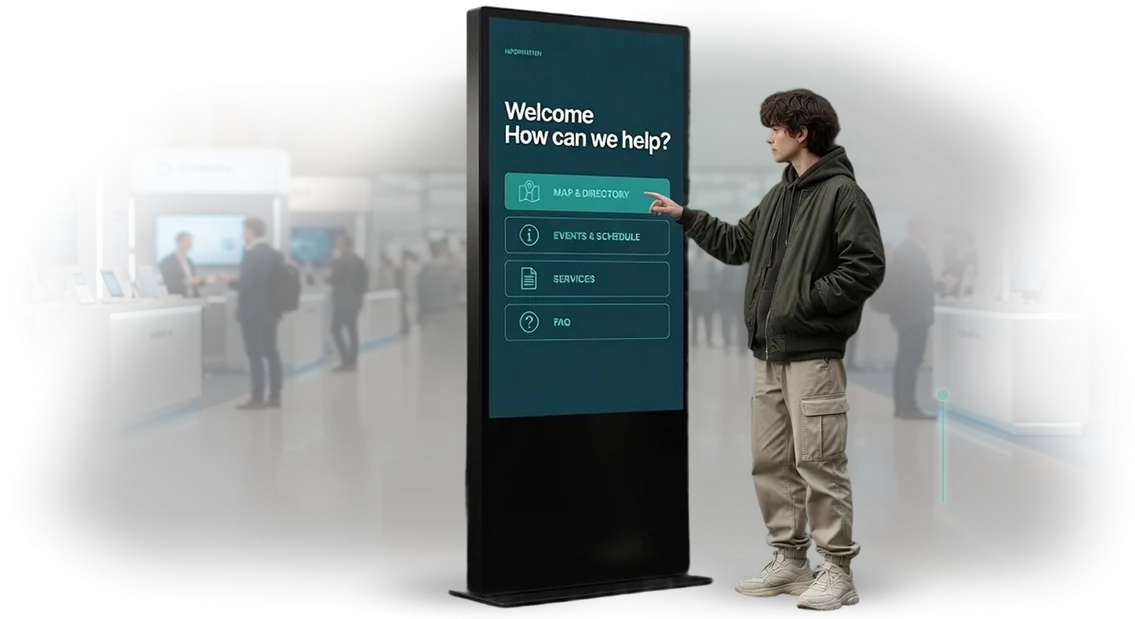
We solve this problem with an interactive kiosk in the reception area. It handles the routine: self-service appointment booking, up-to-date pricing, a pre-visit questionnaire, and promotion selection.
Queues in the clinic shrink noticeably, the administrator is freed up for complex questions and guest care, and the clinic stops losing inquiries.
What Benefits a Clinic Gets from an Interactive Kiosk
The clinic reception is a bottleneck that every patient passes through. While the administrator answers calls and processes visits, a queue builds up at the desk, and some clients simply leave without waiting for an appointment.
An interactive kiosk takes over the routine operations and frees the staff for face-to-face interaction.
Queue reduction begins right at the entrance. The visitor selects a service and a convenient time on their own, sees the current specialist schedule — this takes less than a minute instead of the standard dialogue with the administrator.
During peak hours, the kiosk acts as an additional operator, reducing the load on the front desk and speeding up patient flow.
The increase in bookings happens because the kiosk never gets tired and always remembers about additional services. After selecting the main procedure, the screen offers complementary care, a promotion, or a gift certificate.
This approach increases the average check and fills the schedule even during "quiet" hours — it's an additional sales channel without staff involvement.
Client loyalty is built on the service experience. Quick booking without queues, a clear interface, and no need to wait for the administrator's response create the image of a modern clinic that values the patient's time. This directly affects repeat visits and recommendations.
The result is a full schedule, satisfied patients, and employees freed up for what truly matters: consulting and professional service. We help clinics gain these advantages with interactive kiosks adapted to your specific needs and integrated with your booking system.
Kiosk Formats: Stand, Wall-Mounted Screen, or Tablet
The choice of interactive kiosk format directly affects how the clinic welcomes patients and handles peak loads. Some cosmetology clinics need a stationary booking point, others need a mobile assistant for the administrator. The right format reduces queues, lowers staff workload, and increases booking conversion.
Three Formats — Three Working Scenarios
| Format | Suitable for which spaces and tasks | What it gives the clinic |
|---|---|---|
| Kiosk stand | Spacious lobby, reception area, high-traffic zone. Procedure booking, pricing, room navigation. | Relieves the administrator during peak hours, accepts payments, emphasizes the clinic's status. |
| Wall-mounted screen | Narrow corridors, waiting area, cosmetologist's room. Service discovery, promotions, before/after photos, procedure information. | Saves floor space, keeps patients occupied while waiting, subtly sells additional services. |
| Clinic tablet | Mobile stand, personal patient accompaniment, off-site events. Consultations, feedback collection, booking clients at the administrator's desk. | Maximum mobility, personalized approach, reduced queues during in-person interactions. |
After choosing the format, it's important to adapt the interface to the specific screen: large buttons, convenient navigation, seamless touch response.
We develop kiosks for each format and, at the briefing stage, advise which one will pay off faster in your space — taking into account the layout, patient flow, and the goals of cosmetology clinics.
Stages of Kiosk Development for Your Clinic
Developing a kiosk for a cosmetology clinic shouldn't be a "black box" where decisions are made without your involvement. We structure the process so that at every step you understand what's happening, what we need from you, and when you'll see results. You manage the process, and we handle all the technical work.
-
Brief and objectives. We meet, discuss the clinic's services, target audience, and kiosk usage scenarios. You provide clinic information, pricing, and objectives — we create a work plan and set deadlines.
-
Prototype and project approval. We create an interactive kiosk mockup: menu structure, texts, navigation logic. You see how everything will work, make edits, and approve the concept — only then does development begin.
-
Design and content. We develop the visual style in line with your brand, selecting fonts, photos, and icons. We need your logo, photos of the premises and services, and current prices — we handle the rest.
-
Development and testing. We build the kiosk on a professional platform, connect the touch interface, and verify all working scenarios. You receive a test version, try it on real tasks, and provide feedback.
-
Kiosk launch. We install the hardware and software at the clinic, configure it for your space, and train the administrators. You get a working kiosk ready to accept clients from day one.
-
Support and evolution. We monitor stable operation, make changes, and add new services. Implementation timelines are fixed in the contract, and we follow them — all we need from you is feedback from your staff.
This approach delivers predictable results: you participate in key decisions and don't pay for rework. All development stages are transparent, and intermediate approvals protect you from unexpected surprises at launch.
What's Included in the Delivery: Interface, Content, and Support
We handle the kiosk's entire journey: from the first sketch to the moment the first visitors start booking procedures. You don't need to hire a designer, find a content contractor, or figure out the hardware — everything is already part of the package. You get a working tool that increases client loyalty and relieves administrators.
Here's a checklist of what you receive in a single delivery:
- Interface design in the clinic's brand style — the client immediately feels the kiosk "belongs" to the clinic, not a temporary tablet with a random picture.
- Layout of all key screens: services and prices, specialists, promotions, contacts — the structure is designed so visitors find answers in 2-3 touches.
- Content upload: texts, photos, videos, price list — you provide the materials, and we assemble them into a unified system.
- Setup and testing of touch equipment for your kiosk or wall-mounted screen — we check touch response, viewing angles, and operational stability.
- Staff instructions: a short document and training — how to turn the kiosk on, update prices, change a promotional banner without calling a specialist.
- Trial operation before launch: before the first guests arrive, we verify all usage scenarios and fix any issues.
Support doesn't end after launch. We stay in touch: helping update content, answering staff questions, and ensuring the kiosk runs without interruptions.
For you, it's one clear point of contact instead of a chain of contractors, and for clinic clients — fast navigation through services and easy booking in just a couple of touches.
Case Study: How a Kiosk Helped a Clinic Increase Bookings by 40%
Administrators spend up to 30% of their working time on repetitive questions: schedules, prices, appointment duration. As a result, incoming calls go unanswered, and visitors who've already come to the clinic leave without booking.
We encountered this in the "Estetik Line" chain of cosmetology clinics and proposed moving the routine to an interactive kiosk.
A touch-screen stand with a service catalog, prices, and available time slots was installed in the lobby. Patients select procedures themselves, view descriptions, and book a convenient time on the spot.
Administrators only step in for non-standard situations — this gave them back time for face-to-face interaction with those who need a consultation.
Implementation Results
Within the first two months, the chain recorded a 40% increase in bookings.
Most importantly, every third visitor started booking immediately instead of leaving to "think it over." Repeat visits grew by a quarter: the kiosk reminds patients about upcoming procedures and shows personalized recommendations.
A particularly nice bonus is that administrators stopped working "on repeat." The time to process a single booking was cut almost in half, so managers can now devote more attention to skin health concerns, reactions, and contraindications instead of reciting the price list.
After the first branch, the clinic ordered a similar kiosk for its second office — a clear example of how an interactive kiosk becomes part of a chain's operations. They're now planning to add payment for procedures right at the stand to completely eliminate peak-hour queues.
Small changes in reception workflows deliver measurable results that are visible to both clients and the business owner.
Which Kiosk Format Is Right for Your Clinic?
Choosing a kiosk isn't a question of technology — it's about how the device fits into the clinic's daily life. There's no universal solution: what works perfectly in a spacious clinic would take up half of a small reception area.
That's why we always start with three parameters — available floor space, average client flow, and the goals you set for the kiosk.
A compact wall-mounted kiosk is the optimal choice for small spaces. It takes up minimal room, doesn't visually clutter the interior, and handles booking, the procedure catalog, and the loyalty program.
A floor-standing unit offers more options for self-booking, payments, and service demonstrations but requires open space — roughly one and a half to two meters.
If the clinic operates in the premium segment, a side console near the administrator's area is a better fit: it doesn't get in the way of guests and reinforces the clinic's status.
The most important thing is to avoid queues. With high visitor traffic, we recommend models with two touch panels or relocating the kiosk to the waiting area.
This way, clients queue up on their own, choose procedures, and even pay — waiting time turns into productive interaction.
In clinics with medium traffic, a single device is sufficient, but the scenario plays the deciding role: what guests see on the screen and how many steps it takes to reach the final action.
We help you choose the right format — we don't just sell equipment. First, we assess the layout, count daily visits, and analyze the current points of client contact with the administrator.
Then we propose a specific model, its placement, and on-screen scenarios — aligned with your objectives: from simple booking to a full "patient card + procedure sales" system.
In the end, the kiosk becomes an independent sales tool: it reduces staff workload, speeds up inquiry processing, and increases the average check.
To understand which format suits your clinic, all you need to do is request a site visit from a specialist — they'll assess the premises and prepare a recommendation within a few business days.
Answers to Questions About Kiosk Implementation and Maintenance
Most questions about kiosks aren't about technology but about practical matters: how quickly we can launch, whether the staff can handle it, what happens in case of a failure, and who provides support.
We answer the main pre-purchase concerns — so you get the full picture before the project even starts.
How long does kiosk implementation in a clinic take?
Turnkey — from two weeks to a month, including interface design, brand style customization, and content setup. In parallel, we prepare the kiosk for operation; staff training takes a couple of hours. The launch happens without downtime, and the clinic's current processes aren't interrupted.
How will the kiosk connect to our CRM?
The kiosk transfers data about bookings, leads, and visitor preferences directly to the CRM. No double entry and no manual work: the administrator sees inquiries immediately after a service is selected on screen. Access is role-based — information is available only to employees with the appropriate permissions.
Will we be able to update prices and promotions ourselves?
Yes, no developer needed. In the control panel you can change service descriptions, prices, photos, and promo banners — changes appear on the kiosk instantly. You control the content, and we're responsible for the system's stable operation.
What guarantees do you provide and what's included in maintenance?
We provide a warranty on hardware and software. Maintenance includes continuous kiosk health monitoring, updates, and priority support: we respond to critical failures within one business day. Data is stored on the server side and won't be lost even if the kiosk breaks down.
Order Interactive Kiosk Development for Cosmetology Clinics
An interactive kiosk in a cosmetology clinic solves three tasks at once: speeds up booking, informs patients about procedures without administrator involvement, and increases the average check through upsells.
We develop web applications for touch kiosks specifically tailored to clinic needs — with a service catalog, price list, promotions, and online booking.
To provide an accurate proposal, we need to understand your goals: what the kiosk should display, where it will be placed, and which scenarios matter.
After a short consultation, you'll receive a transparent cost calculation and a launch plan — with no hidden work or unexpected surcharges.
What you get after submitting a request:
- a consultation with an interactive kiosk specialist for cosmetology clinics — we'll advise which functionality will deliver results for you;
- a cost calculation tailored to your budget and objectives — you'll know exactly what the project will cost after audit;
- examples of our work for clinics and beauty salons — see how it looks in real life;
- a kiosk launch plan with precise timelines at every stage: from interface approval to installation and testing;
- recommendations on placement, content, and ways to draw attention to the kiosk;
- post-launch support — we'll update programs, contacts, and promotions whenever needed.
Leave a request on this page — we'll call you back within one business day, discuss the task, and prepare a proposal.
Ordering a kiosk for a cosmetology clinic is the first step toward having clients learn about your procedures on their own and book appointments without waiting in line.