

Patients of ophthalmology clinics don't like queues at the registration desk
Queues at the registration desk of an ophthalmology clinic are one of the main reasons patients leave for competitors. People with vision problems value their time and are not willing to wait at the counter even for 15 minutes.
Patients' patience runs out long before their number is called, and every lost visit is not just an empty slot but also a missed recommendation.
Patient loss begins even before the visit: it's hard to get through to the clinic by phone, booking an appointment with an ophthalmologist stretches over days, and the administrator can't respond to everyone.
Each such rejection is not only a missed appointment but also a negative review that will scare off several more potential patients. The clinic loses up to 15% of inquiries at the earliest stage, without even seeing these people.
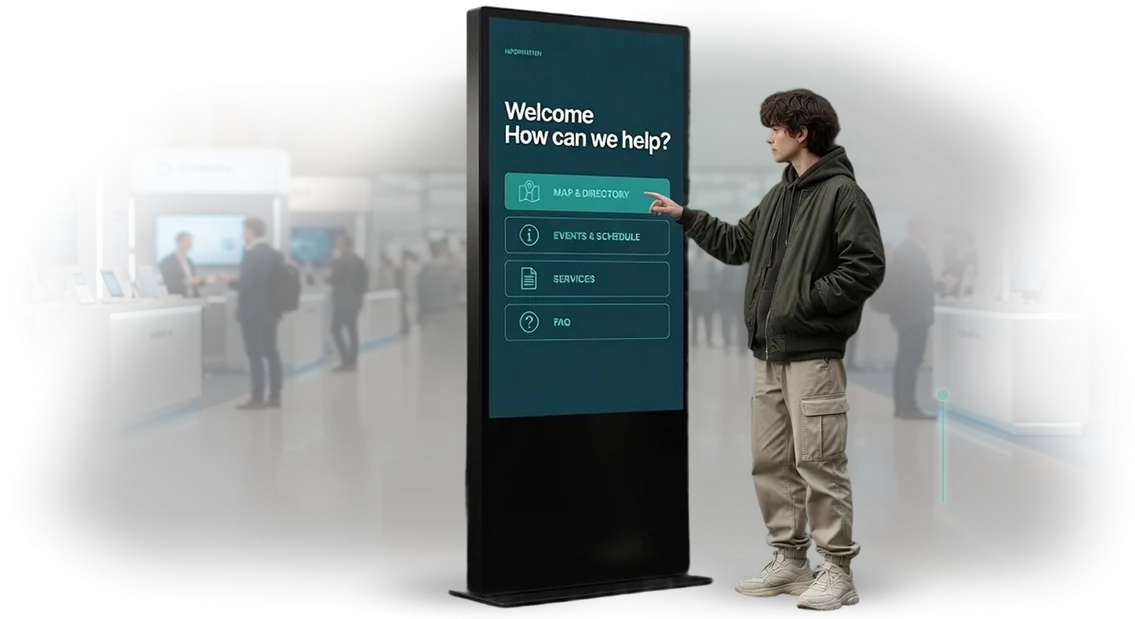
The solution is self-service check-in at the clinic via an interactive kiosk. The patient chooses the doctor, date, and time themselves, without going to the administrator. This reduces the load on the registration desk and speeds up service without expanding staff.
Wehave been developing such kiosks for over 10 years and know how to integrate them into your workflow.
The self-service kiosk operates around the clock and always shows the current schedule. It carefully guides the patient from selecting a specialist to confirming the visit, and your clinic gets statistics on patient flow and can plan doctors' workloads.
Integration with the medical system takes several days, and the effect is visible within the first month.
Don't let queues take your patients away — implement a self-service kiosk and turn the registration desk into a point of service rather than irritation. A patient who books in a minute comes back on their own and brings acquaintances. Contact us — we'll advise you on where to start.
What benefits an interactive kiosk gives to a medical facility
Patients value their time and don't want to stand in line to book an appointment. An interactive kiosk in the clinic lobby solves this problem — it handles routine operations, while staff focus on live communication.
We develop such kiosks tailored to a medical facility's needs: from simple booking to navigation between offices and payment for services. Below are the main results a clinic gets.
Relieving the registration desk and speeding up service
The kiosk receives patients without an administrator's involvement: it checks appointments, issues tickets, and reminds patients of room numbers.
The queue shrinks during peak hours, and registration staff switch to complex matters — paperwork, consultations, and work with privileged categories.
Time spent per patient decreases from several minutes to seconds. This is especially noticeable when several people arrive at the clinic at the same time — the kiosk doesn't get tired and doesn't lose speed.
Additional bookings and revenue growth
The kiosk can offer patients services that suit them: it reminds about preventive checkups, suggests booking an appointment with a related specialist, and shows available slots for the week. Such prompts work delicately — without being pushy, yet with conversion.
A patient who came for one procedure learns about other clinic services. Every additional booking is growth in the average check without advertising costs.
Patient loyalty
A modern kiosk creates the impression of a tech-savvy and caring clinic. The patient sees that their convenience matters here — and returns again, as well as recommending the clinic to acquaintances.
An especially pleasant detail is the absence of paper tickets and queues. This reduces stress for patients, especially for elderly people and parents with children, who appreciate predictable visits.
Medical facility recognition
A kiosk with branded design and logo is part of the clinic's brand. It makes the medical facility stand out from competitors, shows the level of service, and stays in memory as a detail that surprised and delighted visitors.
In addition, the screen can display information about promotions, new services, or doctors' recommendations — so the clinic informs patients without mailings or phone calls.
Kiosk formats for ophthalmology clinics: from floor-standing to wall-mounted
In an ophthalmology clinic, visitors range from children to elderly people, and not everyone is confident using screens. The kiosk's task is to help patients book quickly, find an office, or check the queue — without lines and stress. Therefore, the terminal format matters just as much as its content.
We select the design based on the premises and patient flow: floor-standing kiosks for lobbies, wall-mounted panels for corridors, and compact touch terminals for reception departments. Below are the most in-demand kiosk formats for ophthalmology clinics.
Kiosk format comparison
| Format | For whom and where | What it gives the clinic |
|---|---|---|
| Floor-standing kiosk | Spacious lobbies and waiting areas with high foot traffic | Withstands peak loads, allows self-service booking, reduces queues, and relieves administrators. |
| Wall-mounted kiosk | Narrow corridors, reception departments, areas near exam rooms | Saves space, helps patients not get lost, and engages those waiting with useful information. |
| Registration desk kiosk | Registration area, administrator counter | Duplicates staff during peak hours: check appointments, print tickets, show directions. |
| Touch terminal | Pediatric departments, offices with elderly patients | Large buttons and fonts, height adjustment — convenient for patients of any age and skill level. |
This is not a complete list. We can modify the design for your specific task, add ticket printing, or combine several formats: for example, a floor-standing kiosk in the lobby and wall-mounted panels near exam rooms — as a unified system for the entire clinic.
How kiosk development works: from task to launch
Work on a kiosk begins not with code but with understanding your tasks. We capture the goals set for the interactive solution: appointment booking, clinic navigation, service presentation, or entertaining patients in the queue.
This allows us to move toward a measurable result from the very start, rather than just a "pretty screen."
From there, the project follows a clear route, where you see an interim result at every step and control the timeline. Below is a typical path from the first brief to a working kiosk in the clinic lobby.
- Task definition and brief. We discuss who will use the kiosk (patients, administrators), what scenarios are needed, and how the kiosk fits into the registration process. We capture expectations for design and functionality.
- Work plan and cost estimate. We create a stage schedule with clear deadlines and a fixed scope. You get a transparent plan showing what will be ready and when — without hidden work or surprises.
- Prototype and layout approval. We show the screen structure and navigation logic on a simple mockup. You see how patients will move through the menu and approve the logic before development begins — this eliminates costly rework at later stages.
- Development and content. We build the interface and add your clinic's texts, logos, photos, and videos. In parallel, we set up integrations with the systems you need — for example, the doctor schedule database.
- Testing on a real device. We check how the kiosk performs under near-real conditions: response speed, usability for different age groups, and touchscreen accuracy. Final adjustments are made at this stage.
- Launch and handover. We install the software, configure auto-start, and protect against accidental failures. We conduct a short training session for administrators so they can manage content without technical expertise.
- Post-launch support. We monitor the system, update content on your request, and respond promptly in emergencies. The kiosk keeps working stably, and you focus on the clinic rather than the technology.
The result of this approach is a predictable launch without downtime. You know the timeline in advance, understand what you'll get, and receive a kiosk that solves your clinic's tasks from day one.
What is included in the interactive kiosk delivery package
The interactive kiosk delivery package is a complete turnkey solution, not just a "box with a screen." You get everything you need to start using the kiosk in the clinic lobby right away, without hiring technical specialists or incurring extra integration costs.
- Touchscreen and housing: a durable housing that withstands constant use by patients and fits stylishly into the interior.
- Kiosk software: a patient-friendly interface with doctor appointment booking, clinic navigation, and service information. The system works without freezing and is easy to update.
- Design and branding: we adapt the kiosk's appearance to the clinic's corporate style — logo, color scheme, screensavers, and on-screen forms.
- Staff instructions: a short guide for administrators — how to turn on the kiosk, update information, and resolve common issues in a few minutes.
- Kiosk warranty: official warranty on hardware and software, with prompt replacement of failed components.
- Installation and setup: we'll install the kiosk at the right spot in the lobby, connect it to power, verify it works, and train your staff.
As a result, you get a working tool that helps patients book appointments from day one and reduces the load on administrators. All you need to do is keep the content up to date — we handle the rest.
Case study: how a kiosk reduced queues and increased bookings
In ophthalmology clinics, the queue is the main enemy of loyalty. A patient comes for a scheduled appointment but has to wait to be checked in at the registration desk, especially during peak hours. Some visitors can't stand the wait and leave for another center.
A real implementation example is a private clinic with a daily flow of about 150 people. Before the kiosk was installed, administrators spent up to seven minutes per patient: verifying data, filling out charts, and searching for available slots. During peak hours, people stood in line for 15–20 minutes, and phone calls went unanswered.
We placed a touchscreen self-service kiosk in the lobby. Patients chose the service, doctor, and convenient time themselves — without an administrator's involvement. The system immediately transferred data to the shared database, eliminating errors and double bookings.
The kiosk's results became measurable within a month: average check-in time dropped from seven to two minutes, queue wait time was cut in half, and the share of bookings made via the kiosk reached 40% of the total flow.
The clinic saw booking growth without additional advertising investments and was able to reassign administrators to consultations and patient care.
The head of the "Vision" clinic shared her feedback: "The kiosk has become our second administrator. Patients master it in one or two minutes, the queue moves faster, and we see real growth in the number of bookings."
This example is not an isolated case. We implement the same approach in medical centers of any scale: from specialized offices to multidisciplinary clinics. Tell us what challenge you're facing — we'll find a solution that reduces the queue and increases bookings.
How to choose a suitable kiosk for your organization's needs?
Choosing a kiosk starts not with a model catalog but with answering the question: what exactly should patients do at the screen — book appointments, learn about the clinic's services, take preliminary vision tests, or get directions between departments?
This determines the device size, touchscreen type, configuration, and usage scenario. Ophthalmology adds an important nuance: some visitors have poor eyesight, wear glasses, or come with age-related changes in perception. Therefore, the interface should be high-contrast, with large elements and minimal fine detail.
The second step is to assess the physical location. Will the kiosk stand in a busy lobby, in a narrow niche, or near the reception desk? The design is selected accordingly — floor-standing or wall-mounted, impact-resistant, and tolerant of wet cleaning.
It's important to ensure the device doesn't create queues or obstruct the main visitor flow. These parameters directly affect dimensions, housing materials, and screen placement.
The third step is requirements for reliability and support. A medical facility works seven days a week, so the kiosk must start up in seconds and not freeze at the most critical moment.
That's why we use professional industrial components, and the cost includes ongoing support: monitoring, updates, and fast replacement in case of failure.
When you contact us, we don't just sell equipment — we provide a consultation on choosing a kiosk: we analyze the clinic's tasks, patient flow, existing processes, and propose the optimal format.
We take into account the specifics of ophthalmology — from the color scheme to scenarios for people with limited vision. You get a ready-made solution that serves patients from day one, without rework or unnecessary expenses.
Frequently asked questions about implementing kiosks in medical centers
Implementing an interactive kiosk in an ophthalmology clinic is not just installing equipment but changing familiar processes.
Managers often have questions: who will support the project, how will staff master the new system, will there be integration issues, and how secure is patient data? We've gathered answers to the main ones — briefly and to the point.
What does the warranty on the kiosk and software cover?
We provide a warranty on hardware and software for the entire duration of our cooperation. If a device fails, we'll replace it or carry out prompt repairs. The software is updated and maintained by us — you're never left alone with technical issues.
How does staff training at the clinic work?
We conduct training for administrators and medical staff in 1–2 days. We show how a patient books via the kiosk, how staff manage the schedule, and what to do in unusual situations.
After launch, we stay in touch and answer questions — no additional training is needed, as the interface is intuitive.
Is it difficult to integrate the kiosk with the clinic's existing systems?
Integration is configured to your medical information system: doctor appointments, schedules, and patient data. The kiosk connects to your processes rather than replacing them.
Patients register themselves, and the information immediately enters the shared database — eliminating double entry and administrator errors.
How is patient data security ensured?
All data is transmitted over secure channels and stored in accordance with personal data legislation requirements. Access to information is role-based: patients see only their own booking, while staff see the functionality they need. We regularly update security measures to prevent leaks and unauthorized access.
If you still have questions about implementing a kiosk in your clinic, ask us directly. We'll plan the project considering your specific operations, help with integration, and provide full support at every stage.Let's discuss your project: order interactive kiosk development
An interactive kiosk for an ophthalmology clinic is not just an electronic schedule but a full-fledged tool that reduces queues and simplifies booking. Patients choose their doctor, convenient time, and immediately get a ticket without distracting staff.
The kiosk reminds them about appointments and suggests how to prepare for diagnostics, which reduces no-shows and increases exam room utilization.
Administrators no longer have to repeat the same thing dozens of times, and the clinic looks modern and caring. In the end, you win on three fronts: service speed, patient satisfaction, and reputation.
We develop such systems turnkey: we analyze patient flow, design scenarios, create the design, and launch the kiosk in your lobby. You don't need to dive into technical details — we'll propose the optimal solution for your tasks and budget.
Leave a request for a kiosk consultation — we'll tell you which scenarios already work in clinics, how to adapt them to your patient flow, and how quickly the kiosk will pay for itself. After your inquiry, you'll receive:
- A clear turnkey kiosk development plan with precise deadlines and stages.
- A calculation for your clinic: number of locations, scenarios, and functionality.
- Equipment and design recommendations that fit your lobby.
- An interactive prototype before development starts — you see the result in advance.
- Staff training and technical support after launch.
- A warranty on the work and refinements based on real usage results.
Ordering a kiosk is simple: write or call us — we'll capture the requirements, prepare a proposal, and agree on a plan. The project can start as early as next week.
Leave your contacts in the form, and we'll get in touch within one business day to discuss the details of your project.