

Why Guests Forget About Hotel Services and Go to Competitors
Every evening in hotels, tables in restaurants, spa slots, and excursion seats remain free — not because the services are bad, but because guests simply don’t know about them.
After check-in, a guest gets a key and goes to their room, then relies on the front desk, paper booklets, or a random remark from an administrator.
Most services stay behind the scenes: guests don’t know about hotel services that are literally a couple of minutes away — and this repeats day after day.
This invisibility hits revenue directly: guests spend on additional services where they see an offer.
A guest who doesn’t notice the spa or the panoramic bar has dinner at a nearby café, takes a transfer from an outside company — and leaves money to competitors in the hospitality business.
Lost bookings and occupancy become a regular story for hotels where information exists but doesn’t work for the business.
The issue isn’t the number of services but the way they are presented. The front desk is overloaded, booklets become outdated, and guests aren’t ready to read walls of text — they want to understand what they can get right now and do it in a couple of taps. If there’s no quick answer, they choose those who know how to sell themselves.
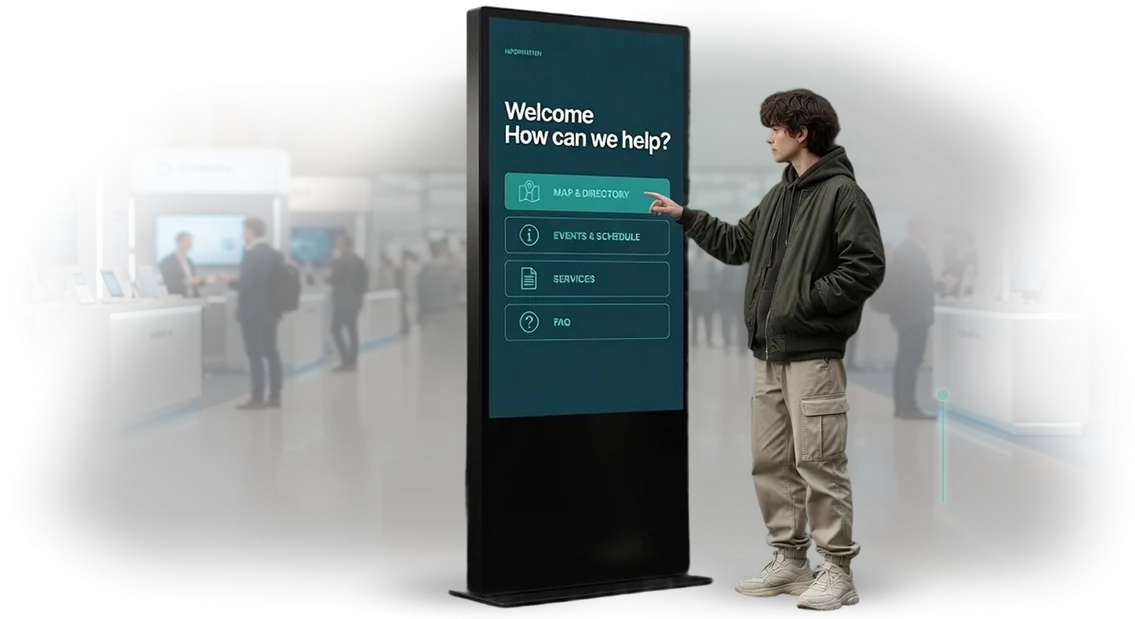
This is exactly where an interactive kiosk for hotels comes in — a point in the lobby or near the elevators that works without staff involvement. Guests find current services and promotions on their own, see schedules, and book in a couple of taps.
The hotel recovers lost bookings and upselling opportunities, while guests get the impression that they were taken care of. Below — how it works and what it brings you in practice.
Five Benefits: From Higher Revenue to Guest Delight
An interactive kiosk in a hotel is not just a screen at the reception desk but a full-fledged tool that changes the service economics. Guests get information instantly, and staff free up hours for truly important tasks. Let’s look at five key benefits a hotel gets after implementing such a solution.
The first benefit is revenue growth through upsells. The kiosk prompts the guest to order dinner in the restaurant, a spa treatment, or an excursion without staff involvement.
Warm contact with the guest at the moment of interest turns into additional orders that used to be lost during face-to-face conversations.
The second is guest loyalty. A modern interface, a quick answer to the question “where is what,” and the ability to self-checkout create a positive experience. Guests return to a hotel where they weren’t forced to wait in line and where recommendations turned out to be relevant.
The third is staff time savings. The operator no longer needs to repeat the same thing ten times — the kiosk answers typical questions about the restaurant, Wi-Fi, spa, and checkout time.
The freed-up hours are spent by employees on non-standard tasks and guest attention, which directly affects service ratings.
The fourth is reducing the load on the front desk. During peak hours, the kiosk takes over part of the flow: guests independently check their reservations, learn details, and get useful information. The queue becomes shorter, and guests stop feeling anxious before check-in.
The fifth is the image of a modern service. Interactive kiosks are perceived as a sign of a tech-savvy and caring hotel that values its guests’ time. This advantage supports brand recognition and generates positive reviews, which in turn brings new customers.
In the end, the kiosk pays for itself through a combination of factors: new sales, loyalty, and optimized staff workflows. This is a solution that benefits both guests and the hotel owner.
Kiosk Formats for Hotels: Information Desk, Navigation, Service
In a modern hotel, a kiosk is not just an electronic desk but a tool that solves specific business tasks: welcoming guests, directing them to the right services, and selling additional services.
The format is chosen according to the usage scenario, and the benefit the hotel gets directly depends on it.
Main Kiosk Formats for Hotels
| Format | Who it’s for | What it gives the hotel |
|---|---|---|
| Information desk | Guests without reservations, event visitors, tourists with questions | Relieves the front desk, instantly answers common questions, presents the hotel in a favorable light |
| Navigation kiosk | Guests looking for a restaurant, spa, conference rooms | Reduces the flow of questions to staff, helps guests find their way independently, enhances the service impression |
| Service ordering kiosk | Guests who want to order room service, an excursion, or book a spa slot | Increases the average check, automates order taking, frees up staff time |
The information desk works as the guest’s “first guide”: it shows the location of zones, opening hours, and contacts. The navigation kiosk is especially useful in large hotels with several restaurants, a pool, and conference spaces.
The service ordering kiosk turns passive guest waiting into an impulse purchase — especially if it’s placed in the lobby and near the elevators.
The formats are easy to combine: for example, a navigation kiosk with a service ordering function, or an information desk with a property map.
We will select the hardware, interface, and placement to fit the specific hotel’s needs so the kiosk delivers value from the very first days.
How Kiosk Development Works: From Brief to Launch
Work on a kiosk begins not with code but with a conversation about your goals. We discuss what a guest should find on the screen within 30 seconds, how many languages are needed, and which scenarios matter to the front desk and the restaurant.
We record the requirements and agree on an estimate with exact timelines — you know the budget and dates before work starts.
Then a designer creates the screen structure and navigation logic so guests can go from “welcome” to the information they need without any hints. You approve the layout before development: you can change texts, buttons, and block placement until edits no longer affect the cost. After your “okay,” the design is handed over to development.
Programmers build the interface and connect it to your systems: current prices from the hotel’s PMS, news, infrastructure, and service contacts. We test on a real touchscreen — we simulate taps, check response speed, and language switching.
We launch the kiosk at your property, configure it, and train the staff. Post-launch support includes content updates, seasonal promotions, and system monitoring.
- Brief and audit — you describe the kiosk’s goals, we ask questions and record the requirements.
- Plan and estimate — timelines, scope of work, and cost are approved before the start.
- Structure prototype — section scheme, transition logic, texts in all languages.
- Layout approval — screen design, you make edits before development begins.
- Development and integration — interface assembly, connection to hotel systems, testing.
- Launch and training — installation, configuration, and hotel team instruction.
- Support — content updates, technical support, and functionality expansion.
What’s Included in the Delivery: Interface, Content, Installation, and Training
The hotel receives not a “as-is” interface but a complete turnkey solution. We handle all stages — from screen logic to staff training — and are fully responsible for the result. You don’t need to coordinate different contractors: one team does everything. Here’s what’s included in the delivery.
- Hotel interface — on-screen menus built around guest scenarios: property map, services, table booking, taxi ordering. Guests find what they need in a couple of taps without distracting the administrator.
- Kiosk content — photos, descriptions of rooms and services, promotions, contacts. We collect the information together with you and provide a simple editor so you can change prices and special offers yourself.
- Kiosk installation — we choose a location based on foot traffic, install and configure the equipment, and check connectivity. The kiosk goes live on the day of installation.
- Staff training — a practical session for administrators and service staff: how to update content, change a promotion, and what to do in case of a failure. Usually one hour is enough; after that the team works on its own.
- Documentation — a clear instruction for employees, a launch checklist, and support contacts. Everything in English, without technical jargon.
- Post-launch support — we consult, update the system, help add new services, and connect additional features as the hotel grows.
In short, you get a tool that relieves the front desk, speeds up service, and makes the experience more convenient for guests. The kiosk operates as part of the hotel’s service, not as a separate technical task.
Case Study: A Kiosk for a Hotel Chain Increased Additional Service Sales by 30%
A hotel chain like Hilton faced a typical problem: the front desk always had long lines, and administrators physically couldn’t find time to tell guests about the spa, restaurants, and excursions.
Guests went to their rooms without even learning about additional services, even though they were willing to pay for experiences.
We proposed a simple solution — an HTML5 touchscreen kiosk that introduces guests to the property independently and selects personalized offers while check-in is being processed.
The result appeared within the first month. The share of guests who added additional services grew by 30%, and the average booking value increased by 12%.
Front desk queues halved because the administrator no longer needed to give a “lyrical aside” — the kiosk took over the sales role. The system operates autonomously, updates remotely, and requires no additional software installation on the hotel side.
The kiosk’s effectiveness is also confirmed by repeat visits: 9 out of 10 guests who had already used the kiosk approach the screen themselves on their next stay and choose services.
The hotel manager commented on the solution: “This is the fastest and most visual way to introduce a guest to the property.
We stopped depending on how tired the administrator was at the end of a shift — the kiosk is always polite and never forgets anything.” After the pilot project, the chain ordered the same kiosks for all its properties in the region.
The main takeaway from this case: a kiosk is not an information board but an additional sales channel. We configure scenarios for each specific hotel, analyze guest choices, and regularly update content.
This keeps offers relevant: today it’s breakfast in the room, tomorrow it’s water park tickets. That’s why the hotel gets not a one-off “lobby screen” but a manageable tool that generates revenue and improves service quality.
How to Choose a Kiosk for Your Hotel’s Goals?
Choosing a kiosk doesn’t start with the device model but with the question of what exactly the kiosk should simplify in your hotel.
For one property, the main goal is to relieve the front desk during check-in hours; for another, it’s to increase spa and excursion sales; for a third, it’s to give guests self-service navigation around the property.
Identify two or three key scenarios, and then select the format to match: a floor-standing desk at the entrance, a compact terminal at the front desk, or an interactive panel in the lobby.
The next step is to assess how the kiosk will fit into existing processes. It’s important that it works together with your booking system rather than existing separately.
A guest checks in through the kiosk — the information immediately goes into the system, the room key is ready, and breakfast is paid for.
Also think about who will help guests in the first days after launch: even the most intuitive system requires a short adaptation period, and staff should be ready to assist.
The budget for a kiosk is not the cost of hardware but an investment in service speed and additional sales. Calculate how much time an employee spends on routine actions: check-in, excursion bookings, answering repeated questions.
The kiosk takes these tasks on itself, and staff shifts to live guest interaction and non-standard situations — exactly what earns a hotel high ratings.
Consider your hotel’s specifics: seasonality, average length of stay, guest profile. If families with children come — the interface should be large and friendly. If business guests value speed — instant response and a minimum number of steps to the result matter. A good kiosk adapts to your scenarios rather than forcing you to adapt to it.
The final choice is a balance between goals, format, and budget. We help hotels go through this process: we analyze guest flow, select a configuration that matches your objectives, and set up the kiosk so it delivers measurable results as early as the first month of operation.
Frequently Asked Questions About Kiosk Implementation
Implementing an interactive kiosk is a new point of contact with the guest, and like any new solution, it raises doubts: will it get in the staff’s way, will the texts need constant rewriting, and what happens if it breaks. We answer typical hotel questions and show that the risks are covered from the start.
How long does it take to launch a kiosk?
A typical project takes 2–4 weeks: from brief to a working screen in the lobby. The timeline depends on the number of locations and non-standard features, but the basic scenario — greeting, map, services, booking — fits into two to three weeks. You get a clear plan and don’t get distracted from the hotel’s day-to-day operations.
Is it difficult to integrate a kiosk with existing hotel systems?
No. The kiosk connects to your CRM, booking system, and rates through standard interfaces — room, service, and promotion data updates automatically. All work happens in parallel with hotel operations, with no front desk downtime.
If integration with a specific system requires modifications, we find a solution through open formats or dedicated modules — the main thing is that guests see up-to-date information and staff don’t waste time on manual synchronization.
How do we update content — prices, promotions, menus?
All information is changed through a simple admin panel: your employees, without a programmer or special training, can edit texts, photos, and rates. Updates take minutes and don’t require stopping the kiosk — the new version appears immediately. If there’s no one to manage content, we offer maintenance and regular updates on your behalf.
What happens if the kiosk breaks down?
The equipment is designed for 24/7 operation in high-traffic areas. In case of a failure, we have rapid device replacement within one or two days. Remote monitoring is also configured — our team sees a malfunction before the guest learns about it.
Even if the device physically fails, a staff member can always help nearby, so hotel service will not stop.
What warranty and support does the hotel get?
We officially document the warranty on equipment and software in the contract. It includes staff training, technical support, and an agreed response time. You get a single contractor responsible for the entire project — from initial setup to daily operation. Support continues after launch: hotline, remote access, and engineer visits if needed.
Discuss Your Kiosk Project for Your Business
To make a touchscreen kiosk bring value to your hotel, it’s important to discuss the project before development starts. Tell us what tasks it should solve: faster check-in, property navigation, selling additional services, or guest information.
We’ll recommend the format that suits you best — from a compact desk in the lobby to a multi-functional terminal integrated with the booking system.
Leave a kiosk inquiry — and we’ll contact you within one business day. We’ll provide a kiosk consultation, clarify your requirements, and help you choose the optimal solution. Then we’ll prepare a cost and timeline estimate — without hidden conditions or obligations.
What you get after contacting us:
- Kiosk consultation: we’ll analyze the hotel’s goals and propose a working scenario.
- Cost estimate: we’ll give the exact development cost and a preliminary breakdown.
- Implementation plan: we’ll show stages, timelines, and control points.
- Solution examples: we’ll show how kiosks work in other hotels.
- Integration recommendations: we’ll explain how to connect the kiosk to your accounting systems.
- Full support: we’ll handle the entire cycle from design to launch and maintenance.
You can discuss the project in any convenient format — by phone, messenger, or video call. We work remotely, so it doesn’t matter where your hotel is located. Leave a request — we’ll come back with concrete proposals and answer all your questions.
Translate the above into English. Preserve structure exactly.