

Amusement park visitors get lost and leave without buying
Visitors come to an amusement park for experiences, but often face chaos: long lines, confusing signs, and no information about where the ride they need is located.
The guest loses time, gets nervous, and leaves disappointed, never spending money at cafes, souvenir shops, or additional services.
As a result, the park loses not only the current purchase but also future visits — a person remembers the negative experience and is unlikely to return.
Missed revenue becomes a systemic problem. Without clear navigation in the park, guests do not reach remote locations, do not learn about ongoing promotions, and cannot quickly buy a ticket or grab a snack without waiting in line.
Staff cannot always help in time, and during peak hours the lines only grow. Every such lost interaction means lost money and lower guest loyalty — visitors who could have recommended the park to friends.
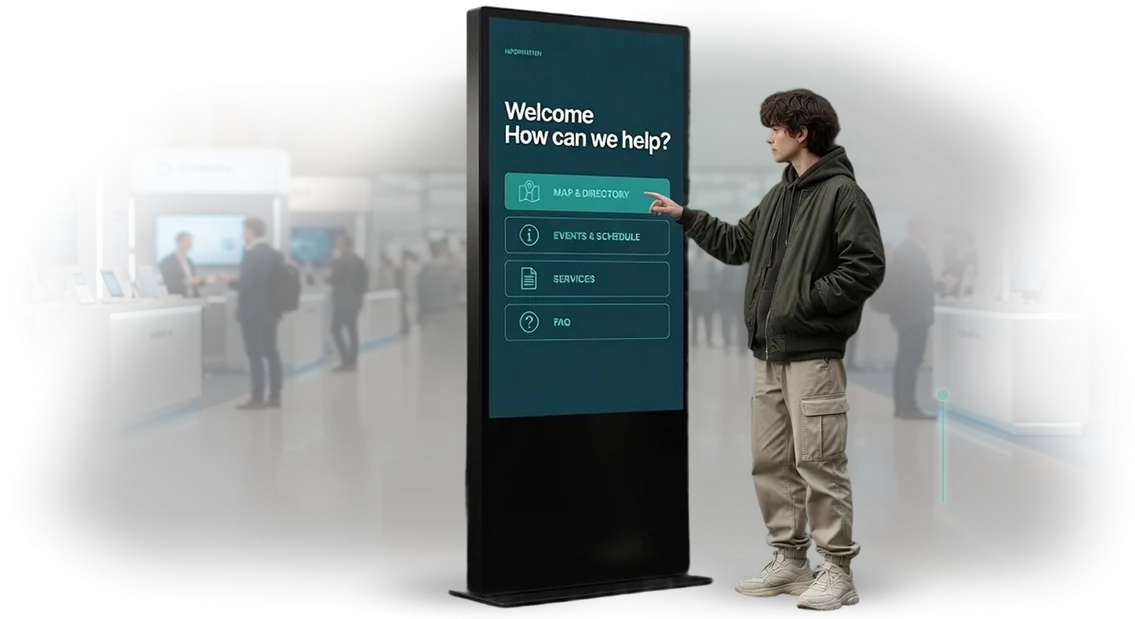
The solution is an interactive kiosk that works as a guest's personal assistant. On a touchscreen, visitors can quickly get oriented, view a map, choose a route, buy a ticket, or learn about special offers.
This reduces queues, increases sales of additional services, and creates the impression of a modern park that cares about its guests. Moreover, the kiosk works without breaks and never gets tired, so it helps guests even on the busiest days.
We work on park navigation, ticket sales, and loyalty programs — everything that brings lost guests back and increases the average transaction value. Tell us about your situation, and we will show you how an interactive kiosk will pay off in your specific park.
What benefits do interactive kiosks bring to a business
Interactive kiosks in an amusement park are not a replacement for a cashier, but a tool for revenue growth. On a bright touchscreen, a guest sees posters, the map, and ready-made combo packages — and instead of one ride, buys more. This drives sales growth through kiosks and makes them pay off within the first seasons.
The direct benefit is shorter queues. The kiosk handles routine operations: selling tickets, topping up wristbands, and booking ride times. Staff are not distracted by routine and focus on live guest service. The park's throughput increases without expanding the staff.
Kiosks increase visitor loyalty. Guests choose their own scenario: study the map, check waiting times, or get a personal recommendation. A feeling of care and modernity appears — guests are more willing to return and recommend the park to friends.
The kiosk also collects contacts for the loyalty program, building a database for repeat invitations.
An additional plus is sales automation. The system itself calculates the cost, applies discounts, and issues tickets and receipts. This eliminates calculation errors and reduces the load on accounting. A sales report is generated automatically — the park receives a transparent financial picture.
And most importantly — visit analytics. Kiosks record which sections are in demand, when guests are more active, and which offers bring in more money. This data helps manage ride capacity, adjust prices, and plan promotions. Decisions are made based on numbers, not intuition.
Implementing interactive kiosks solves several problems at once: increasing the average transaction value, reducing queues, increasing loyalty, and providing analytics for management decisions.
We implement the project turnkey — from scenarios to launch and support — so you get a working sales tool, not just a screen in the lobby.
Formats of interactive kiosks for amusement parks
Park visitors come for impressions, not instructions. A kiosk that simply "hangs in the corner" does not work. A properly chosen format solves a specific task: helps a guest quickly get oriented, buy a ticket without a queue, or engage in the park's atmosphere.
We select a scenario according to your goals — from simple navigation to full-fledged entertainment.
Below are the main formats we implement for amusement parks and what each one gives your business.
| Format | What tasks it is for | What it gives the client |
|---|---|---|
| Navigation kiosk | Helping visitors find their way around a large area: maps, routes to rides, wait times | Reduces staff workload, visitors get lost less often and manage to visit more points |
| Ticketing kiosk | Self-service ticket purchase, choice of dates and rates, payment without a queue | Speeds up guest flow, reduces queues at ticket offices, increases the average transaction value through additional options |
| Information kiosk | Information about the park, services, rules, events, restaurants | Reduces the flow of questions to staff, guests get answers at any time |
| Kiosk with game mechanics | Quests, quizzes, interactive maps with park characters | Enhances the impression, increases the time a guest spends and the desire to return |
Each kiosk is integrated into the park's overall logic: it not only shows information, but guides, sells, and engages.
Navigation kiosks help guests build a route taking into account age restrictions; ticketing kiosks help quickly arrange a visit and choose the optimal rate; and game mechanics turn waiting into an exciting adventure.
We do not simply install "hardware with a screen." First, we analyze guest flows, entry points, and the areas with the highest load; then we design a scenario for your park.
In the end, you get a tool that works for attendance, loyalty, and revenue — without extra staff costs.
How kiosk development works: from brief to launch
We have carried out dozens of projects for amusement parks, so the process is structured so that you understand the status of the work and do not have to dive into technical details. Below are seven steps from the first brief to a working kiosk.
Stages of kiosk development
-
Brief and immersion in the task. You tell us what the kiosk should do: help with navigation, sell tickets, show the park map. We clarify guest behavior scenarios and installation points in order to propose the right solution.
-
Concept and prototype. We define the structure of screens and the logic of actions. You see how a guest will use the kiosk before programming begins — this allows you to adjust the idea without unnecessary costs.
-
Design and interface. We draw the screens taking into account the park's brand: large buttons, clear labels, adaptation for a touchscreen. A guest does not need to figure anything out — it is intuitively clear at first glance.
-
Functionality development. We connect the interface with your systems: cash registers, databases, maps. We write code with a reserve for the future, so that it is easy to add new functions — from accounting to advertising blocks.
-
Testing on real scenarios. We check operation under conditions close to real ones: bright light, high load, different types of touches. We eliminate failures before the kiosk meets visitors.
-
Launch and setup. We install the kiosk, connect the equipment, train your team. We start it up and make sure everything is stable.
-
Support and development. We stay in touch after launch. We add functions, update content, consult staff — the kiosk develops together with the park.
What is included in the delivery and what materials you receive
You receive everything needed for the kiosk to work from the first day: from the interface to staff training. This is not just a screen with a picture, but a ready-made tool that shows current information, accepts orders, and relieves the park's administrators.
No self-assembly and no dealing with documentation. We bring, install, configure, and hand over the keys — then you work on your own.
The delivery package includes:
- A ready-made kiosk interface — adapted for touch control: large buttons, clear navigation, fast ticket selection. Guests of different ages can figure it out without staff assistance.
- An admin panel — a simple web interface for content management. Change posters, prices, schedules, and promotions in a couple of minutes — without programmers and long approvals.
- An operation manual — short practical guides for staff. They contain answers to typical guest questions and algorithms of actions in non-standard situations.
- Installation and setup on site — specialists arrive, mount the kiosk, connect it to the cash register system, and check all scenarios: from selecting a service to payment and receipt printing.
- Staff training — a practical session after which your employees confidently work both with the kiosk itself and with the admin panel. Training takes place at your site at a convenient time.
- Warranty support — we stay in touch even after launch: we quickly answer questions, update content, make changes, and help with the development of functionality.
Thus, you get a working turnkey tool, not a "semi-finished product." Launch does not require a separate technical department, and your staff get used to the new equipment faster. There is time left to focus on the park and guests, not on technical details.
Case study: how an interactive kiosk increased sales by 37%
One of our case studies is the implementation of an interactive information kiosk at the amusement park Ostrov Sokrovishch. The task was not just to show a map, but to turn the kiosk into a tool for increasing sales: rides, cafes, souvenirs, express tickets.
The problem
Park visitors got lost on the large territory, spent time looking for the right attraction, and often left without planned purchases.
Cafes and related outlets did not get enough guests, and the management did not understand where visitor flows were moving and which services were in demand. Staffed information desks could not cope during peak hours, creating queues and tension.
The solution
We developed a web application for a touchscreen kiosk based on HTML5 — it works equally reliably on any equipment installed in the park.
The interface includes an interactive map, filters by interests, "what to try" tips, discount offers, and the ability to immediately send a ticket to a phone.
The kiosk implementation took six weeks, including integration with the cash register system and staff training.
The result
After the kiosk launch, sales grew by 37% in the first month, and the average transaction value increased by 15% — thanks to smart tips and cross-suggestions. Repeat visits to the park grew by a quarter, and the queue at the cafe was halved.
The main result of the kiosk is clear analytics: the park now sees which zones are the most popular and can plan the development of the territory. After three months of operation, the client extended the contract for two more seasons.
How to choose a kiosk format for your business task?
When the question of choosing a kiosk for an amusement park arises, first determine what task it will solve: navigation, ticket sales, or guest engagement. The selection criteria depend on this: whether you need a moisture-protected enclosure, a large screen, or game scenarios. Understanding the target function helps to avoid overpaying for unnecessary options.
The second factor is the site and traffic. Outdoors, the kiosk needs protection from precipitation and vandals; indoors, design and speed are more important. In an area with a large visitor flow, the interface should reduce queues and respond instantly to actions.
The format for a task combines the enclosure, screen diagonal, and functionality. Floor-standing stationary kiosks are good for maps and navigation, wall-mounted ones for information and upsells, mobile stands for temporary activities. And interactive panels with game mechanics help engage the family and collect contacts.
The kiosk budget is a constraint, not the main criterion. Sometimes a compact wall-mounted kiosk pays for itself faster than an expensive terminal if it fits into the logic of visitor movement. We recommend first choosing a scenario, then calculating the configuration for it.
We use this approach in projects for amusement parks: we analyze goals, site, and budget, select the format, and show how much it will bring. Describe your task — we will suggest a suitable kiosk and justify the solution with numbers.
Frequently asked questions and concerns about kiosk implementation
Before installing interactive kiosks in an amusement park, managers have reasonable fears: what if the equipment breaks in the middle of the season, who will update the information, how quickly will we get help.
This is normal — let us look at typical concerns and show how warranty, management, and support work.
What if the kiosk breaks down on the busiest day?
We use professional equipment designed for intensive operation and conduct remote monitoring — it helps to notice a problem in advance. In an emergency, we quickly replace the device or solve the issue remotely, so downtime for guests is minimal.
Is it difficult to manage information on the kiosk without a programmer?
Management is organized through a simple administrative panel. Your employees themselves will update prices, schedules, and posters in a couple of minutes, and the differentiation of rights protects against accidental errors.
What warranty is provided on the kiosks and the system?
We provide an official warranty on the equipment and pre-installed software. During the warranty period, you receive technical support, updates, and regular maintenance, and we resolve most issues remotely, without stopping the park's operation.
How is support organized after launch?
After the project is delivered, you have a personal manager and an engineering line. We carry out regular checks, update content, and monitor the stability of the system, so that you always know where to turn and when help will come.
Let's discuss your project: get a consultation and an estimate
The same kiosk for navigation, schedule, and advertising works differently depending on the park, guest flow, and tasks.
Therefore, before starting, we conduct a consultation and make a project estimate — so that you understand not only the cost, but also exactly what you will get for your money.
Here is what is included in the consultation and preliminary estimate:
- Task analysis — we analyze where the kiosk will bring more benefit: at the entrance, in the attraction zone, near a cafe, or at the navigation center.
- Format selection — floor-standing, wall-mounted, or as a stand; we take into account foot traffic, park design, and the usage scenario.
- Project estimate — a cost estimate for development, integration, and equipment, as well as realistic launch dates.
- Solution demonstration — we show examples of kiosks for amusement parks and their logic, so that you see the result before the start.
- Answers to questions — we discuss load, content updates, resistance to weather and vandalism, and options for connecting to the cash register system.
- Launch plan — we outline the stages of work, areas of responsibility, and what is needed from your team.
No abstract promises — only specifics for your facility. You will receive an estimate, timelines, and an understanding of how the kiosk will fit into your park and when it will begin to pay off.
To order a kiosk or get a consultation, leave a request on the website. We will contact you within one business day, clarify the details, and prepare a project estimate — without obligations. This way you can compare options and make a decision based on numbers.