

Why visitors get lost in nature parks and leave
Visitors to nature parks often leave without seeing the main attractions: without clear navigation in natural areas, routes blur into a gray trail, and people lose interest within half an hour.
Sparse signposts and paper maps don't answer the key questions — where to go, how long the path will take, and what can be seen along the way. As a result, visitors leave the park sooner than planned and carry away the feeling that there is nothing to see here.
For you, this means direct losses: less time spent on the territory means less revenue from cafés, equipment rentals, and souvenirs. And unmet expectations turn into negative reviews that scare off new guests.
The problem is not that the park is boring, but that its potential remains invisible to someone holding a map for the first time.
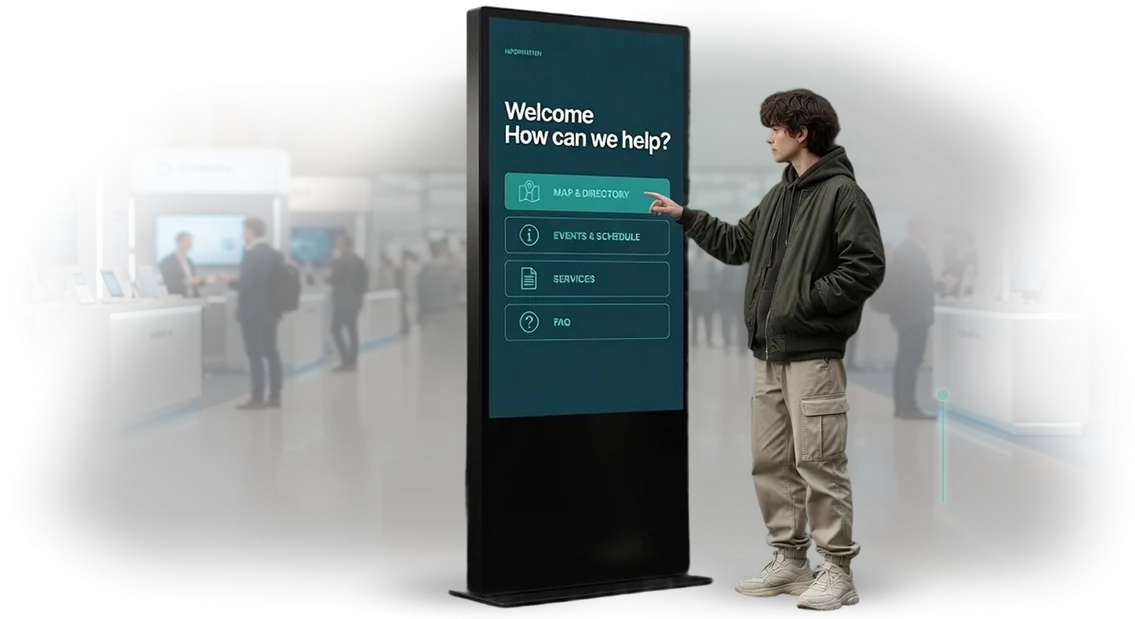
Information kiosks for parks close this gap. Interactive stands at key points along the route explain the trails in plain language, show where the visitor is and what interesting things lie ahead.
This is not just a replacement for a map, but a tool that helps people decide to stay longer and come back again.
We create such kiosks with visitor retention in mind: a clear interface without excessive detail, a quick answer to the guest's main question, and neat design that fits into the natural environment.
Navigation in natural areas stops being a problem — the guest feels confident, and you keep their attention and time. This is what turns a one-time visit into a lasting habit and makes the park a place people want to return to.
What an interactive kiosk will give your park
An interactive kiosk turns a visit to the park from a simple walk into a living introduction to nature. Visitors choose their own route, learn about rare plants and animals, watch photos and videos — and stay longer than planned. This is engagement: it directly influences the impression and the desire to return.
For the administration, the kiosk means automated information. Staff stop answering the same questions over and over, and guests get an up-to-date map, excursion schedule, and rules of conduct in any weather.
Mistakes and queues disappear, and freed-up time can be directed toward caring for the park and its guests.
Environmental education stops being a boring display board. Interactive materials with tasks and quizzes explain why you can't leave the trail or feed the birds — in a game format.
Such knowledge is remembered better and turns the visitor from a casual observer into a conscious friend of nature.
An additional plus — visitor data. Anonymous statistics show which routes and topics interest guests, when peak attendance occurs, and what raises the most questions. This information helps develop the park based on real demand rather than guesswork.
Finally, the kiosk works for the park's brand. A modern, convenient digital space emphasizes care for the guest and sets the territory apart from neighboring ones.
Guests share their impressions, come back themselves, and bring friends — so the investment in the kiosk pays off through increased loyalty and repeat visits.
Kiosk formats for different park tasks
Visitors to a nature park come with different questions: how to get to the observation deck, what to feed the animals, where the restroom is.
One universal kiosk is not always convenient — the entrance needs one format, the animal enclosures another, the educational center a third. That's why we offer a range of configurations: from compact stands to full-fledged educational pavilions.
Below is a table of formats most commonly ordered for nature parks and nature reserves.
| Format | For whom / where it is placed | What it gives the park |
|---|---|---|
| Information stand | At the entrance, ticket offices, waiting areas | Quick navigation, reduced staff workload, fewer questions |
| Floor-standing kiosk | In the lobby, by large exhibits, in crowded areas | Large screen, convenient for groups, engages visitors in interactivity |
| Outdoor touch panel | In open areas, by trails, viewpoints | Works in any weather, provides routes and information about nature |
| Educational kiosk | In eco-classrooms, nature museums, children's zones | Learning materials, quizzes, engagement of schoolchildren and families |
| Solutions for nature reserves | At ranger stations, visitor centers, checkpoints | Closed ecosystem, access control, visitor data collection |
Each format is not just "hardware" but a well-thought-out guest communication scenario. For example, an outdoor panel helps build a route without internet, while an educational kiosk turns waiting time into a game.
We combine formats: a main kiosk at the entrance, compact stands at attractions, game panels in the children's zone. The whole system is managed from a single interface — you change content without a programmer.
We will select the right format for your park: taking into account attendance, climate, territory specifics, and cost calculated after audit. Contact us — we'll show you examples and prepare a quote.
How we develop a kiosk: project steps
To ensure the kiosk truly solves the park's tasks — navigation, education, guest entertainment — it's important to build the process without surprises. We've long made it clear and transparent: you always know what stage the project is at and what you get as a result.
-
Brief and task immersion. We gather context: who the park's guests are, what routes they need, what content already exists, and what tasks the stand will solve — navigation, education, or engagement.
You receive a questionnaire that takes less than an hour to fill out, and we take the main load of defining the task off your shoulders.
-
Project plan and approval. We fix the screen composition, information structure, timeline, and budget. You see the stages and understand what you are responsible for. We sign a short document where everything is honest — no fine print or surprises mid-way.
-
Design concept and content. We design the interface to match the park's style: large buttons, readable cards, expressive photos and videos.
At this stage, you approve the visual style so the interface doesn't look "foreign" in its natural surroundings and appeals to both adults and children.
-
Development and content filling. We build the interactive interface, add your texts and media, connect maps and route descriptions. You get a working version that can be opened from any device and see progress every week.
-
Testing with real scenarios. We test visitor scenarios: how a guest finds the restroom, how a child opens information about an animal, how the stand performs under peak load. We fix everything before launch — you get confidence that the first day will go without failures.
-
Launch and maintenance. We install the software on the kiosk, check connectivity, and train the staff. After launch, we stay in touch: we update content, monitor stability, and respond quickly to questions. If the park wants to add new routes or activities after a season — it takes days, not months.
What you get in the delivery package
We put together a complete interactive kiosk package for you — not just a program, but a turnkey solution that works right after installation.
You won't have to refine anything, look for subcontractors, or figure out technical details: everything, from design to content, is already thought through and packaged.
Each element of the package solves a specific park task — from quick guest orientation to collecting statistics for reports. Here's what you get:
-
Kiosk software. A ready-to-use web application optimized for touchscreens. It works stably even under prolonged use — visitors won't see freezes, and you won't have to restart the kiosk during peak hours.
-
Custom design. Styling matching your park: branded colors, logo, nature photography. The kiosk becomes part of the landscape rather than a foreign device, and reinforces the territory's recognizability.
-
Kiosk content. We fill the system with your information: route maps, plant and animal descriptions, rules of conduct, event announcements. Texts are adapted for simple navigation — the guest finds what they need in 30 seconds without staff assistance.
-
Admin control panel. A personal account where you can update news, ticket prices, or photos yourself. Changes appear on the kiosk within minutes — no need to wait for a programmer or pay for every edit.
-
Staff training. A short session for your employees: how to turn the kiosk on, resolve common issues, replace content. Any park administrator can handle it without special knowledge.
-
Technical documentation. A simple set of instructions for your IT specialist or maintenance company. Includes connection diagrams, preventive maintenance schedule, and a list of frequently asked questions.
-
Warranty and support. We stay in touch after launch. If something goes wrong, you receive consultation or a fix within agreed timelines — kiosk operation will not be halted indefinitely.
In the end, you get not "a box with a program" but a working tool that improves service quality in the park and reduces the load on administrators: guests find answers themselves, and staff have more time for genuine care of visitors. We deliver the package with full confidence that it will be used every day.
Case study: how a kiosk increased visitor satisfaction in nature parks
Visitors to nature parks often get lost: routes are unclear, infrastructure is scattered, and paper maps become outdated by mid-season. Visitor center staff answer the same questions ten times a day, and guests waste time searching instead of walking. Nature Park "Lake Valley" came to us with exactly this pain.
We developed an interactive kiosk that replaced the information desk. Guests choose their own route, view an up-to-date trail map, and learn about rules of conduct and upcoming events — without queues and waiting.
Results after one season
Visitor satisfaction increased: 87% of guests rated navigation in the park as "excellent" compared to 64% the year before. Average dwell time increased by a third — guests reached key points instead of leaving the route. Overall attendance grew by 22%, and repeat visits by 18%.
"In the past, there was always a queue at the desk in summer, and we couldn't tell everyone about all the trails. Now the kiosk does it for us — each guest has their own pace and their own interests. People started coming back more often and bringing friends," notes the park director.
Over the season, the kiosk was used more than 40,000 times, and photos of routes from the screen spread across social media. That's free coverage that keeps working even after the season ends.
Convenient navigation directly affects guest loyalty and park popularity — and our case study confirms this.
Frequently asked questions about kiosk development
A kiosk in a nature park is not an office stand but a device that works outdoors. Rain, sun, dust, and even careless visitors — these are normal operating conditions.
We design enclosures and touchscreens with these loads in mind, so the equipment is not afraid of frost, high humidity, or heavy use.
The client's main fear is that the kiosk will break in the first season and turn into an expensive art object. We address this with construction and warranty.
Impact-resistant glass, weatherproof design, and internal temperature regulation — this is the baseline that minimizes the risk of failure. And if something does happen, there's no need to ship the kiosk to a service center. The modular construction allows a screen or board to be replaced on site by your administrator.
Warranty and maintenance. We provide an official warranty on the enclosure and electronic components. We keep spare parts for touch panels and mounting hardware in stock so you don't wait months for deliveries.
For remote facilities, we provide scheduled diagnostics — a specialist visits the site or connects to the system remotely.
Vandal resistance and weather protection. Anti-vandal construction is not just a thick screen but a whole protection system. A reinforced enclosure, concealed mountings, and overheat protection eliminate most of the problems common with ordinary outdoor information panels. The screen coating is non-glare, so content remains readable even on sunny days.
Return on investment and timelines. A kiosk in a park pays off through three sources: ticket sales for activities, sponsor banners, and staff savings. Visitors find information themselves and don't distract employees.
A standard project takes 2-3 weeks to build; a custom one with individual enclosure design takes 4-6 weeks. You get a ready solution that starts delivering value within the current season.
In short, the essentials: we handle protection from external impacts, provide fast repairs, and know how to make the kiosk useful rather than a burden for the park. Below are answers to common questions.
How to choose the right format for your park?
Choosing a kiosk format starts not with the screen but with the park's tasks. What matters more: helping guests find their way, telling them about nature, or entertaining them?
The answer determines the type of equipment, interface, and placement location, so we begin format selection with an audit of the territory and routes.
The criteria for choosing a kiosk are simple: number of visitors, entry points, and usage scenarios. A floor-standing kiosk with a large screen works well at the entrance — it immediately shows the map and routes.
In rest areas, compact stands that don't obstruct the view are suitable. The placement location affects screen size: the farther guests look, the larger the elements and the higher the required brightness.
Lighting also matters: in open areas, the screen must be readable in bright sun; in shade, standard brightness is enough. For queues, a vertical format with quick response is convenient; for relaxed browsing, a large horizontal panel.
If the main task is an interactive guide, the format combines a park map, plant and animal descriptions, and route building based on visitor interests. Such a kiosk reduces questions to staff and makes the walk meaningful.
We select the configuration for each park — from stationary pavilions to protected outdoor options — and support content updates. The right format saves time for guests and your team, and you get a ready solution for park recognizability and visitor comfort.
Order kiosk development for your park
To give park visitors a modern guide and yourself a manageable point of contact, start with a simple step: leave a request. After that, we take on the design, content production, and launch, while you control the result.
We work with nature parks and protected areas, so we take into account the specifics of these sites: open air, varying weather conditions, and the need to operate without constant supervision.
The result is an information kiosk that easily integrates into your route and reduces the load on staff.
After your inquiry, you receive:
- a specialist consultation — we'll discuss tasks, placement points, and usage scenarios;
- a preliminary cost and timeline estimate — you understand the budget and stages before work begins;
- a site visit — we'll inspect the location, check utilities, and prepare installation recommendations;
- a development agreement — we'll document the scope of work, timelines, and obligations of both parties;
- a launch plan with milestones — you know when the kiosk will start working and who is responsible;
- technical support after launch — information updates and operator assistance without additional approvals.
Let park guests get answers on their own, and let your team focus on developing the territory. Leave a request for kiosk development — we'll contact you within one business day, clarify the details, and offer a solution that fits your budget.