

Kiosks for sports clubs — why clients leave without booking
Every evening at a sports club it's the same: a queue forms at the administrator's desk. Visitors wait to book a workout, check the schedule, or buy a membership. Some of them get tired of waiting and leave — quietly, without booking, without leaving contacts.
Those who don't dare to approach often can't find the information they need. The schedule on the paper board is outdated, the coach is busy, and the club is already closing. A person leaves thinking "I'll figure it out later" — and never comes back.
Each such departure is a lost client and lost revenue. You won't find out why they didn't book, and you won't be able to offer them the right workout format. Without visitor data, it's difficult to build retention programs and increase the average check.
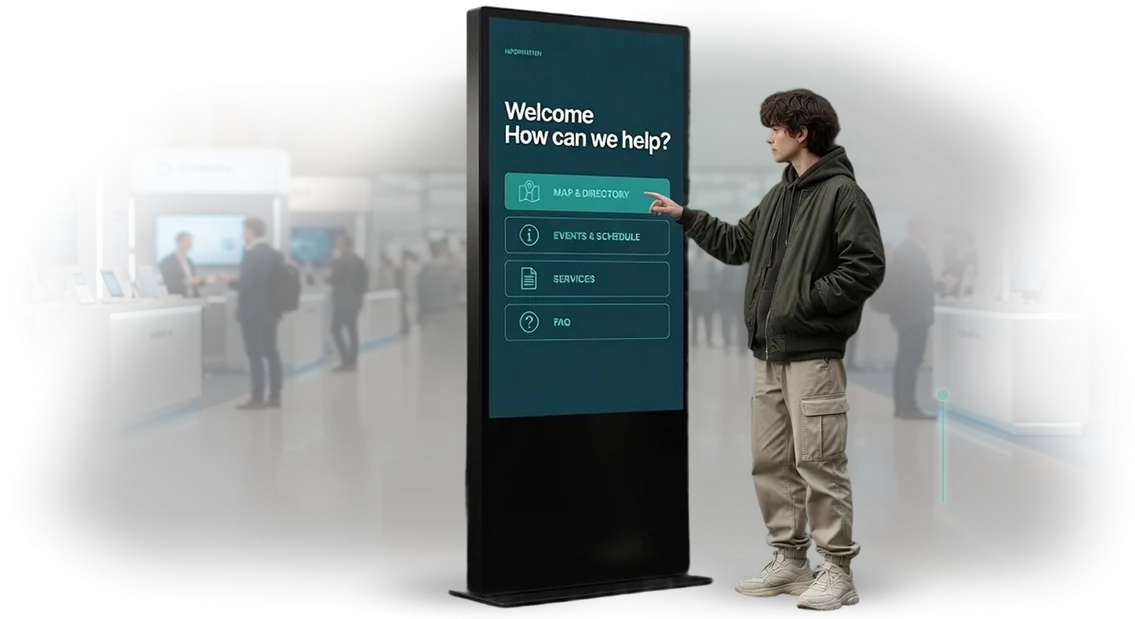
An interactive kiosk helps solve this problem. It takes over the routine: shows the current schedule, helps choose a direction, and handles club booking without an administrator.
The visitor gets what they need in a couple of minutes, and the club gets their contacts and willingness to return.
A self-service information kiosk is not a replacement for live communication, but a way not to lose those who value speed and independence. This is how we bring back to clubs those who previously left without booking.
What an interactive kiosk in your venue's lobby delivers
A visitor sees your club from the very first seconds — and that's when the first impression of your service is formed.
An interactive kiosk in the lobby turns waiting into useful time: the guest finds the right room on their own, checks the schedule, and books a workout without distracting the administrator.
The kiosk solves three key tasks: navigation, self-service, and loyalty building. Instead of a queue at the desk — self-booking in a couple of taps. Instead of "where are the locker rooms?" — a clear venue map. Guests feel cared for, and your staff focuses on live communication instead of routine.
For the club, this means more repeat visits and additional revenue. The kiosk suggests open slots, announces new group programs, and helps the guest book their next visit right after a workout. It's a simple and measurable loyalty mechanic.
We choose HTML5 and modern touch panels as the technology foundation for their stability and response speed. The kiosk starts instantly, doesn't freeze during peak hours, and updates easily remotely — without reflashing or downtime. It's a reliable tool, not just another "checkbox screen".
Head of a fitness club chain on the result: "Before, at peak hours a queue of five to seven people would gather at the desk. With the kiosk, booking takes less than a minute, guests stopped getting anxious, and administrators have time for everyone.
In the first month, kiosk bookings accounted for a third of the total flow, and this share keeps growing."
Interactive kiosk formats for any task
Sports club visitors value speed: checking in, booking a coach, buying a single session. Different club zones require different solutions, so we use three basic kiosk formats: a freestanding stand, a wall-mounted kiosk, and a mobile stand.
Each format covers its own scenario, and in combination they take the load off staff — from the reception desk to the gym entrance.
Below are the kiosk formats that help you choose a solution for a specific club zone and task.
| Format | Who it's for | What it gives the club |
|---|---|---|
| Freestanding stand (self-service stand) | Reception, lobby, waiting area | Relieves the administrator during peak hours: self-service membership checks, payments, schedule. Looks solid and sets the tone for the whole club. |
| Wall-mounted kiosk | Gym entrance, group program studio, corridors | Saves space and provides quick access to the schedule and workout booking. Ideal where a kiosk is needed but there's no room for a full stand. |
| Mobile kiosk | Events, open workouts, temporary service points | Moves around the club in a couple of minutes: at the entrance today, in the strength training zone tomorrow. One set covers several tasks at once. |
This approach lets you avoid overpaying for unnecessary features: each scenario gets its own format. And if you need to combine capabilities, we put together a hybrid version on professional touch hardware — the client gets stable operation and a neat look.
We'll help you choose the right kiosk format for your zones and tasks — just describe how the club is organized, and we'll propose a solution.
How kiosk development for sports clubs works
For a sports club, a kiosk is not just a screen with a schedule, but a tool that relieves administrators and helps visitors book workouts quickly. To make the result meet expectations, the development process needs to be clear and manageable.
We structure the work so that at every stage you see an intermediate result and can influence the final solution.
"Transparency of the process is the main thing a client needs. We regularly show intermediate versions, agree on details, and only then move forward," — this is how the team at our team works.
- Brief and task analysis. You tell us how the club is organized and which services are in demand, and we propose kiosk scenarios: booking group classes, buying a club card, navigating the zones.
- Layout approval. We create a screen prototype based on your brand identity and visitor logic. You see what each page will look like and make changes before development starts.
- Development and content. We build the interface, connect the schedule, and add information about coaches and services. At this stage the kiosk can already be tested on real scenarios.
- Testing and debugging. We check how the kiosk behaves under peak loads, fix issues, and make sure the interface is comfortable for both younger and older generations.
- Launch and training. We install the equipment, set up integration with your systems, and conduct training for administrators and staff.
- Support and development. After launch we stay in touch: update the schedule, add promotions and new features, and monitor operational stability.
This sequence eliminates misunderstandings: each stage ends with a concrete result that you approve personally. In the end, the kiosk becomes a reliable assistant for your club — for both visitors and staff.
What's included in delivery: ready-to-launch package
You receive not just software, but a complete working package — with design, instructions, and launch support. Everything needed for the information kiosk to start working in your sports club from day one is already included in the delivery.
- Configured software for your tasks — the program is installed on the kiosk, tested, and ready to use: workout schedule, club news, promotions, and coach booking.
- Screen design mockups — all pages are designed in your club's brand style so the kiosk looks like part of the reception or waiting area.
- Clear documentation — a short guide for administrators and staff: how to turn it on, update the schedule, replace the poster. No technical details, plain language.
- Staff training — we record video tutorials or run a short webinar so your managers can manage kiosk content on their own without contacting developers for every small thing.
- System warranty — for a fixed period we fix any kiosk errors for free. This is written into the contract, not just promised verbally.
- Launch assistance — in the first days after installation we connect remotely or in person, check that everything works stably, and quickly resolve any questions from your staff.
This approach removes the main risk: you're not left alone with an unfamiliar device. Warranty, training, and all materials are included in the work — nothing needs to be purchased or ordered separately.
In the end, the kiosk becomes a working tool from day one, not a source of questions: it welcomes visitors, shows up-to-date information, and relieves administrators.
Case study: how the kiosk increased workout bookings
The Atlant sports center had constant booking problems: phone calls, queues at the administrator, human errors. During peak hours clients waited 15–20 minutes, many left without booking, and coaches received incomplete group lists.
We proposed installing an interactive touch kiosk for self-booking. The screen in the lobby works as an independent booking stand: the visitor selects a direction — from yoga to strength training — sees the coach's available slots, and reserves a spot in a couple of taps. Payment can be made right at the kiosk or left as a request for a manager.
The results were noticeable within the first month. About half of all new requests came through the kiosk, the peak-hour queue halved, and administrators were freed from paperwork.
As a bonus, the share of repeat bookings grew — clients come back because now they can plan workouts in a minute.
The sports center director's feedback is telling: "Before, people left without waiting for a booking, and we lost up to 15% of inquiries. After installing the kiosk, the number of requests grew by 40%, and complaints about queues practically disappeared. Visitors book themselves even outside working hours — convenient for them, peaceful for us."
This case is a clear example of how a simple self-booking point changes a sports club's operations: higher conversion, less load on staff, and concrete payback figures.
How to choose the right kiosk format?
Choosing a kiosk format is not about "more expensive or cheaper", but finding a solution based on three parameters: the floor area, the tasks the kiosk must handle, and the budget the club is ready to allocate.
If these three points are defined correctly, you get a scenario that pays off from the first month and doesn't require rework six months later.
Let's start with the floor area. For a small administrator desk or a narrow reception zone, a compact wall-mounted kiosk is more convenient — it takes up minimal space, doesn't block the walkway, and looks neat.
If the club has a spacious lobby, a waiting area, or a separate gym entrance, a floor-standing kiosk becomes a noticeable point of attraction: a large screen, a sturdy body, and more opportunities for visitor interaction.
The second parameter is tasks. It's one thing when the kiosk is only needed for viewing the workout schedule, and another when guests use it to book group classes, check their membership, pay for additional services, or leave a request for a personal training session.
The wider the functionality, the larger the screen and the more polished the interface needs to be, so a visitor can figure it out in seconds without staff help.
The third factor is budget, and here it's important not to overpay. For a club that just needs to relieve administrators and speed up bookings, a basic configuration with a single scenario is enough.
For a club that wants to increase sales of additional services and collect visitor contacts, it's worth choosing a model with a larger screen and expanded functionality. We help find the balance: you get a format that solves the club's tasks, not a set of unnecessary options.
The bottom line is simple: choosing a format is not guesswork, but a step-by-step fit to your situation.
Tell us the floor area, usage scenarios, and budget range — we'll offer specific options with visualization, explain the difference between them, and prepare a solution that fits both your space and the club's goals.
Frequently asked questions about development and support
Any project is not just about launch. For a sports club, it's important to understand what happens after: how quickly we respond to an outage, who is responsible for content, and whether content can be changed without development. We answer these questions in advance so you know your service level right away.
What happens if the kiosk breaks during operation?
No need to panic. We have a clear procedure: you report the issue — we connect remotely and restore operation within the working day.
If the equipment is physically damaged, we quickly provide a replacement, and during downtime we can open the necessary information on the administrator's tablet or phone — guests won't feel the difference.
Who will update the content on the kiosk?
You can do it yourself through a simple control panel: change the workout schedule, add a promotion, or replace a video — no programmer needed. Or you can leave it to us: we handle regular content updates and adapt to your events calendar.
How quickly can schedule or promotion changes be made?
Changes are usually published within an hour of the request. We deliberately made the system flexible: texts, prices, photos, and even the menu structure can be changed in a few clicks. We only coordinate major design changes so the layout doesn't fall apart.
Didn't find your question? Write to us — we'll suggest a solution for your club and your workflow.Discuss your project — leave a request
Developing an information kiosk for a sports club is a project where both technical reliability and convenience for your visitors matter. To offer a precise solution, we need to understand the club's tasks: workout booking, schedule, membership payments, or gym navigation. Leave a request — and we'll help you figure out which format suits you best.
After your request you'll receive:
- a consultation with a specialist on kiosk capabilities for sports clubs;
- a development cost estimate based on your tasks and chosen format — wall-mounted, floor-standing, or mobile;
- demo access to a working prototype where you can evaluate the interface and main scenarios;
- recommendations on integration with your client management system and electronic memberships;
- an implementation plan and a list of required equipment;
- an assessment of launch timelines and post-project support.
We start every project with a consultation — this allows us to accurately determine the scope of work and avoid unnecessary expenses. You'll receive a transparent estimate with no hidden fees.
To order a kiosk or simply discuss an idea, fill out the form on this page. We'll contact you during working hours, clarify the details, and prepare a tailored proposal for your sports club's tasks.