

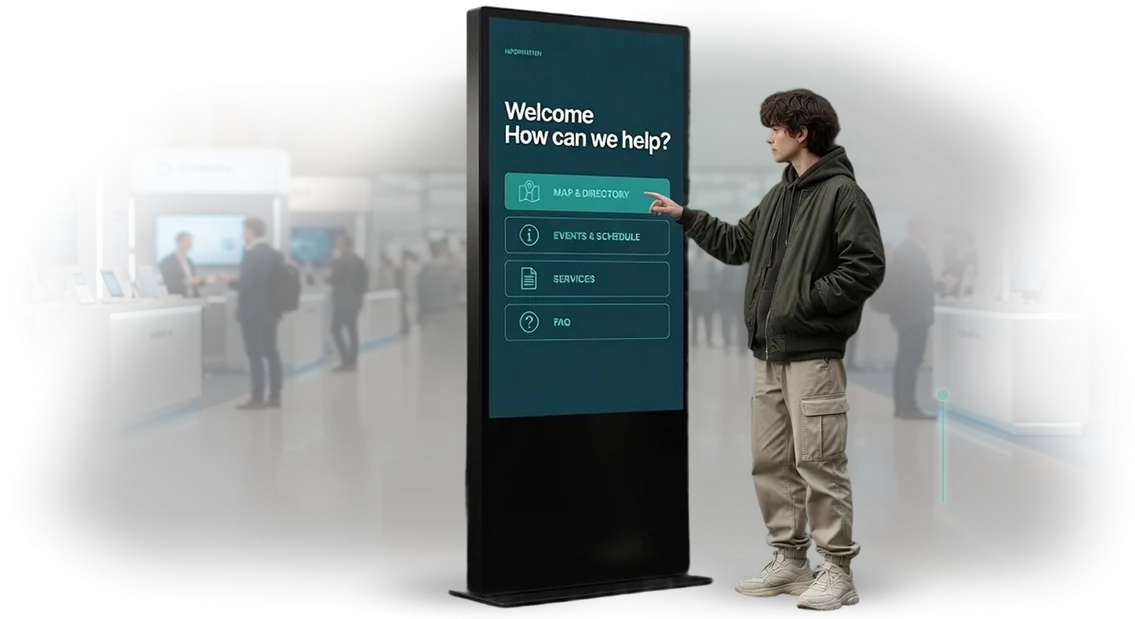
Interactive Kiosk for Dental Clinics: Patient Retention
Queues in dentistry are the main reason patients leave for competitors. A person arrives for an appointment but is forced to wait in an overcrowded area, not understanding how much longer it will take, and not getting answers to simple questions.
As a result, even a good clinic loses up to a third of repeat visits — simply due to disorganized service.
An interactive kiosk for dental clinics changes this. Patients book a convenient time themselves, see the current queue status, review service prices and information about doctors. All of this — without an administrator's involvement, at a pace that's comfortable for the person.
Such a solution directly impacts patient retention. When people feel that their time is valued, they return and recommend the clinic to acquaintances.
The kiosk reduces staff workload, shortens waiting time and raises the level of service in the clinic — what sets modern dentistry apart from the ordinary.
We have been developing interactive kiosks for over 10 years and know how to make them convenient for patients and staff. We work remotely and deliver the project ready to use: from the interface to integration with your booking system.
The kiosk pays for itself through increased loyalty and repeat visits. If you want patients to choose your clinic — start with a convenient service that's visible from the doorstep.
What an Interactive Kiosk Will Give Your Clinic
Every patient values their time, especially when it comes to health. Long waits in line and filling out paper records create tension before the appointment even begins.
An interactive kiosk in the clinic lobby changes this scenario: visitors book a convenient time themselves, see current services and prices, and the registrar is freed from routine recurring questions.
Thanks to this, queues shrink significantly, and patient flow is distributed evenly throughout the day. Front desk staff focus on communication and complex questions rather than on filling out documents.
The atmosphere becomes calmer — and that's the first thing patients notice and tell their acquaintances about.
Beyond speed, the kiosk increases loyalty. Patients see the clinic's care for their comfort: clear navigation, service hints, the ability to rebook or check examination results.
The fewer barriers in service, the more willingly people return and recommend the clinic to family and friends.
Finally, the interactive kiosk directly increases the number of bookings. Patients can be offered additional procedures, reminded about a preventive check-up or invited to book the next visit right away.
This way, the clinic gets a steady stream of patients without extra calls and reminders — you just need to configure the interaction scenarios correctly once.
An interactive kiosk is not just a screen in the lobby but a tool that pays for itself through higher room utilization and a larger average check. It integrates into the clinic's existing infrastructure and starts working from the first day of installation.
Formats of Interactive Kiosks for Dental Clinics
In dentistry, the administrator's time is the clinic's money. While staff answer calls about schedules and prices, attention shifts away from patients in the chair, and the queue at the front desk only grows.
An interactive kiosk automates this routine: patients learn about services, choose a doctor and book a convenient time — without the administrator's involvement.
We offer flexible configurations for a specific clinic's needs: from a simple information stand to a full booking and payment center. By choosing the right format, you reduce staff workload and speed up service.
| Format | For whom | What it gives the clinic |
|---|---|---|
| Information kiosk | Small clinics, lobby and waiting area | Introduces services, prices, doctors and promotions — patients study the information themselves, the administrator is freed for current tasks |
| Booking kiosk | Clinics with a steady patient flow | Patients choose a doctor and convenient time on the screen — the booking immediately enters the schedule, fewer errors and missed calls |
| Full booking with payment | Large centers, clinics with corporate health insurance | Self-service booking of a service and on-site payment — up to a third of bookings go through without staff involvement |
Which format to choose depends on the patient flow and how busy the administrators are. We'll help determine the optimal configuration and set up the kiosk for your processes so it brings value from the first day.
How a Kiosk Development Project for a Clinic Proceeds
For a clinic, a kiosk is a tool that relieves administrators and improves patient comfort. We structured the process so you understand every stage and control the outcome. We handle the technical details.
- Brief. We discuss the tasks, study the patient flow and typical questions. We capture the goals and timelines in the technical specification.
- Prototype. We show a mock-up of all screens and scenarios: booking, navigation, services. You make edits before development — without extra costs.
- Design. We adapt the interface to the clinic's brand identity: logo, colors, fonts. Patients feel your brand from the first screen.
- Development. We create a web application for the touch kiosk and test it on real hardware. The system works stably even at peak hours.
- Implementation. We install the application and set up the connection to the doctors' schedule. We train administrators in operating and updating content.
- Support. We maintain the kiosk: updates, backups, security. We handle requests quickly — the equipment won't disrupt appointments.
- Evolution. We analyze feedback and propose improvements. We add payment, questionnaires and integrations as the clinic grows.
We have already completed more than 40 projects for dental clinics. At the Denta-Lux clinic, after launching the kiosk, waiting time in line halved, and administrators stopped answering recurring questions. We work remotely but stay in touch at every stage.
What's Included in the Interactive Kiosk Delivery
When you order an interactive kiosk for dentistry, you get a ready-made turnkey solution — without separately purchasing hardware or hunting for programmers.
The delivery already includes equipment, software, content, training and warranty, so the clinic launches the kiosk quickly and incurs no hidden costs.
What the package includes:
- Kiosk equipment — a touch-enabled enclosure designed for a clinic lobby: protected against scratches and moisture, operates flawlessly.
- Software — a control panel through which staff themselves update promotions, prices and doctor information, without calling a developer.
- Dental content — sections for services, prices and appointment booking, ready for use from day one.
- Staff training — instruction for administrators: how to guide patients, use the kiosk and resolve common questions.
- Launch and setup — installation, connection and verification of all scenarios: navigation, service viewing, running promotional materials.
- Warranty and support — equipment maintenance and software consultations during business hours, remotely or on-site.
Each item addresses a specific clinic need: relieves administrator workload, speeds up booking and makes services clear for patients. It's easier for patients to understand the services, and the clinic gets a modern service without extra spending on lobby advertising.
Case Study: Interactive Kiosk in Dentistry — 30% Booking Growth
For a private dental practice, booking is a point of loss: the administrator is busy on calls, a queue forms in the lobby, and some patients leave without ever getting served.
For the DentaLux clinic network, we solved this with an interactive kiosk in the lobby: patients choose the specialty, doctor and time themselves, and the booking immediately enters the shared schedule.
Implementation Results
The project took three weeks: we developed the scenario, agreed on the services structure and installed the kiosk. Another month was needed for the staff to get used to the new system and start using it as their main tool.
Two months after launch, bookings grew by 30%, administrators stopped working in a constant call mode, and the queue in the lobby decreased several times over.
Importantly, it wasn't just the load numbers that grew: every second patient was able to book a slot for the nearest day, something that couldn't be done quickly before.
Average booking time dropped from 7 to 2 minutes, and the share of visits where a person left without a booking practically disappeared. For the clinic, this means not a one-time effect but a steady additional flow.
Clinic Feedback
The head physician assessed the result this way: "Patients no longer need to wait until we're free, and this immediately showed in loyalty. People choose a convenient time and doctor themselves, and we see a full schedule without extra calls. Two months in, bookings grew by 30% — and this is only the beginning."
We didn't just install a touch screen — we designed a scenario for patients of different ages. The kiosk provides hints at every step, so there's no need to put an extra staff member nearby.
Such a solution pays for itself not through staff cuts but through additional bookings and fewer lost clients — exactly the metrics that matter to a clinic owner.
How to Choose the Right Format for an Interactive Kiosk?
Choosing an interactive kiosk begins not with the model but with the clinic's goals and the characteristics of the space.
For a small reception desk or narrow corridor, a compact wall-mounted kiosk is sufficient — it takes up no usable floor space and lets patients book an appointment or call an administrator without waiting in line.
In a spacious lobby, a floor-standing kiosk with a large touch screen looks better: it becomes a prominent navigation point and handles the patient flow without creating bottlenecks.
The second criterion is the intensity of the flow. If more than a hundred visitors pass through the clinic daily, a single device will create a queue.
In that case, it makes sense to install two or three compact kiosks in different zones or choose a modular design that allows adding screens as load grows. For a private clinic working by appointment with a small number of patients, one universal device is enough.
The third factor is the functionality you plan for. A kiosk can simply display information about doctors and services, or it can automatically book appointments, send reminders and sync with your clinic management system.
The more tasks you place on the device, the more important it is to discuss the operating scenarios with the contractor: what the patient sees on the start screen, how specialist selection works, and where the data goes. This affects not only visitor convenience but also real time savings for administrators.
Finally, consider the long term. A cheap kiosk that can't be adapted to schedule changes or new features will need to be replaced within a year. Better to choose a format that's easy to update: information blocks change, new sections appear, additional modules connect.
Then your investment works for the clinic's image and improves service quality — patients appreciate not having to stand in line just to check the schedule or book an appointment with the right specialist.
Answers to Frequently Asked Questions About Clinic Kiosks
Before buying a kiosk, a dental clinic director has three main concerns: whether the equipment will fail at the busiest hour, who will update prices, and what about the warranty. These are normal doubts — especially if you have no experience with professional interactive systems.
Below we answer the questions we hear most often in negotiations with clients. Let's say it right away: the kiosk is not an extra device but a manageable tool that requires no special knowledge from your staff.
What happens if the kiosk breaks down?
The probability of an unexpected breakdown is minimized: we use industrial components designed for round-the-clock operation. In case of a failure, remote diagnostics, a replacement kit and an engineer's visit on an agreed day are provided — patient appointments won't stop.
How do we update prices and promotions?
Through a personal account: the administrator changes the text and numbers on the screen without a programmer, and the changes apply immediately. No requests to the contractor and no waiting for several days.
What warranty and support do you provide?
We provide a warranty on the equipment and software, carry out scheduled maintenance and monitor the kiosk's condition remotely. If a question arises — you write to support and receive instructions or a solution within one business day.
Won't elderly patients be afraid of the screen?
We design the interface with an older audience in mind: large buttons, a clear structure, and a "call the administrator" screen. The kiosk doesn't make life harder for patients — it speeds up booking and takes part of the load off the front desk.
If you have any other doubts — ask us directly. We'll show you the kiosks in action and answer questions about timelines and integration terms specific to your clinic.Order Development of an Interactive Kiosk for Your Clinic
Leave a request for a kiosk and receive a ready-made turnkey solution — without the need to dive into technical details. We take on the full cycle: from analyzing patient flows to launching the touch terminal in the clinic lobby.
After your first inquiry, you receive a transparent project plan, fixed timelines, and an understanding of how the interactive kiosk will increase visitor loyalty and relieve administrators. Here's what the work includes:
- Consultation on kiosk usage scenarios specific to dental practice — navigation, doctor booking, service catalog.
- Demonstration of interface references already working in clinics and favored by patients.
- Calculation of cost and timelines for turnkey development with a clear list of stages.
- Approval of the design and menu structure before programming begins.
- Testing with real users and refinement based on pilot results.
- Staff training and technical support after launch.
Ordering a kiosk from us means getting a tool that pays for itself through reduced front desk workload and increased bookings via self-service.
Patients value speed: instead of queuing at the administrator's desk, they immediately see open doctor slots and can book a convenient time.
We work remotely and have already supported projects for high-traffic clinics. That's why we know how to make an interface intuitive even for those approaching a touch screen for the first time.
All settings and content are updated remotely — you don't need to change the firmware or wait for a programmer.
Leave a request for a kiosk — in response, we'll send a commercial proposal with implementation options and recommendations tailored to your clinic.
After discussing the details, we'll lock in the timelines and begin work, so that within a few weeks patients are using a convenient service, and you see results in bookings and reviews.