

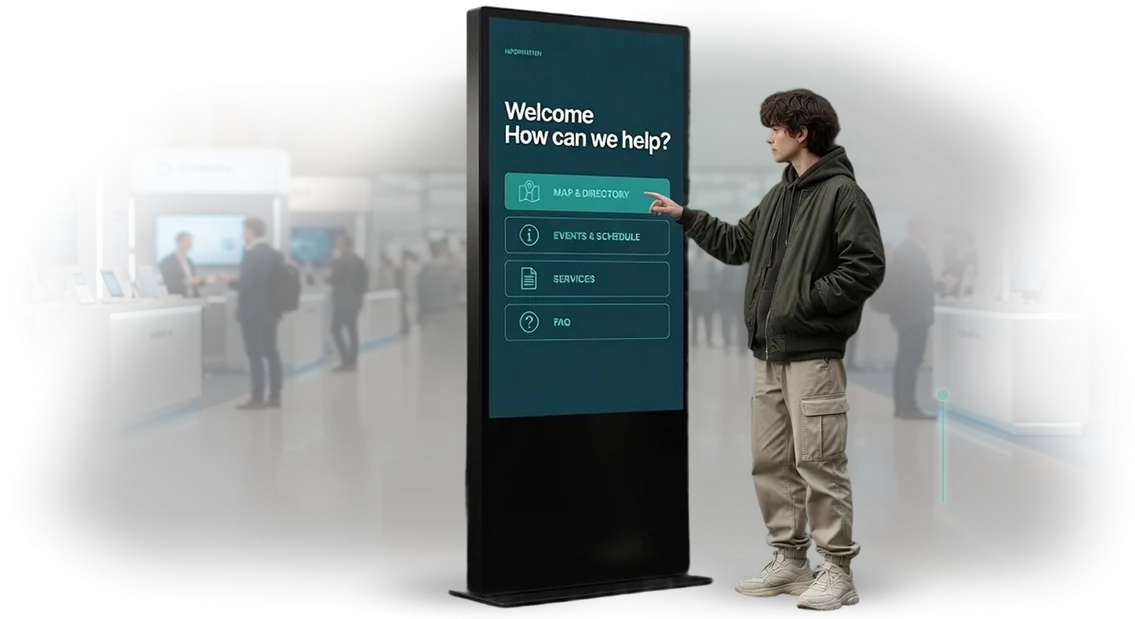
Guests Leave Without Ordering: How a Restaurant Menu Kiosk Saves Revenue?
Guests leaving without ordering is not about an “inconvenient location” but about lost revenue. During peak hours, the line at the cash register grows, visitors see the wait and turn around, and those who stay order less to free their table faster.
Each such departure is not only a lost check today, but also the risk that the guest will not return: they will remember a bad experience, not the taste of your dish.
An outdated paper menu adds more problems: items are no longer current, prices have changed, and making edits means reprinting and new expenses.
The guest spends time browsing, hesitates, asks the waiter questions — and the average check drops, because the “visible” doesn’t sell and the “needed” isn’t found.
Service speed directly affects profitability: the faster a guest chooses and pays, the more table turns per evening and the higher the profit from every square meter.
While you solve these issues manually, competitors are already automating ordering. The solution exists — a restaurant menu kiosk that cuts selection and payment time to a couple of minutes, eliminates queues, and makes the menu flexible.
It doesn’t require the guest to understand technology — just touch the screen, and all changes to the assortment and prices are made in a couple of minutes without a print shop or waiting.
We help restaurants implement such kiosks so they immediately affect revenue: guests order faster, the average check grows through upsells, and queues stop scaring visitors away.
What Benefits Does Order Automation Bring?
A restaurant menu kiosk is not just a replacement for a waiter, but a tool that directly affects revenue. Order automation delivers several key effects at once: growth in the average check, increased hall throughput, and fewer order errors. Each one alone pays back the investment, and together they noticeably increase profit.
Through intelligent prompts and visually appealing dish photos, the kiosk actively encourages upsells. It’s easier for the guest to add a drink to a burger or a dessert to coffee — the system itself suggests suitable items at the right moment.
As a result, the average check grows by 10–15% without pressure from staff and without feeling pushy.
The kiosk speeds up order placement several times over, especially during peak hours. The guest chooses dishes independently, while freed-up staff focus on table service and maintaining the atmosphere.
This means more guests in the same amount of time, shorter queues, and, as a result, growth in the restaurant’s total revenue.
Errors in transmitting orders to the kitchen almost disappear. The guest sees their selection on the screen, confidently confirms it, and the data immediately goes into the kitchen system.
This eliminates misunderstandings, remade dishes, and guest dissatisfaction, which directly affects their loyalty and desire to return.
Fast and accurate service is memorable — the guest has a positive experience and recommends the restaurant to friends. Together with the growth of the average check and staff savings, this delivers a steady profit increase within the first months after implementation. Order automation becomes a growth point, not just a technology trend.
Menu Kiosk Formats in a Restaurant: Which One to Choose?
Customers are used to choosing with their eyes and finger: an interactive menu removes queues and increases the average check. But it is the kiosk format that determines how guests will use it and whether the investment pays off.
The same restaurant menu kiosk works differently in fast food, a coffee shop, and a family café — so first you choose the scenario, then the equipment.
We compared three popular formats so you can understand in advance which option suits your establishment and goals.
| Format | For whom | What it gives the guest |
|---|---|---|
| Floor-standing kiosk | Fast food, food courts, high-traffic venues | Quick ordering without a queue, increased throughput |
| Tabletop kiosk | Cafés and restaurants with table service | The guest calmly chooses and adds to their order, the average check grows |
| Counter touch terminal | Coffee shops, bakeries, burger joints | Compact placement, instant self-order and payment |
A floor-standing kiosk pays off where guests drop in “on the go” and aren’t willing to wait. The tabletop format suits venues with a cozy atmosphere: the guest browses the menu without rushing, while the waiter handles service rather than taking orders. A counter touch terminal saves space and works great where every square meter counts.
The main selection principle is to look not at the screen size, but at guest behavior and hall occupancy.
We’ll help you choose a format for your space, traffic, and kitchen, and during launch we’ll make sure the kiosk speeds up staff work and delivers measurable benefits from the first weeks.
Step-by-Step Plan for Implementing a Terminal in Your Establishment
So you know the implementation stages and approximate launch timelines in advance, we’ve structured the process as a transparent sequence of steps. No surprises: at every stage you see the result and make a decision. The standard launch time is two to four weeks from design approval.
- Brief and venue analysis — we discuss the menu concept, guest flow, and your goals. We prepare a personal proposal on the terminal format and installation points.
- Design approval — we develop an on-screen design layout in your brand style, show it on a real device, and make edits until full approval.
- Menu content — we transfer dishes, prices, photos, and descriptions. We add promotions and recommended items to increase the average check and speed up selection.
- Testing and debugging — we check the terminal in your venue’s conditions: load speed, stability, and guest convenience. We resolve all issues before launch.
- Staff training — we conduct a short training session for waiters and bartenders: how to help guests during ordering, quickly solve issues, and stay focused on service.
- Launch — we install the equipment, connect it, and run a final check. On launch day, the terminal is already taking the first orders.
- Support and development — we stay in touch: we update the menu, add new dishes and features, and monitor uninterrupted operation. You can request improvements at any time.
What Is Included in the Delivery Set and What Do You Get?
When you order a restaurant menu kiosk, you get not just a device, but a complete turnkey solution. We put together a full package: equipment, interface, content, staff training, and warranty — all you have to do is place the kiosk in the hall and use it.
The delivery set includes:
- A touch kiosk in a protected enclosure: resistant to moisture, dust, and accidental impacts, designed for intensive use in the hall.
- Menu kiosk interface: dish photos, descriptions, prices, highlighting of bestsellers and new items — all in your venue’s style.
- Content filling: we upload your menu, categories, promotions, special offers, and allergen warnings.
- Control panel: you update dishes, prices, and photos yourself without a programmer or extra costs.
- Installation and setup: we deliver, install, connect to the network, and check operation before opening.
- Staff training: we help waiters and administrators confidently work with the kiosk from day one.
- Warranty and support: service during the warranty period and prompt resolution of issues.
- Documentation: clear instructions for staff and a daily maintenance checklist.
After launch, we don’t disappear. Our engineers are available by phone and remotely, and come on site if needed. Training takes no more than a couple of hours — employees quickly get the hang of it, and visitors start ordering on their own.
Thus, you get a single package from one team — without hunting for separate contractors for equipment, design, and setup.
This saves launch time and reduces risks: all parts of the system are coordinated with each other, and the warranty and support are covered by a single contract.
How Order Automation Paid Off in a Venue in One Season
Case Study: One Season — and the Break-Even Point Was Reached
For the urban café chain Listva, we implemented menu kiosks in two high-traffic locations. Before that, during lunchtime a line of 10–12 people would build up at the cash register, and some guests left without waiting for their order.
The staff worked at their limit: one person took orders, another handed them out, but speed didn’t save the situation.
We placed kiosks at the entrance and set up the menu, prompts, and payment flow. After two months, we compared the metrics with the previous season. The average check grew by 18%: the system itself suggested adding a drink or dessert to the main dish, and visitors gladly agreed.
Peak-hour queues nearly halved, and waiters stopped being distracted by the checkout and focused on serving and engaging with guests. During peak hours, the kiosk processed an order in a minute — even at rush hour, no one left.
By the end of the season, revenue at the kiosk locations grew by 20% compared to the previous period.
The payback came after just four months — that is, in the middle of the same season. An additional bonus was that guests who tried ordering through the kiosk returned more often: the share of repeat visits grew by a quarter. The venue is already expanding the project to three new locations.
What People Ask Before Launch: Answers to Doubts
Doubts before launch are normal: any new equipment in a restaurant raises questions like “won’t it break?”, “will the staff cope?”, and “isn’t it too expensive?”. Let’s go through them point by point — briefly and to the point, just as we answer these questions for every client.
Breakdowns Are Rare, Not the Rule
Our kiosks are built on industrial components designed for round-the-clock operation in food service. This is not consumer electronics: the enclosure is impact-resistant, the screen is scratch-resistant, and the cooling system copes even in a kitchen next to the stove.
If something does happen, we have remote diagnostics and spare parts in stock. In most cases, we resolve the issue in a single engineer visit, and provide a replacement device while the repair is underway. Your restaurant doesn’t sit idle.
Staff Will Be Trained in One Day
Employees will take orders through the kiosk rather than running to every table. Our engineers conduct training right on site — we show how the system works, how to change the menu, and how to handle typical situations. Usually a couple of hours is enough for waiters and the administrator to feel confident.
New employees will also catch on quickly: the interface is intuitive, and all prompts are in Russian, without special jargon.
The Cost Pays Off Through the Average Check
The kiosk doesn’t just take orders — it boosts sales: it shows dish photos, highlights advantageous items, and suggests adding to the order. On average, guests order 15–20% more, and the average check grows.
With this scenario, the investment pays off in a few months — after that, the kiosk works for your profit.
What You Get as a Result
| Format | For whom | What it gives the guest |
|---|---|---|
| One kiosk at the entrance | Small café or restaurant with a hall of up to 40 seats | Speeds up service during peak hours, relieves the checkout and waiters |
| Several kiosks | Medium and large restaurant, chain | Reduces queues, increases hall throughput by a third |
| Self-service terminals with integration | Business with its own accounting system | Automatic transfer of orders to the kitchen, fewer staff errors |
How the Launch Goes
- Brief: we study your hall, menu, and guest flow to propose an optimal layout.
- Configuration selection: we choose the kiosk model for your tasks and budget.
- Installation and setup: we arrange the equipment, set up the menu, and connect it to the cash register.
- Staff training: we conduct training for administrators and waiters.
- Test period: together with you, we check operation in real conditions.
- Launch and support: we stay in touch, update the menu, and help with any questions.
What Is Included in the Package
- A kiosk with a touchscreen that isn’t afraid of the hall.
- Software with your menu, dish photos, and prices.
- Integration with your cash register system (if needed).
- Staff training and instructions in Russian.
- Warranty on equipment and software.
- Remote support and engineer visits when necessary.
- Menu updates — we’ll help even if you do it yourself.
Example from Practice
In one restaurant with seating for 60, we installed two kiosks at the entrance. Within two hours after installation, the system took 120 orders — waiters only delivered the dishes.
The average check grew by 18%, and guests started returning more often because they no longer had to wait for a table to free up. The restaurant ordered a third kiosk a month later.
What if the kiosk breaks down — will we be left without sales?
No. We have a replacement pool: while your kiosk is being repaired, we bring a temporary one — operations don’t stop. Plus, remote diagnostics resolve the problem in most cases without an engineer visit.
The staff will resist — what to do about it?
Usually resistance appears only until the first shift. When waiters see that the kiosk takes routine orders and tips remain, their attitude changes. We train staff so that within a day the kiosk is seen as an assistant, not a competitor.
Is it expensive for a small restaurant?
We consider not the cost of the kiosk, but the return on investment: through the growth of the average check and service speed, the kiosk pays off in 3–6 months. For small venues, there is a rental model — you pay a fixed amount monthly and don’t freeze working capital.
Leave a Request — and Get a Calculation for Your Task
Leave a request for a calculation — it doesn’t obligate you to anything. Within one business day, our engineer will contact you to clarify how your restaurant is structured: how many halls, what capacity, and how the kitchen and checkout are organized.
Based on this data, we’ll prepare a cost calculation for a menu kiosk tailored to your tasks — with exact figures for equipment, installation, and setup.
Then everything follows a proven plan:
- Request — you leave your contacts on the website or by phone, and we record your task.
- Feedback — we call you back within one business day, clarify details, and answer questions.
- Cost calculation — engineers prepare a budget and timeline estimate, and you see a full estimate with no hidden fees.
- Approval — we offer implementation options, and you choose the one that fits your interior and budget.
- Launch — we install the kiosks, connect them to the cash register system, and train staff to work with the new equipment.
- Support — we update the menu, monitor performance, and help when needed.
After the calculation, you’ll receive specific figures and recommendations for automating orders in the restaurant.
We offer a trial launch on one kiosk — in a couple of weeks you’ll see how service speed and the average check change, and then we’ll scale the solution to all halls or locations.
Leave a request through the form on the website or by phone — and on the same day you’ll know how much such a project costs and what results it will bring to your restaurant. We work across the entire country and guarantee support at every stage.
How to Choose the Right Format for Your Establishment?
There is no universal format: the choice depends on the type of establishment, guest flow, and budget. A takeaway coffee shop values service speed, while a restaurant with waiters values atmosphere and guest recommendations.
So first we look at how your guests place orders: quickly and independently, with assistance, or through a staff member. This determines what suits you — a compact counter kiosk, a separate touch stand, or a terminal with a large screen.
Then we take into account traffic and space. For a high-traffic spot near the entrance, a stationary kiosk wins: it takes orders while staff are busy.
For a compact location, a tabletop format is better — it doesn’t clutter the hall and allows guests to browse the menu without rushing. And if guests are used to consulting with the waiter, the kiosk complements service rather than replacing it.
Budget also matters, but we select the format based on your tasks: a cost-effective solution for a seasonal location or an investment terminal for years.
The cost immediately includes menu setup, integration with the accounting system, and staff training — with no hidden surcharges.
That’s why we offer a short audit of your establishment: location, concept, typical guest, and service pain points.
Based on this, we provide two or three options with clear results — where and how waiting time will be reduced, the average check will grow, and staff will be freed up. You choose the option for your goal, and we take care of the rest.