

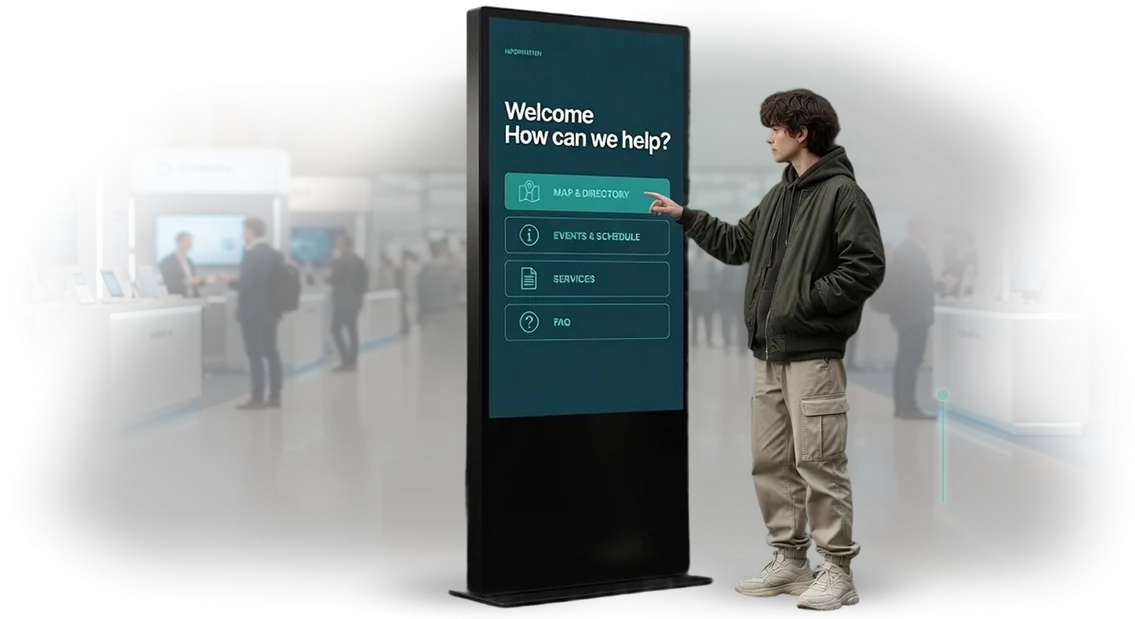
Customers Leave Because of Queues: How Self-Service Kiosks Are Changing Service
Queues are not just an inconvenience—they are a direct loss for a business. When a customer sees a long line, they decide not to wait and go to competitors instead—and next time they will go straight there.
Every such departure means a lost sale today and lost loyalty for years to come, and winning a customer back is always more expensive than keeping them now.
The problem is especially acute during peak hours: lunchtime in a cafe, evening in a pharmacy, appointments in a clinic, document issuance. Staff work at full capacity, but the speed still doesn't satisfy people—and they vote with their feet. The result is missed purchases, negative reviews, and a lower average check.
A self-service kiosk changes this dynamic: instead of one operator, there are several terminals working without breaks or weekends. Placing an order or accessing a service takes minutes, not tens of minutes of waiting.
The customer stops getting frustrated, service becomes fast and predictable—people are more likely to stay, order more, and come back.
We develop such kiosks for your specific field: we analyze bottlenecks, design clear user flows, and launch a solution that relieves staff and increases revenue.
We have dozens of implementations across various industries behind us, so we know how to eliminate queues so seamlessly that the customer doesn't even notice—and comes back again.
What Benefits Does an Interactive Terminal Bring to Business
An interactive terminal is not just a screen at the entrance, but a full-fledged point of customer contact. It handles routine operations and frees people for tasks that require real human interaction.
As a result, the company speeds up service, and visitors no longer stand in queues and leave with a positive impression.
The first and most obvious benefit is speed. Customers can independently choose a service, submit a request, or pay for a purchase in a minute, without waiting for a consultant.
During peak hours, the terminal processes traffic several times faster than a human employee, and customers appreciate it when their time isn't wasted. This directly impacts the throughput of the location and the average check.
The second benefit is extended coverage. The terminal operates without breaks or weekends, so the business remains accessible even at night and in remote locations where maintaining full staff is not cost-effective.
Such a point helps collect leads during off-hours: a person leaves contact details, requests a callback, or books a service even when the office is already closed.
The third advantage is brand visibility. An unusual interactive stand attracts attention and sparks interest by itself. It makes the company stand out from competitors, and a well-designed interface unobtrusively introduces visitors to the full range of products and promotions.
Every screen touch is another brand mention and an opportunity to build a contact base for future offers.
Finally, the terminal boosts loyalty. Consistent service quality at every location, instant enrollment in the discount program, and personalized recommendations create a sense of customer care.
The cumulative effect adds up to measurable benefits: more inquiries, higher repeat sales, and steady revenue growth with the same staffing costs.
Solution Formats: Choosing a Kiosk for Your Task
Choosing a format based only on a picture means risking overpaying for features that won't be used or underestimating the load on the terminal.
We select the type of self-service kiosk based on your tasks, installation location, and real visitor scenarios—from lobby navigation to meter readings and payments.
Below are typical formats we have implemented in commercial and government projects. The enclosure, screen, and mounting can vary, but the key is the interface and self-service logic that give customers a quick result without staff involvement.
| Format | Who It's For | What It Gives the Customer |
|---|---|---|
| Floor-standing touch kiosk | Stores, shopping centers | Helps guests independently find a product, arrange delivery, or view promotions—relieves staff and increases the average check. |
| Wall-mounted terminal | Clinics, banks, public service centers | Queue registration and payment acceptance without an administrator desk—fewer queues, simpler request tracking. |
| Outdoor kiosk | Gas stations, parks, city services | Works in any weather, accepts payments, and issues certificates 24/7—expands service without expanding staff. |
| Mobile stand | Exhibitions, promotions, events | Quickly deploys and moves: guest registration, surveys, photos—audience coverage without renting extra equipment. |
We help you choose a format based on three criteria: the goal (sales, navigation, or service), the flow of people, and the installation environment.
Then we prepare test interface logic and show how the kiosk will fit into your processes—only after that do we roll out the solution to the required number of locations. This saves budget at the launch stage and protects against mistakes during scaling.
Project Work Stages: From Brief to Launch
A clear process is half the success: you always know where the project stands and what comes next. We structured the work to be transparent for management and to require no technical knowledge on your part. Below is a typical kiosk journey from the first meeting to stable operation.
- Brief and task immersion. You tell us about your audience and scenarios: what visitors should get—an appointment, a certificate, payment, information. We ask clarifying questions, study the installation site, and help you formulate goals even if they are still vague.
- Plan and estimate. Based on the brief, we prepare a clear proposal: scope of work, timeline, and cost. You see what you are paying for and can adjust priorities before development starts.
- Logic and design approval. We show the interface structure, on-screen scenarios, and visual style. You make edits at this stage—it's faster and cheaper than reworking a finished product.
- Implementation and progress demos. Our engineers write the software, configure hardware, and set up integrations with your systems. Every few days, you receive a working version so you can see progress first-hand.
- Testing and launch. We verify all scenarios on real hardware, install the kiosk on site, and train your staff. You get a ready-to-use self-service point that works immediately.
- Support and development. After launch, we monitor stability, update the interface, add features, and help with new tasks. The kiosk is never left unattended—this is part of the service.
What's Included in the Delivery: A Complete Kit for Your Project
We deliver not scattered parts, but a complete kit tailored to your project. Everything is selected, configured, and tested before shipping—all you have to do is plug in the kiosk and start reaping the benefits.
A single package eliminates the need to coordinate vendors, engineers, and designers yourself, as well as downtime during launch.
The standard delivery includes:
- Hardware — touch panels, enclosures, mounting, and peripherals selected for your premises and operating scenario. Critical components are duplicated, so a failure of one part won't stop the service.
- Software — interface, operating logic, and integration with your internal systems. The kiosk starts automatically, and updates are installed without staff involvement.
- Design — screen design in your brand style: colors, logo, fonts. Guests don't see a "foreign" interface; they perceive the kiosk as a natural part of your brand.
- Documentation — short instructions for employees: how to replace consumables, reboot the kiosk, and quickly resolve common issues. For technical support—a maintenance and update guide.
- Launch services — installation, configuration, and on-site testing. We deliver the kiosk, install it, and make sure everything works in real-world conditions.
- Staff training — a practical session for your employees: how to help guests, respond to non-standard situations, and keep the kiosk in good order.
- Warranty support — the entire package is covered by a warranty. During the first months, we quickly resolve issues remotely or with an engineer on site, so service is never interrupted.
Additional services—custom enclosures, advanced analytics, integrations with external services—are assembled separately for your specific task. The delivery scope is documented in an acceptance certificate, so you always see what you are paying for and what you receive.
Case Study: How a Terminal Increased Sales by 30%
"Coffee House on Prospekt" is a chain of 12 locations across two cities. The task was simple: speed up service during morning hours while queues were driving some guests away.
We proposed not "a kiosk for the sake of a kiosk," but a scenario that fits into the real visitor flow.
Within two months after launching the kiosk points, revenue there grew by 30%. The average check rose thanks to subtle upsell prompts—syrups, desserts, larger sizes.
Guests who used to leave the queue now place their order in a minute, and staff shifted to floor support and preparation.
The chain's manager notes: "The terminal has become a full-fledged salesperson: it doesn't get tired, doesn't get rude, and always suggests what's needed." Repeat orders through the loyalty program at kiosks grew by a quarter—guests themselves return to a familiar payment scenario.
Menus and promotions were updated remotely, without visiting the location—this saved the team about 20 hours per month per location.
The chain is now rolling out the solution to 8 more locations, and we are supporting the project: monitoring stability, updating content quickly, and consulting staff.
What the Case Delivered
- Revenue growth of 30% at kiosk locations
- Payback in less than 6 months
- Staff relief during peak hours
- Repeat orders up 25%
- Savings of ~20 hours of administrative work per month
This example shows how a properly designed self-service kiosk pays for itself and becomes a growth point, not just an "expensive screen." Ready to achieve the same result for your business—let's discuss your location, calculate the scenario, and show where the kiosk will deliver maximum value.
- Transparent payback calculation before launch
- A scenario tailored to your audience, not a template
- Remote management of content and promotions
- Post-launch support, not "goodbye"
Contact us—within 1-2 days we'll send a plan for your task and rough numbers.
Frequently Asked Questions About Implementing Solutions
Implementing an information kiosk is a decision that raises questions: how quickly will it pay off, who will maintain it, how to fit it into current processes. Let's address the main client concerns—briefly and to the point.
What are the implementation timelines?
A typical project takes 2-4 weeks from the moment the scenarios are approved. The exact schedule is fixed in the contract: it's clear when installation will begin, when the kiosk will be operational, and when staff will be trained. For large chains, the timeline increases due to scaling, but usually remains within a quarter.
How reliable is the kiosk?
We use professional equipment designed for intensive operation—the kiosk works all day without overheating or freezing. The software "forgives" accidental user errors, and critical components are duplicated. As a result, you get stable operation without daily incidents.
How will the kiosk work with our systems?
The solution integrates easily into your infrastructure: it exchanges data with your accounting system, booking services, and payment services. We'll set up report exports and connect the required scenarios. You won't have to change your existing tools—the kiosk becomes part of them.
Who is responsible for support?
After launch, we stay close: we provide remote monitoring, regular software updates, and staff consultations. The contract specifies response times and the troubleshooting procedure. You work as usual, and we handle technical matters.
What if the kiosk breaks down at the busiest time?
The engineering team arrives at your site within the agreed timeframe, and before the technician arrives, many failures can be resolved remotely via a secure connection. If the kiosk is physically damaged, we'll provide a replacement unit for the duration of the repair. Business processes won't stop.
Order Development of an Interactive Terminal
Submit a request for developing an interactive terminal—from there, we take over all stages: from idea to launch. You get a ready-to-use self-service solution that accelerates customer service and reduces the load on staff.
For this, we only need an understanding of your task: where the kiosk will be located, who will use it, and what result you expect.
Everything else—audience analysis, interface design, equipment selection, assembly, configuration, and testing—our engineers handle without your involvement.
Here's what you get after ordering development:
- Consultation — we'll discuss the terminal's tasks, format, and design options that fit your business.
- Transparent estimate and timeline — we'll fix the cost and work stages so you can plan your budget without surprises.
- Interface prototype before development starts — see how the kiosk will look and work, and make edits before programming begins.
- Warranty maintenance — throughout the entire service life, we repair and refine the system at no extra cost.
- Post-launch support — our specialists are on call: content updates, feature additions, and quick resolution of any issues.
- Staff training — managers and administrators get a short guide on how to use the kiosk and handle common situations.
Fill out the request form on the website—we'll call you back within one business day, answer your questions, and send a preliminary estimate. Tell us what you want to automate, and we'll propose a solution that will pay off within the first months of operation.
How to Choose Between Renting and Buying a Terminal?
There is no right answer for everyone—the choice between renting and buying a self-service kiosk depends on your task, budget, and planning horizon.
In short: buy when you are confident in a constant visitor flow, rent when you are testing a hypothesis or launching a temporary format.
Renting saves money and freedom. You pay only for the period of operation, can easily test different locations, and can return the terminal after a pilot project. For a business, this is a low entry threshold: no need to freeze capital, and expenses remain predictable.
Buying requires a larger investment upfront, but becomes more economical over time. If the terminal starts generating profit in the first months, the invested money quickly returns, and the kiosk then earns for you.
An additional plus is full control over the equipment and the ability to configure it for your tasks without rental restrictions.
Evaluate payback in your own numbers. Compare the cost of renting for a year and the cost of buying, including maintenance. If the kiosk operates at a permanent, high-traffic location and the return on investment is clear, buying is more advantageous. If demand is unclear or the project is seasonal, renting reduces risks.
We help you make a balanced decision and calculate both scenarios for your business: traffic, average check, payback period, and total cost of ownership. Based on the results, we recommend whether to rent, buy, or start with renting and buy out later. This way you don't overpay and choose a format that truly fits your budget and plans.