

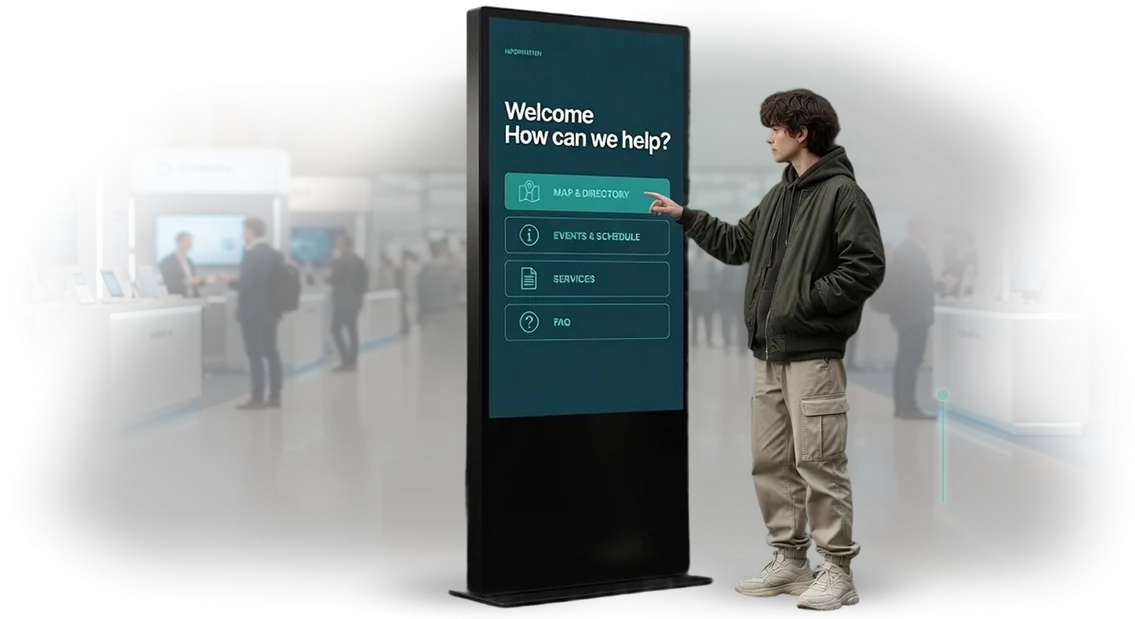
POS Self-Service Kiosks: Eliminating Queues and Winning Customers Back
Queues during peak hours are not just a strain on visitors' nerves but also direct revenue losses. Every customer who leaves without waiting their turn is a lost order, and sometimes a lost regular guest.
Meanwhile, the load on cashiers grows, order errors multiply, and staff spend time on routine tasks instead of caring for guests and driving sales.
POS self-service kiosks solve this problem systematically: the guest places their order independently, without staff involvement. They select items, see the final total, and pay right away — the entire process takes minutes instead of a long wait in line.
For business, this means higher throughput, lower staffing costs, and a noticeable reduction in order errors.
Speed of service directly affects loyalty: the faster and easier it is to place an order, the more willingly the customer returns. The kiosk handles repetitive operations, freeing the team to interact with guests and handle non-standard tasks.
This automation pays for itself by reducing losses and increasing the average order value — on-screen prompts gently encourage additional purchases.
We have been designing and implementing such solutions in the food service and retail sectors for several years. We handle the entire journey: we analyze guest flow, select equipment and interface for your needs, launch the kiosks, and support them after opening.
As a result, you get stable operation even during peak load hours and satisfied customers who keep coming back.
Five Results That Order Automation Delivers
Order automation at a self-service kiosk works on five business metrics at once. This is not a cash register replacement but a way to eliminate queues and free up staff for live interaction with guests.
First, speed of service. The guest selects dishes in a couple of screen taps, without waiting for a server to approach. During peak hours, this reduces order time from five minutes to one, meaning 30-40% more guests pass through the location without any loss of service quality.
Second, average order value. The kiosk shows additional items at the moment of selection: sauces, drinks, desserts. The guest sees the offer when they have already decided to spend, so about 20-25% of orders are supplemented with items they had not considered.
As a result, the average order value grows by 10-15% — that is direct revenue without advertising costs.
Third, loyalty. Modern guests value independence and control over their order. The ability to calmly review the menu, change the contents, and immediately see the final amount increases satisfaction. A guest who has tried a convenient service once comes back and brings friends.
Fourth, data. Every order at the kiosk leaves a digital footprint: popular items, purchase times, declined options. Based on this data, we fine-tune the menu, promotions, and demand forecasting. Instead of intuition — a clear picture that helps increase margins.
Fifth, staff relief. The checkout and order intake no longer require constant staff presence. Employees focus on serving dishes, cleaning, and caring for guests, which increases the speed of the entire establishment and reduces turnover caused by overload.
We are a development team with ten years of experience. We design kiosks for the needs of a specific business, launch them turnkey, and provide support after opening.
POS Kiosk Formats for Business Tasks: Outdoor, Countertop, and Built-In
The choice of POS kiosk format directly affects how visitors use the service and how many orders the business can process.
The same menu, service, or loyalty program can be deployed on an outdoor, wall-mounted, or built-in terminal — the decision depends on where the customer encounters the device and what task the location needs to solve.
Formats and Scenarios
| Format | Who it's for and where | What it gives the customer |
|---|---|---|
| Outdoor kiosk | Auto service centers, gas stations, fast food, pickup points — for street traffic | Operates 24/7, accepts orders and payments without staff, increases revenue during off-peak hours |
| Wall-mounted kiosk | Cafés, convenience stores, clinics, fitness clubs — where space is limited | Takes up minimal space, reduces the queue, speeds up ordering, booking, or payment |
| Built-in terminal | Restaurants, hotels, business centers — when the kiosk should be part of the interior | Looks like an extension of the counter, creates an impression of premium service, builds guest trust |
The countertop option is a mobile companion to the three main formats: it can easily be placed on a bar counter, table, or temporary promotion zone.
We help you choose the right type for your floor space, visitor flow, and operating scenario — from a street location to a built-in self-service zone.
How the Project Works: Step-by-Step Plan from Brief to Launch
A self-service kiosk project is not just buying a device but a joint effort that leads to a measurable result: faster service, shorter queues, more orders.
We have completed dozens of launches across different industries, so the process is polished and transparent: you always know what stage the project is at and what comes next. Here is what a typical plan looks like.
- Brief and goals. We lock in the kiosk's purpose: reduce the queue, remove routine work from staff, increase the average order value. We define your audience and scenarios, and agree on timelines and budget.
- Planning and prototype. We sketch the screen structure and workflow, and show you an interactive prototype. You see how the customer will place an order before a single line of code is written.
- Design and copy approval. You approve the look, colors, fonts, and on-screen messages. We make revisions until the kiosk becomes a natural part of your brand.
- Development and installation preparation. We build the software and select hardware for your load, while preparing the layout and connection point in parallel. We send a status update once a week — you stay informed without meetings.
- Testing and kiosk launch. We test every real-life scenario: payment, receipt, errors, order cancellation. Then we install the kiosk, train the staff, and assist with the first guests — the launch goes off without a hitch.
- Support and growth. We monitor operations, update the menu and promotions, and add new scenarios. If anything happens, we respond according to a defined procedure so the kiosk never sits idle.
The result: you get a predictable launch, a ready kiosk, and a team that continues to own the outcome.
What's Included in the Delivery: A Complete Package for Start and Operations
We deliver not just equipment but a complete turnkey solution. The cost already includes everything needed for launch and day-to-day operations: from installation to training your staff. You receive a single package that lets the kiosk start generating profit from day one.
- Installation and connection. Our engineers arrive, place the kiosk in a convenient spot, connect it to the network, and check all systems. You don't need to find contractors or spend time on technical details.
- Software tailored to your business. The interface already contains your menu, prices, payment acceptance, and required settings. Visitors immediately start placing orders without your involvement.
- Instructions and cheat sheets. Clear procedures for staff, on-screen hints for guests, and quick guides — employees get up to speed quickly, and visitors won't be confused.
- Staff training. We conduct a hands-on session: how to service the kiosk, refill consumables, and act in emergencies. Your team works confidently from day one.
- Integration with your accounting system. Orders automatically flow into your database — you see revenue and stock levels without manual entry or errors.
- Warranty and support. We stay in touch after launch: we update the software, help resolve issues, and provide maintenance. The kiosk doesn't sit idle.
You get a working business tool without any extra hassle. All that's left is to place the kiosk in a busy spot and welcome your first visitors.
Case Study: How a Coffee Chain Accelerated Service and Cut Queues
The coffee chain Coffee Break, with locations in business districts, was losing up to a quarter of its customers during morning hours: the line for cappuccino scared off people rushing to meetings.
Management understood the problem was not the baristas but the capacity of the checkout. We proposed installing POS self-service kiosks next to the main counter.
What We Did
In two weeks, we audited the two busiest locations, identified peak windows, and configured a purchase scenario that required no cashier involvement. An order is assembled in three taps: select a drink, add extras, pay by card.
Integration with the existing cash register system meant no changes to accounting or reporting. Staff were trained in one day, and we took on technical support ourselves.
The Result
Average service time dropped by a third, and peak-hour throughput grew by 40% — the queue no longer bottlenecked at a single cashier.
Kiosk orders reached half of all traffic, while the average order value rose by 12%: guests are more willing to add syrups and desserts when they aren't holding anyone up. The coffee shop increased revenue without expanding staff or floor space.
The strongest proof is repeat orders. After validating at two locations, the chain scaled the solution to 10 more coffee shops. Now the kiosks work as full-fledged cashiers: they accept orders around the clock and never take a break.
How to Choose the Right Format for Your Task?
Which POS self-service kiosk format is right depends not on the screen size but on the business task you're solving. The easiest approach is to start from three criteria: visitor flow, floor space, and order scenario complexity.
We always start here — that makes the format choice obvious and eliminates overpaying for unnecessary functionality.
For a location with modest traffic, a compact model with a simple menu of a few items is enough. Such a kiosk speeds up service and reduces the load on the cashier.
If you run a quick-service restaurant, a store, or an establishment with high guest volume, you need a full-fledged order terminal: with a catalog, payment acceptance, and automatic order transmission to the kitchen. That's what delivers a noticeable boost in throughput and average order value.
The second key criterion is payback. Estimate how much time an order currently takes and how many orders per hour the kiosk can handle. If the time savings exceed the costs of placement and maintenance, the format is a fit.
Also consider how the kiosk fits into your accounting system: it connects to the cash register and inventory — this eliminates manual entry and staff errors.
If you're unsure, send us a description of your location — we'll select the optimal format for your needs. Our engineers will analyze the premises, customer flow, and order scenario, and propose a solution with the right functionality and an accurate payback calculation. You'll get a kiosk that fits into your business processes and starts delivering value from day one.
Frequently Asked Questions and Concerns: Straight Talk
Doubts are normal, especially when it comes to new service points. It's important to us that you make a decision not "on trust" but with a clear picture of timelines, costs, and results. Below we answer the four questions we hear most often — no fine print, no caveats.
What about the warranty, and how reliable is the kiosk?
We provide an official warranty on equipment and workmanship — from one year and up, with maintenance coverage for the entire service life.
The enclosures and modules are designed for round-the-clock operation in high-traffic locations: these are not office devices but industrial-grade components.
The safety margin is backed by the statistics of our projects: clients in food service and retail have been running kiosks for years, and the average uptime exceeds 12-18 months of continuous use.
If something fails, we resolve it remotely or with an engineer visit — usually within 1-3 days, so downtime doesn't hit your revenue.
When will the kiosk pay for itself, and what benefits will it bring?
The break-even point depends on visitor flow and average order value. With 50-100 visitors per day, a kiosk typically pays for itself in 6-12 months — just from cashier savings and the higher average order value driven by upsells.
On top of that, the kiosk accepts orders 24/7 and works faster than a cashier: queues shrink, and revenue per square meter grows. Our economic model also includes the reduction of order errors — those are direct losses you stop paying for.
Will the kiosk work with our accounting system?
Yes. We respect the money you've already invested in accounting and inventory: we connect the kiosk to your cash register software and inventory system through official APIs, or through an intermediate layer if no direct access is available.
You get a single window: menu, stock, prices, and orders sync automatically. You won't have to enter data manually or spend hours reconciling — the kiosk becomes part of your infrastructure, not a separate "black box".
What happens if there's a breakdown or a power outage?
The kiosk is designed so that orders are never lost, even in emergency situations. An uninterruptible power supply is installed: it completes the current order and shuts down safely.
In a power failure, orders don't disappear — they're saved on a protected drive and sent to the kitchen as soon as the kiosk is back online.
For critical cases, we set up remote monitoring: our team sees the device status in advance and often resolves the issue before staff even notices. Your location keeps working, and you don't have to think about the technical side.
If you didn't find your question — write to us, we'll answer in detail and honestly for your specific scenario.Ready to Eliminate Queues? Let's Discuss Your Project
Queues at the checkout aren't just frayed nerves — they're real missed sales: a visitor leaves without waiting. A self-service kiosk relieves cashiers, speeds up payment, and increases the average order value — and you stop losing customers during peak hours. We'll help you find a solution for your business, from a single terminal to a citywide network.
To understand which option is right for you, a project calculation is needed. The next step is a short consultation request: we'll call you back, ask a few questions about your goals, and prepare a preliminary estimate. Then we follow a simple checklist.
- You submit a request on the website or by phone.
- We provide a consultation on kiosk capabilities and payback.
- We perform a project calculation: equipment cost, implementation, and launch timelines.
- We select a configuration for your floor space, visitor flow, and product range.
- We start the work — from interface design to installation and staff training.
This way, you understand the budget and the result in advance, rather than getting surprises after launch. The consultation is completely non-binding: even if the solution isn't a fit, you walk away with numbers and an action plan.
Submit your request now — and by next week we'll be discussing the details of your project. Write to us or request a callback, and we'll respond within one business day.