

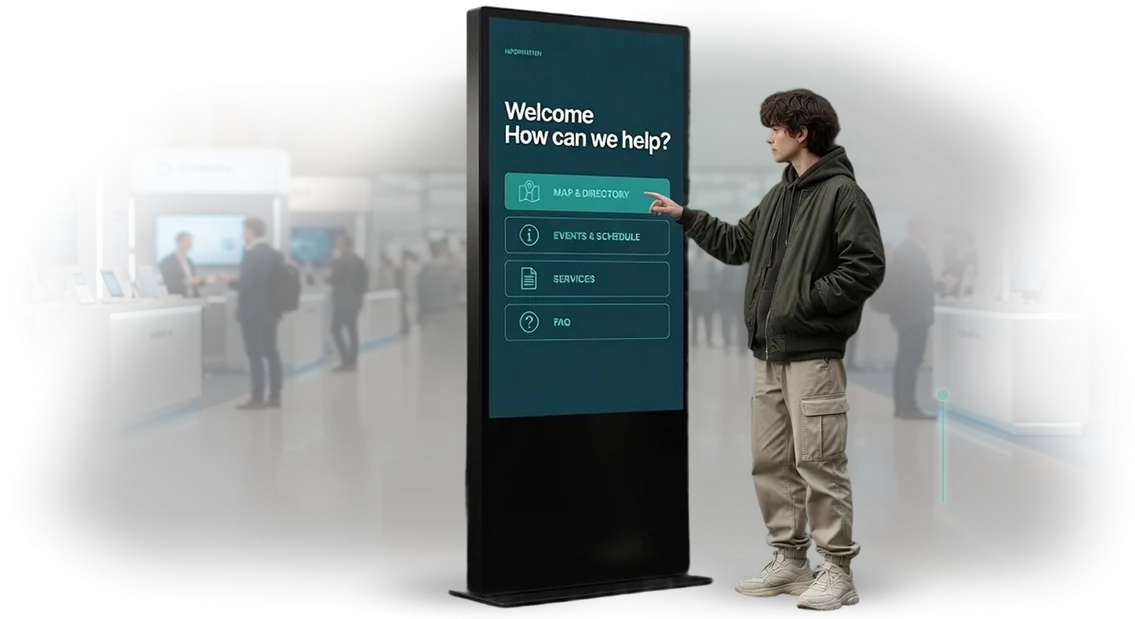
Payment System Integration: Why a Kiosk Won't Pay Off Without It
If a kiosk doesn't accept payments, it turns into an expensive display case: the visitor finds the information but can't complete the action. They still have to go to the checkout, stand in line, or look for another location — half of these visitors simply leave.
That's a direct loss of revenue, plus dissatisfied customers who are already used to getting things done in a couple of taps.
That's why integrating a kiosk with payment systems isn't an option but a condition for paying off. When an infokiosk accepts card payments, it covers the entire chain: from the first request to the payment.
The visitor chooses the service themselves, pays, and receives confirmation — without queues, cashiers, or extra steps. You reduce staffing costs and at the same time increase the average ticket, because the customer hesitates less before purchasing.
If you keep postponing payment integration in the infokiosk, the project's payback period stretches out for months. The kiosk keeps running but actually brings in only part of the profit it could. Meanwhile, competitors whose payments work right away take those customers.
Every day of downtime isn't a lost percentage — it's real money that could already be in your account.
We set up payment acceptance so that the customer gets a working tool, not a headache. Kiosk integration with payment systems is done with professional equipment and proven payment gateways — you get stable operation, data protection, and compliance with security requirements.
You don't need to dive into the details: we handle configuration, testing, and launch, and your staff quickly gets used to a simple and clear interface.
As a result, the kiosk starts generating revenue from day one: payments at the infokiosk work fast, visitors come back, and repeat orders grow. You get transparent transaction reporting and save on maintenance.
If you want the kiosk to pay off rather than just hang on the wall — start with payment acceptance. This is a case where one solution covers several business tasks at once: revenue growth, customer loyalty, and cost reduction.
What Built-in Payment at the Kiosk Gives Your Business
Built-in payment turns an information kiosk from a reference desk into a point of sale. The benefits of paying at the kiosk become visible from day one: the visitor gets a service and pays right away — without searching for a checkout or standing in line. This is one of the fastest ways to grow revenue without expanding staff or redesigning the floor.
The first benefit is a higher average check. When payment takes just a few seconds, the customer is more willing to add extra items to the main service: tickets to related events, gift certificates, extended warranty.
The kiosk itself offers an upsell at the moment of payment, so the average check grows without staff involvement.
The second benefit is faster customer service. The payment goes through automatically, funds are credited instantly, and the receipt goes to email or smartphone. Checkout queues shrink, and employees switch to consultations and complex tasks. During peak hours, you can serve two to three times more visitors without extra points of sale.
The third benefit is customer loyalty. Users remember where they can quickly place an order and pay without a cashier. This lowers the barrier to a repeat visit and increases the share of regular customers.
And if the kiosk is linked to a loyalty program, every payment automatically accrues points — so you encourage people to come back again.
In short, built-in payment solves three tasks at once: it increases the check, speeds up service, and strengthens loyalty. You get more revenue from every visitor and a steady flow of customers in the long run.
Think over where a kiosk with payment will bring the most benefit — and we'll help implement it in your project.
Kiosk Formats with Payment Systems: How to Choose for Your Task
Choosing a kiosk format with payment isn't about hardware — it's about how visitors will pay and how long it will take. Overpaying for unneeded features or skimping on a payment module that can't handle the traffic is equally expensive.
So the first step is to define the scenario: where the kiosk stands, who uses it, and which payment methods should be available.
Below are the typical formats we deliver in practice.
| Format | For whom | What it gives the customer |
|---|---|---|
| Floor-standing terminal with acquiring | Shops, pharmacies, fast food restaurants | Reduces checkout queues, lets guests pay without staff assistance |
| Tabletop mini-kiosk | Cafés, pickup points, beauty salons | Speeds up service, takes little space, accepts card and QR payments |
| Kiosk with cash acceptance | Housing and utilities companies, transport companies, retail chains | Covers customers without cards and maintains transparent revenue records |
| Integration with the accounting system | Store chains, delivery services | Automatically transfers payment data to 1C or CRM, eliminating manual entry and errors |
In every format, we install a payment module that works with popular acquiring services — from YooKassa to bank gateways. The customer gets not a "raw" program but a ready-made tool: payment, receipt, reporting, and refunds are already fine-tuned and work together.
How to choose for your task: for quick payment in a café, the tabletop format fits; for a store with a high flow of visitors, the floor-standing one. If customers are used to paying in cash, we add a banknote acceptor.
The key is not to overpay for extra options and not to save on payment reliability: every failure is a lost customer.
How the Integration Project Goes: From Brief to Launch
Integrating payment into a kiosk isn't about "installing a terminal and forgetting it." How quickly the kiosk starts generating revenue, how much time staff spends on training, and whether the scenario needs to be redone all depend on how well the stages are planned.
We structured the process so the customer understands at each step what is happening, what the deadlines are, and what they receive.
-
Brief. We discuss the kiosk's tasks, customer flow, and required payment methods. Already at this stage, it's clear which scenarios are important — quick purchase, service, or top-up.
-
Plan and approval. We put together the work list, deadlines, and areas of responsibility. You see the full picture before the start; we lock in the mockups and the kiosk logic so there are no unexpected edits.
-
Implementation. We configure the kiosk interface and connect payment scenarios: payment method selection, confirmation, receipt. We work on professional equipment, so the integration is stable.
-
Testing. We check every customer scenario: successful payment, cancellation, refund, bank connection failure. You get a test report and confidence that the kiosk won't fail on the first day of operation.
-
Launch. We install the kiosk, tailor it to your location, and provide brief training for the staff. Our specialists stay in touch until the kiosk is running in normal mode.
-
Support. After launch, we accompany the project: update the software, monitor payment scenarios, and respond to questions quickly. The warranty isn't a formality but an obligation to help you earn.
What Is Included in the Delivery: A Kit for the Kiosk's Stable Operation
A kiosk project isn't just a screen and a housing. For the device to work stably and bring value to the business, a support kit is needed: from the interface to documentation.
We assemble this kit for the customer's tasks and hand it over along with the device — without hidden stages or emergencies.
Here's what's included in the delivery:
- Updatable kiosk interface. The menu, catalog, promotions, and news change without rewriting code or calling a contractor. Your manager makes edits through a clear admin panel.
- Up-to-date payment interface. Payment rules and system requirements change regularly. We track this and update the payment module in time — the kiosk doesn't lose functionality because of new standards.
- Protection of payment transactions. The data flow from the kiosk to the bank is encrypted and meets industry requirements. You're protected from disputes and security claims.
- Analytics in a personal account. See the number of transactions, revenue, popular services, and conversion to purchase. This data makes it clear which items to promote and which to remove.
- Kiosk documentation kit. A complete package: operating manual for the staff, instructions for replacing consumables, procedures for emergency situations, certificates, and diagrams. Employees will handle it without calling an engineer.
- Technical support and software updates. The system doesn't stay unattended after launch. We answer questions, release updates, and help in case of failures — you don't need to look for third-party specialists.
- Accesses and accounts. All information about logins, employee roles, and keys is passed to the customer. You fully control the system rather than depend on the contractor.
This kit covers the main risks: outdated software, payment failures, downtime due to untrained staff, and data loss. You get not just hardware but a working tool that is easy to manage and predictably brings in revenue.
Case Study: How Payment at the Kiosk Paid Off in 4 Months
Visitors don't like waiting — during peak hours, queues formed at the checkouts, and some guests left without placing an order. For the CoffeeBreak coffee shop chain, this became a problem: revenue was slipping away and employees couldn't serve everyone who wanted to order.
We connected payment to the interactive kiosks — now guests selected items on their own and paid by card or phone. This relieved the cashiers and redirected the flow to self-service.
The results of the payment implementation exceeded expectations: the number of successful payments through the kiosks grew 2.5 times, queues decreased by a third, and revenue after integration increased by a quarter. The kiosk paid for itself in 4 months — faster than planned.
This kiosk payment case shows that proper payment system integration pays off not only through revenue growth but also through the loyalty of customers who come back for coffee without waiting.
If you're unsure whether to implement payment at kiosks, the CoffeeBreak example shows the result comes quickly and measurably.
How to Choose a Kiosk Format for Your Task?
A kiosk format is chosen not by design but by who will pay through it and how. First, identify the audience: a visitor with a card, a courier with a phone, an employee with a corporate pass.
This determines whether you need a physical keyboard, a scanner, or just contactless payment. That narrows your choice from dozens of models to two or three that fit your business.
The second criterion is transaction frequency. If the kiosk takes payments once a day, a basic configuration is enough. If a stream of customers goes through it during peak hours, the speed of operation and a reliable connection to the payment system are crucial.
We help you choose a format so you don't overpay for excess features but also don't create a queue because of a slow terminal.
The third question is whether a cash register is needed. Depending on the type of service and legal requirements, you may need to print receipts and send data to the tax authority. This affects the configuration: a built-in printer, special software, or an additional module.
We configure integration with payment systems and, if needed, connect an online cash register — you work legally without manual operations or fines.
The fourth criterion is the level of support. A kiosk works unattended, so how quickly failures are fixed matters — it directly affects the cost of ownership. Check whether remote monitoring, auto-restart, and software updates for new payment system requirements are included. When you order a kiosk from us, you get support that keeps downtime losses to a minimum.
The result: the right format is a balance between functionality, speed, and cost of ownership. Answer three questions — who pays, how often, and whether a cash register is needed — and you'll choose a kiosk that pays off, not one that just stands in the lobby.
If you're unsure, send us your task: we'll select the configuration and calculate the financials before the purchase.
Common Customer Questions Before Project Launch
Before launching an interactive kiosk, customers most often ask about payment security, equipment reliability, and ease of updates. These are the right questions — they affect whether the event goes off without a hitch. Here are the key answers so you understand how we cover these risks.
Is it safe to accept payments through a kiosk?
Yes. Our team use certified payment services that encrypt card data. The kiosk doesn't store payment information — it's transmitted directly to the bank, so you're protected from leaks and comply with payment system requirements.
What if the kiosk breaks down during an event?
We set up remote monitoring of the kiosk's operation and backup of settings in advance. If the device fails, an engineer restarts it remotely or advises the staff on what to do. For long-term projects, we provide a spare unit — replacement takes minutes, not hours.
Is it difficult to update the payment interface?
No. Updates are done remotely and don't require stopping the kiosk. If your tariffs, promotions, or screen design change, we make edits upon request and test all payment scenarios before they become available to guests.
What support is there after launch?
We don't disappear after the project is handed over. We sign a maintenance agreement: engineers are available during business hours, we respond quickly, help with refinements, and regularly check that payment scenarios work properly. You always know who is responsible for the kiosk.
Leave a Request — We'll Calculate the Integration Project in One Day
After a request for payment system integration, we prepare a project calculation for your kiosk in one day. You get not an abstract estimate but a plan that shows the cost, timeline, and stages of connecting payments — from choosing a payment service to testing at your site.
Within 24 hours, you receive:
- a kiosk project calculation with your payment scenarios: card, SBP (fast payment system), QR code;
- a payment system integration plan with the stages and deadlines of each step;
- a commercial proposal for the kiosk with a fixed cost and timeline;
- a list of requirements and documents from the payment system — to prepare for the launch in advance;
- hardware and software recommendations, if the kiosk hasn't been chosen yet;
- answers to questions about payment security, support, and warranties.
Submitting a request for payment integration takes a couple of minutes — you just leave your contact details. We get in touch, clarify the task, and by the next day send you the kiosk project calculation and commercial proposal.
This way, you know the budget and timeline before the work starts, not during it. That lets you make a decision quickly and without the risk that payment integration will cost more than expected. Leave a request — in a day, you'll know what the project costs and what's needed for launch.