

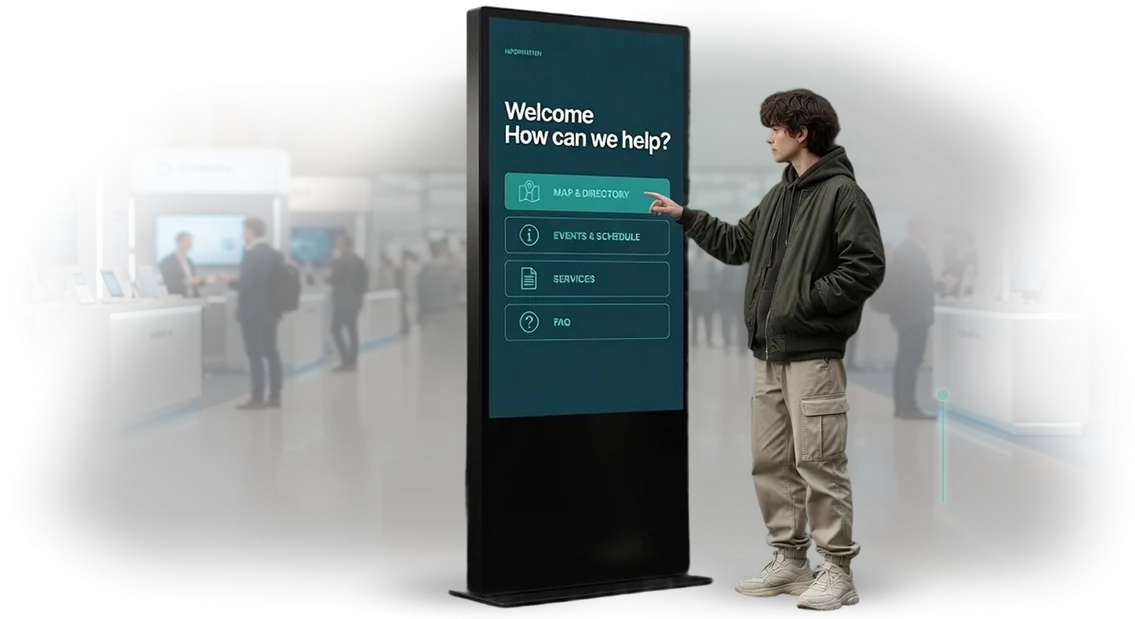
Clients Are Turning to Kiosks with 3D Visualization Systems
Clients compare your kiosk with the experience they get on their smartphones and websites. There, they are already used to spinning a product around, looking inside a space, and seeing how colors change in real time.
A flat kiosk with a menu and static photos cannot deliver that — attention drifts away within 5-7 seconds, and the person leaves without completing the desired action.
For business, this is not just aesthetics — it is lost clients. Without 3D visualization, an interactive kiosk wins only against a paper stand, but loses to competitor kiosks where a volumetric model lets customers explore the product before even talking to a salesperson.
As a result, session duration, number of views, and — most importantly — conversion to inquiries or orders drop.
Buyers already know well: if a kiosk has a volumetric product model, it means the company cares about details and is ready to show the product honestly. This creates a competitive advantage even before any interaction with staff.
Conversely, an outdated interface tells the guest that the brand is falling behind the market — and the person moves on to those who know how to present a product beautifully and clearly.
We design interactive kiosks with 3D visualization that solves business tasks: helping customers choose, compare, build configurations, and make decisions faster. We do not turn a kiosk into a showcase — we turn it into a sales tool.
That is why your kiosk does not lose its audience, but keeps it engaged and guides every visitor to the desired action.
What Benefits Does an Interactive Kiosk Bring to Business
An interactive kiosk with 3D visualization is not just a screen — it is a sales tool. It turns window shopping into a live interaction: the customer chooses what to view, rotates the product, compares specifications.
This holds attention longer than static advertising and increases interest in the product before any conversation with a manager.
The first benefit is audience engagement. When a visitor controls the interface and examines details in three dimensions, they become emotionally involved.
The kiosk clearly explains the advantages of a complex product without a salesperson, and 3D visualization creates a sense of presence. As a result, the guest stays longer at the point of contact and decides to buy faster.
The second benefit is higher conversion and average order value. The interactive assistant suggests complementary products, shows configuration options, and accepts orders right on the screen.
The manager does not waste time repeating information, and the business gains more sales per square meter and a quick return.
The third benefit is brand recognition. An unusual screen with volumetric objects is memorable: visitors photograph it, share it on social media, and tell their friends. This way, the kiosk generates free advertising and shapes the image of a modern company long after the event.
The main business effect is measurability. The kiosk shows which items were viewed most often, how much time people spent at the screen, and which scenarios lead to orders.
This data improves the display, assortment, and promotions, turning interactivity into a systematic efficiency tool.
Kiosk Formats with 3D Visualization Systems for Business Tasks
For 3D visualization to deliver results, the kiosk must suit the installation location and usage scenario. A compact stand in a showroom is one thing; an outdoor terminal operating in any weather is another. The format determines how often and how comfortably clients will use the system.
Below is a mapping of the main kiosk formats to typical business tasks. This is a guideline: for each specific project, we select the construction, size, and sensor type based on your audience and space.
| Kiosk format | Who it suits | What it gives the client |
|---|---|---|
| Touchscreen kiosks | Showrooms, stores, exhibition stands | Self-service viewing of a 3D catalog without staff assistance; the buyer examines the product in detail and makes decisions faster |
| Floor-standing kiosks | Shopping malls, museums, waiting areas | Sense of presence: a large screen with a 3D model captures the attention of passersby, increases time at the stand, and expands brand reach |
| Vandal-resistant kiosks | Streets, train stations, stadiums, parking lots | 24/7 unattended operation: a protected enclosure and reinforced screen withstand weather, impacts, and tampering attempts |
If you have multiple locations, formats are often combined: a floor-standing kiosk in the lobby, a touchscreen kiosk in the sales area, and a vandal-resistant one at the entrance.
This way, 3D visualization works at every stage of customer contact — from first touch to order placement.
We help you choose the right format for the task, calculate the usage scenario, and integrate the kiosk with your 3D visualization system. To get a preliminary recommendation, simply describe your installation point and target audience.
Stages of Working on a Kiosk Project
You are never left alone with the contractor: each stage has checkpoints where you see the interim result and make decisions. This process eliminates surprises at launch — what was put into the brief is what you get at the site.
- Brief and immersion. We discuss the kiosk’s tasks, audience, installation location, and expected scenarios. We lock in the cost and timeline — you understand the budget before work starts.
- Concept approval. We show the screen structure, scenario logic, and interface prototypes. You see how a visitor will interact with the kiosk and make edits before any code is written.
- Development and assembly. We create the design, program the logic, and integrate 3D visualization and connections to your systems. On request, we send a demo version for testing on your device.
- Testing and acceptance. We verify scenarios on real equipment: touch input reliability, rendering correctness, and performance. You receive a checklist and accept the work against it.
- Launch and post-production. We install the software on site, set up remote monitoring, and support the kiosk after opening. If new content or scenarios appear, we implement updates promptly.
At every stage, you see deadlines and statuses, and all edits are recorded in a shared register — approval takes days, not months. As a result, you get a working kiosk with 3D modules that is ready to greet its first visitors tomorrow.
What Is Included in a Complete Kiosk Delivery
A complete kiosk delivery is not just a box with a screen. We hand over a fully working point of information and service, turnkey, including everything needed for launch from day one.
The project includes the full cycle: layout and interface design, component selection, assembly, on-site installation, and staff training.
We also integrate the kiosk software with 3D visualization systems so visitors can examine a product or object from every angle without touching a physical sample. This noticeably increases engagement and helps them make decisions faster.
Here is exactly what you receive within a complete delivery:
- Project scope and estimate — a detailed description of the work, configuration, and timelines before production begins.
- Equipment — touchscreen, protected enclosure, and necessary peripherals. Everything is tested and configured at our production facility.
- Preinstalled software — the kiosk interface, content updates, and integration with 3D visualization systems for vivid product and service demonstrations.
- On-site installation — delivery, installation, connection, launch, and testing of all operating scenarios.
- Staff training — practical instruction for your employees: how to manage the kiosk, change materials, and resolve common issues.
- Documentation — manuals, acts, regulations, and connection diagrams for your maintenance team.
- Warranty and support — service maintenance, remote monitoring, software updates, and replacement parts when needed.
Each item addresses a specific business task. You do not need to find separate contractors and coordinate their work — we take full responsibility for the result.
Case Study: Showroom Kiosk Paid for Itself in 3 Months
High-end furniture showrooms often share the same problem: the display looks impressive, but visitors cannot picture how a piece will fit into their apartment. They walk around the hall, touch fabrics, but hesitate to approach a consultant and leave without buying.
This is a typical pain point in high-ticket retail — and that is exactly what we addressed in this project.
We integrated an interactive kiosk with a 3D catalog visualization system. Visitors select a model themselves, change the upholstery, wall color, lighting level, and see the future interior on a large screen in realistic quality.
This scenario replaces dozens of verbal explanations: the guest “assembles” the product to their own liking and approaches a manager with a ready solution.
Business Results
- Time at the display grew from 40 seconds to 3 minutes — guests study the product instead of silently walking past.
- The average order value increased by a third — customers arrive with a ready solution and haggle less.
- Staff workload decreased: the kiosk handles basic questions, and the consultant steps in with warm leads.
- The project paid for itself in 3 months — thanks to higher purchase conversion and repeat visits.
The behavior of regular customers is the most telling indicator: they return to the showroom to “play” with the layout and often bring friends.
Two months after launch, the client ordered a second kiosk for another retail location — for us, that is the best proof that the interactive format delivers measurable results for business owners, not just a “pretty picture.”
How to Choose a Kiosk for Your Task?
There is no universal kiosk: the same machine cannot serve both as wayfinding in a shopping mall and as a demonstration tool for a complex product in a showroom.
That is why the right choice always starts not with device specifications, but with the task — who you want to serve, what information to convey, and what result to achieve. The format, screen size, and type of interaction depend on exactly that.
First, define the usage scenario. If customers need to quickly find a department or service, a compact floor-standing kiosk with a simple menu will do.
If you need to show a product in detail, rotate it, and view it from different angles, you will need a touchscreen panel with 3D visualization support and sufficient performance.
For showrooms and exhibitions, large interactive stands that attract attention and become the centerpiece of the display are usually the choice.
Integration with 3D visualization systems imposes its own requirements. 3D models demand smooth response: when rotating an object, the screen must react without delay, otherwise guests lose interest.
This means the kiosk configuration must be calculated for the required graphics load — not necessarily maximum power, but enough for comfortable operation of your scenario.
Also think about controls: gestures, touch zones, on-screen buttons — all of this affects usability for people of different ages.
If you are unsure about the choice, pay attention to scalability options. Tasks often change after launch: new sections, languages, and interaction methods are added.
It is good when the selected kiosk allows the interface and functionality to be adapted without replacing hardware.
Our team helps you select a solution tailored to your specific task: we analyze visitor flow, the 3D content workflow, installation conditions, and then propose the optimal configuration.
We also always provide recommendations with room for future development — so your investment works for more than one season.
The main rule is not to choose the “biggest and most powerful” kiosk, but to match it to a specific business task.
Then you do not overpay for unnecessary features and get exactly the result the project was started for: engaged customers, clear navigation, and an impressive product presentation.
Common Client Questions and Answers
Clients most often ask about reliability, warranties, and the difficulty of content management. These are understandable concerns: a kiosk is highly visible, and any failure is noticed by visitors. We answer in business terms.
What happens if the kiosk breaks down during operation?
We work with professional equipment designed for continuous load. Critical components are backed up: in the event of a failure, the system switches over automatically and guests notice nothing.
If problems occur, we perform remote diagnostics or dispatch an engineer — recovery usually takes a few hours. The maintenance schedule is agreed with you in advance.
What warranty do you provide and what does maintenance include?
We provide an official warranty on equipment and work. Basic maintenance includes monitoring, content updates, and preventive checks. You can also arrange permanent support — then repairs and replacement consumables require no additional approvals. One contractor handles everything, so you do not need to dive into technical details.
How difficult is it to update 3D content on the kiosk?
Content management is done through a simple personal account: you upload images, videos, and 3D scenes, and changes appear immediately. No programmer needed. You can also schedule automatic material changes by time or audience. You approve; we handle the technical side.
Request a Preliminary Estimate
To receive a preliminary estimate for a project with interactive kiosks and 3D visualization systems, simply submit a request. We will respond within one business day, clarify your tasks, and propose a solution that fits your scenario, budget, and timeline.
After your inquiry, you receive:
- a consultation on kiosk usage scenarios: where to place it, how to attract attention, and what content to keep on screen;
- a preliminary cost and timeline estimate with no obligation — you immediately understand the scale;
- format and quantity recommendations for stands based on area, visitor flow, and event goals;
- examples of projects with 3D visualization in your industry — see how it works in practice;
- a discount on your first order — a nice bonus for deciding to start;
- an integration plan with your system and design: operating logic, connection points, and launch stages.
Our team works remotely and has been helping businesses implement interactive solutions for over ten years. That is why your estimate is not an abstract quote, but a well-thought-out plan with clear deadlines.
Submit your inquiry through the form on this page, or write to us in any convenient messenger. If you have a technical specification or a mockup, attach it — this allows us to prepare a more accurate estimate.
We will send a preliminary response within one business day, with further details on request. We begin with the estimate — the rest is simply a matter of execution.