

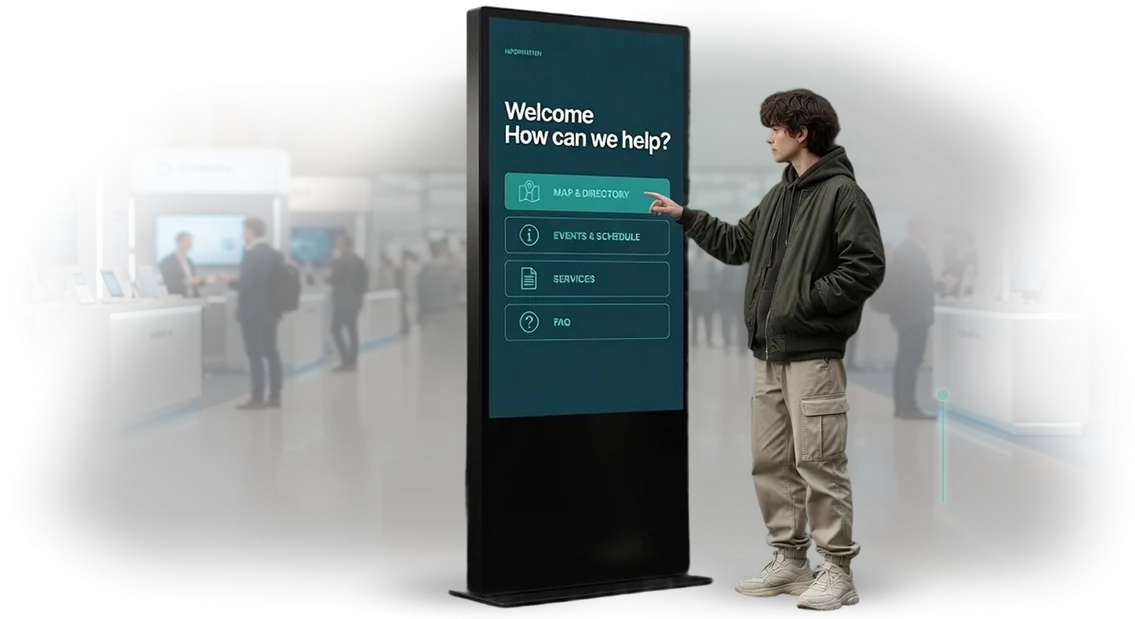
Losing customers to queues? Implement biometric identification
Queues and manual document checks are the main enemy of quality customer service. A visitor spends 5–10 minutes getting checked in, loses patience, and leaves for a competitor or abandons the service altogether. Every such departure is lost revenue and a damaged impression of your brand.
The loss is not limited to a single customer. A dissatisfied guest tells several other people about the bad experience, and the company’s reputation suffers long before you even learn about the problem.
Meanwhile, a service that works quickly and without friction becomes a reason to come back and recommend you to friends.
Biometric identification in interactive kiosks solves this in seconds. The customer doesn’t need to search for a passport, fill out paper forms, or wait for staff to double-check the data — simply confirming their identity at the screen is enough.
The system instantly verifies the data and grants access to the needed service or information, eliminating manual entry errors.
We implement such solutions turnkey: we connect kiosks to biometric identification systems, configure service scenarios, and ensure that the customer goes from “hello” to the result several times faster.
Queues shrink, staff is freed from routine, and you gain higher satisfaction, more repeat visits, and audience loyalty.
How biometrics in kiosks improves security, loyalty, and speed
Security without compromise
Biometrics eliminates the main risks: card theft, password guessing, and use of other people’s passes. Identity is confirmed by unique facial features that cannot be forged or transferred to someone else.
Encrypted storage of biometric templates and strict access control protect customer data. We work on proven platforms, refined on thousands of sites around the world. For you, this means minimal security costs and no reputational risks.
Service speed at peak hours
Identification takes seconds — a person doesn’t need to find a card, remember a PIN code, or fill out forms. As a result, the average visit time is reduced by 2–3 times, and queues stop slowing down operations and irritating visitors.
Staff spend less time on manual checks, and the kiosk itself requires no constant supervision.
Loyalty of returning customers
The kiosk recognizes the guest and immediately provides a personalized greeting, purchase history, and offers tailored to their tastes. This kind of service is memorable — people come back more often and recommend you to friends.
Growth in average order value
Based on purchase history, the system selects additional items the customer actually needs at the moment of interaction. Personalized recommendations increase the average order value by 15–30% and increase the number of repeat orders.
Kiosk formats with biometric identification systems: how to choose
Biometric identification solves different tasks: access control, fast visitor registration, and protection of personal data. There is no universal kiosk for all cases — it is important to choose a format for your specific scenario.
Below are typical formats and scenarios where each one delivers the most value.
Comparison of kiosk formats by application scenarios
| Kiosk format | Who it suits | What it gives the customer |
|---|---|---|
| Floor-standing unit with a large panel | Business center lobbies, medical centers, government institutions | Self-service visitor registration, biometric scanning without staff involvement, reduced queues |
| Wall-mounted kiosk | Enterprise checkpoints, warehouses, educational institutions | Fast access control: just place a palm or look at the camera — access is granted |
| Desktop terminal | Reception desks, HR departments, client zones | Integration with accounting systems: identification when issuing passes, time tracking, error-free service |
| Mobile stand on wheels | Exhibitions, temporary promotions, relocations | Flexibility: the kiosk can be easily moved to the right location and biometric registration can be deployed quickly |
| Self-service kiosk with multiple sensors | Stores, banks, airports | A single entry point: the person is identified and immediately gains access to a service or purchase |
Still have doubts? We’ll select the right format for your task and show examples from your industry.
How we implement biometric kiosks: from brief to launch
We designed the process so that you always know what is happening with the project and when the result will appear. No improvisation: each stage addresses a specific task — from gathering requirements to the kiosk working in your facility. Below is how biometric kiosks are implemented turnkey.
-
Brief and immersion in the task. You tell us where the kiosks will be placed, who your visitors are, and what problem biometrics should solve: fast entry, cashless payment, or checking customer status.
We record the goals and deadlines so that you get a solution for your scenario, not an abstract terminal.
-
Site audit and plan preparation. We study the installation location, load, visitor flows, and security requirements. Based on this, we create a plan: number of units, placement, and an integration scheme with your accounting system. You receive a cost estimate and a schedule — no hidden work.
-
Interface and scenario design. We develop screen forms so that a guest with any level of digital literacy can figure them out in seconds. For business, this means fewer queues and fewer support calls asking “how do I press this?”
-
Integration with the biometric system and your infrastructure. We connect facial recognition, fingerprints, or other parameters — depending on the task. We configure the link with your customer database, passes, or CRM so that data goes where it is needed. You get a single entry point without manual verification.
-
Testing on real scenarios. We check how the kiosk behaves under peak load, in different lighting, and in conditions close to real operation. Errors are fixed before launch, not on opening day — otherwise you waste time and nerves.
-
Installation, configuration, and launch. We deliver the equipment, install it, set up communication, and run a final check together with your team. Launch takes one or two days, and you immediately see results in operation.
-
Support and maintenance. We stay in touch after handover: monitor performance, update scenarios, and help add new features. If something changes in your business, the kiosk changes with you — without buying new hardware.
This approach allows you to control project stages and budget at every step. You don’t get a “black box” — you see what you pay for and what you receive in the end: a working kiosk that speeds up service and increases visitor loyalty.
What is included in the supply and setup of biometric kiosks
You get more than “a box of hardware” — you get a ready-made working entry point with biometrics that starts delivering value from the first day it is turned on. We take on the entire cycle, from selecting the kit to training your staff, so all you have to do is use the result. Here is what is included in supply and setup.
- Equipment kit — a kiosk with a touchscreen and biometric module, assembled and tested for your scenario. You don’t need to buy anything extra or coordinate anything: everything works immediately.
- Preinstalled and configured software — the kiosk software is already configured for your task: whether it is access control, booking an appointment with a specialist, or starting by fingerprint. No self-installation and no “dancing with a tambourine.”
- Integration with your biometric identification system — we connect the kiosk to your employee or customer database. People pass through in seconds, and data goes where it needs to go.
- Customization for your business process — we adapt the start screen, dialogue scenarios, and access rights. The kiosk guides a person step by step instead of scaring them with a complex interface.
- Commissioning work on site — an engineer visit, connection check with your server, and testing of real scenarios: biometric entry, errors, and fallback mode. You get a working system, not just a connected screen.
- Staff training — we conduct a short session for your employees: how to welcome guests, what to do in case of failure, and where to view statistics. People start using the system without fear or mistakes.
- Clear instructions and regulations — we provide a set of documents: short operator guides, daily maintenance instructions, and a quick-start checklist. You always know what to do and who to call for help.
- Warranty support after launch — we monitor system performance in the first weeks and respond promptly to questions. If something goes wrong, we resolve it ourselves; you focus on your business.
As a result, you get a predictable outcome: the kiosk works, staff are trained, and guests pass through without queues. The rest is on us.
Case study: how a fitness club sped up entry and increased sales
One of our clients — a fitness club with three branches — faced a typical problem: in the mornings and evenings, a queue formed at the reception desk. Administrators spent up to a minute per visitor: checking the card, searching the database, and marking the entry.
During peak hours, this created bottlenecks, irritated guests, and created the impression of poor service.
We proposed installing an interactive kiosk at the entrance with integration of a biometric identification system.
Now a visitor approaches the station, the system recognizes them in seconds, automatically opens the turnstile, and records the visit in the club’s accounting system. No cards, no queues — only fast and secure access.
The results exceeded expectations: entry time was cut threefold — from 40 to 12 seconds per person. During peak hours, the club began admitting 30% more visitors without expanding staff.
Administrators stopped performing routine checks and were able to focus on consultations and sales of additional services.
An unexpected bonus was the growth in average order value. The biometric kiosk not only entertains guests but also shows personalized offers: membership freeze, personal training, or nutrition plans — depending on visit history.
Guests responded to these offers more often because they came at the right moment. Two months after launch, the club’s average order value grew by 18%, and repeat visits increased.
Today, this fitness club is a permanent client of ours. We have already implemented biometric entry in two more of its branches and are preparing integration with a mobile app.
This case shows that proper automation not only speeds up a process but also delivers measurable benefits to the business — in revenue and visitor loyalty.
What if a biometric kiosk doesn’t suit my business?
Biometrics is indeed not universal: in some places passage speed matters more, in others there are strict personal data requirements, and in some cases a regular card is enough for visitors.
These are normal doubts at the selection stage — and they are exactly what we discuss at the very beginning. We don’t sell one solution for all tasks; instead, we analyze your business scenario: how service works today, what slows customers down, and where you lose revenue.
Before proposing a launch, we listen and clarify — who your visitors are, how ready they are to understand the interface, and what systems you already use.
If a biometric kiosk turns out to be unnecessary, we will suggest an alternative format. It could be a terminal with individual codes, integration with an existing pass system, or a classic touchscreen kiosk with card-based authorization.
When choosing between options, we rely not on trends but on real usage scenarios. If people simply find it more convenient to touch the screen, then that is what we’ll do. The main thing is that the solution solves your task and doesn’t add work for your employees or visitors.
Even if your specifics require an unconventional approach — for example, only age verification or confirmation of benefits — we adapt the biometric identification system to your industry.
This is not complication for the sake of technology but a professional selection of a scenario: you pay for results, not for features you won’t use. We discuss limitations in advance and show how the solution will fit into your current processes.
So the answer is: for us, there is no “doesn’t suit” approach. There is only an incorrectly chosen scenario — and we don’t allow that. After a short analysis, you will get a clear plan: which kiosk you need, how it will affect service speed, and how it will pay for itself.
And to remove doubts completely, you can test the solution with a limited group of users for one day. This reduces risks and gives you confidence before the full launch.
Frequently asked questions about interactive kiosks
When it comes to interactive kiosks, the most common questions are about reliability, data security, and compatibility with your systems. Our team has gathered answers to the main questions — short and to the point.
What happens if the kiosk freezes or the internet goes down?
The kiosk operates autonomously: the basic scenario works even without a network. If the connection is lost, data is saved locally and sent after recovery. This way you don’t lose applications or forms.
How protected is visitors’ personal data?
Data is encrypted during transmission and storage. Only authorized employees have access, and all actions are logged for control. This is the standard level of protection for working with biometrics.
Can the kiosk work with our CRM or biometric identification system?
Yes, integration with your systems is planned at the design stage. The kiosk adapts to existing protocols and data formats, so you won’t need to change your infrastructure.
What guarantees and support are provided after launch?
After launch, we remain in touch: we monitor performance, update software, and respond to requests. The warranty and response times are specified in the contract so that you receive support exactly on time.
Ready to discuss your project? Leave a request
Leave a request and get a consultation and a project estimate for integrating an interactive kiosk with biometric identification systems.
It takes a couple of minutes, and in return you get a clear picture: whether the solution suits your business, how much it will cost, and when it will pay for itself.
We have been implementing such solutions for over 10 years, so we will save you weeks of research and help you avoid typical mistakes.
In the request, just briefly describe the task: how many visitors you have, what service format you use, and what you want to improve — speed, security, or customer experience.
Then we will suggest options, show examples from similar industries, and honestly tell you where biometrics will deliver results and where you can do without it. This is a consultation, after which you will have a clear understanding of the next step.
What you get after the request:
- Personal consultation — we analyze your specific situation, not generic recommendations from the internet. You will learn which kiosk usage scenarios actually work in your niche.
- Project estimate within one business day — budget, timeline, and scope of work. You can plan investments in advance and coordinate them with management.
- A solution matched to your scale — from a single kiosk to a network of locations. You won’t overpay for unnecessary functionality or have to purchase missing items later.
- An integration plan with existing systems — without stopping your processes. We’ll explain how the kiosk will fit into your current infrastructure and what modifications will be needed.
- Examples of completed projects in your industry — see how it works in practice and what metrics clients achieved.
- Support after launch — we train staff, configure updates, and stay in touch for quick adjustments.
Leave a request now — we’ll call you back at a convenient time, answer all your questions, and prepare an estimate. Your project will begin with a conversation that saves you months of trial and error.