

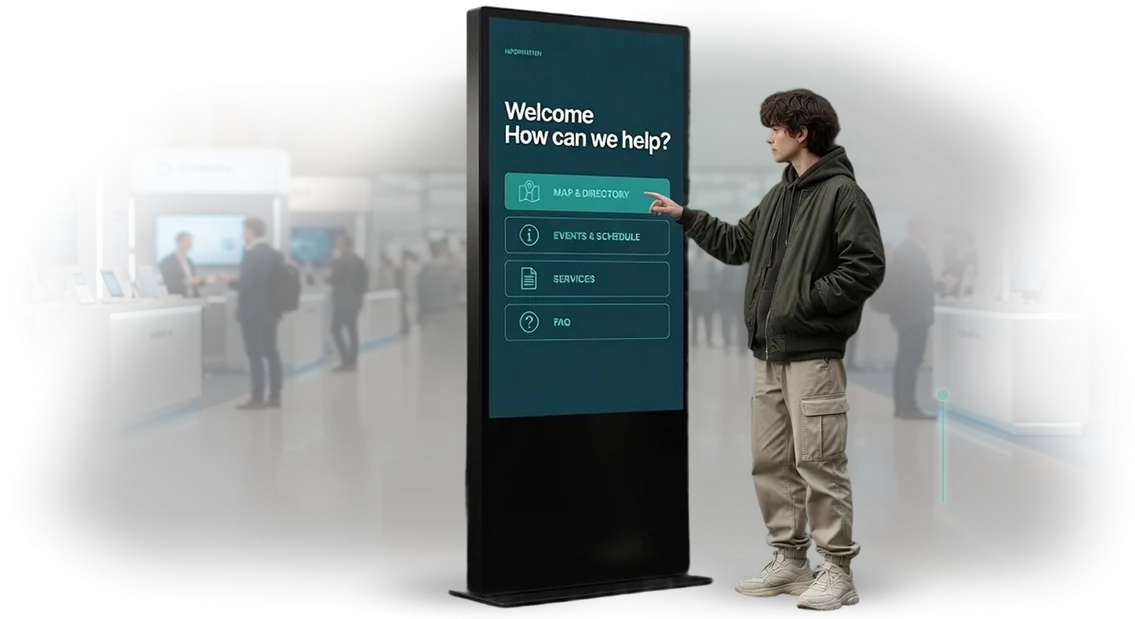
Kiosks without IoT monitoring integration lose efficiency
An interactive kiosk is not just a screen with a menu, but a point of customer contact that must work without failures. When a kiosk is not connected to IoT monitoring systems, you learn about a problem only from a visitor complaint or after downtime.
Every hour of downtime means queues, unhappy guests, and direct revenue losses that no one compensates.
Without IoT integration, you are deprived of the most important thing — transparency. You cannot see which scenarios customers use, where they get stuck, when the screen freezes, or when thermal paper runs out. Instead of data for improving service, you get guesses.
Meanwhile, competitors who have already connected monitoring are able to respond to demand faster and do not lose visitors due to malfunctioning equipment.
Kiosk efficiency directly depends on how quickly you learn about its status and how accurately you understand audience behavior.
An IoT monitoring system turns disparate devices into a manageable network: you see load, popular features, failures, and peak hours in a single window. This is not technology for the sake of technology — it is a tool that protects your image and customer experience.
We configure the integration so that the kiosk becomes part of your digital infrastructure, rather than a separate “black box”. You get control over every device and the data needed for decisions that increase conversion.
So if you want your kiosks to bring value rather than headaches, connect them to IoT monitoring. We will help you do this quickly and without downtime.
Business benefits of integrating with IoT monitoring systems
The client gets not just an interactive point from a kiosk, but a manageable communication channel. Integration with IoT monitoring systems turns each device into a source of live data: what is viewed, when the screen is touched, which scenarios attract interest.
Based on these signals, the business makes decisions — from rearranging content to changing in-store routes.
We have been connecting kiosks to client infrastructure for 10 years. Below are three business benefits you get right after launch.
Accurate reporting. Every visitor action is recorded and appears in a single dashboard. You see not “about 200 touches a day,” but the exact picture: which sections are in demand, when peak load occurs, and which scenarios lead to target actions.
This analytics becomes the basis for reports to management and marketing — you plan campaigns based on numbers rather than intuition.
Quick response. Integration with IoT monitoring gives instant event control: a frozen application, a disconnected sensor, a queue at the kiosk — the system sends a notification, and staff resolve the issue before the visitor leaves without a result. For a network of devices, this reduces downtime and increases the availability of each location.
Increased loyalty. When a kiosk works stably and responds quickly, the visitor remembers the convenience, and personalized prompts based on data make the interaction useful. A person gets what they were looking for, returns again, and recommends the brand to friends.
You get an increase in repeat visits and additional reach without advertising costs. We handle turnkey integration: we connect the kiosk to your monitoring system, configure scenarios, and train staff — you get a stable tool that delivers measurable value from day one.
Interactive kiosk formats for your tasks
A kiosk brings value only in the right format. It determines how visitors interact with information, how much time they spend at the screen, and how easily you can update content. Below is a comparison of the main options that cover most typical business and event tasks.
Comparison of formats
| Format | For whom | What it gives the client |
|---|---|---|
| Information kiosk (floor-standing or wall-mounted) | For lobbies, offices, shopping malls | 24/7 access to information, navigation, reduced load on staff |
| Touch kiosk with a wide screen | For exhibitions, showrooms, museums | Interactive catalog, visitor engagement, vivid product presentation |
| Event kiosk | For conferences, forums, presentations | Quick registration, schedule, contact collection, impressive photo backdrop |
This is not a complete list — we make custom enclosures and mounts for a specific location. But the main point is: any format can be easily connected to IoT monitoring systems. You get data on each kiosk’s operation — load, user activity, technical condition. All in one window, without manual report collection.
We will select the format for your task, create the design, and configure the operating logic. You will receive a ready-made turnkey solution — from enclosure to analytics. Tell us about your project, and we will offer the best option with a clear budget and timeline.
Stages of turnkey kiosk development
A turnkey kiosk development project is not a series of surprises but a clear route with fixed stages. We have structured the process so that you see results at every stage and understand where the timeline and budget go. Below are the typical project stages that most of our implementations follow.
How the work is structured
- Task definition. We discuss goals, audience, installation location, and the need for integration with your equipment.
- Interface prototype. We show the screen structure and scenario logic — approved before development starts.
- Development and approval. We build the interface in your style and the software part, showing intermediate versions.
- Integration and testing. We connect the kiosk and configure communication with IoT monitoring systems, checking stability and performance.
- Implementation and launch. We install the kiosk, train staff, and hand over documentation.
- Support and development. We update content, add scenarios, and maintain integrations.
Each stage ends with a clear result, development timelines are fixed in the plan, and kiosk implementation proceeds without emergencies. You always understand what is happening and what comes next — and you get a solution that works for your business.
What is included in the delivery of an integrated kiosk
You receive not just a kiosk, but a fully ready-to-work solution: hardware, preinstalled software, and configured IoT monitoring integration.
You won’t have to assemble the system from different contractors — everything arrives assembled, passes inspection, and is launched on the day of installation.
The delivery includes:
- Kiosk hardware — enclosure, touch screen, built-in computer. We select according to your tasks: for a lobby, outdoor area, or production.
- Preinstalled software with license — the interface is already configured; you just need to upload your materials.
- IoT monitoring integration — the kiosk automatically sends operational data and receives commands from your system.
- Installation and commissioning — specialists install the kiosk on site, check connectivity, and launch it.
- Documentation and instructions — clear procedures for your employees and system administrators.
- Staff training — we conduct a short session so your team confidently works with the kiosk.
- Warranty and post-support — we resolve hardware and software issues during the warranty period.
Each item saves your time and eliminates hidden work. You know in advance what you will receive, and we are responsible for the performance of the entire chain: from the enclosure to data transfer to your IoT system.
The kiosk warranty covers all hardware and preinstalled software. If questions arise after launch, we connect remotely or visit the site so the kiosk continues to benefit your customers and employees.
Case study: 40% conversion growth after integration
An interactive kiosk is not just a screen with a menu. If it is not connected to IoT monitoring systems, you cannot see how many people approach, which sections are in demand, and when help is needed. This connection is the basis of the case study for the electronics retail chain ElectroTrade.
How it happened
Before the integration, the kiosks worked as standalone directories: consultants did not know that the price list took too long to load, and customers left because of queues in the self-service area.
We connected the kiosks to an IoT monitoring system: it tracks visitor flow, the duration of each session, and alerts about failures without staff involvement.
Monitoring immediately revealed bottlenecks. During peak hours, one kiosk near the entrance was overloaded while the other sat idle — we reconfigured the scenarios and redistributed the flow. Waiting time decreased, and customers stopped abandoning transactions halfway through.
Numbers after integration
Conversion increased by 40% — the number of purchases started from the kiosk grew by almost 1.5 times. Thanks to automatic support scenarios, service costs were reduced by a third, and equipment downtime decreased to a minimum.
The project paid for itself within a few months and is now scaling to other locations in the chain. IoT monitoring integration gives the client clear analytics and quick response: a manager sees the problem before it turns into a lost customer. These results have become the benchmark for launching new kiosks.
How to choose the right kiosk format for your task?
Choosing the right kiosk format starts not with the screen size, but with the task it must solve. One client needs fast navigation for hundreds of guests, another needs in-depth product presentation, and a third needs lead collection and payment.
So we first discuss the business goal, usage scenario, and installation location, and only then select the design and functionality.
If visitors are in a hurry, we choose a compact touch terminal with large buttons and instant response. If employees work with the kiosk throughout the day, a durable enclosure suitable for regular use is needed.
For outdoor locations, we recommend a protected model resistant to weather and vandalism. In each case, we explain why this particular format suits your audience.
It is also important to consider how the kiosk will fit into your infrastructure. For example, if you want to see when the equipment is working, how many sessions have passed, and whether the terminal needs maintenance, we connect the kiosk to IoT monitoring systems.
This gives you control and reduces downtime — you don’t have to wait for a visitor to report a problem.
We don’t offer a “boxed” solution. At the start, we conduct a brief analysis of the task, calculate the load, and choose a format that will deliver the desired result without overpayment.
You get a kiosk that truly works toward your goal — whether it is increasing leads, raising service levels, or providing information support to customers.
Frequently asked questions about kiosk development and integration
Business owners usually worry about the same things: will the device withstand the load, who will be responsible if something goes wrong, and whether the system can be hacked. We have collected answers to common questions — briefly and to the point.
What if the kiosk breaks or freezes?
Our kiosks are designed for long-term operation, and the software is tested before launch. If a failure does occur, support takes the request into work within a couple of hours.
With IoT monitoring integration, the issue is visible remotely — often we manage to fix it before visitors even notice the stoppage.
How is the security of the kiosk and data ensured?
Security is handled on two levels: a sturdy enclosure and information protection. Access to settings is restricted, data is transmitted in encrypted form, and payment scenarios include additional protection according to industry requirements. You don’t need to worry about the safety of customer data.
What support is provided after launch?
After launch, you are not left alone with the kiosk: we help update content, perform maintenance, and advise employees. With IoT monitoring connected, the kiosk itself reports a decline in performance, so downtime is minimized.
How long is the warranty period?
The warranty on equipment and completed work is from 12 months. Repair and replacement of parts are free during this period. If desired, we sign an extended service contract so the kiosk remains supervised even after the warranty period.
Order kiosk development with the integrations you need
Leave a request for kiosk development, and on the very first call we will show how we will integrate with your IoT monitoring systems.
You will get a clear plan, timeline, and budget without “fluff” — and you can launch the project without the risk of drowning in technical details.
Why wait when you can get right away:
- Audit of the task and a screen prototype for your scenario — even before signing the contract.
- Development of the kiosk’s connection to IoT monitoring: which metrics to display, how to update data, and how to respond to events.
- A transparent cost estimate and work schedule with a fixed cost — no hidden extras.
- Equipment recommendations already proven in projects across various industries.
- Answers to questions on security and data access control — without missing deadlines.
- Turnkey integration: we launch the kiosk, train employees, and connect support.
We have refined this approach over dozens of projects: you get the ordered kiosk with working integration, not a “box” with the prospect of lengthy refinements. Let our engineers take the technical load off you — you can focus on business while the devices work.
Leave a request — we will send a solution for your task within one business day. Start with a consultation: tell us about your goals, and we will propose the optimal integration scheme taking into account your infrastructure.