

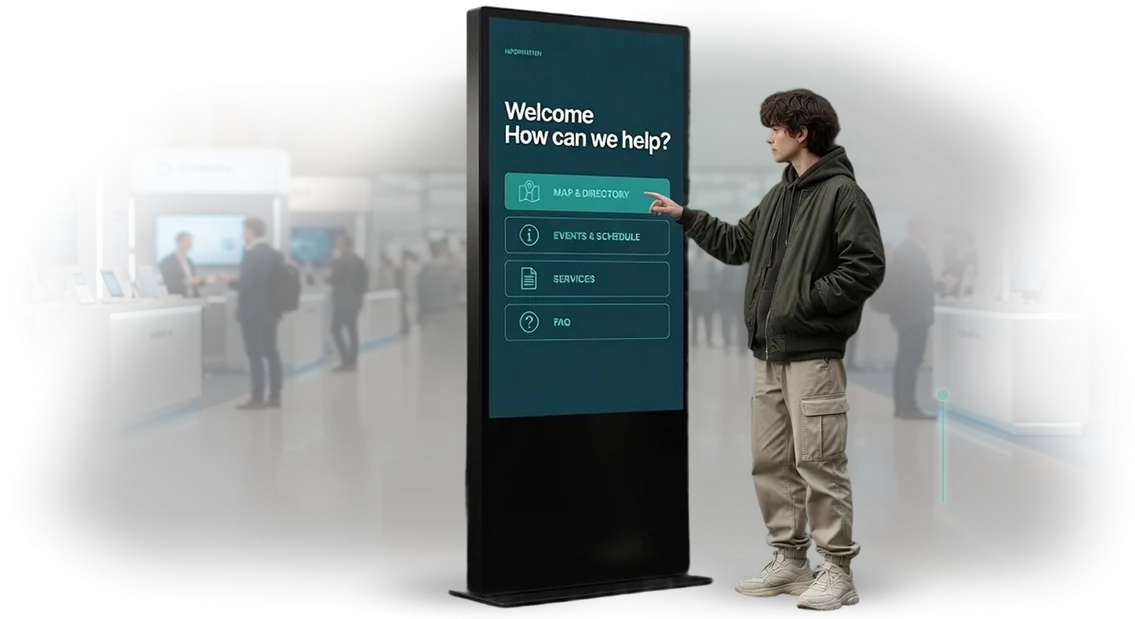
A Kiosk Without Access Control Systems — Losses and Risks
A visitor has already passed the entrance check, but the kiosk "doesn't know" about it — and asks them to present their pass again, enter data, or wait for confirmation.
During peak hours, this turns into a queue, and a queue means lost customers: some leave without waiting. The access control system and the kiosk operate separately, even though business logic says they should work as a single process.
A kiosk standing alone without access control integration also creates security risks. There is no synchronization: someone passes through the turnstile, but the system has no record of the visit; another person gains access even though their pass has already been blocked.
This is not a technical detail — it is a management error that surfaces during incident analysis or an internal audit. Fixing it after the fact is costly and stressful.
The company ends up with duplicate work for staff: the entrance employee checks a person, and then the same person re-verifies their identity at the kiosk.
Resources are wasted, service speed drops, and the client is left with the feeling that the organization's processes are "out of sync." In the end, three metrics suffer: throughput, security, and visitor loyalty.
We close this gap by integrating the kiosk with your access control system: passage data is automatically pulled into the kiosk scenario, and the work result flows back into the system.
Our team has been building such integrations for over 10 years — we configure data exchange to fit your infrastructure and current access rules, without replacing existing equipment.
After launch, the kiosk becomes part of a unified security perimeter, not a separate "island" with queues.
Why Business Needs Access Control at the Checkpoint
The checkpoint is a business bottleneck: queues in the morning, crowding in the evening, and the risk of letting unauthorized people in. Manual checks take time and provide no clear picture of who is in the building.
Integrating a kiosk with the access control system solves these challenges — quickly, securely, and with benefits for the brand. The owner also gets data on every passage and can manage access without unnecessary approvals.
Enhanced Security
The kiosk automatically checks visitors against the database — human error is eliminated, and every passage is recorded. You always know who is on the premises. In an emergency, the visit history can be easily reconstructed.
Service Speed
An employee or guest passes through in seconds, without forms or queues. The administrator's time is freed up for real tasks. During peak hours, the flow is not delayed, and the entrance stops being a point of tension.
Brand Recognition and Customer Loyalty
A stylish kiosk shapes the image of a modern company. The screen can welcome guests, show news and advertising — this strengthens the brand at the moment of contact and increases the desire to return. Integration with the access system highlights your care for the safety of guests and employees.
We combine the kiosk with your access system without reworking your processes. You get not just a checkpoint, but a tool for managing people flow and customer experience — with clear results for your business. We handle launch and support, so you don't need to understand the technical details.
Kiosk Implementation Formats for Your Task
An interactive kiosk solves various tasks: from simple visitor registration to managing guest flows at an event. Customers often spend time choosing hardware, but the key thing is the working scenario.
That is why we distinguish three integration formats — Basic, Standard, and Premium — each addressing a specific business need.
| Format | For whom | What it gives the client |
|---|---|---|
| Basic — office kiosk | Visitor reception area, HR department, administrators | Automated visitor registration, electronic log, printing temporary passes. Eliminates routine and prevents lost records. |
| Standard — production kiosk | Checkpoint, warehouse, workshop, security department | Employee access control, working time tracking, synchronization with the access control system. Reduces the likelihood of violations and "arrangements" at the checkpoint. |
| Premium — event kiosk | Guest registration, stands, conferences | Fast badge printing, site navigation, collection of guest activity analytics. Increases visitor loyalty and provides data for client reports. |
Each format is scalable: starting with Basic, you can always add integration modules for access control, accounting, or analytics. The main thing is that the kiosk solves your task, not just acts as a screen.
Tell us what you want to automate — we will select a configuration for your process and calculate the savings.
How the Project Goes from Brief to Launch
A clear, transparent process is half the success of any project. You always know what stage the work is at, what decisions are needed from you, and when the kiosk will go live.
No surprises: we handle the entire technical side, and you get a result that solves your business challenges.
Integration with an access control system is not just "connecting wires" — it is the coordinated operation of two systems. That is why we document every stage and approve it with you. This approach avoids rework and guarantees the system works from day one.
-
Brief and site audit. We discuss the kiosk's tasks: what it should provide, what data it should work with, and how many visitor flows it must handle. We examine the installation site and security requirements.
-
Scenario design. We work out the screen logic and the algorithm for interacting with the access control system: pass verification, visitor status, and the scenario for a guest without access. You receive a clear description of the mechanics.
-
Concept and estimate approval. We fix the scope of work, timeline, and cost. You see how long each stage will take and what your side is responsible for, as well as what we are responsible for.
-
Development and testing. We configure hardware and software, and test the "kiosk — access control system" integration. We test request processing speed and correct responses in non-standard situations.
-
Launch and acceptance testing. We install the kiosk at the site and conduct joint tests. You accept the work according to a pre-agreed scenario.
-
Post-launch support. We train staff to work with the system. A personal engineer is available to resolve issues quickly and help develop scenarios.
A transparent process saves your time and money. You pay for clearly defined work with a fixed result, not for "experiments along the way." Most importantly, at every step you make the decisions, and we simply guarantee technological quality. This keeps the project manageable and the result predictable.
What Is Included in Delivery and Implementation
It is good when a kiosk integration with an access control system ends with the delivery of a complete set of materials and settings, not just "it works." After the project is complete, you get everything you need for stable operation and easy staff training.
- A working "kiosk — access control system" integration: visitors pass through using passes, cards, or a guest code, and the event log automatically goes into your accounting system.
- Complete documentation: connection diagram, settings description, list of access rights, and failure response procedures — so any administrator can figure things out without a developer.
- Staff instructions in plain language, without technical details. Complex operations are described step by step, with pictures and checklists.
- Employee training: we conduct sessions at your site or remotely, showing how to work with the kiosk and how to handle typical situations. The results are documented in an acceptance report.
- Warranty on work and equipment, plus a fixed response time for service requests. If something goes wrong, you know the timeline and process for resolving the issue.
- Support during the first weeks of operation: we help with real-world usage questions and fine-tune the system to your processes.
So you get not just a touch screen, but a manageable piece of infrastructure. The access control system continues to work as usual, while the kiosk becomes its convenient interface for visitors. All documents and procedures stay with you — you are not dependent on us after launch.
Case Study: How a Kiosk Replaced Paper Passes
In one business district, the pass system ran on paper: a guest filled out a form, a security guard checked documents, and issued a temporary badge.
At peak times, a queue formed at the reception desk, badges were lost, and the visit log was filled out by hand — errors and forgotten passes became an everyday problem.
We connected an interactive kiosk to the existing pass system and automated the routine. Visitors independently find the company they need, complete identification, and receive a one-time code for the turnstile — in 30–40 seconds.
Reception staff no longer handle check-in, and the security department got a single digital log of all passages without replacing the installed equipment.
The results were measurable within the first month: pass issuance time dropped from seven minutes to forty seconds, and badge losses disappeared entirely. The load on the reception desk almost halved, and repeat visits no longer require re-registration.
"We used to spend half a day reconciling paper reports and searching for unreturned badges. Now the system handles tracking on its own, and the kiosk has become the first step every guest sees," shared the head of the pass service at Panorama business quarter.
Importantly, we did not have to change the entire access infrastructure: the kiosk integrated with the existing turnstiles and internal software. So the automation fit into current processes without disrupting the business quarter's operations.
After two months, the client came back for expansion: they asked to add scenarios for conferences and large-scale events. This case brought a second repeat order — practical proof that the solution solves a problem rather than creating a new one.
How to Choose the Right Format for Your Task
The kiosk format should be chosen not from a catalog but for a specific business task — that is the main principle. If you need to issue passes quickly and avoid queues at the checkpoint, authorization speed becomes the priority.
When the kiosk helps a guest find an office or book an appointment with a specialist, interface simplicity and prompts come to the fore.
Integration with an access control system shifts the focus: reliable visitor identification and seamless data transfer to the server become key, rather than decorative effects.
The second criterion is who exactly will use the device. General visitors in the lobby expect intuitive large buttons and a minimum of actions; employees with permanent passes expect quick card tapping; and one-time guests need a clear scenario without training.
A properly chosen format saves people's time and reduces the load on the administrator, who stops answering the same questions.
When the kiosk is connected to an access control system, you also get data: who came, when, and which zone they entered. This helps you assess real traffic, plan staff schedules, and spot peak hours.
Thus, choosing a format stops being a guessing game — it becomes a tool for managing people flow and increasing loyalty.
Practical advice: before choosing, discuss with your integrator what information you need as output. If you only need the fact of a visit, a compact terminal with a basic scenario will suffice.
If the task is broader, for example collecting analytics on each client, it is worth building in extended functionality from the start so you don't have to redo the project later.
And most importantly: choose a format that is easy to develop. The ability to add scenarios, change screen logic, and connect new zones without replacing equipment is your insurance against obsolescence.
Then the kiosk and access control work as a single system that is convenient to use and easy to manage.
What to Know When Ordering a Kiosk
Before ordering a kiosk, clients most often ask about security, timelines, warranties, and support. We answer the main concerns so you can make a decision with complete clarity.
We have been integrating kiosks with access control systems for years, so we know what questions really matter to businesses.
Is it safe to use a kiosk with my access control system?
Yes. We provide a secure connection and separate access rights: the kiosk only sees the data it needs for its task. All actions are logged, and after launch you receive a report on system operation.
What are the development and implementation timelines?
A typical project takes 3–4 weeks. At the planning stage, we set a schedule with milestones so you can see progress. The complexity of the integration affects the timeline, but we give you the exact date before work begins.
What warranty do you provide?
Warranty on equipment and work is stated in the contract. During the warranty period, we fix any issues related to our solutions for free. After that, you can sign a support agreement.
What should I do if the kiosk stops working or I need to update content?
We connect remotely and resolve the issue in most cases within a few hours. Updating the interface or information usually takes one or two working days. On request, we can offer scheduled maintenance.
Get Your Integration Cost Estimate in 1 Day
Kiosk integration with an access control system usually raises many questions: how it will work, what modifications are needed, how long implementation will take.
Without an accurate estimate, it is difficult to plan a budget and timeline — which is why most projects stall at the evaluation stage.
We offer a different path. You submit a request — and the very next day you receive a transparent cost estimate and a work plan tailored to your task. No need to wait for weeks, clarify details, or guess about hidden costs.
What you get after submitting a request:
- Estimate for your scenario — based on the kiosk type, access verification format, and number of installation points.
- No-surprise estimate — fixed cost of work, additional services, and equipment are clearly listed.
- Implementation timeline — a realistic schedule from the start of work to launch at your site.
- Solution options — we will offer 2–3 ways to integrate with your current access control system, from basic to advanced.
- Engineer consultation — we will discuss details, risks, and compatibility with your infrastructure.
- Hardware recommendations — we will advise what can already be used and what should be upgraded.
- Post-launch support — technical support and warranty on all work, so the system runs stably.
We will also answer questions about security, backups, and access control bypass scenarios — before you sign the contract.
Fill out the form or call us — in a day you will have a clear document on hand that you can use to make a decision and launch the project.