

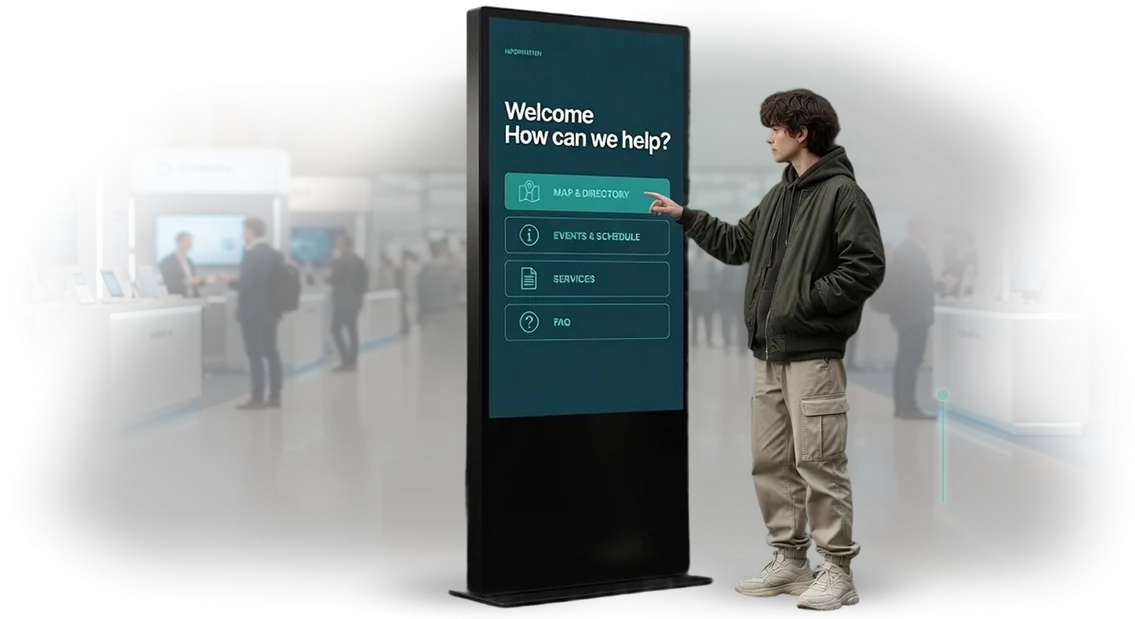
Integrating Kiosks with Telemedicine Systems: Where to Start?
An interactive kiosk in a clinic solves one task on its own — automating doctor appointments. But if it isn't connected to telemedicine systems, the clinic loses the key opportunity: turning an ordinary visit into a full-fledged remote consultation.
Patients who can't come in are left without help, doctors are overloaded with in-person appointments, and revenue is limited by lobby capacity. A kiosk without integration is just an expensive terminal.
We close this gap. We integrate the kiosk with your telemedicine platform — and the patient right in the lobby can choose a specialist, book a video appointment, and get a consultation without entering an examination room.
All data automatically flows into a unified system: the doctor sees the medical history, test results, and prepares for the appointment in advance. This way, the kiosk becomes an entry point into the clinic's digital ecosystem, not a standalone device.
Where to start? With an audit of your processes: which services are in demand, where patients most often book appointments, and whether doctors have open slots for online consultations.
We use this as a foundation and configure the kiosk so that telemedicine integration is seamless for staff and convenient for patients. Already at the planning stage, we define scenarios: booking with doctor selection, quick consultation start, and repeat visits.
As a result, the clinic gets not just a terminal — but an additional channel for delivering medical care. Patients book consultations at convenient times, the queue at the reception desk decreases, and the range of services expands without increasing staff.
Comprehensive integration pays off through growth in the number of appointments and patient loyalty. And most importantly — you get a single control point for all patient interactions, and we continue to support the system after launch.
What an Interactive Kiosk Gives a Clinic and Patients
An interactive kiosk integrated with telemedicine systems delivers measurable benefits to a clinic at three key points: booking, appointment, and patient return.
According to a study by Deloitte, digital services reduce waiting times by an average of 30% and increase patient satisfaction by roughly a quarter. These are the metrics that directly affect revenue and reputation.
Booking stops being a bottleneck. The kiosk lets patients choose a doctor and time in 1–2 minutes without queuing for an administrator. Slots fill more evenly, and freed-up staff have more time to serve in-person visitors properly.
Telemedicine availability grows without a technological barrier. An elderly patient doesn't need to figure out a smartphone app — they simply walk up to the kiosk, put on the headset, and connect with a doctor within minutes.
As a result, the clinic can provide consultations even during hours when there's no free administrator in the lobby.
Patient loyalty increases thanks to visit predictability. If a person once goes through the entire journey smoothly, they're more likely to come back and bring an acquaintance.
Research figures confirm this: 70% of patients are willing to choose a clinic where they can book quickly without a phone call or queue. The kiosk is an investment in repeat visits.
Kiosk Formats for Working with Telemedicine Systems
The kiosk format directly affects whether a patient will use telemedicine — or walk right past it. A well-chosen configuration saves time, doesn't create queues, and looks natural in the clinic's interior.
We'll help you select an option for your tasks and integrate it with your telemedicine system turnkey.
| Kiosk format | Where to place | What the patient gets | What the clinic gets |
|---|---|---|---|
| Floor-standing kiosk | Lobby, waiting area, entrance hall | Quick connection session with a doctor without a reception desk | Reduced load on administrators, queue-free flow |
| Tabletop kiosk | Doctor's office, reception, laboratory | Additional consultation channel right during the visit | Expanded services without reconfiguration, space savings |
| Stationary infomat | Remote locations, pharmacies, partner offices | Access to a specialist even when there's no clinic nearby | Coverage of a new audience, growth in consultations |
Floor-standing kiosks are a universal solution for large medical centers: they're visible, equipped with everything needed for video communication, and don't require staff involvement.
The tabletop format is convenient for targeted placement in offices where compactness matters, while the infomat is a reliable assistant for branches and locations without a permanent doctor.
At the consultation stage, we assess your premises, patient flow, and usage scenarios, then propose a specific configuration. All formats run on the same software, so telemedicine integration takes minimal time and staff don't need retraining.
Project Launch Stages: From Brief to Support
Here's how work on an interactive telemedicine kiosk proceeds, so you know the timelines, areas of responsibility, and checkpoints in advance. The process is transparent and well-tuned — at each stage, you know what's happening and what you'll get as a result.
-
Brief and task analysis. We discuss project goals, kiosk usage scenarios, your telemedicine platform's requirements, and specifics of the installation site. We draw up a detailed technical specification to avoid misunderstandings at the start.
-
Concept and mockups. We propose an interface design that considers your brand, patients' age characteristics, and navigation simplicity. We align the screen logic — from doctor selection to video consultation booking — and the integration order with your system.
-
Contract and schedule. We fix the scope of work, stages, and deadlines in the contract. We agree on server-side conditions, equipment technical parameters, and responsibilities for both parties.
-
Development and integration. We configure the kiosk's interaction with telemedicine systems: doctor booking, consultation launch, payment, and electronic ticket output. In parallel, we assemble and test the equipment — on a professional basis, this avoids failures on day one.
-
Delivery, installation, and launch. We bring the kiosk to the site, install it, connect it to the network, and test all user scenarios. We train your administrators to work with the system and provide clear instructions and procedures.
-
Support and development. We monitor operation after launch, promptly address any issues, and collect feedback from patients and staff. Later, upon your request, we update the software, expand functionality, and grow the number of services.
What's Included in the Kiosk Delivery Set
The delivery set includes everything needed to launch the kiosk: a touch panel, a protected enclosure, preinstalled software, and documentation. We hand over the system turnkey — from unboxing to the first patient appointment via the telemedicine service.
Here's what you get in the base delivery configuration:
- Kiosk hardware — a touch panel with a tamper-resistant enclosure, suitable for lobbies, entrance halls, and waiting areas without constant staff supervision.
- Software — a preinstalled interface with a telemedicine module: specialist booking, video consultation, document upload, and payment for services.
- Integration with your systems — we configure the kiosk's connection with the clinic's or private practice's internal accounting system so that visit data automatically enters your database.
- Operational documentation — clear instructions for staff and a daily maintenance checklist: how to turn it on, reboot, clean the screen, and replace consumables.
- Staff training — a short briefing for administrators and medical staff: how to start a session, help a patient, and quickly switch the kiosk to manual mode in an emergency.
- Warranty on hardware and software — troubleshooting within the warranty period, software updates, and phone consultations during business hours.
- Remote monitoring — in the base configuration, the kiosk reports failures to us, so we often learn about an issue before your staff does.
You don't need to assemble a solution from multiple vendors or dig into technical details. The entire set is tested before shipping: hardware and software are configured for your task at our production facility.
After delivery, we don't disappear: for the entire warranty period, you get support by phone and email. If the kiosk requires servicing, our engineer will arrive with the necessary spare parts — no need to find a specialist yourself. This reduces downtime and keeps patients' access to telemedicine even during peak hours.
Case Study: How We Reduced the Queue in a Clinic
In a private clinic with a wide network of branches, bookings with specialists stretched out for weeks, and during peak hours a 20–30 minute queue formed at the reception desk.
Simply installing another terminal didn't solve the problem: patients needed not only an electronic queue and tickets but also fast access to a doctor without extra visits.
We proposed combining an interactive kiosk with the telemedicine system. Through the terminal, a patient books an in-person appointment or immediately gets a video consultation session if their case can be handled remotely.
Integration took several weeks, and the modification didn't require replacing existing equipment — only software configuration and scenario setup.
How It Happened
At City Clinic No. 1 (name changed), four kiosks were installed.
A patient selects "Telemedicine" in the menu, sees available slots, pays for the appointment, and connects with a doctor right at the terminal — in a separate meeting room or from home via a personal dashboard. For those unfamiliar with screens, every kiosk retains a call button for the administrator.
Results
Two months after launch, we recorded the following changes:
- Waiting time at reception dropped from 25 minutes to 5–7 minutes during peak hours.
- The share of remote consultations grew to a third of all initial visits.
- The number of repeat telemedicine bookings increased 3 times — patients appreciated not having to travel for a quick question.
- Call center load dropped by 40% since kiosk booking became the primary method.
For the clinic, this means not only patient comfort but also savings: less administrator downtime, even patient flow distribution, and higher throughput without expanding staff.
Patients benefit too — they don't have to take time off work or sit in traffic just to check test results.
This approach scales: other services can be connected to the kiosk — from specialist booking to certificate issuance and doctor home visits. We adapt the scenario to your clinic and help estimate the expected effect before work even starts.
Frequently Asked Questions Before Ordering a Kiosk
Before ordering an interactive kiosk, we hear the same questions: will the equipment break, is it hard to use, will we need to assign staff to help. We answer these concerns in advance — so you can decide calmly, without hidden risks.
The kiosk is designed for autonomous operation and integrates with telemedicine systems: visitors book consultations, talk to a doctor, and receive results on their own.
You don't need to monitor every step — the interface is understandable even for those seeing a touchscreen for the first time.
What happens if the kiosk breaks down?
All equipment is covered by warranty. If a breakdown occurs, we'll promptly repair or replace the device — average response time is one business day. This avoids prolonged downtime and keeps visitor flow moving.
Will we have to assign an employee to manage the kiosk?
No. The kiosk is designed so visitors complete every step on their own: large fonts, clear prompts, and voice guidance help even elderly users. No extra staff is needed, and if an unusual situation arises, you can always contact the support service.
How safe is data transfer?
When working with telemedicine systems, protecting personal data is essential. We use secure communication channels and encryption, and access to information is strictly restricted — this meets medical organizations' requirements and your security policies.
How often does the kiosk need maintenance?
Maintenance doesn't require your involvement. We remotely monitor the kiosk's status and conduct scheduled inspections. Staff intervention is minimal, so the equipment works reliably and doesn't distract your team from core tasks.
How to Order Kiosk Development for Your Task
To order a kiosk and get a cost calculation, send a request through the contacts on the website. We'll get in touch within a day, clarify your goals, and propose a project launch plan — without lengthy approvals.
Here's how the work proceeds:
- Request and brief — you describe the kiosk format, placement location, and functions.
- Cost and timeline calculation — we send a transparent commercial proposal.
- Mockup and logic approval — we show the interface before development starts.
- Kiosk assembly and content setup — we connect the necessary services and content.
- Testing and debugging — we verify in real conditions and make adjustments.
- Launch and support — we install the kiosk, train your team, and stay in touch.
After your request, you receive:
- A personal manager — manages the project from the first contact to launch.
- A fixed price in the contract with no hidden charges.
- Recommendations on kiosk format, including telemedicine system integrations.
- Prototypes and mockups for approval before production.
- Clear project launch timelines with checkpoints.
- Post-launch support — we respond to questions promptly.
We've been building interactive kiosks for business, healthcare, and the public sector for 10+ years. We launch projects turnkey. Leave a request — we'll discuss the details within the week and start work.
What If We Have Non-Standard Requirements?
Non-standard requirements aren't an obstacle — they're a reason to build a solution that fits your clinic specifically. We've worked with various medical organizations and know: no two processes are identical, and standard configurations don't suit everyone. That's why any request beyond the typical scope is treated as an individual project.
We start with your task, not a ready-made template. We analyze how patient intake is organized, which telemedicine systems are already in use, and where the kiosk should speed things up — at the entrance, during booking, or when transferring data.
Based on this, we adapt the kiosk: interface, scenarios, connection to your platform, and data flow — everything is tuned to the clinic's specifics, not the other way around.
This also applies to non-standard integrations: if you need a specific telemedicine system, an unusual schedule, custom fields in the patient card, or automatic doctor notifications — we build it into the project.
Adapting the kiosk to these tasks takes as long as needed for a careful implementation without disruptions to the reception desk.
You're never left alone with the question "how do we do this?" We propose an option, align it with you, implement it, and support it after launch.
As a result, the kiosk solves exactly your problem: it shortens queues, reduces administrator load, and works the way your patients find convenient.
If you're unsure whether your request is realistic — send it to us. Even the rarest scenarios have come up in our practice before, and those that haven't become interesting individual projects. We'll find a solution and handle all the technical details.