

Integrating Kiosks with Learning Management Systems: Why It Matters
Kiosks and the learning platform often exist separately from each other, which creates "blind spots" for the business.
An employee completes a course in the learning management system, but at the touch kiosk sees only general information that has nothing to do with their progress.
As a result, you lose the ability to deliver exactly the materials that are relevant to that person right now, and you cannot measure how effectively offline equipment engages the audience.
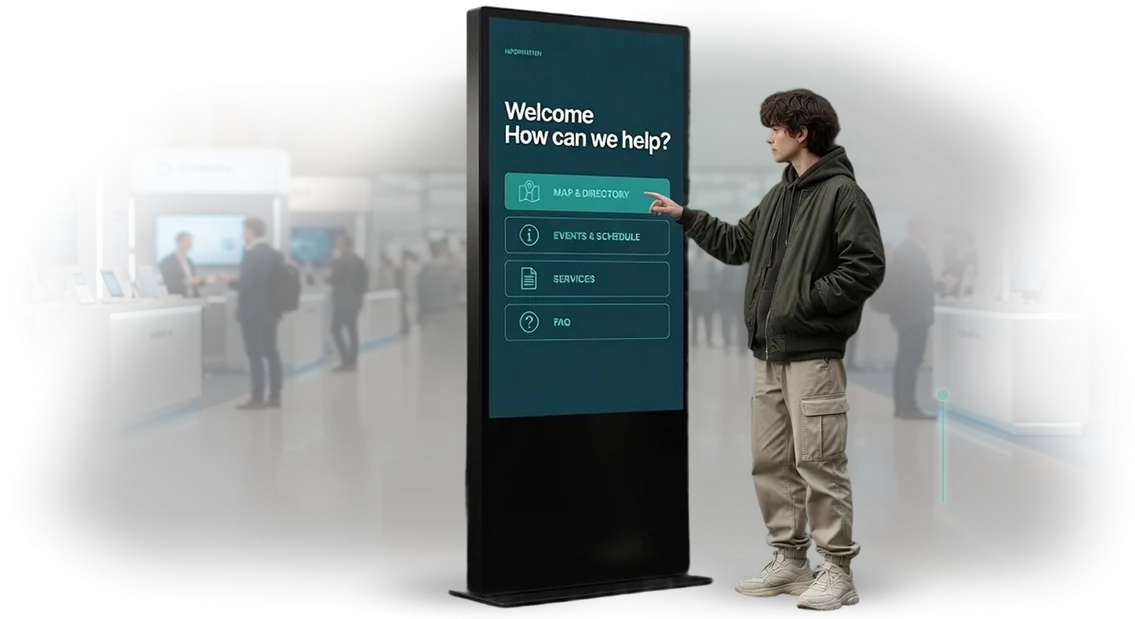
Integrating a kiosk with the learning system turns an ordinary kiosk into a personalized learning center.
An employee or learner signs in and gets to their profile: assigned courses, tests, and instructions are available to them, and their results are automatically sent to the shared database.
This format answers the question of why a kiosk needs learning integration—it stops being a display and becomes a full-fledged tool for knowledge checks and staff onboarding.
For the business, this means greater reach and discipline: learning is no longer limited to a workstation with a computer. New information is available in the lobby, in the warehouse, in the meeting room—anywhere a kiosk is installed.
At the same time, you save employees' time because the whole process takes a few minutes, and completion data appears in reports without manual collection.
We connect the kiosk to the learning portal through reliable integration protocols, so you get seamless synchronization without data loss or the need to duplicate records manually.
As a result, you build a unified ecosystem in which offline equipment works toward your educational and business metrics rather than standing as a separate, disconnected solution.
Five Results of Integrating a Kiosk with a Learning Portal
Integrating a kiosk with a learning portal turns an ordinary information point into a full-fledged tool for staff development and guest engagement.
Instead of scattered PDF instructions and paper tests, you get a single system where every step is recorded and results are visible in clear statistics.
Below are five measurable results you get after implementing such a solution.
1. Higher Course Completion Rates
An employee completes training during downtime at the kiosk—no need to distract them from work or gather them in a meeting room. The kiosk itself reminds them about unfinished material, and the number of people who reach the final test increases noticeably.
2. Clear Statistics Instead of Guesswork
A manager sees who completed the course and who stopped halfway, how long the training took, and which questions caused difficulty. This provides a basis for improving the program without surveys or guessing.
3. Engaging Guests and Visitors
If the kiosk is used not only by employees but also by clients, you can offer short learning scenarios or quizzes. People readily interact with the screen—this increases engagement and brand recall.
4. Single Window for Learning and Information
The kiosk handles two tasks at once: it helps people navigate the space and gives access to up-to-date materials. There is no need to update bulletin boards or send out files—changes are made once and are immediately visible on all devices.
5. Saving Your Team's Time
An administrator no longer needs to collect signatures manually or check tests—the system itself records completed steps. This relieves staff and reduces paperwork.
We specialize in such integrations: we connect kiosks to popular learning management systems and configure scenarios for your task.
Over ten years of work, we have completed more than a hundred similar projects—from internal corporate portals to public areas in shopping centers.
To ensure the result is exactly what you need—with growing metrics and transparent reporting—we agree with you at the start on the list of courses and the rules for displaying statistics. You get a working system, not just screens with content.
Interactive Kiosk Formats: Choose the Right One for Your Scenario
An interactive kiosk delivers results when the format matches the task. One thing is employee sign-up for webinars through a compact kiosk at the entrance; another is a touch panel for the lobby where guests explore materials and take short tests.
Choosing the right equipment for the scenario directly affects how often people use the kiosk and how quickly the learning management system (LMS) receives data.
We design and supply kiosks in various formats—from small stands to large touch panels.
Every option integrates with your LMS, so it does not matter whether you choose a stationary solution or a mobile stand: training results, surveys, and registrations automatically flow into a single system.
| Format | Who it is for | What it gives the customer |
|---|---|---|
| Compact kiosk | Reception area, small corporate center | Self-service sign-up for courses, schedule viewing, quick LMS access without an administrator |
| Corporate center kiosk | HR department, training room, internal university | Registration for programs, post-training tests, automatic transfer of results to the LMS |
| Touch panel for the lobby | Large office, meeting room floors, event zones | Visitor engagement: navigation, demo materials, mini-surveys; does not take floor space, mounts on the wall |
| Interactive table | Meeting rooms, exhibition booths, lounge areas | Collaborative viewing of training materials, presentation of new programs, collecting feedback in an informal setting |
Whichever format you choose, it solves one task—shortening the path for an employee or guest to the information and training they need.
And integration with the learning management system turns every kiosk into a data collection point: you see which courses are in demand, where people struggle, and which formats generate more engagement.
We will select a solution for your corporate scenario—from a single point to a network of kiosks across all offices.
How a Kiosk Integration Project Works: Stages and Timelines
So that kiosk integration with a learning management system does not become a "black box" with unpredictable timelines, we have built a transparent process with clear stages.
You always know what is happening, what decisions are needed from you, and when the project will launch. Below is the typical path followed by most of our projects.
-
Brief and task audit. You describe the kiosk's goals: which courses or materials it should provide, who the audience is, and where it will be located. We analyze your LMS and integration capabilities to propose the best option. The result is a short summary with an assessment of timelines and scope of work.
-
Agreement on kiosk scenarios. Here we define how a visitor interacts with the screen: from the start screen to receiving a certificate or enrolling in a course. You see the logic in diagram form and approve it. This is the key stage—after it, development proceeds without changes.
-
Integration plan and design prototype. We prepare a detailed plan with dates, show the look of the kiosk screens, and the connection to your LMS. You receive a clear timeline estimate and understand what data will be exchanged between systems.
-
Development and technical configuration. Our specialists configure the kiosk software, connect it to your learning system, and test the scenarios. At this stage, you see intermediate results and can make edits without affecting the overall schedule.
-
Testing on a real device. We check the kiosk under conditions close to real ones: course loading, employee identification, stable operation under a high number of sessions. If necessary, we make adjustments within a few days.
-
Launch and training for your team. We install the kiosk in the right location, conduct a short briefing for staff, and hand over operating instructions. On launch day itself, you can already track the first results in the learning system.
-
Support and development. After launch, we stay in touch: we update content, help add new courses, and answer questions. If desired, we connect analytics so you can see which materials are in demand.
Project timelines depend on the complexity of the scenarios and the readiness of your LMS, but at the start, we always set exact dates for each stage in the plan.
Typically, the launch takes two to six weeks—you know in advance when the kiosk will begin working and when the first results will appear.
What Is Included in the Delivery When Integrating a Kiosk with a Learning Platform
In reality, integrating a kiosk with a learning platform often turns into a headache: the equipment is there, but the system does not answer users' questions or requires manual intervention from an administrator.
We structure the project so that you get a working tool "turnkey," not a set of components and promises. The delivery includes everything needed for launch and confident operation.
The LMS integration package includes:
- Connecting the kiosk to your learning platform — the system itself pulls in current courses, schedules, and completion results, without manual data updates.
- Adapting the interface to user scenarios — a guest sees clear navigation, finds the right course, and signs up in a couple of taps, which reduces the load on administrators.
- Setting up notifications and reports — you see statistics on kiosk usage and performance to understand how relevant the content is.
- Technical documentation in English — instructions for launch, day-to-day operation, and typical actions for a non-programmer employee.
- Training for your team — a short hands-on session (in person or remote), after which staff can independently manage the kiosk and help users.
- Warranty support at launch — we are available during the first weeks of operation, help fine-tune processes, and answer questions so you are never left alone with the system.
As a result, you get not just a kiosk but a ready-made service that saves employees' time and makes learning convenient for your audience. All details and agreements are recorded in advance so there are no surprises at launch.
Case Study: Kiosk Integration in a Corporate University
A corporate university for the MedLife clinic network found it difficult to deliver mandatory training to doctors and administrators: they rarely sit at computers, and email notifications get lost in the flow of tasks.
We proposed placing interactive kiosks in lobbies and lounge areas—so an employee could open a personal account in 5 minutes, complete a short module, and receive a reminder about the next stage.
We launched a pilot in three branches and refined the scenario after the first few weeks: we added employee authorization via barcode and adapted the interface for touch control.
The kiosk became not "just another screen" but a working channel of the educational process—an entry point where it is clear what to study and how long it will take.
Kiosk Implementation Results
Two months after launch, the number of employee visits to the learning portal increased by 64%, and the completion rate for mandatory modules rose from 41% to 87% among those who used the kiosk.
The share of completed courses also grew even among groups that had not logged into the system for more than two months. Learning managers did not need to expand their team—the kiosk took over repetitive questions and notifications.
Employees appreciated the convenience: a short video testimonial helped confirm real usage scenarios and refine the interface. Now the kiosks operate in all 14 branches, and the corporate university plans to add new courses without the involvement of programmers.
This example of kiosk implementation shows that even complex integration with an internal learning portal delivers measurable results: more training requests, fewer drop-offs, and clear analytics for managers.
How to Choose a Kiosk Format for a Specific Task?
A universal kiosk does not exist—and that is a good thing. The format, screen, enclosure, and set of functions should be driven by the specific task: who will use the kiosk, in what space it will stand, and which scenario needs to be covered.
If you approach the choice formally, it is easy to end up with an expensive stand that does not fit into the learning process or creates queues at the information point.
That is why the first step is always analyzing the business task, and only then selecting hardware and software.
When a kiosk needs to work in conjunction with a learning management system, the speed of user entry and ease of navigation become paramount.
An employee or student taps a card, scans a barcode, or enters a code—and immediately sees their courses, learning materials, and test results. This means the kiosk needs a reliable touch panel, a well-thought-out interface, and seamless integration with your LMS.
We select an option that does not require constant administrator involvement and easily handles peak loads—for example, at the start of the workday or before an exam.
If the kiosk is intended for informing visitors, the task is different. A large screen, an intuitive menu with no training required, and the ability to quickly find the right room or service matter most.
In this case, what is critical is not integrations but response speed and interface robustness against rough handling.
We assess the flow of people, the size of the space, and typical requests to propose a kiosk that will not become a "bottleneck" and will be useful during peak traffic hours.
Our approach is not to sell a box but to select a solution for your processes. We study scenarios, space constraints, security requirements, and the potential for future expansion.
If needed, we integrate the kiosk with your learning system, set up user roles and access rights, and add a guest mode. You get not just a device but a tool that saves employees' time and makes interaction with information fast and intuitive.
Describe what task the kiosk should solve—and we will propose a format that covers it with minimal costs and maximum return. We will tell you which options are effective in your situation, what to consider at the start, and how to avoid unnecessary expenses when retrofitting. Describe your scenario, and we will select the optimal configuration for your budget and goals.
Frequently Asked Questions About Kiosk and Learning Platform Integration
Customers ask questions about kiosks long before launch: how integration with the learning platform works, what happens if something breaks, and who provides support. We answer the main concerns so you understand how we reduce risks.
What happens if the kiosk does not work?
Any technology can fail, but we build in a margin of safety. Test results are stored on a protected drive and, after recovery, are synchronized with the learning platform.
For urgent situations, there is a hotline—an engineer can connect remotely or arrive on site within the time specified in the contract.
Is the kiosk compatible with our learning management system?
Ready-made solutions already exist for popular learning management systems. Integration does not require migrating courses or replacing equipment: it is enough to set up data exchange between the kiosk and your platform. During the audit, we will check compatibility and give you exact timelines before work begins.
Is kiosk support included in the contract?
Yes, support is a mandatory part of the work. We monitor the condition of devices remotely, update software, and respond to requests during business hours.
Response time and part replacement time are recorded in the service agreement, so you know exactly when the kiosk will be back up and running.
If you have a question that is not on the list, send it to our engineers. We will analyze your infrastructure and propose a plan for integrating the kiosk with the learning management system.Let's Discuss Your Project: Request for Kiosk Integration
Send us a request and we will prepare a selection of interactive kiosk formats that integrate with your learning management system (LMS). During the consultation, we will review which scenarios already work in your industry and propose a solution for your tasks.
After your inquiry, you will receive a timeline estimate: from interface development to integration with the corporate portal and testing. We work remotely, so you can start the integration project without being present in the office.
What happens after a kiosk request:
- We call at a convenient time and clarify your goals: employee certification, onboarding of new specialists, professional development.
- We select kiosk formats and user interaction scenarios.
- We prepare an integration plan with your learning management system.
- We calculate timelines and implementation stages and record them in the contract.
- We agree on the design and screen structure with your team.
- We launch a pilot kiosk, then scale it across the entire network.
- We hand over materials and support the project after launch.
This way, you get a ready-made access point to learning that works without an administrator. Employees get quick access to courses, tests, and instructions, and you get transparent completion statistics.
Submit your kiosk request right now: we will respond within one business day, prepare a proposal, and provide a timeline estimate for your task.