

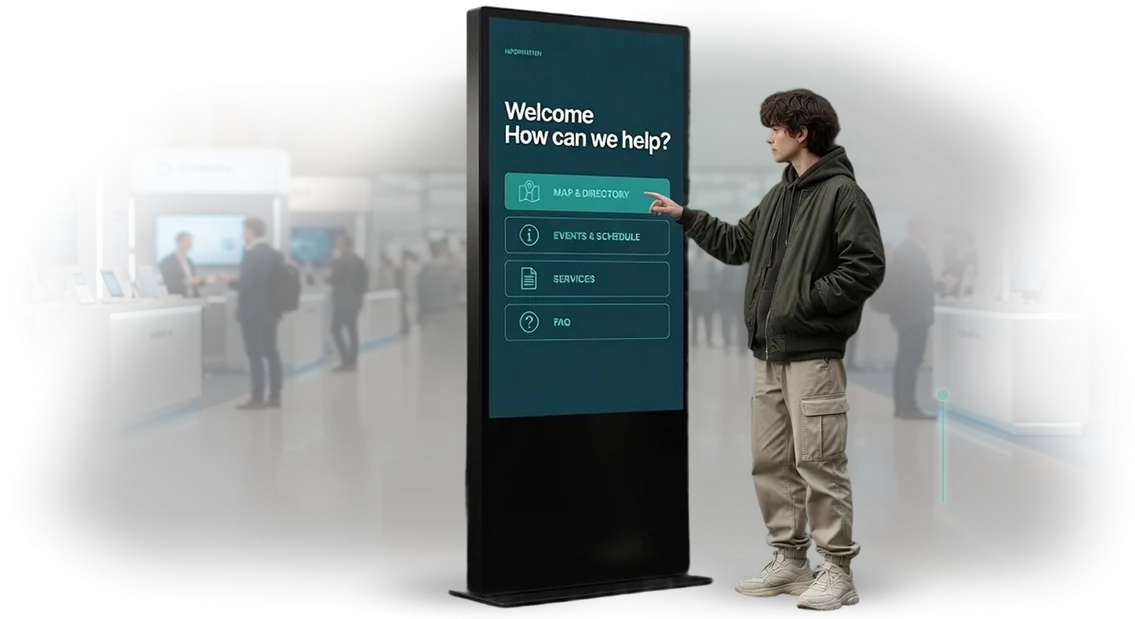
How an interactive kiosk works with parking management systems
Parking is the first point of contact between a client and your facility. If there is chaos, queues, and confusion here, even excellent service inside will not save the impression.
Visitors do not want to waste time looking for a free spot or figuring out the entry rules — they just want to park and get on with their business.
An interactive kiosk solves this problem by becoming the link between the guest and the parking management system.
Instead of a long conversation with staff or waiting at the barrier, the client chooses a scenario on their own: enters a vehicle number or booking code, sees available spaces on the map, pays for parking — and receives confirmation to proceed.
Integration of the kiosk with your existing parking management system is critical. Only then all data about entries, exits, and payments remains in one system: the kiosk does not become a separate “foreign” service but works as an additional service window. This eliminates manual recalculations, operator errors, and disputes with guests.
For business, the result is a predictable flow of clients and short queues. The kiosk processes a request in seconds, relieving staff and checkpoints.
At the same time, integration preserves your existing infrastructure and does not require replacing parking equipment — we build collaboration with what is already installed.
As a result, you get a convenient service for visitors and lower parking maintenance costs. Clients increasingly choose a facility where arriving and leaving is easy. And transparent integration makes this path seamless for both you and the guest.
What the kiosk gives your parking lot and business
Any parking lot is a point of contact with the client that either works for your business or against it. Payment queues, unhappy guests, operator errors, and a lack of data on actual occupancy quietly eat away at profit.
An interactive kiosk removes these losses and turns parking into a predictable service that delivers value rather than headaches.
Service speed is the first thing clients notice. A person pays for parking independently in a couple of touches, without spending time waiting for an operator.
The flow of cars at entry and exit speeds up, queues inside the parking lot disappear, and you get more vehicles served per hour. For business, this is a direct benefit: faster turnover, higher revenue, and fewer irritated visitors.
Automation gives the owner full control. The system itself records every session, time, tariff, and payment, so you do not need manual reports and cash reconciliation.
All information about occupancy and payments is collected in one window — you can see which hours are peak, which tariffs work, and which should be changed. Transparency reduces the risk of abuse and makes parking manageable rather than a “black box.”
Service and loyalty are what bring clients back. The kiosk is clear to everyone: large on-screen prompts, multiple payment methods, instant receipt.
You can easily connect a loyalty program, season tickets, or electronic passes — then regular guests and employees feel cared for and willingly use the parking again. Convenient service becomes part of the impression of your company.
The bottom line is simple: an interactive kiosk is not just a payment stand but a tool that saves time, increases control, and strengthens audience loyalty.
We design and implement such solutions for your task — from a single terminal to a parking network, with the interface adapted to your brand and operating rules. You get a service that pays off through speed, automation, and repeat visits.
Kiosk formats for different parking tasks
Parking is the first and last point of contact between a guest and the facility. If there are delays at entry or exit, visitors remember them, even if the store or service itself was excellent.
Informational kiosks integrated with the parking management system relieve this burden: they show free spaces, accept payment, and help find a car or an exit.
The choice of kiosk format depends on where it will be installed, how much traffic passes through the facility, and what conditions it operates in. Below is a comparison of typical solutions we use as a basis for design.
| Kiosk format | Who it is for / where it goes | What it gives the client |
|---|---|---|
| Wall-mounted | At entrances to shopping centers, business centers, on parking floors | Saves space, fast payment and session extension without queues, reduces staff load |
| Outdoor | Open parking lots, parking near airports and railway stations | Resistance to weather and vandals, cashless payment, fewer exit bottlenecks |
| Information stand | Waiting areas in airports, large malls, congress centers | Route guidance to free spaces, advertising of additional services, improved navigation and loyalty |
| Multifunctional terminal | Shopping centers, city parking, parking near stadiums | Payment, car finder, device charging, occupancy analytics collection |
For airports and large malls, a combination of formats is usually needed: wall-mounted near elevators and outdoor at entrances. The key is that all kiosks are connected to a single parking management system — then data on spaces and payments is current at any point.
Tell us about your facility and we’ll suggest a kiosk format tailored to your parking tasks — taking into account traffic flows, layout, and guest scenarios. This will help reduce queues and increase revenue from paid parking.
Stages of connecting a kiosk to parking management systems
Connecting a kiosk to a parking management system is not just installing a device; it is setting up an entire process: the visitor gets up-to-date information about free spaces, the administrator gets flow control, and the business gets fewer manual operations.
We structure the work so that each stage is clear and transparent, and the result appears exactly on time.
Implementation stages
- Brief and parking audit. We study your objectives, vehicle flow patterns, and current methods of providing information. We determine kiosk installation points and data sources on space occupancy.
- Scenario design. We work out the operating logic: displaying free spaces, routes to the entrance, the ability to book parking. We account for peak loads and non-standard situations.
- Interface and content creation. We develop screens and texts tailored to your brand and typical visitor questions, so the kiosk is clear from the first touch.
- Data exchange configuration. We connect the kiosk to your parking management system. The main focus is real-time synchronization and correct handling of changes.
- Testing on real scenarios. We simulate working situations: guest arrival, parking lot occupancy, short-term communication failures. We fix issues before launch.
- Launch and staff training. We install the equipment, verify operation on site, and briefly explain to staff how to manage the kiosk and respond to standard requests.
- Support and development. We stay in touch after launch: monitor stability, update content, and add new features as your tasks grow.
What is included in the delivery and setup of the kiosk
When you buy an interactive kiosk, you get not “hardware in a box” but a ready-made solution for your parking lot. We handle everything: from the kit to daily support. Here is what is included in the delivery and setup.
- Delivery kit — the kiosk itself, protective casing, mounting hardware, power supply, and all necessary cables. The equipment is fully ready to operate immediately after unpacking.
- Integration with your parking management system — the kiosk immediately works with your tariffs, rules, and payment format. No intermediate “modifications” or additional purchases.
- Installation and launch on site — our engineers will arrive, install the kiosk, connect it to power and the network, and test it under real conditions. You get a working kiosk without the need to find a contractor.
- Customization to your scenarios — interface design, tariff plans, payment methods, texts, and instructions for visitors. Everything is configured in advance and exclusively for your parking facility.
- Staff training — a short training session for your administrators and operators. They will be able to manage the kiosk themselves, change tariffs, and resolve common issues without calling an engineer.
- Documentation — clear operating and maintenance instructions, including procedures for emergency situations. All written in plain language, without technical details.
- Technical support — direct contact with an engineer, remote diagnostics, and prompt problem resolution during business hours. If the kiosk is not working, you are not left alone with the issue.
- Warranty and updates — for the device itself and built-in software. If your parking management system changes or is updated, we will help adapt the kiosk to the new conditions.
The result — you get a kiosk that works from day one. You do not need to hire a separate contractor for installation or figure out the intricacies of configuration. Everything is already thought through and included in the delivery.
Real case: how a kiosk reduced queues at a parking lot
An interactive kiosk at a parking lot is most often associated with payment. But the main value lies in its integration with the parking management system: it turns scattered operations into a single flow and removes queues.
An example — the shopping complex Severnaya Galereya. Parking with 1,200 spaces; during peak hours, guests waited 10–15 minutes to exit.
Entry was faster, but bottlenecks accumulated at the exit: someone was looking for change, someone forgot their vehicle number, someone could not figure out the automated system.
We combined the kiosk with parking session management and gave guests a single point for all operations.
What changed after launch
The kiosk accepts payment, extends time, and shows where free spaces are. At the same time, the system itself determines that the guest has already entered and deducts the required amount — the cashier and barrier work synchronously. The guest does not think about details; for them, it is simply “walked up — paid — drove out.”
A month after launch, the exit queue had decreased by 40%. The average payment time dropped from five minutes to one and a half. The number of abandoned sessions, when a driver left without paying, halved — because there is no confusion in front of the machine.
Why the client came back
Severnaya Galereya did not limit itself to one kiosk. A couple of months later, they ordered a second unit at the entrance and integration with the complex’s mobile app.
A repeat order is the best assessment: the client got numbers they see in their reports, not an abstract “we improved the service.”
How to choose the right kiosk for your parking lot?
Choosing a kiosk for parking starts not with studying hardware specifications, but with answering the question: what tasks should it solve for you?
One parking lot only needs automated ticket issuance, another needs payment acceptance and access control, a third needs to fully replace a cashier at entry and exit.
Therefore, the first step is to determine the vehicle flow per hour, peak loads, and typical driver operations: one-time payment, season pass, booking, barrier. The kiosk’s design, feature set, and speed during peak hours depend on this.
The main criterion that is often overlooked is compatibility with the already installed parking management system. The kiosk should not be a separate “island” operating in its own mode.
It must exchange data with your accounting system: see space status, activate season passes, record payment, and open the barrier automatically. If such integration is absent, staff have to enter information manually — and that means new errors and queues.
This is why our approach involves configuring the kiosk software to your infrastructure: tariffs, rules, payment methods, and interface appearance.
Kiosk requirements are determined not only by technical conditions but also by the convenience of your visitors. Think about where the kiosk will be placed — outdoors or indoors — and who will use it: regular tenants, random drivers, or guests.
The enclosure protection, screen size, ease of navigation, and availability of additional payment methods — card, phone, QR code — depend on this.
If the kiosk is difficult for an elderly person or does not accept a popular payment method, some drivers will simply drive on, and you will lose revenue.
The mistake most customers make is buying a “universal” kiosk that is okay on average but does not fit your particular parking lot in terms of size, capacity, or operating scenarios.
It is cheaper and more correct to conduct a short audit: how many cars pass per hour, when queues occur, and which operations cause difficulties for staff.
Based on this data, we select a model and adapt it to your tasks — without overpaying for features you do not need, but with full compliance with your parking management system requirements.
The right kiosk pays off not through a low price but through service speed and accounting accuracy.
If a driver completes payment in a minute, the barrier opens without staff involvement, and all data automatically enters the parking management system — then such a kiosk truly suits your parking lot.
This is exactly the combination we help you build: we select equipment for your real conditions, configure it to your business processes, and ensure uninterrupted operation after launch.
Addressing common concerns before launch
Before launching an interactive kiosk, customers have the same concerns: will the equipment fail at the most crucial moment, who will service it, and how strong is the warranty.
Especially when it comes to integration with the parking management system — here the cost of failure is measured not in minutes but in client flow and revenue. We answer the main fears so you can make a decision based on facts, not emotions.
What if the kiosk breaks down on the busiest day — for example, during peak hours at the parking lot?
We use industrial components designed for round-the-clock operation and configure server-level redundancy. Even if a failure does occur, the average response time is 2 hours, and unit replacement takes no more than a day.
The parking lot continues to operate normally even during repairs, as access to basic functions is preserved.
Who is responsible for maintenance after launch? I do not have my own engineer.
We take full technical support: scheduled inspections, software updates, and preventive maintenance of sensors and screens. This prevents sudden downtime, and routine work is performed during low-load hours — without affecting visitors.
What is the warranty on the kiosk itself and on the parking integration?
For equipment — from 12 months; for our work — 3 years. If a problem arises in the integration with your parking management system, we fix it free of charge and on a priority basis.
All warranty obligations are documented in the contract so you see specific timelines and responsibilities.
How reliable is the connection between the kiosk and the parking system? What if the parking server goes down?
The kiosk retains key functions autonomously — payment, information display, navigation — even if connection to the parking server is lost. Data is not lost and is automatically synchronized after recovery. Nothing changes for your guests: they receive the service, and you retain control.
That is why we deliver parking kiosk projects turnkey: from the initial brief to daily support. All concerns are resolved before launch — you get a working system with clear warranties, repairs, and maintenance, not a box of hardware and code.Get a solution for your parking lot — request a calculation
Each parking lot has its own entrances, tariffs, load, and control requirements. An interactive kiosk should not just accept payment, but be convenient for your clients and clear for your staff.
Therefore, we select the configuration and screen logic for your tasks, rather than offering a standard solution.
Leave a request — and within one business day we will prepare a calculation and offer the best option. During the consultation, we will analyze how the kiosk will fit into your infrastructure, what self-service scenarios are possible, and what is needed for launch.
What you get after your inquiry:
- Preliminary calculation for your parking lot: for specific entrances, tariffs, and access control method.
- Feature selection — only what is truly needed: from space booking to integration with the parking management system.
- Equipment recommendations — based on installation conditions: outdoor, indoor, traffic intensity.
- Implementation plan and timeline — you will understand when the kiosk will start operating and what stages are required.
- Honest consultation — if a kiosk is not needed or another automation solution is sufficient, we will say so directly.
- Cost calculation in two or three options, so you can choose according to budget and project scale.
The request is non-binding — you get information for decision-making, and we get clarity on the task. This is a quick way to understand whether an interactive kiosk suits your parking lot and what is needed to launch it.
Leave a request for a calculation and consultation — we will respond within one business day. This saves you time studying technical details and gives you a clear action plan for your parking lot.