

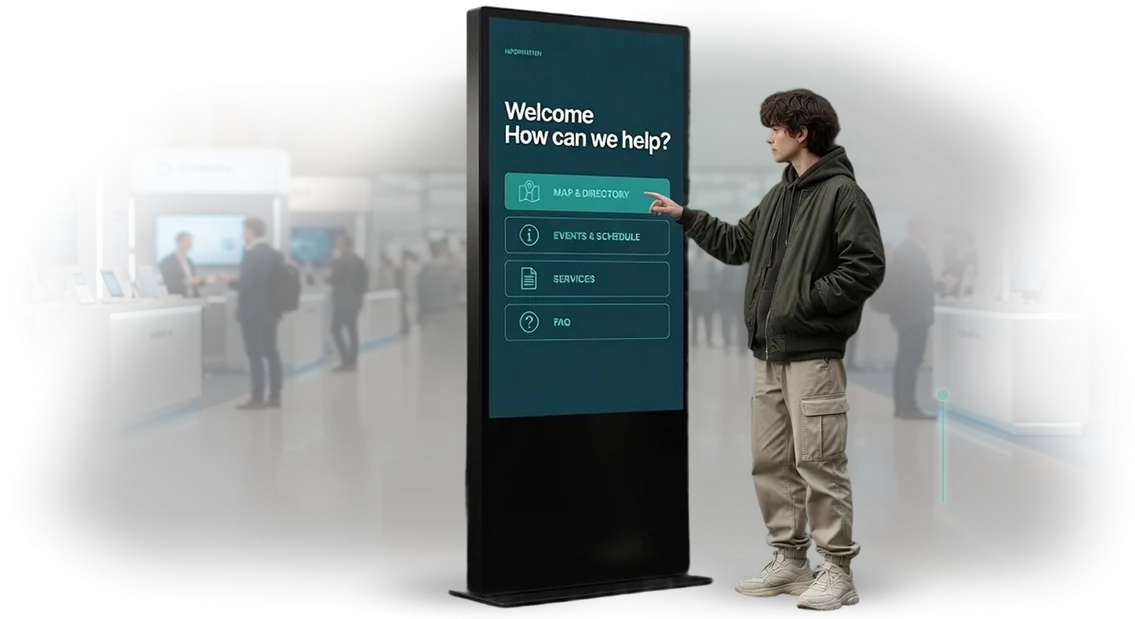
Kiosk Not Connected to Production Management Systems: Customers Leave
Imagine: a kiosk is installed on the production floor, and the customer sees data on the screen that is long out of date. They ask about order status or readiness dates, and the screen shows a completely different picture from what is actually happening in the workshop.
For the client, this is not a technical detail but a signal that the company does not control its processes. When the kiosk and the production management system exist separately, data becomes fragmented — and trust in you drops. The visitor goes to someone who answers more accurately, and winning them back is difficult.
Losing customers due to disconnected data is a natural outcome: the choice is made in favor of those who show an up-to-date picture. An interactive kiosk for production should be not just a terminal but an interface to your management system.
Then it honestly answers the key questions: where is my order, when will it be ready, what is happening with my products.
We close this gap. We design kiosks so they work directly with production data (MES), rather than existing as a separate showcase. As a result, the screen always reflects the live situation, your employees are free from manual reconciliations, and customers stay with you.
What Integrating a Kiosk with Factory Systems Provides
For a production manager and workshop employees, integrating a kiosk with the production management system (MES) delivers the main thing: up-to-date data in real time.
Instead of outdated paper instructions and scattered files, the worker sees the current state of tasks, standards, and equipment load on the screen. Decisions are made based on facts, not "from memory."
Errors during manual data transfer are reduced many times over. The operator does not rewrite numbers from one form to another: information is pulled directly from the factory system, so discrepancies between plan and actual are visible immediately. Fewer errors mean less rework, less scrap, and fewer disputes between shifts.
Reactions to deviations also become faster. The foreman sees a shift in the schedule and intervenes immediately, without waiting for the morning planning meeting.
The manager gets transparency: at any moment it is clear how work is progressing on the site, which tasks are priorities, and where their involvement is needed.
For the plant as a whole, such integration pays off by reducing downtime and accelerating output. The kiosk becomes a working tool, not a "gallery screen," and every employee action is synchronized with production logic. This is the foundation for efficiency growth without expanding headcount.
We take the integration upon ourselves: we configure data exchange, connect the necessary modules, and train personnel. The kiosk is embedded into your processes, not break them — so the client gets a predictable result without diving into technical details.
Kiosk Formats for Different Enterprise Tasks
An industrial enterprise lives in several zones, and each zone has its own tasks.
At the checkpoint, you need to quickly clock a shift and get a certificate; in the warehouse, to control receiving and shipping; and on the production site, to issue an assignment to a team and collect actual output data.
The same kiosk rarely suits all locations: every place has different temperatures, dust levels, and usage intensity.
That is why we select the kiosk format for a specific zone rather than offering a "universal average." Each option connects to your production management system (MES), so data from the screen immediately enters your records and does not require manual transfer.
Interactive Kiosk Formats
| Format | Where It Is Used | What It Gives the Enterprise |
|---|---|---|
| Checkpoint kiosk | Access control zone, main entrance | Fast pass through with passes, electronic certificates, shift control |
| Warehouse kiosk | Receiving, shipping, picking | Error-free waybills, address-based storage, fewer mis-sorts |
| Production site kiosk | Workshops, workstations, lines | Tasks from MES, output entry, up-to-date data for planning |
| Outdoor kiosk | Territory, parking, checkpoint without a building | Works in any weather, vandal protection, navigation |
The format directly affects service life and launch speed. A production site needs a housing that withstands vibration and temperature changes; a warehouse needs dust protection; a checkpoint needs compactness.
We take these conditions into account in advance so the kiosk works for years and does not require frequent maintenance.
As a result, employees spend less time on routine tasks, dispatchers see actuals in real time, and the manager gets an accurate basis for decisions. Tell us which zone at your enterprise needs automation first — we will choose the format and calculate the effect.
How Implementation Works: Five Steps from Brief to Launch
Implementing an information kiosk is not just installing equipment but a project that must organically fit into the work of a workshop or warehouse.
We have structured the process so that at every stage you understand what is happening, when the result will be ready, and how it will affect the speed of personnel work.
-
Brief and task analysis. We record what data employees need to see and what operations with production management systems need to be simplified. As a result, you receive a technical specification with clear timelines and budget.
-
Project plan and approval. We draw up a kiosk implementation plan: stages, control points, responsible persons. You see the schedule and can plan production load in advance — without downtime or surprises.
-
Development and configuration. We design a user-friendly interface and connect the kiosk to your MES system. You receive intermediate versions for review and can make edits as work progresses — this does not delay the timeline.
-
Testing and acceptance. We check scenarios on real data, eliminate inaccuracies, and show the result. You accept the work based on a clear checklist, not "on trust."
-
Launch and staff training. We place the kiosks, train employees, and hand over short instructions. After launch, we stay in touch and quickly resolve emerging issues — you get a working system, not a headache.
What Is Included in the Delivery: A Complete Working Package
A complete working package is not just a set of "hardware" and programs but a ready-made solution you receive turnkey.
We assemble, configure, and test everything in advance, so after unpacking you simply turn on the kiosk — and it is immediately ready to display data from your production systems.
Here is what is included in the delivery:
- Professional touchscreen kiosk in a protected housing — a single device that does not require assembly or modifications. It is designed for work in a workshop, warehouse, or any production facility.
- Configured software with access to your production management systems (MES). Data from equipment appears on the screen immediately after power-on — the operator does not need to install anything.
- An intuitive interface adapted to your processes and tasks. We design the screens so workers do not have to retrain: standards, instructions, and statuses are displayed clearly.
- A full documentation package: operating manual, operator instructions, and maintenance regulations. Everything is described in simple language with pictures, so any employee can understand it without technical training.
- Training for your staff — a short briefing for operators and administrators. We go through typical situations and answer questions before launch.
- Warranty and technical support for the entire service life. You receive contacts of an engineering team that helps with configurations, updates, and any questions during working hours.
With this package, you will not need to search for missing parts, hire contractors for connection, or figure out complex documentation. Everything is designed so production does not stop and the necessary data is always at hand.
Implementation Result: A Case Study at a Factory
Example from Practice
At a component manufacturing plant, employees constantly spent time searching for information about parts and order statuses. Calls to the dispatcher, waiting, clarifications — all of this slowed down work and created tension. We connected interactive kiosks to the production management system.
The plant in question is Orion. After implementing the kiosks, workers and foremen began receiving the necessary information at the screen in a couple of minutes — without calls or paper logs.
The system shows the current order status, the next operation, and part requirements right at the line.
Figures the Customer Saw
The average time to obtain information dropped from 12 to 3 minutes — a fourfold reduction. The number of calls to the dispatch office fell by 40% because the answers are now available at every kiosk. In the staff survey, 9 out of 10 noted that work had become easier and clearer.
For management, it is important that the data in the kiosks always corresponds to the real production picture — it comes from the same system that manages the workshops. No "merged" copies or manual updates. Job satisfaction increased, and errors caused by incorrect information decreased.
Within six months, the plant ordered two more kiosks for neighboring workshops. They first decided to test on one site, then saw the result — and implemented it in other areas.
That is usually how it goes: clear benefits quickly turn into a standard solution for the entire enterprise.
How to Choose the Right Format for Your Workshop Tasks?
Choosing a kiosk format starts not with the appearance but with the answer to the question: what workshop task will be solved on this screen?
If the operator needs to see the current shift assignment from the production management system, monitor equipment statuses, and record deviations — that is one scenario.
If the kiosk should help a new employee on the line quickly get operation instructions or display key site indicators for the foreman — that is another.
The second criterion is the installation location and operating conditions. In a noisy or dusty workshop, you need protected housings and reliable touchscreens that are not afraid of vibrations and temperature changes.
In a clean zone or near a checkpoint, lighter wall-mounted panels can be used. It is important that the kiosk is available exactly where the need for information arises and does not interfere with the production process.
The third point is the nature of interaction with MES. The kiosk can simply display data from the system, or it can allow the operator to enter data — mark operations as complete, start a shift, report an emergency situation.
This determines whether a keyboard, barcode scanner, or just a full-screen touch interface with large buttons is needed. A properly selected format reduces input time and lowers the number of errors.
Finally, consider frequency of use. If the kiosk is accessed several times per shift, it is a stationary stand that is always in one place. If information is needed periodically for different areas, it is better to consider a mobile platform that can be moved. In any case, the kiosk should be part of the work process, not just another screen.
We select the format for the specific tasks of your workshop: we analyze which MES data is needed on site, in what mode employees will work with it, and what operating conditions are expected.
As a result, you get a kiosk that truly helps production rather than requiring modifications after installation.
What Data Is Pulled into the Kiosk Automatically
When information in the kiosk becomes outdated, employees stop trusting it, and managers get a distorted picture. We configure automatic data export from your production management system (MES).
The human factor is eliminated — data appears on the screen by itself, on a schedule, or when an event changes.
Typically, the following data appears on the kiosk screen:
| Data Type | What Is Displayed | Why You Need It |
|---|---|---|
| Shift assignments | Production plan for the shift: nomenclature, quantity, deadlines | Employees immediately see what to do and do not distract foremen |
| Standards and regulations | Current time standards, material consumption, instructions | Uniform standards for everyone — less scrap and fewer disputes |
| Order statuses | Current stage, readiness, deviations | The manager sees execution progress in real time |
| Announcements | Urgent messages, safety reminders, schedule changes | Instant notification of all employees without meetings |
| Analytics | Output, downtime, scrap percentage | Decisions based on facts, not guesses |
Such automatic export saves up to several hours of manual work per week and eliminates errors in data transfer. Employees always see up-to-date figures, and you do not need to worry that someone forgot to update a file.
We have already integrated kiosks with MES-class systems, including SAP and other common platforms. We will set up the export to suit your tasks — synchronization can be once a minute or event-based.
Answering Questions Before Launch
Before launching a kiosk, customers ask the same questions: what happens if the equipment breaks down, how long will implementation take, and is it necessary to change current processes.
We hear them every time, so we answer the main ones — briefly and in business language.
What if the kiosk breaks down?
We work with professional equipment and select components with a load margin — this reduces the risk of failures. In case of a malfunction, we provide remote monitoring and rapid module replacement so the kiosk keeps working while we resolve the issue.
How quickly will we launch?
A typical project takes from two to four weeks from the approval of mockups. We configure the kiosk to your processes, train staff, and support the first days of operation. Need it by a specific event? We set a schedule and meet it.
What if there is already an accounting system?
We integrate the kiosk with your production management system (MES) — data on output, orders, and employees is transferred without manual entry. We adapt to your regulations, not the other way around: accounting processes remain familiar, only paper and extra steps disappear.
These are just some of the questions we close during the discussion stage. Call or write to us — we will show how the kiosk fits into your process and give you an estimate of the timeline.Order Kiosk Integration for Your Tasks
The production process cannot tolerate downtime, and manual data entry slows down work and creates unnecessary errors.
An interactive kiosk integrated with the production management system solves this on the spot: the operator sees the current assignment, records the result, and the data immediately goes into MES. All that remains is to choose the right solution for your workshop and processes.
Leave a request for the project — we will conduct a consultation, assess the task, and offer a format that will pay off through speed and accuracy of accounting. Here is what you will get after contacting us:
- Consultation and estimate — we will discuss your task, suggest the optimal kiosk configuration and a preliminary cost before work starts.
- Audit of data entry points — we will see where time is currently lost and where the kiosk will relieve staff of routine work.
- A solution for your MES — we will design integration with your production management system, without replacing familiar software.
- A clear work plan — we will define stages, timelines, and responsible persons: from mockup approval to on-site launch.
- Employee training — we will conduct a short briefing so workers and foremen can immediately use the kiosk without interrupting their shift.
- Post-launch support — we stay in touch, help with refinements, and guarantee stable operation of the integration.
Submitting a project request takes a couple of minutes — contact us in any convenient way. We will discuss the details, prepare an estimate, and show how the kiosk will fit into your production.