

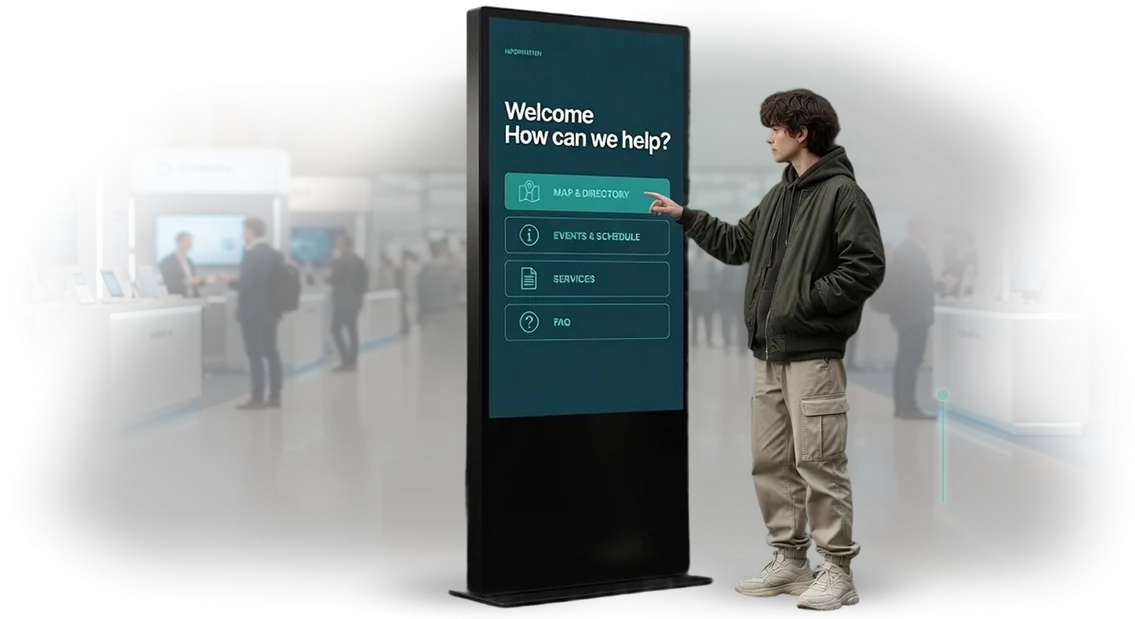
Integrating a kiosk with a warehouse system eliminates manual entry
Manual data entry during goods receiving is a familiar but risky operation. When an employee retypes an order number or SKUs from the kiosk screen into the warehouse system, every mistake hits the accounting and timelines.
A typo in a single digit causes the order to be "lost," and the customer leaves without their goods and with a spoiled impression.
Errors during receiving can go unnoticed, but the consequences pile up: the wrong item is handed over, the wrong status is sent, stock levels diverge from reality.
Warehouse accounting stops being reliable, and then purchasing planning, stock control, and picking speed all suffer. In the end, the business loses money not on some single failure, but on a persistent chain of small inaccuracies.
An interactive kiosk should not exist separately from the warehouse system. When the kiosk immediately transfers data about issuance or receiving to the warehouse management system, manual entry disappears completely.
The employee only confirms the operation, and all information — order number, contents, status — enters the records automatically. This removes the human factor and speeds up every operation.
Integration with warehouse management systems turns the kiosk from a simple terminal into a full-fledged element of accounting. The customer gets accurate real-time warehouse records, employees stop double-checking data, and clients receive their orders faster.
Integrate the kiosk with the warehouse system — and you will remove the main source of losses at the pickup point.
What changes after connecting a kiosk to the accounting system
Connecting a kiosk to the warehouse accounting system removes manual operations and makes the service predictable. The guest gets an instant response, and the manager gets a transparent view of sales without end-of-day reconciliations.
Service speed
The employee no longer needs to run to the back room or check paper stock records. The kiosk sends the order directly to the warehouse management system, and within a minute the item is already in progress.
Current stock levels
The kiosk's display automatically synchronizes with the actual warehouse. Items that are unavailable disappear from the selection, so the guest does not encounter "item unavailable" after placing an order. This removes frustration and speeds up the choice.
Fewer errors
Manual entry is eliminated: SKUs and quantities are transferred without human involvement. Order errors stop accumulating, and inventory becomes simpler — data matches more accurately.
Guest loyalty
When an order is picked quickly and always based on current availability, the guest has a positive experience. They come back and recommend the service to others, and repeat visits grow without additional marketing spend.
As a result, the kiosk becomes a full-fledged link in warehouse accounting — it relieves staff, speeds up issuance, and improves accuracy. The customer gets not just a terminal, but a tool that pays for itself through reduced losses and growth in repeat orders.
Kiosk integration formats with warehouse management systems
Warehouse accounting is a system that stock levels, orders, and product movements are trusted to. If the kiosk works on its own, duplicate records, discrepancies, and extra manual work appear.
Proper integration removes this risk: the kiosk becomes another entry point into your accounting system rather than a separate island.
The choice of format depends on how your warehouse is organized and what tasks the kiosk must solve. We select the option for the specific situation — from simple synchronization to full real-time data exchange. The table below shows four typical scenarios.
| Format | For which warehouse and task | What the customer gets |
|---|---|---|
| Direct integration with bin location storage | Warehouse with fixed bins and high turnover | Employee sees exact availability and the bin at the moment of the request; picking is faster, fewer errors |
| Self-pickup scenario | Online stores, pickup points, warehouses with customer flow | The visitor finds the order themselves by number or barcode; staff only handle issuance |
| Periodic synchronization | Small warehouse, seasonal location, limited budget | Quick launch without complex setup; data updates on a schedule, accounting stays in order |
| Receiving and shipping accounting | Warehouse with constant movements and order picking | The kiosk records movements at every stage; warehouse accounting is always current |
In each format, we configure roles: who sees only their own data, and who sees the full picture. This allows you to connect the kiosk to the existing system without breaking familiar processes.
To select the optimal option, a short audit of your warehouse is enough — then we will propose a solution tailored to your task.
How the project goes: from brief to launch
A kiosk-warehouse system integration project can often seem complex — many technical details and overlapping areas of responsibility. We turn it into an understandable process with a predictable result.
Every stage is coordinated with you, so that the outcome is a tool that saves employee time and speeds up warehouse operations.
-
Integration brief — we discuss how the kiosk will fit into warehouse operations: who will use it and why, and what data should be pulled from the management system. We record goals and success criteria so we do not have to redo work at the finish.
-
Plan and estimate — we prepare a project plan with stages and timelines, show where your team is needed, and what we take on ourselves. You see the full picture before work begins.
-
Approval — we approve scenarios, screen mockups, and the logic for displaying data from the warehouse system. We make changes upfront, not after launch.
-
Implementation and testing — we configure the kiosk, connect it to your warehouse management system, and test it on real scenarios: product search, stock levels, warehouse routing. We eliminate inaccuracies before the first user approaches the kiosk.
-
Launch — we install equipment, train staff, and put the kiosk into operation. We promptly resolve issues in the first days of work.
-
Support — we stay in touch after launch: we update logic, add features, and monitor the stability of the kiosk's connection to the system.
This approach gives you the most important thing — clear timelines, minimum surprises, and a working kiosk that brings value from day one.
What is included in the delivery and who is responsible for the result
When you order an interactive kiosk, it is important to understand: you receive not just a device and software, but a ready-to-use working tool that helps warehouse employees and speeds up operations from the very first day.
To make this tool useful, we hand over a complete package — from configured equipment to staff training and warranty obligations. Below is the delivery scope from the customer's perspective.
- Configured kiosk with installed software. The device arrives ready to work: the interface is adapted to your tasks, brand colors, and logo, and all scenarios are tested. You do not need to understand technical details — just plug the kiosk into a power outlet.
- Integration with your warehouse management system. The kiosk automatically receives data on product availability, shelf stock levels, and incoming shipments. Employees see current information in real time, without manual entry or errors.
- Clear instructions for employees and administrators. Documentation is written in plain language, with step-by-step scenarios and screenshots. Any operator can quickly find an answer to a question, and an administrator can figure out the settings.
- Staff training. We conduct 2–3 sessions for your employees: we show typical operations, go through non-standard situations, and answer questions. Training takes place at your site or online — whichever is more convenient.
- Warranty on integration and kiosk operation. A warranty period applies to the entire package: if something works incorrectly, we fix the issues for free. You are protected from downtime and unexpected expenses.
- Technical support after launch. During the warranty period, you can reach us by phone or chat. The average response time is a few hours, so even in a failure the warehouse does not stop.
- Statistics and event log. The kiosk records every operation, and you receive summary reports: how many requests were processed, which operations were performed most often. This data helps improve logistics and plan workload.
All work — from design to launch — is done turnkey. You interact with one project manager who is responsible for timelines, quality, and the result.
If refinements or changes are needed after implementation, we offer a clear procedure: new tasks are discussed separately, and warranty obligations apply independently of that.
Case study: the kiosk sped up order issuance and receiving
Let us share a real case study: a chain of building materials stores contacted us with a pain point — queues were piling up at order issuance, especially on weekends.
Warehouse staff manually checked waybills, receiving goods took up to 40 minutes, and errors led to mis-sorted items and dissatisfied customers.
Solution
We integrated kiosks with the existing warehouse management system StroyMarket. The customer confirms the order number at the terminal, the system automatically finds the product, writes off stock, and sends a signal to the warehouse worker.
At the same time, the kiosk prints a label with the picking bin number — the employee does not need to search for documents and immediately takes the right item.
Business result
The main thing the customer saw was that issuance time was cut in half: from 20–25 minutes to 10–12. Queues at the counter dissipated, and the reduction in queues became noticeable even during peak hours.
Receiving goods also sped up: data from the kiosk goes directly to the warehouse system, eliminating manual entry and the errors associated with it.
Over the month, the chain noted growth in repeat visits — customers began returning more often because the process had become predictable and fast.
This integration case shows that a kiosk is not just a "screen for information," but a working tool that embeds into warehouse processes and delivers measurable results for the business. If you have a similar situation, we will help you replicate this result at your site.
How to choose an integration format for your task?
The choice of integration format depends on where and how employees will work with the kiosk: at the checkpoint, in the receiving area, or directly among the racks.
There is no universal solution — one warehouse needs a stationary terminal for control, another needs a mobile device that moves with the warehouse worker.
The main thing is that the kiosk does not become a separate "island," but is embedded into daily warehouse operations and exchanges data with your warehouse management system.
Before choosing, answer three questions: how often the kiosk will be used, who works with it (warehouse workers, drivers, managers), and which operations should be accelerated — receiving, shipping, inventory, or issuance.
This determines whether you need a stationary enclosure, a mobile stand, or an embedding module. We always start with an audit of your processes and offer a format that addresses exactly your task, not the "market average."
Below is a comparison table of typical formats so you can orient yourself before talking with us:
| Format | When it fits | What you get |
|---|---|---|
| Stationary kiosk | Receiving, shipping, checkpoint area | Quick access to stock levels and documents, fewer entry errors, operation control |
| Mobile kiosk | Employees move around the warehouse | Up-to-date data anywhere, flexibility, quick response to changes |
| Kiosk with label and document printing | Picking, labeling, shipping | Less manual work, accurate labels, transparency at every stage |
| Self-service kiosk | Issuance, returns, inventory | Relief for staff, faster processes, convenience for employees and customers |
Please note: any of these formats connects to your warehouse management system — we handle the data exchange setup, access rights, and work scenarios.
You do not need to understand the technical details of connecting the kiosk; just describe the business process, and we will offer the optimal option and implement it turnkey.
If you are unsure which format to choose, send us a description of your warehouse, and we will guide you by criteria: operation frequency, number of employees, work zones. This takes one short call.
Frequently asked questions and doubts before getting started
Doubts before getting started are normal, especially when a kiosk must work in conjunction with warehouse management systems.
Below we have collected answers to the questions most often asked before ordering: about warranty, timelines, data security, and compatibility with your accounting system.
What is the warranty on the kiosk and what happens if it breaks down?
We provide a warranty on the equipment and software — if any malfunction occurs, you are not left alone with the problem.
Support works remotely and quickly, and if necessary an engineer will come or we will replace the device so the warehouse continues operating without downtime. Importantly, you pay for the result and are protected by a contract with clear obligations.
How long will integration with our warehouse management system take?
On average, integration takes three to six weeks depending on accounting complexity and the number of scenarios. We collect a brief in advance, define data exchange points, and give an exact timeline before work begins.
Integration happens in stages — you see intermediate results and understand when the system will be fully operational.
Is it safe to connect a kiosk to warehouse accounting?
Yes, warehouse data remains under your control. We use secure exchange channels and access rights separation — the kiosk receives only the information needed for its tasks: stock levels, receiving, shipping, and zone navigation.
Access to the full database and the system management base is not provided, so the risk of leakage is minimized.
Will the kiosk work with our accounting system if it is not the newest?
Most likely, yes. We have worked with most popular warehouse solutions and know how to adapt integration to non-standard configurations.
If the accounting system does not have ready-made exchange mechanisms, we will set up an intermediate layer through which the kiosk will receive data — this is invisible to you, and warehouse operations will continue as usual.
Order turnkey kiosk integration
Leave a request — and we will take on the entire path from idea to a working kiosk. You get a ready-made solution integrated with your warehouse management system, without involving your own developers or causing downtime.
Immediately after you contact us, we will prepare for you:
- Project cost calculated after audit — we will assess the scope of work, timelines, and equipment composition so you understand the cost before development begins.
- Integration plan with your warehouse system — we will show how the kiosk will exchange data: stock levels, receiving, shipping, inventory.
- Interface prototype — we will agree on employee work scenarios and screen logic before writing code, so we can avoid rework.
- Turnkey launch — we will deliver, configure, and test the kiosk at your site ourselves, including staff training.
- Kiosk support after launch — we answer questions, update software, and quickly resolve any failures so the system runs without interruption.
- Legal support — we sign a contract, record guarantees and timelines, so you are protected at every stage.
You do not need to hire a team of programmers or dive into technical details. You hand over the task — we deliver the result: a kiosk that speeds up warehouse operations and reduces the number of errors.
Leave your contacts in the form below — we will call you back within one business day, clarify the details, and prepare a cost estimate.