

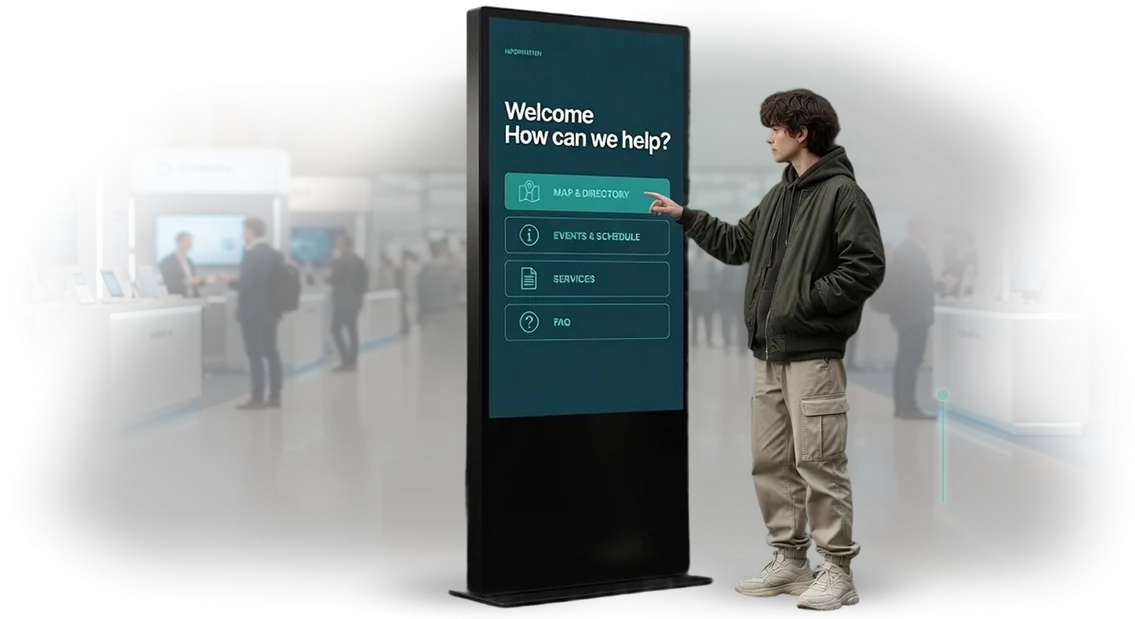
Customers leave because notification systems and SMS don't work
Visitors don’t forgive wasted time: if an important message doesn’t arrive, the person goes to a competitor and is unlikely to return.
An information kiosk is not just a screen but a full communication channel, and when it operates disconnected from notification systems, you lose customers at every step.
Imagine: a guest books a service, waits for confirmation, and the SMS never arrives. Or an employee changes the schedule, but the visitor only finds out on the spot. Every such failure means dissatisfaction, negative reviews, and customers leaving for those who respond faster.
We solve this pain through automated notifications. The kiosk becomes a single entry point: it takes the request, instantly passes the data to the notification system, and the customer receives an SMS confirmation at the right moment. This eliminates manual work, errors, and forgotten calls.
The key is speed and reliability. The integration is configured so the message goes out immediately after an action: booking, status change, visit reminder. The person is always informed, and you get fewer cancellations and more satisfied visitors.
The result is a predictable flow of customers and more repeat visits. People return where they were taken care of, and automatic notifications work for you around the clock, even when the office is closed.
What you get from implementing an interactive kiosk
An interactive kiosk is not just a screen with a menu but an independent channel for working with visitors. It handles routine operations: booking, submitting requests, issuing a ticket, or payment.
The customer gets the service faster and without unnecessary contacts, while the business reduces staff workload and brings more order to the hall.
The main result is increased loyalty. The visitor doesn’t stand in line or wait for an employee to become free; they resolve their issue in a couple of minutes. Such an experience is memorable and increases the chance the customer will come back.
Companies that implement kiosks notice a significant reduction in queues during peak hours and a calm atmosphere in the service area.
Another plus is lead collection. The kiosk can invite the visitor to leave a contact in exchange for useful information, a promotion, or an event registration. The data enters the database automatically, without the administrator’s involvement.
This turns an ordinary information desk into a marketing tool: you know who came, what they chose, and who can be sent a personalized offer.
Staff time savings show up in day-to-day work. Employees stop processing routine forms and answering repetitive questions, and focus on what requires personal involvement: consultations, non-standard requests, sales.
At the same time, connecting to notification and SMS systems closes the final step — the customer immediately receives confirmation on their phone: appointment accepted, order ready, your ticket number. This reduces call center inquiries and eases the visitor’s anxiety while they wait for the result.
In the end, the kiosk pays off not only by reducing queues. It improves service quality, provides the business with customer data, and frees the team for revenue-generating tasks. This is a clear step for any company that wants to make its service modern and convenient.
SMS integration formats for the kiosk
Kiosk SMS integration is not a “for show” mailing but a working tool that brings the customer back at the right moment. Without it, a notification gets lost among dozens of push messages. With it, the person receives a short, clear message exactly when it influences their decision.
The integration format is selected according to the scenario: a one-time promotion, a permanent loyalty program, or a complex process involving a manager.
Drawing on proven solutions, we choose the right option and adapt it to your tasks — without overpaying for unnecessary features.
| Format | For whom | What it gives the customer |
|---|---|---|
| Basic | Convenience stores, pickup points, small salons | Notification about order status or service readiness. The customer returns at a convenient time — no calls, no waiting. |
| Extended | Retail chains, showrooms, businesses with regular promotions | Personalized offers and booking reminders. The customer feels the brand’s attention, and repeat visits become the norm. |
| Custom | Companies with non-standard processes | Integration with your CRM or internal system: request routing, employee notifications, complex confirmation scenarios. The format solves a specific task according to your rules, not the other way around. |
The custom format is especially relevant for retail with multiple locations or branches. One scenario can connect the kiosk, warehouse, and manager: the customer submits a request at the kiosk, the system notifies the person responsible for fulfillment.
The whole chain is transparent — the employee receives the task instantly, and the buyer gets confirmation on their phone.
The main advantage of a well-thought-out integration is its invisibility. The kiosk works by itself, and notifications arrive on time and to the point.
Your employees don’t get distracted by manual calls, and the customer receives a service that feels like personal care, not an impersonal mailing.
How a turnkey implementation project works
A turnkey project means you don’t have to deal with technical details. We take care of the entire path: from the first brief to the kiosk launch and its support. Below are the implementation stages that all our projects go through.
-
Brief and understanding the task. We start by talking about your goals: who the kiosk should serve, which scenarios matter, and which systems it needs to work with. We record the requirements and deadlines — this is the foundation of the future project.
-
Plan and project approval. We prepare a placement scheme, screen structure, and a list of integrations, including connection to notification and SMS systems. You approve the plan before work begins and know exactly what you will get in the end.
-
Implementation and configuration. We create an interface in your brand style, configure scenarios, and connect the kiosk to your services. We show intermediate versions so you can make edits along the way.
-
Testing and kiosk launch. We check all scenarios: from simple information viewing to sending notifications and SMS messages. We fix any issues, install the kiosk at your site, and run the final launch.
-
Training and documentation. We provide clear instructions and train your staff. This is so the team can manage the kiosk independently and quickly resolve simple issues.
-
Support and development. After the launch, we stay in touch: we monitor stability, update content and features, and add new capabilities. The kiosk operates as part of your business, not as a one-off project.
This structure reduces risks and makes the project transparent at every stage. You always understand what’s happening and can influence the outcome.
What is included in the delivery: launch kit
The delivery includes everything needed for a turnkey kiosk launch — from software installation to staff training. You get a kit your team can start working with on day one, without hunting for contractors or hidden surcharges.
- Software with licenses — a solution configured for your tasks: information display, contact collection, SMS and notification integration. Licenses are valid for the entire usage period.
- Professional kiosk with a warranty — equipment matched to your premises and tasks. The warranty is active from day one: repairs and component replacement are included.
- Instructions and documentation — a clear administrator’s guide: startup, content updates, consumable replacement. No complex jargon.
- Staff training — a practical course: order intake, common guest questions, non-standard situations.
- Personal dashboard — change menus, promotions, and information blocks yourself, without calling developers.
- SMS and notification integration — the customer leaves a number, and the system sends confirmations and reminders automatically. Everything works on its own.
- Technical support — available during business hours: setup, staff answers, remote assistance.
Such a kit removes the headache at the start — you get a working service, not a box of parts. All that’s left is to launch the kiosk and invite your first visitors.
Case study: a pharmacy chain reduced queues with a kiosk
The pharmacy chain Zdorovye+ faced a typical retail pain point: during peak hours, lines at the checkout built up to 15–20 minutes. Customers went to competitors, and pharmacists spent time finding medications instead of giving consultations. They needed a solution that would relieve the staff without requiring new hires.
We installed an interactive information kiosk in the waiting area. It took over the routine: medication search, stock checking, reservations, and visit appointments.
Most importantly, the kiosk was integrated with an SMS notification system — the customer leaves their phone number and receives a message as soon as the order is ready. This removes the anxiety of waiting and brings the customer back to the pharmacy at the right moment.
Project results
After two months of kiosk operation, the chain saw measurable changes: the queue dropped by 30% — average waiting time fell from 15 to 10 minutes. The kiosk sends 500 SMS notifications daily — three times more than initially projected. Repeat visit share grew by 22%: a ready order and an SMS reminder bring the customer back.
This was a successful implementation without failures: the kiosk paid for itself in six months through growth in average ticket size and reduced losses from lost customers.
The chain plans to scale the solution to other locations and connect a loyalty program to the kiosk — the next step is already being developed.
What if I have specific requirements for the kiosk?
Specific requirements are not a problem — they are part of the workflow. Over the years, we have completed dozens of projects where a standard solution didn’t fit: kiosks with non-standard design, special workflow scenarios, and integrations into the client’s internal systems.
The more precise the task, the more value the customer gets — because the kiosk works exactly as the business needs, not “like everyone else’s.”
Kiosk customization can cover anything: from appearance and construction to interaction logic and connections to external services.
For example, we integrate the kiosk with notification and SMS systems — this automatically informs employees or guests about appointments, service status, schedule changes, and important events. Everything is configured around your process, without forcing you to change familiar tools.
A non-standard task is a reason for a conversation, not a refusal. At the start, we do a short analysis: what already exists, what result you want, and what constraints to consider. After that, we propose the solution architecture and timelines.
If something is technically impossible — we honestly say so right away and offer an alternative that achieves the same result more simply and reliably.
Don’t be afraid to describe your requirements “as is” — the more details, the more accurate the solution. We will ask clarifying questions if anything is missing. In the end, you get a kiosk that solves your specific task, not an abstract “information stand.” The rest is our job.
Frequently asked questions about kiosk operation
We understand: the decision to launch an interactive kiosk often comes down to questions — whether it will freeze, how safe it is to connect it to internal services, and who will maintain updates. Here we briefly explain how the kiosk works in real operation.
What happens if the kiosk freezes or there is a power failure?
The kiosk operates autonomously: in the event of a failure, it reboots itself and returns to a working state without losing data. We monitor the equipment remotely — if the problem is not resolved automatically, we receive a signal and connect remotely or send a technician. For your visitors, this looks like a short pause, not a service stoppage.
How is kiosk and data security ensured?
Access to the service loop is separated from the user loop: visitors only see the functions they need, and kiosk management is protected by authorization.
Data exchange runs over secure channels, so connecting to notification and SMS systems does not create additional risks to your infrastructure.
How often is the software updated and who does it?
We configure automatic updates on a schedule — usually at night, so guests are not disturbed. Updates can be installed remotely, without a technician’s visit. If you change a scenario or add new functionality, just send a request — and we prepare a new version.
Can we connect the kiosk to our notification and SMS system?
Yes, this is one of the standard scenarios. The kiosk can send events to your notification system (for example, about visitor registration or a callback request) and receive commands back. The integration is configured so your employees don’t have to change their usual processes.
Discuss kiosk integration for your business
Kiosk integration with notification and SMS systems is not a one-time setup but a new communication channel with customers that starts providing value immediately after launch.
The visitor receives an operation confirmation or promo offer at the right moment, and you gain an additional touchpoint without advertising costs. To make everything work exactly that way, it’s important to choose the right solution and embed it into your processes. We’ll help you do this quickly, taking into account the specifics of your business.
Let’s discuss how a kiosk can strengthen your communication and propose a format that fits your tasks. Leave a request — we’ll get back to you within one business day, answer your questions, and prepare a cost estimate.
What you get when reaching out:
- Expert consultation: we’ll suggest which notification scenarios are effective for your industry and audience.
- Cost calculation for your specific tasks: no hidden payments or optional extras.
- A solution matched to your scale — from a single terminal to a kiosk network across locations.
- Integration with your existing SMS mailing services and messengers.
- Scenario setup: request confirmation, status notifications, personalized offers.
- Work guarantee and post-launch support, so the system reliably delivers results.
Leave a request for a consultation — and we’ll prepare a kiosk integration plan with notification and SMS systems for your business. This is without obligation.