

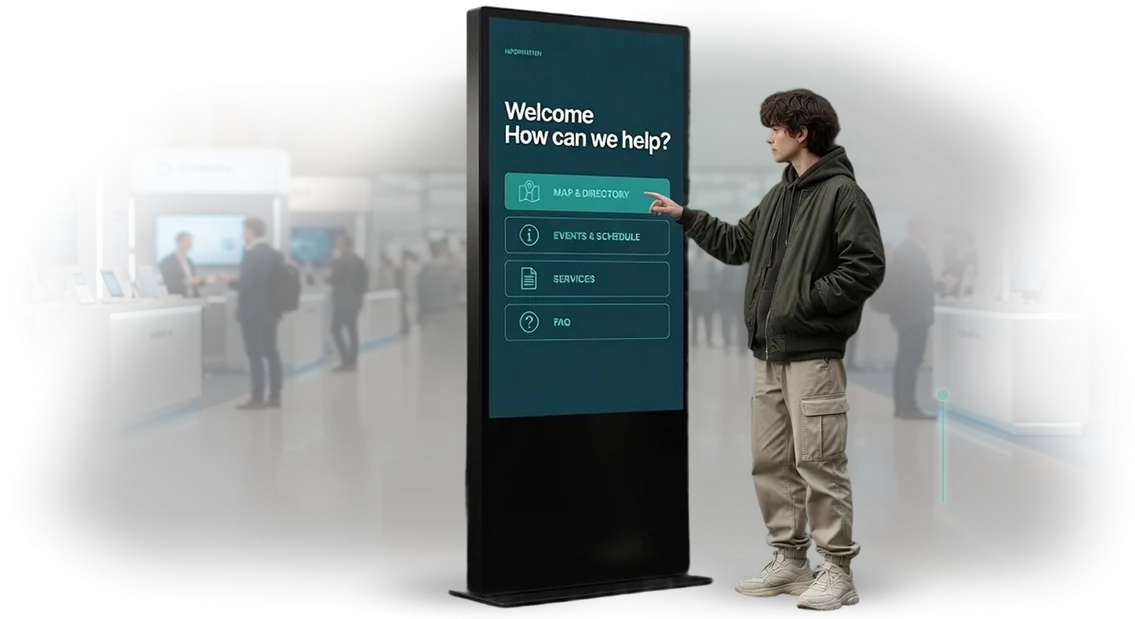
A Kiosk Without Video Analytics Integration Loses Profit
An interactive kiosk without video analytics integration works blind.
It only sees those who have already started interacting, but it misses the most important information: how many people walked past, who stopped for a couple of seconds and left, and which area of the store attracts attention. Customers are lost before the guest even touches the screen — and you simply don't know about it.
The lack of visitor behavior data inevitably lowers kiosk conversion. Budget is spent on equipment and placement, but there is no answer to which scenario fails to engage, at which step the user abandons the action, when traffic is highest, and when the kiosk sits idle. Every such lost contact is missed revenue and unjustified spending on attracting attention.
Integration with video analytics systems solves this problem. The kiosk begins to understand the audience: the number of people nearby, direction of movement, waiting time, and moments of hesitation.
Data immediately turns into action — the scenario adapts in real time, prompts become more noticeable, and the customer's path to the desired service gets shorter.
For business, this means measurable kiosk conversion growth and return on investment. You see which scenarios lead to an order or a request and which need to be replaced.
Decisions are based on numbers, not assumptions, and every visitor gets a fast, relevant answer — even if they were just passing by.
Such a kiosk stops being a static display and becomes a manageable sales tool. We design and implement such integrations turnkey: we analyze traffic, configure scenarios, and tie them to your business goals. As a result, the kiosk generates revenue instead of losing customers.
Business Benefits: Higher Conversion and Audience Control
An interactive kiosk is no longer just an ordering point. Combined with video analytics, it collects visitor behavior data and helps adjust the menu, advertising, and service.
We have been integrating kiosks with video analytics for over 10 years — here are the key benefits for your business.
Benefit: Higher Conversion and Larger Average Check
The kiosk observes visitor actions and at the right moment offers what increases the basket: for example, it recommends popular items or an add-on product.
Such prompts raise conversion and the average check by 10–20%, and customers return more willingly — without pressure, in the form of a useful recommendation.
Benefit: Clear Kiosk Statistics for Performance Control
Kiosk statistics show which items are in demand, when the kiosk is active, and what the abandonment rate is. Kiosk performance becomes transparent: you know exactly what pays for itself and which module needs to be changed.
Benefit: Understanding Visitor Behavior
Video analytics adds guest traffic information to kiosk data: where visitors come from, how long they wait in line, and how they move through the space.
Combined with kiosk interactions, you get a complete audience profile and can prepare for influxes of customers in advance, adjust zoning, and allocate staff.
Benefit: Audience and Staff Control
The system automatically counts visitors and records how employees work with guests. You see queues, service times, and cases where a customer leaves without waiting. This data helps shape staff motivation and service so that no customer is lost.
Kiosk and Video Analytics Integration Formats
Video analytics turns the kiosk from a simple screen into an information-gathering tool: how many people approached, how many started interacting, and which content held attention longest.
This data directly affects advertising planning, staff workload, and product displays — but only if the kiosk format matches your objective.
We choose the deployment format for a specific scenario: a stationary kiosk in a store, a panel at an administrator's counter, or a mobile structure for an exhibition booth.
For reliability and long-term operation at any venue, we use industrial platforms such as Advantech and proven video analytics modules — this prevents failures during peak loads and ensures a stable flow of data.
Main Deployment Formats
| Format | Best for | What it gives the customer |
|---|---|---|
| Stationary kiosk in the sales floor | Retail: grocery chains, clothing and electronics stores | Accurate incoming traffic count, time spent at the display, evaluation of promo campaigns and videos |
| Touch panel at the counter or in the waiting area | Banks, clinics, public service centers, hotels, business centers | Shorter queues, employee workload measurement, quick navigation for visitors |
| Mobile kiosk for events | Exhibitions, conferences, corporate events | Booth reach assessment, guest interest in different zones, contact collection through an interactive scenario |
| Info kiosk in the lobby or entrance zone | Museums, sports complexes, administrative buildings | Visitor navigation and traffic analytics: where they stop, which sections they view, which locations are underused |
Each of these formats has already been developed by us on real projects. We'll advise which one will deliver the most value in your specific situation — and fit naturally into your existing infrastructure.
How a Kiosk Integration Project Works: Stages and Timelines
How the Work Is Structured
Kiosk integration with video analytics is a clear process with no surprises. We follow a transparent plan — you see the timelines, scope of work, and the result of each stage, so the budget is easy to control.
- Brief and task audit. We discuss where the kiosk is located, what the audience is, and which scenarios the business needs. We check the site and the data — this provides the basis for accurate deployment timelines.
- Plan and approval. We fix the development stages, feature list, and timelines for each item. You know what will be done and when the result will be shown.
- Development and integration. We configure the connection between the kiosk and video analytics: the kiosk counts visitors, reacts to crowds, and collects data for reports. All work is done on professional equipment, so you get a stable result.
- Testing. We check scenarios under conditions close to real life: rush hour, lighting, load. Before launch, we fix anything that could affect your guests' experience.
- Launch and training. We install the kiosk, configure it for your space, and show the team how to use the administrator panel. You get a working tool, not a "black box."
- Kiosk maintenance. After launch, we stay in touch: we update content, monitor stability, and suggest improvements. Expanding analytics or adding new scenarios is a simple continuation of the project.
A basic project takes from two weeks. We set the exact timelines in the plan before work begins, so you can plan an opening or an advertising campaign.
What's Included in the Delivery: The Complete Kit for Launch and Operation
You receive not just a device but a ready-made tool for visitor analytics. The delivery package includes everything needed for launch and daily operation — from official licenses to staff training.
- A complete equipment set: interactive kiosk, mounting hardware, cables — everything for installation at your location.
- Official licenses for the kiosk software and the video analytics system. No "gray" versions — only legal software with updates.
- Integration of video analytics with your services: visitor counting, anonymous activity metrics, and data transfer to your CRM or reporting systems.
- Staff training: your employees gain hands-on skills with the kiosk and the analytics panel. Training is held remotely and takes no more than a couple of hours.
- Clear documentation in Russian: user instructions, maintenance guidelines, and an administrator's guide.
- Warranty on hardware and software. If questions arise, you can always contact our support — we help remotely and, if necessary, visit the site.
- Commissioning services: we install and configure the kiosk at your venue, check the video analytics operation, and verify that reports are correct.
This package covers all stages — from delivery to day-to-day use. You don't need to hire a separate IT specialist or understand technical details: you just turn on the kiosk and get visitor behavior data for decision-making.
Case Study: A Retail Chain Increased Sales by 30%
The Market City grocery chain came to us with a request: how to increase sales in a highly competitive market. Standard promotions and discounts no longer brought growth, and customers were going to neighboring stores.
We proposed installing interactive kiosks with video analytics — not as "one more screen," but as a tool that sees visitor behavior in the store.
The kiosks were placed in the entry area and near the checkouts. The system analyzed the traffic: how many people passed by, who stopped at the screen, which products attracted attention, and what the age and mood of the audience were.
Based on this data, Market City reworked its displays, launched targeted offers, and removed underperforming promos. Within two months, stores with kiosks saw a higher average check, and sales at the test locations grew by 30%.
What Clients Say
The chain's head shares the result: "For the first time, we see not just sales figures but the reasons why people buy or leave.
The kiosks showed us where to place the promotional stand and when to offer a discount — and it worked." They also noted higher loyalty: customers became more active in registering for the loyalty program right at the kiosk, and repeat visits increased by almost a quarter.
After the first phase, the chain ordered kiosks for three more stores — a stable result that shows up in revenue. For us, this confirms that video analytics in a kiosk works not as a technical feature but as a source of business decisions.
How to Choose the Right Kiosk Format for Your Tasks?
Choosing a kiosk rarely comes down to technical specifications — more often, it's about how the equipment will solve your business problem. The same interactive kiosk can work well in a waiting area and turn out to be inconvenient in a passageway.
That's why selecting a solution starts not with a model, but with answers to simple questions: what should the client do at the screen, and how will that step affect your revenue or brand awareness?
Three groups of factors influence the kiosk configuration: the installation location, the use scenario, and how you will evaluate the result.
For example, in a shopping center with high foot traffic, response speed and resistance to external impacts are important, while for an exhibition, compactness and the ability to quickly change the design matter.
If through the kiosk you want not only to show information but also to get data about visitors, you should plan integration with video analytics systems right away. It will let you see how many people approached the kiosk, how long they interacted, and at which stage they left.
We select the configuration individually for each task: we analyze visitor flow, staff workflows, and the goals you want to achieve. At this stage, we determine whether you need a kiosk with a touch panel, an anti-vandal housing, or a built-in camera for analytics.
This is not just about choosing components — it's a way to avoid overpaying for options that won't pay off and not to miss important capabilities because of an overly basic model.
The right model is visible immediately: guests approach the screen without prompts, use it without queues, and you get clear numbers — how many visitors interacted, which content they viewed longer, and what result it produced.
That's why at the start we ask clarifying questions about your audience and success metrics. It takes a little time, but it allows you to choose a kiosk format that will be useful from the first day after launch.
Addressing Your Concerns: What If the Kiosk Breaks or Doesn't Pay Off?
Before ordering a kiosk, it's natural to have doubts: what if the equipment fails at an important moment and the investment doesn't pay off? Almost all clients ask us these questions. So let's explain right away how warranty, repairs, and payback work. Below are answers to the main concerns.
What happens if the kiosk breaks down?
All hardware is covered by warranty, and the software is covered by contractual support. If a malfunction occurs, we perform diagnostics and repairs free of charge and provide a replacement kiosk during the repair period. Your business doesn't stop.
How quickly will the kiosk pay off?
It depends on the tasks: replacing an employee, increasing the average check, reducing queues. Usually, payback comes within a few months. Before launch, we'll help you calculate the economics using your figures.
What about repairs after the warranty expires?
After the warranty period, you can take out a service contract: regular maintenance, remote diagnostics, and priority repairs. We resolve most issues remotely, without business downtime.
What if the kiosk is idle because of video analytics?
Video analytics is built into the whole system, and we are responsible for its operation as a whole. A failure in one module doesn't stop the kiosk: data is backed up, and the connection is restored automatically.
Ready to Discuss Your Project? Get an Estimate and Consultation
We understand: integrating a kiosk with video analytics is not just installing a screen, but a working tool that provides visitor data, helps manage queues, and increases conversion.
To get such a result, it's important to calculate the scenarios in advance and choose the right configuration. That's exactly why we offer a consultation and a project estimate — before work begins, you'll know exactly what you'll get and in what timeframe.
Leave a request — and we'll contact you within one business day, clarify your tasks, and prepare a personalized offer. Here's what you get after reaching out:
- A project estimate for your task: number of kiosks, necessary video analytics modules, and integration options with your systems.
- Consultation on use scenarios: how the kiosk will affect visitor service, reduce queues, and increase loyalty.
- Selection of hardware and software to fit your budget and space — without unnecessary options that your business doesn't need.
- A transparent cost estimate and timelines: you understand the implementation cost and launch stages in advance.
- Technical support after launch: we don't disappear after the project is delivered — we stay in touch for modifications and feature development.
- Examples of completed projects in your industry — we'll show how similar tasks have been solved for other clients.
You can order a kiosk with video analytics right now — start with a short conversation with our engineer. It's non-binding, but you'll get an expert assessment and understand how the technology scales for your business.
Leave your contacts via the form on the website — we'll call you back at a convenient time, answer your questions, and prepare an estimate within two days.
We work remotely across the country and have been creating interactive solutions for retail, government institutions, and the service sector for over 10 years. Entrust your project to a team that is responsible for the result at every stage — from brief to launch and support.