

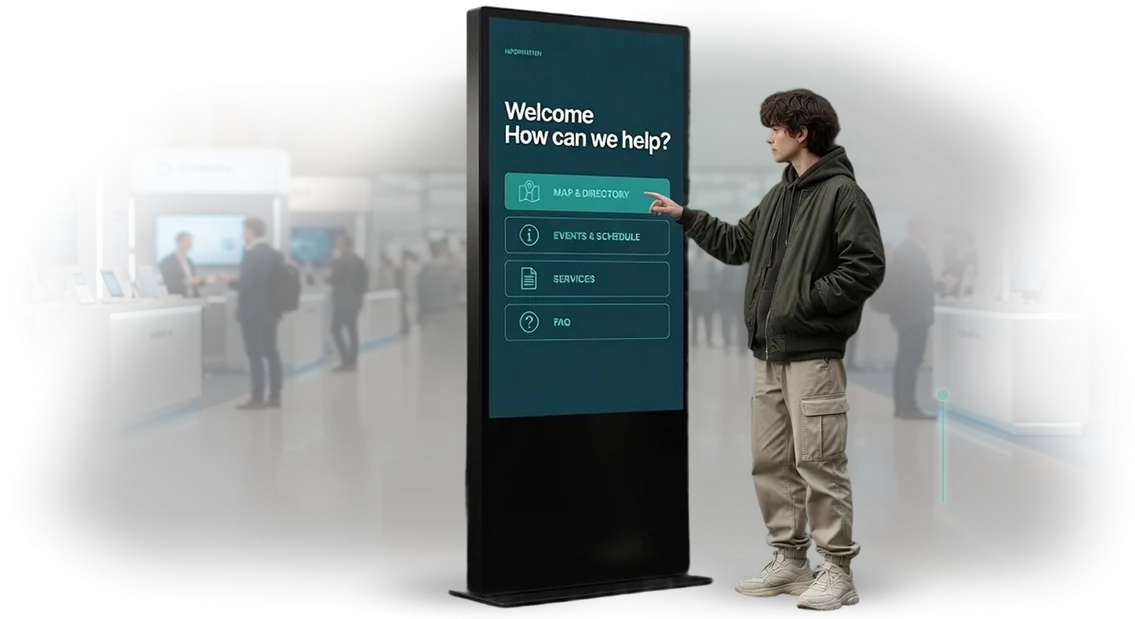
Why do bank-style interactive kiosks attract customers?
Interactive kiosks have already become a familiar point of contact, but a bad interface negates all investments. A visitor approaches, sees an overloaded menu, unclear icons, and long texts — and leaves without completing the desired action.
Each such lost contact is not only missed revenue today, but also the risk that the person will never return to your brand.
The problem is often blamed on the hardware, when in fact it is the interface that makes the difference: it creates the first impression of the speed, quality, and security of service.
Bank-style kiosk design works directly with this impression. A calm color palette, a well-structured hierarchy, large navigation elements, and short labels — all of this reminds the customer of familiar and reliable banking services.
This design requires no training: a person reads the logic of the screen in a second and feels their data is protected. This is how customer trust is built before the first contact with a staff member.
When a kiosk looks reliable, the share of successfully completed sessions also grows. Clients are more willing to enter data, explore services, and ask staff for help less often.
For business, this means higher conversion, reduced staff workload, and more repeat visits — people return to places where they felt comfortable and everything was clear.
Bank style is not about strictness for its own sake, but about a customer experience that directly affects revenue.
We have been developing touchscreen interfaces for more than ten years and know exactly what a kiosk that sells looks like.
For us, bank style is not a static template but a well-calibrated system where every detail works for the trust and convenience of a specific client.
Order an interactive kiosk from us — and your customers will go from the screen to the target action without hesitation or wasted time.
What will change in your business after installing interactive kiosks
Speed of service is the first thing customers notice. A touchscreen kiosk removes routine from staff: balance checks, statements, tariffs — all in a couple of taps. The queue moves faster, and the operator focuses on complex issues where a human is genuinely needed.
According to our measurements, the time for a typical operation is reduced several times over — that means savings and visitor loyalty.
Improved conversion happens through prompts at the right moment. The kiosk offers related services and tells about products the customer did not ask about.
A bank-style interface looks familiar and inspires trust — the visitor is more willing to leave a request or sign up for a service right at the screen.
Brand recognition is strengthened when the kiosk follows the corporate style. A unified design, logo, and brand colors are not decoration for beauty's sake but part of the image. The customer remembers the experience with the bank and comes back again.
Additional analytics answers the question "what was happening in the branch." We configure the collection of anonymized statistics: which sections are viewed most often, where visitors linger, which services they choose.
Based on this data, it is easier to decide what to change in scenarios and how to improve the branch.
What changes after the kiosk launch:
- Speed of service — typical operations take minutes without operator involvement.
- Conversion — targeted prompts increase the number of product interactions and requests.
- Recognition — a unified bank style strengthens trust and brand memorability.
- Analytics — reports on visitor behavior help make decisions without guesswork.
Each point is verified within the first weeks of operation. You get not just a screen with a menu, but a manageable growth tool for your network.
Formats of bank-style information kiosks for your business
The choice of touchscreen kiosk format directly affects customer convenience and business efficiency. There is no one-size-fits-all solution — what works perfectly for a bank is not always appropriate for a small coffee shop or exhibition stand.
To help you navigate, we have collected the main bank-style information kiosk formats and explained when to use each one. Focus on the company's objectives, the floor area, and visitor behavior.
| Kiosk format | Who it suits | What it gives the customer |
|---|---|---|
| Floor-standing kiosk | Banks, MFCs, shopping and business centers with a spacious hall | Attracts attention, accommodates more functions, lets visitors get a service independently without queuing |
| Wall-mounted kiosk | Small offices, stores, areas with limited space | Saves space, does not block passage, convenient for short inquiries and service appointments |
| Touchscreen kiosk | Retail outlets, clinics, airports — everywhere speed matters | Reduces queues, relieves staff, speeds up information search and service completion |
| Kiosk with card acceptance | For paid services, state fees, account top-ups, and payment terminals | Allows payments and service completion without staff involvement, increases revenue |
| Kiosk with autonomous power | Field promotions, exhibitions, temporary sales points | Works in any conditions, easily moved, no mains connection required |
If you are unsure which format to choose, pay attention to visitor flow and the kiosk's purpose. For short inquiries, a wall-mounted version is enough; for comprehensive service, a floor-standing one is better.
If the service is paid or documents need to be completed, a kiosk with card acceptance is more convenient.
We adapt bank-style kiosk development to your scenario: from design to menu structure. Leave a request, and we will prepare a recommendation on format and cost tailored to your needs.
How kiosk creation goes: from the first brief to launch
Kiosk development is not a "black box": you control the process from brief to launch. We split the project into stages and show the result at each one.
For bank style, it is especially important to approve the interface before programming, so it looks strict and reliable.
- Brief. We dive into business objectives and visitor behavior, determine the scope of work and deadlines.
- Prototype. We work out the screen logic and user scenario: you know in advance how many steps are required to reach the target operation.
- Bank-style design. We create a strict, trustworthy interface — calm colors, large elements, clear typography.
- Approval. We show mockups, make edits before development starts, you approve the final version.
- Integration. We connect the kiosk to your systems (catalog, schedule, client database) and test it on real hardware.
- Production and installation. We fabricate the enclosure, deliver and mount the kiosk on site, launch and test it.
- Support. We train staff, hand over documents, and stay in touch: we update content and monitor stability.
Each stage ends with your confirmation — you understand what is happening and how much time is left until launch. As a result, you get a solid kiosk that works reliably and helps visitors understand services without staff involvement.
What components are included in a ready interactive kiosk
Understanding exactly what you get for your budget is more important than looking at a beautiful kiosk image. A ready solution is not just a device but a working system that helps your clients get services faster and lets you see real value from your investment.
The standard package includes:
- Touchscreen panel and enclosure. Reliable equipment that withstands daily use in high-traffic areas. The enclosure protects the hardware from dust, moisture, and accidental impacts — the kiosk works stably rather than "freezing" at the worst possible moment.
- Software. This is the kiosk's "brain": interface loading, touch processing, connection to your services. We fine-tune the system so the client does not wait for a response and does not see errors.
- Bank-style interface design mockups. Your corporate style is transferred to the screen: strict, clear, with an emphasis on trust. The user immediately understands that this is an official channel of your company and is more willing to enter data.
- Analytics and reports. The kiosk collects data: which services are chosen more often, how much time is spent at the screen, at which step difficulties arise. You get clear statistics on which it is easier to improve service and make decisions.
- Instructions and regulations. Short guides for your employees: how to turn on the kiosk, replace consumables, and respond to emergencies. No need to hire a separate engineer.
- Warranty service. If something goes wrong, we resolve the issue quickly. You are not left alone with a breakdown — our team stays in touch while the device operates at your site.
This package takes away the headache: you get not "hardware" but a ready tool for improving service quality. All you need to do is connect the kiosk to power and the network, and it starts benefiting your business.
Case study: how we created a kiosk that paid for itself in 3 months
One of our clients — a retail bank — faced a typical pain point: by the end of the month branches were overloaded, queues took 15–20 minutes per visitor, and some people left without waiting for a consultation. At the same time, operating costs were rising and sales of additional products were declining.
We proposed not just "installing an interactive kiosk" but creating a point that covers part of the routine operations without a staff member.
A bank-style kiosk — with corporate branding, a clear scenario, and adaptation for touch control — allowed the customer to independently check their balance, pay for services, and apply for a card. The consultant only gets involved at the stage where live expertise is needed.
What changed in numbers
The average waiting time in the branch dropped from 14 to 6 minutes — twice as fast. Visitor-to-product conversion grew by 18%: a client who has already "done part of the work themselves" listens more willingly to a consultant's offer.
The share of repeat transactions through the kiosk in the first months reached a third of all service operations.
Importantly, we did not just hand over the project and leave. For the first two weeks we analyzed usage scenarios and refined the interface — this added a few more percentage points to action completion. All together allowed the bank to reduce branch personnel costs and shift employees to sales.
Payback and result
The result — the project paid for itself in 3 months by relieving operators and increasing sales of cards and loans. Six months later, the bank ordered another series of kiosks from us for other branches.
This is the best indicator: when a client returns for a repeat project — it means the system really works.
We work on professional touch equipment and build a solution for a specific branch's needs. If you want the same momentum — let's discuss your scenario.
How to choose a kiosk format for your business specifics?
Choosing a kiosk format starts not with the equipment model but with the question: what exactly should the customer do at your terminal — quickly pay, get a consultation, submit a request, or simply find their way around the premises. This determines the number of touchpoints, the interface scenario, and even the enclosure design.
There are no universal solutions: a kiosk for a bank branch queue and a kiosk for service appointments at a communications store solve different tasks and require different functionality.
To avoid overpaying for unnecessary options, evaluate three parameters: the customer journey (how many steps to the target action), the average session duration, and the need for staff assistance.
If a visitor should quickly get a certificate or statement, choose a compact stand with a simple bank-style menu where large buttons and clear navigation reduce the time to 30–40 seconds.
If a kiosk replaces an employee and must handle a complex scenario (for example, opening a deposit or submitting a loan application), you need a full-featured terminal with a multi-step interface, data protection, and document printing.
It is equally important to think through the location: a floor-standing kiosk with a large screen works well in a waiting area, while a wall-mounted version saves space in narrow halls.
Pay attention to the enclosure materials and vandal-resistant design — in high-traffic places this directly affects the service life.
Functionality should match not only today's tasks but also development plans: it is better to build in the ability to update content and add modules from the start than to replace the entire set in a year.
If you have already looked at our format table, you noticed that each option is tied to a typical business scenario.
When choosing, focus on your specifics: for banks and financial organizations, a strict interface style and security matter; for retail, speed and CRM integration; for government institutions, convenience for all categories of visitors.
We will help you select the right format for your task and adapt the scenario so the kiosk becomes a growth point rather than just an expensive stand.
Frequently asked questions and concerns: looking at the details
A bank-style kiosk is the face of the hall: people judge the company by it. Customers often have typical questions: what if the hardware breaks, how to update information, how long to wait, and what the warranty covers. Let's go through them to make the decision easy.
What happens if the kiosk breaks down or starts freezing?
We work on professional equipment designed for intensive use. The bank-style interface is protected against accidental touches and failures. If a problem does arise, we connect remotely and resolve it quickly.
How often and how quickly can information be updated?
Content is updated within minutes via a web interface or by email. No developer is needed, and the kiosk does not need to be stopped.
How long does kiosk production take?
A typical kiosk takes two to three weeks. A non-standard enclosure or design increases the timeline, but we fix the stages in the contract. You see the progress and know the completion date in advance.
What is included in warranty and support?
Warranty covers the equipment and installation work. During the warranty period, we provide remote assistance, update content, and fix issues. After that, we provide support on request.
Ready to discuss your interactive kiosk project? Leave a request
Are you looking for a contractor who will make a kiosk convenient for your clients and employees? We specialize in bank-style touchscreen kiosk interfaces — a strict, clear design that inspires trust and requires no user training.
Leave a request on the website — and within one business day we will contact you, clarify the tasks, and offer a clear plan. After that, you will receive a cost estimate with a commercial proposal and can make a decision without extra calls.
What happens after your inquiry:
- Consultation: we will analyze your task, audience, and kiosk usage scenarios.
- Cost estimate and commercial proposal — with fixed figures and no hidden charges.
- A bank-style interface mockup sketch — you will see what the solution looks like before development starts.
- Realistic timelines by stage: from mockup approval to testing and launch.
- Single point of contact: a personal manager answers questions and keeps you updated.
This approach saves time: you know the budget, timeline, and result in advance. No need to guess what will come out at the end.
Leave a request — we will discuss the details, prepare a mockup and a cost estimate in a convenient format for you. We'll start with a consultation, then follow the plan.