

Interactive Kiosks with Accessible Design: How Not to Lose Customers
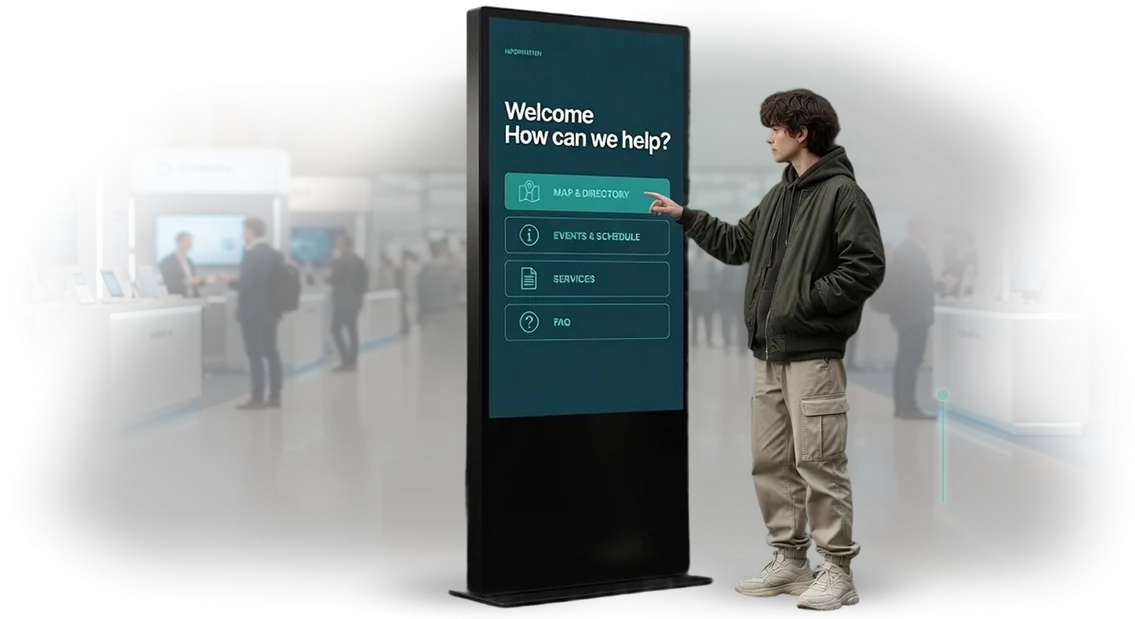
A visitor approaches a touch-screen kiosk to quickly resolve their issue: check a schedule, pay for a service, or get information.
If the interface is inconvenient — small buttons, confusing navigation, complex wording — the guest wastes time, makes mistakes, gets annoyed, and turns to another channel. Every such case is a lost customer and a negative experience they will tell others about.
The problem is that a kiosk cannot verbally explain where to tap. If the design does not guide, does not forgive mistakes, and does not adapt to different people, even a simple payment or booking scenario becomes an obstacle.
The visitor does not understand the logic of internal menus — they expect the screen to lead them by the hand from the first touch to the result.
Accessible design for interactive kiosks solves this problem. It is not just “large buttons”: it is a clear structure, prominent action elements, and hints that work without instructions.
Such an interface even accounts for guests who rarely use touch screens — older people, visitors with low vision, or simply those in a hurry. As a result, the kiosk does its job: it helps rather than scares off.
For business, this means fewer abandoned operations, shorter queues, and more satisfied visitors. An interactive kiosk becomes a point of confident service rather than a source of irritation. A properly designed interface pays off because people return and use the service regularly.
We develop interfaces for touch-screen kiosks with exactly this approach: first, we study the guest’s scenario, then we design the interaction logic and test it with real users.
That way, the kiosk becomes convenient for everyone who approaches it — and you don’t lose customers due to a poor interface.
What a Kiosk with a Thought-Out Interface Delivers: Benefits for Business
A Convenient Kiosk — Guests Find Everything Themselves
A well-designed interface is not just a pretty picture, but a tool that saves time and nerves. Our team designs scenarios so that the visitor understands what to do next from the first touch. Step by step, they find the necessary information without distracting staff.
Accessible design adds another advantage: large buttons, clear labels, and logical transitions suit any person. Guests with any level of experience feel confident and are not afraid to use the kiosk.
Growth in Submissions Thanks to Clear Scenarios
When the interface guides a person from selecting a service to confirmation, the share of completed actions grows noticeably. The kiosk becomes a manager who never gets tired, never rushes, and always suggests the next step.
Well-thought-out hints and visual examples answer questions before the customer approaches an employee. As a result, the kiosk reliably collects submissions even during peak hours.
Guest Loyalty and Repeat Visits
A kiosk that is easy to use is pleasant to use. The guest remembers that the company cares about their time, and this builds trust in the brand. A positive experience increases the number of repeat visits and recommendations.
People willingly share their impressions, and word of mouth remains one of the most effective promotion channels. A convenient kiosk becomes a point they tell their friends about.
Reducing Staff Workload
By handing over typical questions and simple operations to the kiosk, you free up the team for tasks that require live communication and professionalism. Employees are less distracted by routine, and the speed of service increases.
For business, this means lower costs on simple operations and the ability to redirect efforts toward increasing the average check. The kiosk works for you around the clock, relieving staff and improving service quality.
Formats of Interactive Kiosks with Accessible Design for Your Venue
The same touch-screen kiosk rarely suits different venues: what works well in a store may not suit a clinic lobby or a museum.
Therefore, the kiosk format and its operating scenario are selected for a specific task — whether it is navigation around a building, a product showcase, or appointment booking.
In all cases, we rely on accessible design: large elements, clear labels, and a minimum of actions to achieve the result. Such an interface is equally easy to master for young visitors, older people, and guests with disabilities.
| Format | For whom | What it gives the customer |
|---|---|---|
| Navigation kiosk | Shopping malls, business centers, hospitals, campuses | Visitors find the right office or store on their own, contact staff less often, and don’t get lost in the building |
| Product catalog | Stores, showrooms, pick-up points | The buyer sees the full assortment and adds to the order, increasing the average check and revenue per square meter |
| Appointment kiosk | Clinics, beauty salons, government institutions, fitness clubs | Queues move digital, the administrator is relieved, and the client books in a couple of touches without a call |
| Information kiosk | Museums, exhibitions, hotels, company offices | The guest gets the needed information independently, the brand looks modern and caring |
Each format is tailored to your venue: the design is styled according to your brand, and the screen logic accounts for the real routes and questions of your visitors.
As a result, the kiosk does not gather dust in a corner but works as one of the points of contact with your guests.
How an Interactive Kiosk Project Works: From Brief to Launch
We make the process transparent: you always understand what stage the project is at, what is already done, and what result you will get. No “black boxes” — only clear steps united by one goal: to make a kiosk that is convenient for your visitors and profitable for you.
- Kiosk brief — you tell us about the kiosk’s tasks, your audience, and the installation location. We clarify details and suggest options for your budget and deadlines.
- Prototype and scenarios — we show the screen structure and interaction logic. You see in advance how a guest will use the kiosk and can make edits before development starts.
- Design approval — we create a visual style in line with your brand. We take accessible design into account right away: large elements, clear labels, contrasting colors — so everyone can use the interface.
- Interface implementation — we build the kiosk using professional equipment and proven tools, testing it on real scenarios. We fix shortcomings before they become a problem.
- Kiosk launch — we install the device, configure it, and check its operation. We train your staff so they can assist visitors.
- Kiosk support — we take over maintenance: update content, monitor stability, and quickly respond to any requests. You get a working tool, not a headache.
This process saves your time and money: all edits are made in the early stages, when they are cheap, rather than after launch. As a result, you get a kiosk that truly solves business tasks and is understandable to every visitor.
What Is Included in the Kiosk Interface Work
Work on a touch-screen kiosk interface is not just about “drawing screens.” We put together a comprehensive package for you that is clear to your staff and convenient for visitors: from behavior scenarios to instructions and ongoing support. Below is what exactly you receive as a customer.
- Scope of work and project plan — we record the stages, deadlines, and responsible persons so you can see what happens at each step and when the result will be ready.
- Interface mockups — ready screens for all kiosk sections: catalog, navigation, promotions, contacts. You can see how the product will look and work right away, before development begins.
- User scenarios — we describe typical visitor actions: how to find a product, join a queue, or get a consultation. Thanks to this, the interface is understandable from the first touch.
- Adaptation for different user categories — we adjust fonts, contrast, large touch zones, and voice guidance so that people with visual and motor impairments can use the service. Accessible design expands your audience without additional staffing costs.
- Staff instructions — a short guide for employees: how to turn on the kiosk, replace content, and help a visitor if they are confused. Your staff starts working without lengthy training.
- Placement and content recommendations — we advise on where best to install the kiosk and how often to update information so it delivers maximum benefit every day.
- Post-launch support — we stay in touch: consult, make edits, and help with updating materials. You are not left alone with the technology after project handover.
This package allows you to launch the kiosk without “surprises”: the interface solves business tasks, employees use it confidently, and visitors quickly get the information they need.
Case Study: How a Convenient Kiosk Increased Submissions by 1.8 Times
A clinic chain came with a typical problem: touch-screen kiosks stood in the lobby, but visitors still went to the administrator. Older people were shy about touching the screen, got confused in the multi-step menu, and abandoned booking midway.
As a result, the kiosk sat idle, queues grew, and management saw in reports that electronic booking was practically not working.
We took on the task of creating an interface with accessible design — understandable to a person without experience using touch screens. We removed extra fields, enlarged buttons, and replaced complex terms with simple icons.
We tested every scenario with real visitors of different ages: during the tests, people themselves pointed out where the text was unclear or where a finger missed the button. After the improvements, booking a repeat visit was reduced to two touches.
The project for the clinic chain “Zdorovye Ryadom” showed that accessible design pays off in the first month. A month after implementation, the number of submissions via the kiosk grew by 1.8 times, and the time for a single booking almost halved.
Patients began returning to the kiosk for repeat visits — the interface stopped scaring them and became an assistant.
Now administrators calmly focus on patients instead of diverting people from the kiosk to the counter.
We apply the same approach in projects for banks, shopping malls, and government institutions: first, we study who will use the kiosk, then we design the interface around real scenarios and measure the result after launch.
What to Do If You Need a Non-Standard Kiosk Format?
A non-standard format is not a problem but a common working task. We design kiosks for a specific venue and scenario: an unusually shaped enclosure, built-in interior installation, floor-standing or wall-mounted options, non-standard height and screen tilt angle.
It is important that the kiosk fits organically into the space and does not look like an alien element.
Special requirements often arise from the installation location: a column in the lobby, a narrow niche, a reception desk, or an outdoor area with size restrictions.
In such cases, we find a solution together with you: we change the construction, select materials and mounts, and plan protection from external influences.
At the same time, accessible design remains a priority — so that the kiosk is easy to use for people of different heights, in wheelchairs, or with visual or motor impairments.
An individual project does not mean lengthy approvals and an unpredictable result. We start with a brief and find out the key parameters: where the kiosk stands, who uses it, and which functions are critical.
Then we offer enclosure and interface options, show mockups, and agree on details before production begins. This way, you get a kiosk tailored to the task, not an average standard solution.
If you have an unusual format — built into furniture, non-standard depth, with a non-standard touch screen, or a special navigation scenario — we will find a way to implement it.
The main thing is that the kiosk solves your business task and is convenient for visitors; everything else is a matter of construction and design, which we take on ourselves.
Frequently Asked Questions About Developing Interfaces for Kiosks
We have gathered the most frequent questions from kiosk customers — about breakdowns, content updates, timelines, and technical specifications. We answer briefly and to the point so there are no ambiguities before launch.
What happens if the kiosk breaks down or freezes during operation?
Any equipment can fail, so we design the interface with protection against critical errors: the screen restarts without data loss, and background processes recover automatically.
After launch, you receive a warranty on the interface and a communication channel with a specialist — we will remotely resolve the issue within hours, not days.
How can I update content on kiosks without a programmer?
Through a simple admin panel: you change promotions, menus, or infographics in a couple of minutes, without involving a developer. The system is clear to an employee of any skill level — we train the team and hand over the instructions. All content versions are saved, so you can always roll back to the previous one if needed.
How long does interface development take?
A typical project takes two to four weeks: it depends on the number of screens and the logic. We give the exact timeline after the brief, and keep you informed throughout the process — no surprises in the final week. We deliver in stages: concept, prototype, final interface, testing on equipment.
Do I need a ready-made technical specification to start?
Not necessarily. We will ask the right questions ourselves and record the requirements as part of the first stage. If you already have a technical specification, we will use it as a basis, supplement it, and clarify it.
The main thing is a clear goal for the kiosk; we handle the rest and record it in the plan you approve.
Will your interface work with any equipment?
Yes, we design specifically for the touch screen and firmware the kiosk will use. If needed, we will check compatibility on your model or on our test bench, so the result works without surprises during installation.
We resolve these questions at the start and support the project after launch. We will send examples of our interfaces and prepare a quotation for your task — simply start the conversation.Shall We Discuss Your Task? Get a Cost and Timeline Estimate
Leave a request, and on the next working day you will receive a preliminary cost estimate and project timeline. We do not send a “one-size-fits-all” estimate: we analyze the task, the number of locations, the expected load, and design requirements.
Then we bring implementation details to a consultation. In 30 minutes, we will cover how the kiosk fits into your interior and processes, and offer 2-3 functionality options with different budgets. The result is a ready commercial proposal with a fixed price and milestones.
What you get immediately after your inquiry:
- A preliminary estimate on the day of your inquiry — you understand the scale of investment before work starts
- Realistic project timelines — you know the launch date and checkpoints from day one
- Selection of a kiosk format for your tasks: floor-standing, wall-mounted, or compact
- Interface options in accessible design for different audiences — including visitors with disabilities
- A commercial proposal with no hidden conditions or fine print
- A consultation on integrating the kiosk with your accounting and video surveillance systems
To get an estimate, simply fill out a short form — 2 minutes. It is not binding: we will show possible solutions, and you can calmly decide whether to move forward.
Over 10 years of work, we have launched kiosks for exhibitions, retail, and government institutions — we know how to deliver a project without surprises.