

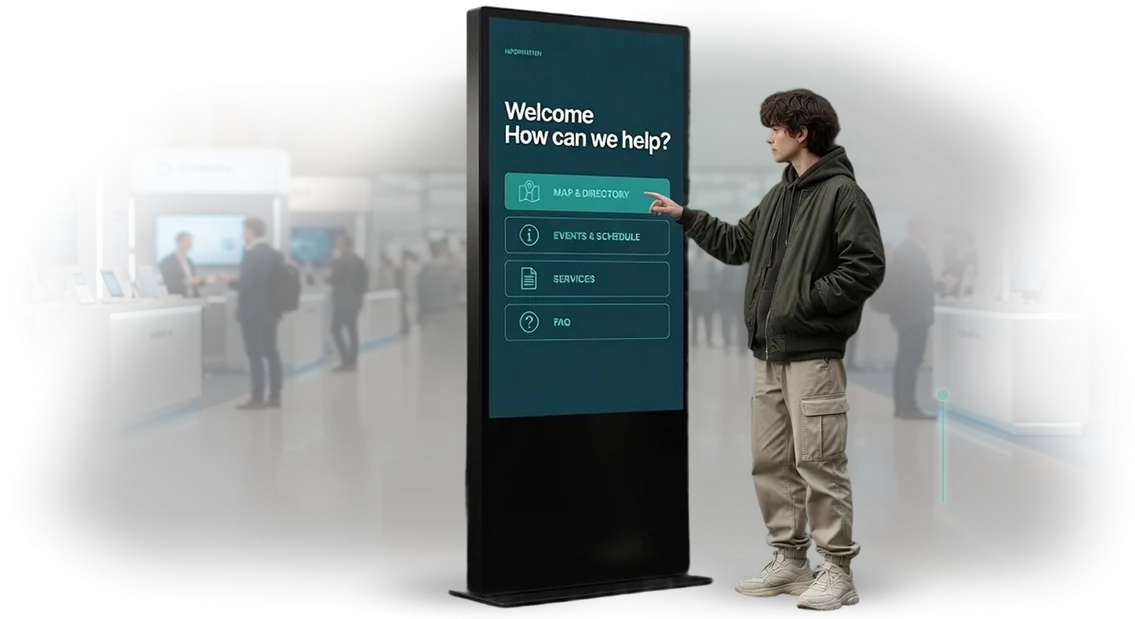
Why government-style kiosks don't work as they should
Visitors come to a government institution with a specific task — to register, get a certificate, pay a fee. If the kiosk greets them with a complex menu, unfamiliar logic, and unclear terminology, they lose trust in the device itself and return to the live queue.
Distrust of kiosks forms instantly. One failed touch is enough for a visitor to decide that "this technology isn't for me." As a result, an outdated interface turns a modern kiosk into an expensive exhibit that just takes up space in the lobby.
A complex interface is the main reason for an ineffective kiosk. When the screen is overloaded with buttons and the logic of actions requires guesswork, people don't understand where to click.
Instead of saving time, they spend even more — and leave with a negative impression of the institution.
The effectiveness of a kiosk is measured not by its technical specifications, but by how many visitors successfully complete their operation. With a poor interface, this metric drops, and equipment investments don't pay off.
Every ignored kiosk is lost budget and lost hours of staff who continue answering the same questions.
We design government-style interfaces that look familiar and clear. We remove barriers, reduce the number of actions to a minimum, use a calm palette, and familiar wording. As a result, visitors trust the kiosk, use it more willingly, and turn to staff less often. This is how investments in interactive kiosks start to pay off.
What benefits your institution will get from a modern kiosk
We've been developing information kiosks for government institutions for over 10 years. During this time, we've learned which kiosk benefits truly matter to clients: speed, staff relief, and visitor trust. Each of them directly affects service quality and organizational reputation.
Benefit: faster service
The kiosk instantly responds to typical requests: working hours, document lists, queue for the right office. Visitors don't need to wait for a consultant — a few screen touches is enough.
The service improvement becomes obvious: average time to get a certificate drops significantly, and specialists only handle complex questions. This is especially noticeable during peak hours when queues start moving faster.
Benefit: reduced staff workload
The reception desk and information phones stop being a "hotline": most inquiries are repetitive questions. The kiosk takes them on, and employees get time to solve real tasks.
Fatigue, turnover, and the likelihood of conflicts with visitors decrease. At the same time, the kiosk works without breaks or vacations — help is available at any moment.
Benefit: improved image of the government institution
A modern kiosk designed in a government style is a sign that the institution is keeping pace with the times. Visitors see care for their convenience, and partners see reliability.
Such an interior element increases trust and forms a positive image of the organization. It fits well into the design of any institution and requires no special maintenance.
Information kiosk formats in government style
The choice of kiosk format directly affects how conveniently visitors will use the service and how organically the equipment fits into the institution's interior. It's not enough to just install a screen — the structure must match the tasks, room size, and visitor flow.
We develop three main formats: floor-standing touchscreen kiosks (infomats), wall-mounted panels, and outdoor kiosks. Each solves its own set of tasks — from indoor navigation to 24/7 information on the surrounding territory. Below is a brief selection guide.
| Format | Who it's for | What it gives the client |
|---|---|---|
| Floor-standing touchscreen kiosk (infomat) | For lobbies, waiting areas, MFCs, administrative buildings | Reduces queues, relieves staff, helps visitors quickly find information or book an appointment |
| Wall-mounted panel | For corridors, elevator lobbies, small spaces | Saves space, works as an information desk, map, or navigation system — requires no separate floor area |
| Outdoor kiosk | For entrance groups, surrounding territories, 24/7 access zones | Works in any weather, informs about working hours, services, and events even outside schedule |
Each format is designed for your specific space and use scenario. We help choose the optimal option and adapt the design to a government style — strict, recognizable, with a focus on functionality and convenience for any age.
Stages of creating an information kiosk: from brief to launch
A clear process is half the success, especially when it comes to facilities of state importance. The client gets not just a kiosk, but a manageable project with fixed deadlines and clear control points at each stage.
We've structured the work so you always know what's happening with the project and when the result will be ready.
Below is the sequence of kiosk creation stages. For each item, you receive an intermediate result and can make edits without losing time.
-
Brief and task immersion. We study who will use the kiosk, what functions are needed, and what design style is required. We record the requirements and deadlines in the technical specification — this is the basis for all subsequent steps.
-
Interface prototype. We draw the screen structure and navigation logic: how a visitor will search for information, register in the queue, or get a certificate. At this stage, it's easy to check whether everything is convenient and adjust scenarios.
-
Government-style design. We create a strict, recognizable visual style: clear icons, restrained color palette, large touchscreen elements. The design complies with the organization's regulations and brand book while remaining comfortable for people of different ages.
-
Approval and sign-off of layouts. You receive ready screens for review. We make edits based on your feedback and approve the final version — after that, we launch production.
-
Manufacturing and assembly. We produce the kiosk enclosure, assemble all necessary equipment, and install the software. The finished product passes inspection before shipping, so a working system arrives at the site.
-
Installation and launch. We deliver the kiosk, install it at the right location, connect it to power, and conduct final testing. We check the touchscreen, stability of all sections, and accessibility for visitors.
The work doesn't end after launch: any kiosk needs to be kept up to date. We stay in touch, help with content updates, and refine functionality if needed.
As a result, you get not a "raw" prototype, but a reliable tool that works for your reputation and citizens' convenience.
What's included in delivery: kit for your kiosk
When you order an interactive kiosk, it's important to understand: you get not just a touchscreen panel, but a fully turnkey solution.
We've assembled the kit so you don't have to figure anything out, look for subcontractors, or deal with technical details — everything is already accounted for.
- Enclosure and stand. Durable construction adapted to your space: anti-vandal design, floor or wall mounting, convenient access for maintenance. The enclosure is matched to the location's style and carries the logo or navigation.
- Software. Licensed software with preinstalled settings: auto-start on power-up, protection against accidental app closure, data backup. The kiosk works from day one without configuration by your specialist.
- Government-style interface design. We develop a strict, concise interface that meets government and corporate standards: clear navigation, large elements, contrasting colors. Comfortable for all age groups — from schoolchildren to retirees.
- Content management system. You get a simple admin panel: a manager can update news, schedules, maps, and reference materials without a programmer. Role and access configuration is also included.
- Instructions and training. Ready-made procedures for staff: power-on, daily inspection, replacement of consumables, publishing new content. We conduct a short on-site briefing — usually no more than an hour.
- Installation and launch. We deliver the kiosk, install it, connect it to power and internet, test all operating scenarios, and hand over the configured device with a signed acceptance act. All you have to do is plug it in.
- Kiosk support. Ongoing support: regular software updates, phone consultations, engineer visits if needed. This protects your investment and extends the device's service life.
This package covers all client needs — from kiosk delivery to daily operation. You know the delivery contents in advance, fix the cost in the contract, and avoid hidden expenses.
If a different package is needed — for example, without the enclosure or without installation — we'll agree on individual terms.
Case study: MFC kiosk reduced waiting time by 30%
We have a real case study that shows how the right interface changes an institution's operations. An MFC network faced a typical problem: visitors spent an average of 15 minutes in line, and some left without receiving the service. This created a load on administrators and reduced satisfaction.
Traditional tickets and the live queue didn't solve the problem: people still crowded around the counters, and staff spent time on explanations. What was needed was a tool that would direct visitors to the right window without staff involvement.
We proposed installing 10 information kiosks with a government-style interface: strict, intuitive, and adapted for people of different ages. The task wasn't just to "install screens" but to move part of the traffic to an electronic queue, relieving staff.
Implementation results
| Metric | Before | After |
|---|---|---|
| Average waiting time | 15 minutes | 10 minutes |
| Share of requests via electronic queue | baseline | +25% |
| Number of kiosks in the network | — | 10 |
The numbers speak for themselves: waiting time dropped by a third, and the electronic queue became the main way to register. Visitors receive services faster, administrators are less distracted by routine questions.
For the client, this means not only comfort for people but also measurable efficiency growth. We continued to support the project and received a repeat order to expand the network — meaning the solution works in real conditions.
Frequently asked questions about information kiosk development
Clients rarely come with a clear technical specification — usually there's a need to guide visitors and relieve staff.
So the most common questions aren't about the kiosk's hardware, but about practical things: how long to wait, who will handle it, and how it all fits into current operations.
Below are answers to what really concerns people before starting. If your question isn't here, ask it directly — we'll suggest a solution for your task.
How long does kiosk development take?
Timelines depend on the volume of materials and the complexity of navigation scenarios. A typical project takes 2 to 6 weeks: first we approve the structure and logic, then we design the interface, build a prototype, and transfer it to the touchscreen.
If the content is ready and it's clear what task the kiosk solves — we launch faster. If needed, we can meet tight deadlines, but that requires a clear task definition at the start.
Is it difficult for staff to manage the kiosk and update information?
We design the interface so that a visitor can use it without preparation — which means staff will understand it even more easily. Administration comes down to simple actions: replacing a file, editing text, changing an image.
Access to content is divided by roles to prevent accidental breakage of settings. We train your team in one short session and stay in touch throughout the support period — if something is forgotten, we'll help.
Is the kiosk compatible with our local infrastructure?
The kiosk is a standalone device that doesn't require restructuring your systems. It runs the interface independently, works with the local network, and connects to internal services through clear and secure data exchange formats.
If a future integration with your database or accounting system is needed — that can be handled as part of refinements. The important thing is to understand what data the kiosk should receive and send; we handle the technical part.
What's included in post-launch support?
Basic support includes monitoring kiosk operation, updates for new browser and hardware requirements, and the ability to quickly make interface changes. As a rule, we work especially closely in the first weeks after launch to make sure everything is stable.
After that — according to procedure: you submit a request, we assess the scope and complete it. Remote access to the kiosk lets us resolve most issues without an on-site visit.
How to choose a kiosk format for your government institution's tasks?
Choosing a kiosk format starts not with the equipment model, but with three questions: where it will be located, who will use it, and what task it should solve. The answers eliminate overpaying for unnecessary features and speed up implementation.
For a lobby with peak-hour visitor flow, operation speed and load resistance are critical; for a quiet office, compactness and a simple interface matter more.
The government format implies restrained design and clear navigation, but the requirements differ: if the audience is older people, large buttons and confirmation signals matter more than a wide screen.
The next criterion is functionality. Queue registration, certificate and schedule output, state fee payment, or building navigation — each task dictates its own set of options.
Ordering a kiosk with a full set of modules just for an information desk is a typical mistake that doubles the budget.
Finally, think about growth. If the institution plans to expand its service list, choose a model with modernization capability.
Our engineers will select a configuration for your scenario — from a single-sided stand for registration to a full terminal with document printing — and you won't pay for anything extra.
Order interactive kiosk development for your institution
Ordering a kiosk means getting a tool that relieves staff and speeds up visitor service. Our team develops interactive kiosks for government institutions, MFCs, and administrations. We have dozens of completed projects — from navigation boards to government service portals.
Leave a request — we'll calculate the cost and name the timelines. We'll suggest the optimal kiosk format based on visitor volume and installation location.
If a strict "government style" is needed — we'll create a restrained interface with large buttons and a clear structure.
What you get when ordering kiosk development:
- Logic design for your services — a visitor finds the answer in 2-3 touches, without calls and queues.
- Government-style design: familiar colors, large font, simple navigation for all ages.
- Touchscreen adaptation: accidental presses, "thick" fingers, protection against freezes.
- Information protection and the ability to update content without a programmer — staff can change news and documents themselves.
- Warranty and support — we respond quickly to any questions so the kiosk runs without downtime.
Turnkey kiosk development takes 2 to 6 weeks depending on the functions. We handle the entire process: scenario analysis, design, programming, delivery, and setup. All you need to do is make a decision.
Fill out the form or call us — within a business day we'll send a cost estimate and suggest the best solution.