

Why do guests leave without sports-style interactive kiosks?
Visitors to sports events come for emotions — and they are the last people who want to figure out event navigation. If it's unclear where a sector is, when a match starts, or how to get to the fan zone, a person loses time, gets nervous, and spoils their experience.
As a result, some guests leave early or abandon the venue entirely, and the organizer loses both revenue and audience loyalty.
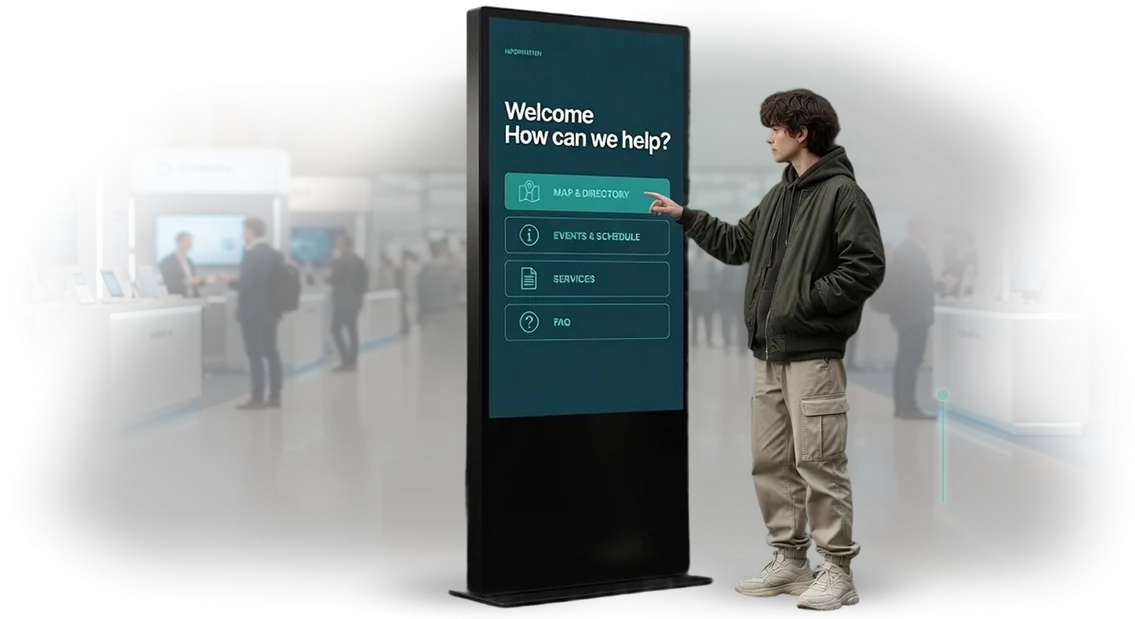
Interactive kiosks solve this pain point: a large interface designed for viewing from a distance and fast touch input helps visitors instantly find the right zone, schedule, roster, and live results.
The guest feels cared for, and the organizer gets a manageable flow of people — no queues at information desks and no chaos in walkways.
A sports-style design makes the kiosk a natural part of the event, not a faceless screen. Dynamic graphics, expressive accents, and brand colors amplify the fan atmosphere, boost brand recognition, and make people want to walk up, take a look, and take a photo. This turns the stand into an engagement point, not just an info desk.
Without such kiosks, the loss of guests becomes a systemic problem: people can't find the right entrance, miss key moments, and leave feeling that the organization let them down.
We close that gap — we design sports-style touch interfaces that keep the audience engaged from the first minute and guide every visitor to the right place without stress.
What benefits does an interactive kiosk bring to your event?
Guests remember impressions, not presentations. An interactive kiosk turns waiting into a game, delivers useful information without the help of staff, and leaves every visitor with the feeling that the event was made personally for them.
Growth in satisfaction and loyalty
Visitors choose for themselves what to view: the program, the map, the speaker list. No queues and no confused staff — just a quick response to the touch.
The easier it is for guests to get what they need, the higher they rate the event and the stronger their desire to come back again. Loyalty grows imperceptibly: people leave with a positive experience and a story to tell about how convenient everything was.
Reduced load on the team
Staff stop answering the same hundred questions and focus on truly important tasks. The kiosk takes over navigation, scheduling, registration, and feedback. This is especially noticeable at large venues where every organizer counts. In the end, the same team handles the flow of guests faster and more calmly.
Visitor analytics
The kiosk collects data on which pages are viewed most often, how much time people spend at the screen, and which sections are ignored. Our team build interfaces that deliver this data into reports the organizer can easily read.
By your next event, you know exactly what to improve, where to add attraction zones, and how to increase engagement.
Event branding
A touch kiosk is also the visual center of your event. Brand colors, fonts, animations, a recognizable style — everything is tailored to your brand. Guests photograph the screens, share pictures on social media, and your reach grows without an additional advertising budget.
Professional hardware and refined tools guarantee stable operation throughout the entire event. The kiosk doesn't freeze at the critical moment, and you get a predictable result with no technical surprises.
Interactive kiosk formats for any sports task
Every sports event sets its own rules — a stadium match, an exhibition, a race, or a corporate tournament. Guests need to find information quickly, and the brand needs to look modern.
We match the kiosk format to the goals of your event: from a compact wall panel to a full-fledged touch stand.
| Format | For whom | What it provides |
|---|---|---|
| Touch stand | Stadiums, arenas, fan zones | High throughput, striking appearance, convenient navigation |
| Wall panel | Corridors, lounges, press centers | Saves space, works as an information point, available at any time |
| Mobile kiosk | Races, off-site activations, tournaments | Quick deployment anywhere, flexibility, draws attention |
The touch stand is the primary tool for large venues: it withstands intensive use and helps spectators find a sector, schedule, or statistics.
A wall panel is appropriate when there is no room for a bulky structure: it is placed in a walk-through area and is always in view — convenient for quick reference.
A mobile kiosk is the solution for off-site events: it is easy to transport, install, and remove without changing the infrastructure.
When choosing a format, we care about guest convenience and brand image. We keep all structures in a unified sports style — dynamic shapes, contrasting colors, clear typography. We fill the kiosk with content: maps, schedules, news, statistics, and partner information.
Tell us about your event — we'll recommend the format that will enhance the guests' experience and accomplish your objectives.
How kiosk development works: from brief to launch
We have structured the process so that you control every stage and know in advance what you will get at the end. Our team uses a transparent six-step framework — from analysis to launch. It saves your time, eliminates misunderstandings, and avoids unnecessary revisions.
-
Brief and analysis. We dive into the task: we study the audience, installation points, and kiosk goals. We lock in the scenarios — exactly what the interface should do and what tasks it should solve.
-
Kiosk prototype. We create an interactive mockup with screen logic and navigation. You see the structure of the future interface before design even begins — this lets you adjust the scenarios in advance.
-
Design approval. We develop the visual design in the required style, including sports style: we select fonts, colors, graphics, and icons. You receive mockups, approve them, or request changes.
-
Development and assembly. We turn the approved design into a working interface: we configure touch control, connect menus, content, and the integrations you need. We show the intermediate result on a test screen.
-
Testing and installation. We verify stable operation on real hardware, mount the kiosk at the site, and connect it to power and the network. We make sure everything works in 24/7 mode.
-
Launch and support. We hand over the kiosk, train your staff, and stay in touch: we help with content updates, scenario enhancements, and technical support.
At every step, you receive clear intermediate results. A typical launch takes from two weeks, and transparent stages allow you to plan the budget and timelines precisely. In the end, you get a working tool that solves your business tasks and doesn't require constant control.
What is included in the interactive kiosk delivery
When you order an interactive kiosk from us, you get not just a device but a completely ready-made solution — from the hardware to staff training. We handle all stages so you can launch the project without diving into technical details.
What is included in the delivery package:
- Touch screen in a vandal-resistant enclosure — the kiosk withstands intensive use and lasts a long time even in high-traffic areas.
- A kiosk interface built to match your brand identity: for the sports direction, this means dynamic accent colors, large typography, and fast navigation.
- A content management system — you update schedules, announcements, and competition results on your own, without a programmer.
- Installation and commissioning: we deliver, install, and configure the kiosk at your venue.
- Staff training: a short session for administrators so they can upload content and handle simple questions.
- Instructions and documentation: clear guides for staff and guests.
This set covers all the client's needs: you get a working tool that starts delivering value immediately after installation. And thanks to the sports-style adaptation, the kiosk also becomes an image element — it emphasizes the energy and modernity of your venue.
All of this is covered by a single contract — clear timelines, a fixed cost, and a warranty on the equipment and work.
Case study: how we improved navigation at a sports festival
The organizers of the SportFest sports festival faced the familiar pain point: on a venue spanning several hectares, guests lost their bearings.
Dozens of zones — from workout to esports, stages, food courts, lounges — and the only way to find the right spot was a paper map or asking volunteers. Because of this, people missed the starts of matches and masterclasses, and queues formed at information desks.
We proposed installing interactive kiosks at key points across the festival.
On the sports-style touch screens — large tiles, dynamic accents, instant response — a guest could build a route to the right zone in just a couple of touches and immediately see what was happening there at that moment and when the next event would start.
What changed after launch
The results exceeded the client's expectations. The average time to find a location was cut in half: guests reached the right zone in one minute instead of the previous two.
The number of "where is…" questions to volunteers dropped by almost a third, which meant freed-up staff focused on helping participants rather than repeating directions.
It was also telling how visitor behavior changed: people managed to attend more activities and were more willing to come back to the festival the next day.
The organizers got clear analytics on zone demand and, within a month, had booked an expanded set of kiosks for the next season.
The bottom line — the kiosks are not just navigation but a tool that increases guest loyalty and simplifies the team's work. For us, this case confirmed that a properly designed touch interface in sports styling pays for itself on the very first day of the event.
Common questions about how interactive kiosks work
When it comes to interactive kiosks, clients raise the same doubts: will the equipment withstand constant load, will it be difficult to update information, and how long will development take. We answer these questions — so you understand what you'll get before the project starts.
How reliable are kiosks under constant operation?
A kiosk can operate 10–12 hours a day in the lobby of a stadium, club, or exhibition center. We build them on professional industrial-grade components — this is not office equipment but a solution for intensive use.
The enclosure protects against impacts, moisture, and dust, and if a failure occurs, our service team will quickly replace the faulty unit or the entire kiosk.
Is it difficult to manage content without a programmer?
No. You get an easy-to-use admin panel where you change schedules, promotions, posters, or photos — just as simply as editing a website. Updates appear on the kiosk immediately after saving.
This is especially convenient in the sports format: the final is tomorrow, qualification is today — you change the information in a couple of minutes.
What are the development timelines for a sports-style kiosk?
A typical project takes 3–6 weeks: from setting the task to installation. This includes interface design in the brand's style, creating sports graphics, configuring touch control, and mounting.
If you need the kiosk by a specific date — the season opener or a major match — we offer an expedited format.
If you still have questions about your scenario — write to us, and we'll recommend the optimal solution for your task and budget.Get a sports-style interactive kiosk for your project
Ordering a sports-style kiosk is a transparent process in which you take part at every step. We focus on your task: the installation location, the audience, the desired result. You always know what stage the project is at and what comes next.
- Brief and consultation. We discuss the tasks, audience, and location.
- Cost and timeline estimate. We prepare a transparent estimate and a work plan.
- Interface design project. We show mockups in sports style.
- Mockup approval. We make revisions until full approval.
- Kiosk development and assembly. We create the device and the software part.
- Testing and launch. We verify on site and train the staff.
- Post-launch support. We update content and provide consultations.
In addition to the refined kiosk development, you get:
- A fixed estimate with no hidden charges.
- Sports-style design that will make your brand stand out.
- Adaptation to your location and audience.
- Short timelines — from idea to a working kiosk.
- A warranty on the equipment and interface.
- Content updates without a programmer.
Call us or leave a request — we'll provide a consultation, calculate the cost, and offer a solution that fits your budget and timeline. Turnkey kiosk development — no surprises and no delays.
How to choose the right kiosk format for your event?
Choosing a kiosk starts not with a model but with questions: how many guests will be at the event, how much space is allocated for the interactive zone, and what budget is planned.
The answers immediately rule out unnecessary options and help you find a format that will work for your goals rather than just sit in a corner.
If you expect a large flow of visitors — a tournament final, a mass race, or a high-traffic exhibition — speed and throughput matter. In this case, compact touch stands with simple scenarios work well: registration, schedule, souvenir photos.
For intimate events where every guest has a few minutes to interact, you can create a deeper experience: quizzes, club history, an interactive achievements map. Both options can carry the sports style and fit organically into the brand identity.
The size of the venue determines the design: at a small location, one kiosk is enough; for a spacious hall, it makes sense to install several points so guests don't stand in line.
The budget also directly affects the choice — we offer rental, purchase, and intermediate configurations where some functions are implemented in software rather than through additional hardware. This way, you stay within the estimate without losing quality or coverage.
We don't sell a "box" — we select a solution for your scenario. We gather the input data, assess the load, space, and budget, and offer the optimal option — from a single touch terminal to a series of zones with different scenarios.
In the end, you get a kiosk that solves the event's task, doesn't overload the venue, and truly engages guests rather than just attracting their attention.