

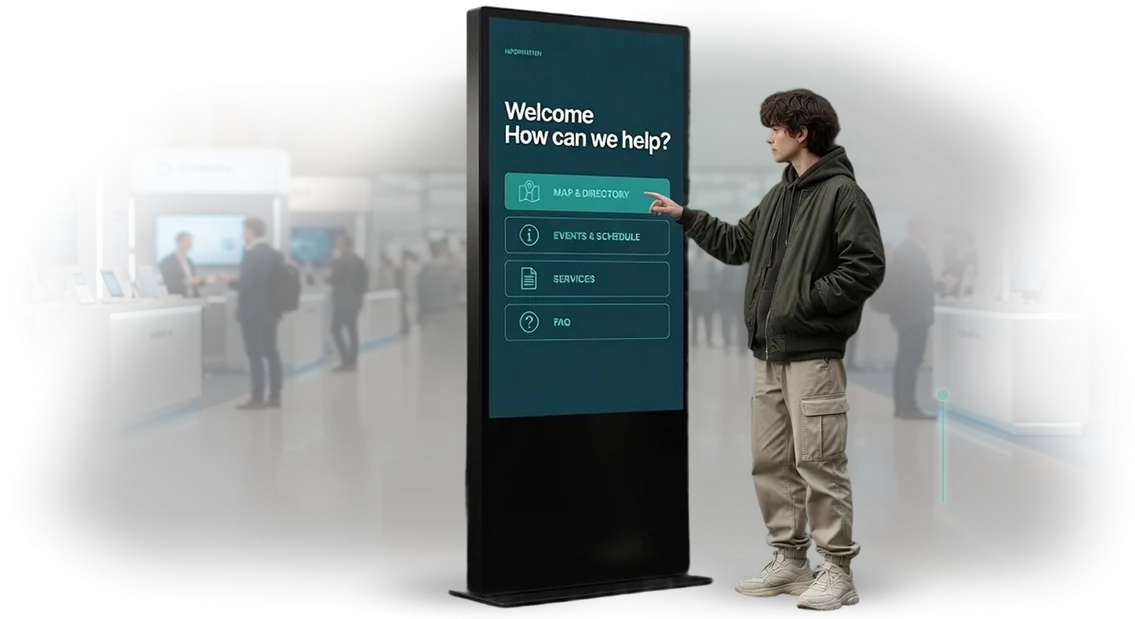
Customers don't linger at kiosks — we fix this in a cozy style
An interactive kiosk stands against the wall, but guests walk past — a familiar sight in many establishments. The reason is almost never the equipment: it's the kiosk interface that greets people with cold menus and confusing logic.
A visitor isn't willing to figure it out — they simply leave, and the business gets neither data, nor an order, nor an impression.
We fix this in a cozy style: we make the kiosk interface warm, clear, and visually calm. Cozy design isn't just soft colors — it's an environment where guests feel confident from the very first seconds.
Large prompts, friendly wording, and a thoughtfully planned sequence of actions remove the fear of technology even for those using touchscreens for the first time.
Guest engagement directly depends on how comfortable they feel using the kiosk.
When the interface requires no effort, people are more willing to explore the menu, promotions, and loyalty card — and end up spending extra minutes at the screen that convert into an order or subscription. For the establishment, this means more repeat visits and genuine feedback.
The cozy style also helps the brand: a warm, human interface is memorable and evokes affinity. Customers tell their friends about the experience, turning every guest into a channel of free advertising.
We combine aesthetics and utility — so the kiosk works for your business instead of scaring visitors away.
What a well-designed kiosk interface delivers: benefits for business and guests
A well-designed touchscreen kiosk interface isn't just a beautiful screen — it's a working tool that affects key business metrics. The cozy design style helps guests feel comfortable, removes barriers, and gently guides them toward action.
Benefit: more time at the screen
A clear and pleasant interface holds the guest's attention. They explore the menu, promotions, and additional services — and every extra minute at the kiosk increases the likelihood of an additional sale.
Benefit: higher conversion to orders
Cozy design relieves tension and uncertainty. Guests easily find the section they need, aren't afraid to make mistakes, and complete their order without staff assistance. As a result, more visitors reach the payment step instead of abandoning the kiosk halfway.
Benefit: convenience for every guest
The interface accounts for different scenarios: quick ordering, exploring options, and returning to selected items. Large elements, calm colors, and clear prompts make the kiosk accessible to people of any age and skill level.
Benefit: brand recognition
The cozy style is an extension of the establishment's atmosphere. Signature colors and a distinctive visual language enhance the impression of the space. Such attention to detail is memorable, increases loyalty, and brings customers back.
All together, this turns a touchscreen kiosk from a mere device into a full-fledged sales and guest-care tool.
Kiosk interface formats: which one fits your task
A kiosk is the first 'employee' a visitor interacts with. In a café or coffee shop, it should create a cozy atmosphere; in a store, it should quickly guide the shopper to the right product.
That's why we choose the interface format not 'by template' but according to your establishment's scenario and guest expectations.
We analyzed how different industries use kiosks and identified several typical formats. Below is a comparison so you can see what each one offers the business. We'll adapt the final version to your style and objectives.
| Interface format | For whom | What it gives the customer |
|---|---|---|
| Cozy, with large cards and soft accents | Cafés, restaurants, coffee shops | Guests relax and take longer to choose — this increases the average check and return rate |
| Concise, with search and categories | Stores, supermarkets | Shoppers find a product in a couple of taps, and the line keeps moving |
| With prompts and illustrative photos | Salons, pharmacies, museums | Visitors get a consultation on their own, and the staff workload decreases |
| Image-driven, with video and atmospheric scenes | Showrooms, exhibition areas | Impressive brand presentation, and visitors are more willing to share their impressions |
| Informational, with news and promotions | Hotel lobbies, shopping centers | Guests learn about your services and promotions without staff involvement |
We design all formats in a cozy style — with neat typography, clear icons, and calm colors when it's a café or restaurant. For a store, we make a more restrained version but with the same attention to detail: every button sits where a finger expects to find it. The interface doesn't just look pleasant — it helps visitors feel confident from the first touch.
If you're unsure which format suits you best, write to us — we'll send examples of similar projects and help you choose a solution that your visitors will love and that will pay off through faster, more comfortable service.
Stages of kiosk interface development: from brief to launch
Working on an information kiosk interface isn't a one-off 'picture' — it's a step-by-step process with visible results at every stage.
We've broken it into six transparent stages: you understand what's happening, control the key milestones, and make decisions, while we handle implementation, testing, and launch.
-
Interface brief — we dive into the task: who uses the kiosk, which functions matter, and which style suits your audience. We document the design and timeline requirements to prevent misunderstandings at the start.
-
Structure and logic — we develop the screen map and scenarios: how a visitor moves from the first touch to the desired action. You see the user journey before the design even appears.
-
Design prototype — we design the screens in the cozy style agreed upon at the start. You get a visual picture of the future kiosk — with colors, fonts, and element placement that create the right atmosphere.
-
Interactive version — we turn the layouts into a clickable prototype. You can 'touch' the interface yourself, test the usability, and make edits at this stage — not after launch, when changes cost more.
-
Implementation and verification — we build the final interface on professional hardware and test it against real-world scenarios: long sessions, restarts, and behavior during failures. You get stable performance, not just a beautiful screen.
-
Kiosk launch and support — we install the solution, train the staff, and hand over short instructions. We stay in touch after launch and quickly fix any details that get in the way of visitors or employees.
This process brings peace of mind: you always know which stage the project is at and never depend on a 'black box.' We handle the technical side; you keep control of decisions. As a result, the kiosk looks cozy, works quickly, and solves your business problem.
What's included in the delivery: a complete kit for your kiosk
You get not just a kiosk but a complete turnkey solution. The package includes all interface layouts, interactive prototypes, and instructions — your team can launch the device on installation day and quickly update content without unnecessary approvals.
The cozy-style design is thought through to the smallest detail: clear buttons, a comfortable color palette, and calm typography. Visitors enjoy using the kiosk, and staff can easily explain its functions. Everything needed for operation is handed over in a convenient format.
- Interface layouts in a cozy style — all screens and states, ready for your content.
- Interactive prototypes — clickable versions for testing scenarios before the final launch.
- Staff instructions — simple guides for powering on, adding content, and daily maintenance.
- Employee training — a review of practical situations and answers to your team's questions.
- Administrator guide — change promotions, news, and sections on your own without a programmer.
- Graphics and icon files — so your designer can update banners in-house.
- Content update procedure — a clear sequence of actions for any changes.
You get the complete package in one place. All that's left is to plug in the kiosk and invite the first visitors — everything else is already thought through and prepared for a launch without surprises.
Case study: how a kiosk interface increased guest interaction time
The owners of a cozy coffee shop came to us with a familiar pain point: guests spent a long time at the counter, couldn't make sense of the menu, and staff explained the ingredients of menu items over and over.
Visitors were in a hurry, placed a standard order, and left — the average check stagnated, and the café atmosphere suffered from the queues. We proposed an interactive kiosk that engages guests in the choice on its own.
What we did
For the coffee chain "Domashny Ugolok", we designed an interface in the brand's signature cozy style: warm tones, large photos of dishes, and clear prompts.
The guest doesn't read instructions — they immediately understand where to tap: they see categories, add-ons, and portion size. The kiosk unobtrusively suggests a dessert with a cappuccino or syrup for a raf coffee, and the customer places an order in just a couple of taps.
Project results
A month after launch, interaction time with the kiosk grew 2.3 times — guests began studying the menu, comparing items, and building orders to their taste. The average check increased by 18%, and repeat visits through the loyalty program reached a third of all orders.
In one month, more than 12,000 sessions went through the kiosk — while the line at the counter was cut in half, and baristas stopped being distracted by explanations.
The owner was pleased with more than just the numbers. The cozy-style interface preserved the establishment's atmosphere — guests don't feel like they're dealing with a 'bare terminal,' and staff gained more time for genuine interaction.
For us, this is confirmation: a properly designed kiosk interface works for both image and profit at the same time.
How to choose the right kiosk interface format for your task?
Choosing an interface format starts not with a layout but with the task: what should a visitor accomplish at the kiosk in thirty seconds, and in what state do they approach it?
A tired exhibition guest needs large text and simple navigation; a store shopper needs a fast catalog with a 'pick up at checkout' button. We design the screen structure around your scenario.
The second criterion is the placement location. A busy lobby needs a vertical kiosk with a single starting screen: a person touches a section and gets an answer.
For an exhibition or training, a horizontal gesture-based table is a better fit — it holds attention and creates an immersive effect. In both solutions, we make the interface cozy: calm colors, large buttons, and instant response.
The third criterion is the audience. People without experience with touchscreens should see a minimum of elements and a 'what to do next' hint. Children need bright game mechanics and protection from accidental taps. We choose the kiosk format for real users, so the device becomes a helper rather than a barrier.
If you're torn between two formats, consider future support: the more complex the screens, the more expensive the refinements. We offer optimal complexity that delivers results without overpaying.
First, you try the prototype on a touchscreen device, then we finalize the decision — the selection process becomes transparent.
Start with the goal and the placement location; we'll adapt the rest — colors, functions, logic — to your audience. You'll get a cozy-style interface that guests don't need to figure out and that easily fits into the atmosphere of your space.
Answers to frequently asked questions about kiosk interface development
Having doubts before starting is normal, especially when it comes to new customer touchpoints. We've gathered the questions clients ask most often and answer them directly. If your question isn't on the list — just write to us and we'll discuss the details.
How long does kiosk interface development take?
Timelines depend on the number of screens and the complexity of the logic. On average, design and prototyping take 2–4 weeks, plus another 1–2 weeks for refinements and handing files over to developers. We lock in the exact schedule after the brief — you'll know the launch date in advance.
Will it be difficult to update content after launch?
No. We design the interface so you can change texts, promotions, and images without involving a programmer. Simply replace files in the admin panel or upload new materials — the kiosk updates automatically.
What guarantees do you provide?
We document the guarantees in the contract: meeting deadlines, matching the layouts, and working correctly on your equipment. After launch, we stay in touch and fix errors free of charge if they arise in the first months of operation.
What if the kiosk is on a brightly lit sales floor or in a high-traffic area?
We account for operating conditions as early as the design stage: we choose contrasting colors, large buttons, and touch-resistant elements. The interface remains readable in any lighting and convenient for a wide range of people — from children to older visitors.
Order a kiosk interface in a cozy style
The cozy style isn't just a pleasant picture — it's a way to win over visitors from the first second: soft tones, clear prompts, and an interface that doesn't strain.
This is the kind of kiosk people remember and recommend to friends — which means your brand gains additional recognition.
When you order an interface from our team, we start by analyzing your audience and the kiosk's objectives. Then we design scenarios, draw prototypes, and assemble a finished design that's easy to integrate into any hardware. At every stage, you see intermediate results and make edits — no surprises at the final stage.
What you'll get after reaching out:
- a cozy-style interface that reflects your brand's character;
- well-developed scenarios for all types of guests — from older adults to children;
- adaptation to touchscreens of any size and resolution;
- convenient navigation: no more than two taps to reach the desired function;
- a complete package of files and source assets — you can hand them over to developers;
- post-launch support: testing, refinements, and assistance.
We work remotely around the world and have already launched dozens of kiosks — from exhibition halls to waiting areas in clinics. In every project, we stick to timelines and budget because we value your time and reputation.
Write to us today — tell us about your goals, and we'll propose a solution for your format. Start with a short brief, and we'll take it from there. A cozy interface that visitors love — in just a few weeks.