

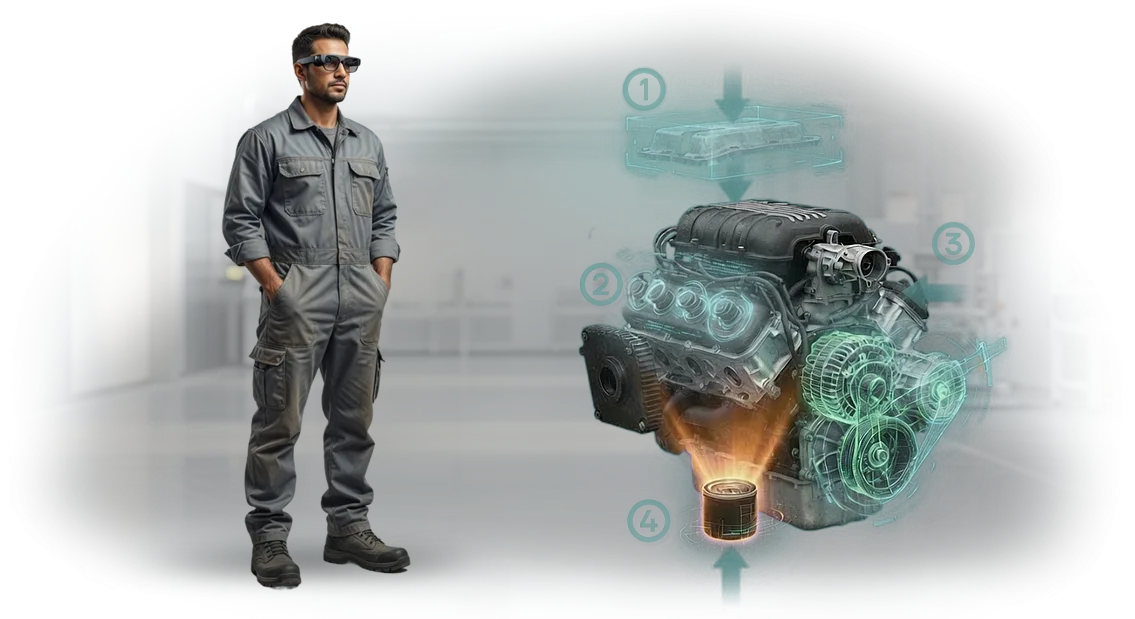
AR warehouse pick: How to Remove the Pain of Inaccurate Picking
Inaccurate picking means lost time in the warehouse and hidden losses that few people calculate to the end. Picking errors — mis-sorting, returns, shipment delays, repeated product searches — increase the cost of each order and hurt your reputation.
During peak hours, when the warehouse runs at maximum capacity, errors grow like an avalanche, and every correction takes time and manual checks.
The main cause is that people have to rely on memory, paper instructions, and their own attention.
A new hire spends weeks learning to navigate the racks, an experienced operator gets tired and misses an item, and the result is the same: the customer receives something they didn't order.
Fixing such an error takes many times longer than the original pick itself, plus logistics costs and reshipments add up.
We solve this pain with AR warehouse pick: the operator sees the exact location, the right product, and the correct sequence of actions right before their eyes. The technology doesn't require stopping production and integrates into current warehouse processes. Augmented reality prompts replace paper and training, so picking accuracy improves from day one.
For example, for the warehouse operator PromLogistik, we deployed AR prompts at the picking area: the number of errors dropped by almost 90%, and operator training time was cut from two weeks to a couple of days.
This is the result our clients come to us for: fewer errors, faster shipping, and quicker onboarding without stopping the warehouse.
Warehouse Benefits: Faster Picking, Zero Mis-sorting, Quick Onboarding of New Hires
Every day of downtime or errors in the warehouse means delayed shipments and extra costs. A new hire spends weeks finding products using paper layouts, while an experienced picker wastes time double-checking article numbers.
Augmented reality removes both bottlenecks: the operator sees the right bin and the exact route right in their field of view, and the system itself highlights the product and confirms each step.
Picking speed increases by 20–30% within the first few weeks: no need to look away at a terminal, search for a line in a packing list, or re-read a code. The AR instruction guides the employee step by step: pick — scan — place.
Each operation is confirmed immediately, so mis-sorting practically disappears — an error in an article code or box simply doesn't get through.
Fast onboarding of new hires is an additional advantage. Instead of two to three weeks of mentoring, a new employee handles their first orders by day two, and within a week works at the pace of an experienced colleague.
The system doesn't require memorizing product locations or the logic of warehouse zones — it guides a person like a navigation app, so staff turnover stops being critical.
Warehouse transparency improves automatically: every picker, every zone, and every operation is visible in the system. A manager can see at any moment where performance is on track and where the bottleneck is, making decisions based on facts rather than gut feeling. That's control without micromanagement.
The result is increased warehouse productivity without expanding headcount or long training. We take on the project turnkey: from process audit to AR instruction launch, so your team gets not an experiment but a working tool with clear metrics.
AR Deployment Formats for Warehouse Tasks
AR deployment for warehouse tasks can't be reduced to a single universal template. Each format has its own logic: one addresses a specific pain point — such as picking errors — while another restructures the entire picking process.
To help you choose a solution that fits your scale and budget, we've split the options into three core formats.
Three AR Formats for the Warehouse
| Format | Who It's For | What It Delivers |
|---|---|---|
| AR on mobile devices | Mid-sized warehouses that want to quickly test the effect | Minimum entry threshold: works with a tablet or terminal without restructuring processes. Picking accuracy improves within the first weeks. |
| Industrial AR glasses | High-intensity picking, high-order-flow zones | Hands are free, and the operator sees the route and product location right in their field of view. Zone speed and throughput increase noticeably. |
| WMS integration | Large distribution centers with high volumes | A unified operations picture: all data is synchronized with the accounting system. Fewer errors, transparent analytics, and the ability to optimize processes based on numbers. |
Choosing a format isn't about "which is cooler" — it's about return on investment. A mobile device pilot costs many times less than glasses but delivers fast metrics for a scaling decision.
Glasses pay off where every hour of employee time is expensive, and WMS integration makes sense when you need to connect AR with supply, inventory, and planning.
We help you choose a format that fits your budget and warehouse needs, starting with a pilot and expanding the solution as necessary. Send us a description of your picking area — we'll calculate which option delivers the greatest savings.
Project Stages: From Process Audit to Pilot Launch
Deploying AR instructions isn't about buying equipment — it's about changing work processes. That's why we start with an audit: we find the points where errors occur and time is lost, and determine where AR will actually deliver an effect.
We work according to the "Pilot with a Measurable Result" methodology — it reduces risk and doesn't require stopping the warehouse.
- Process audit. We study warehouse operations and record current time and error rates — something to compare against after launch.
- Pilot area selection. We identify the operation where AR will pay off fastest — most often this is picking or new-hire training. We agree on success criteria.
- Instruction prototype. We build a scenario on real equipment, show it to employees, and refine the interface based on their feedback.
- Accounting system integration. We set up task and inventory data transfer to the AR interface without restructuring your infrastructure.
- Pilot launch. We train the team, run the process during a shift, and collect metrics: picking speed, errors, new-hire adaptation time.
- Evaluation and scaling. We compare performance against "before" metrics, prepare a warehouse-wide expansion plan, and stay on board after launch.
After the pilot, we don't disappear: we update instructions, add new operations, and remain available. You get a working solution, not a report about what can't be done.
What's Included in the Delivery: Instructions, Integrations, Employee Training
When you order AR instruction development for your warehouse, it's important to receive not a demonstration but a complete, ready-to-use package. We put together the delivery to match your task: from picking scenarios to operator training and documentation for your team.
Here's what's included in the delivery:
- Ready-to-use AR instructions for operators: step-by-step picking, receiving, packing, and shipping scenarios, adapted to your equipment and internal procedures.
- Integration with your warehouse system: data exchange for orders, bins, and statuses, so the employee sees the current task right in the AR interface without switching between programs.
- Configuration for your equipment: tablets, barcode scanners, or AR glasses — we work with the devices you already have or help select suitable ones.
- Employee training: hands-on training for operators and administrators, AR usage instructions, and common scenario walkthroughs so the team works confidently from day one.
- Technical documentation: scenario descriptions, work procedures, and maintenance and configuration guides — your team can support the system after launch.
- Support during deployment: assistance in the first weeks, feedback collection, and scenario refinement to match real warehouse processes.
The entire package is delivered in stages: you see the result at each step and control the quality. In the end, you get a system that works in your warehouse from day one — not a "prototype for review."
Case Study: 38% Fewer Errors in Pick Operations
Large distributor LogisticsPro approached us with a complaint about a growing number of errors in order picking. At the peak of the season, incorrect picks reached 4% — each instance meant a return, mis-sorting, and lost time.
The department head had already tried changing the motivation system and adding checkpoints — that reduced errors by only a few percent but didn't solve the problem.
We suggested not retraining staff but changing the prompting system itself. Our engineers built an AR interface for industrial glasses: the employee sees the bin number, quantity, and route right in their field of view, without looking away at a terminal.
The result after the first month: errors in pick operations dropped by 38%, picking speed increased by a quarter, and a new employee reaches target performance in two days instead of a week.
A 38% error reduction is more than just a number. For a warehouse processing 10,000 orders per day, this level of improvement delivers significant annual savings on returns and mis-sorting alone, not to mention the loyalty of customers who no longer receive defective goods.
Today, this AR project runs across three of the company's warehouses, and the distributor has ordered system expansion to all regional sites. For us, that's the key indicator — the client isn't just satisfied but is scaling the solution with their own budget.
The deployment took six weeks: from process audit to launch on the pilot line. We trained supervisors, prepared instructions, and supported the first working shift. Further rollout is happening in stages without stopping warehouse operations.
How to Choose the Right Format for Your Warehouse and Budget?
Choosing a format starts not with technology but with your losses. If your warehouse has a thousand SKUs, pickers spend time every shift searching for bins, and packing lists and scanners force them to constantly shift their gaze — AR prompts eliminate those pauses.
The key criterion isn't the number of employees but the number of errors and the time per pick: the more expensive mis-sorting and returns are, the faster the assistance pays off.
Assess how much time goes into searching and checking, how often returns arrive, or customers complain about picking. If incorrect picks cost you money and delay shipments, AR reduces those losses.
If your warehouse is compact and errors are rare, simple processes may be enough — and that's the right decision that saves your budget.
The format is matched to working conditions: one team prefers voice mode, another needs visual prompts on a screen, a third wants a lightweight wearable display.
Our engineers evaluate whether hands are free, how racks are arranged, whether wireless coverage is available, and propose the minimally sufficient option. That means you pay for results, not for the most expensive hardware.
The most reliable way to see whether AR fits your warehouse is a pilot test in one area. Over a few days, real employees pick orders with AR prompts, and you observe speed, errors, and fatigue.
Spend a small part of your budget on such a test, and you'll get facts for a warehouse-wide decision while avoiding large blind investments.
Frequently Asked Questions and Concerns Before Launch
Deploying AR instructions in a warehouse is a serious decision, so clients tend to have the same questions before starting.
Here are answers to the main ones: what about the budget, will it break current processes, how fast will staff learn, and what happens if something goes wrong. Below — no marketing, just real project experience.
How much does AR instruction deployment cost, and when does it pay off?
The estimate is calculated for your specific warehouse, not pulled out of thin air: the number of operations, headcount, equipment type, and current picking error rates.
The transparent calculation includes the pilot area, software licenses, and support — scaling afterward comes at a discount.
Payback is fast: a 30–50% reduction in picking errors and 2–3x faster new-hire training generate savings within the first months.
For a typical warehouse, return on investment is 6 to 12 months — after that, AR instructions work as a "digital instructor" with no additional costs.
How risky is this for current warehouse processes?
Integration follows a "do no harm" principle: the AR system runs on top of your WMS or ERP without replacing them. We connect to existing data through secure APIs — we break nothing, only add prompts.
Risks are addressed with a pilot launch in one zone or shift: you see the real effect before full deployment. If the pilot doesn't deliver results, that's stated in the contract and we refund the prepayment. In practice, there have been no such cases, but this scenario protects you from the very start.
Staff won't accept AR — how is training handled?
The AR instruction interface is as simple as possible: the employee puts on glasses, sees an arrow, and confirms the action with a single button. Training takes 15–20 minutes, and for most pickers it's simply "put them on and work."
We prepare supervisors on your side who can onboard new employees independently. No two-week courses: instruction happens right at the racks, without interrupting the shift.
Staff resistance is overcome by the immediate personal win — fewer errors and less hassle searching for bins.
Can the solution realistically scale across all company warehouses?
Yes, the system architecture is built for growth from the start: first one zone, then the entire warehouse, then the distribution center and branches. Configuration for a new site takes days, not months — equipment, zones, and operation types are added through an admin panel.
Scaling preserves unified analytics: you see key metrics across all sites — picking speed, error counts, new-hire adaptation time. This lets you share best practices between warehouses and make decisions based on numbers rather than gut feelings.
What guarantees do you provide on results?
Guarantees are written into the contract: we specify concrete pilot KPIs — error reduction, picking speed growth, deployment timelines. If targets aren't met, we refund the prepayment. After launch, we provide technical support and free updates for the first 12 months.
You're never left alone with the system: our support engineers respond within an hour during business hours, and critical failures are resolved remotely within 2–4 hours. After that, it's up to you: we can expand functionality, connect new areas, or train your IT team.
These are typical questions, but every warehouse has its own nuances. Tell us about your task — we'll send a payback estimate and a pilot launch plan tailored to your processes.Order a Project — What You Get Right After Contacting Us
Submit a request, and on the very first business day you'll receive not vague promises but a concrete calculation for your task. We review every inquiry personally: we clarify the number of SKUs, warehouse configuration, picking speed, and the points where money is being lost.
Based on that, we prepare a proposal you can immediately show to management and include in the budget.
What's included in the response after your inquiry:
- Consultation with an AR solutions engineer. We'll discuss your situation: which operations you want to speed up, which errors to eliminate, and how the process will fit into your current WMS — without technical details, in the language of results.
- Preliminary project estimate. Deployment timelines, cost, and expected effect (for example, fewer picking errors and more orders picked per shift). Figures are given as a range, but realistic.
- Demonstration of similar deployments. We'll show what AR prompts look like in practice: examples from warehouses in your segment, session recordings, and before-and-after measurement results.
- Deployment plan and checklist. What we need from you (labeling, test area, a designated employee) and what we'll do. You'll understand every stage and be able to track timelines.
- Clear next steps. We'll suggest starting with one area or shift: test the effect on real orders in a short timeframe, and use those results to decide on scaling.
- A transparent cost estimate. No hidden fees: we fix the scope of work, equipment, and support. The price doesn't change after signing.
A couple of days after your request, you'll receive a document with the calculation and recommendations. Then we'll have a short meeting to discuss the details, answer questions, and advise on where to start — even if you're planning the full launch later. There are no obligations until you make a decision.