

AR for Construction: Accelerating Commissioning and Reducing Risks
On a construction site, time is money. Every day of downtime means a delay in commissioning and rising costs, while a mistake can lead to rework, missed deadlines, and safety risks.
Traditional paper instructions and drawings no longer meet the demands of a modern site: they become outdated, get lost, and are awkward to use in protective gloves and dust.
The result is downtime while waiting for clarifications, on-site errors, and lengthy onboarding for new staff.
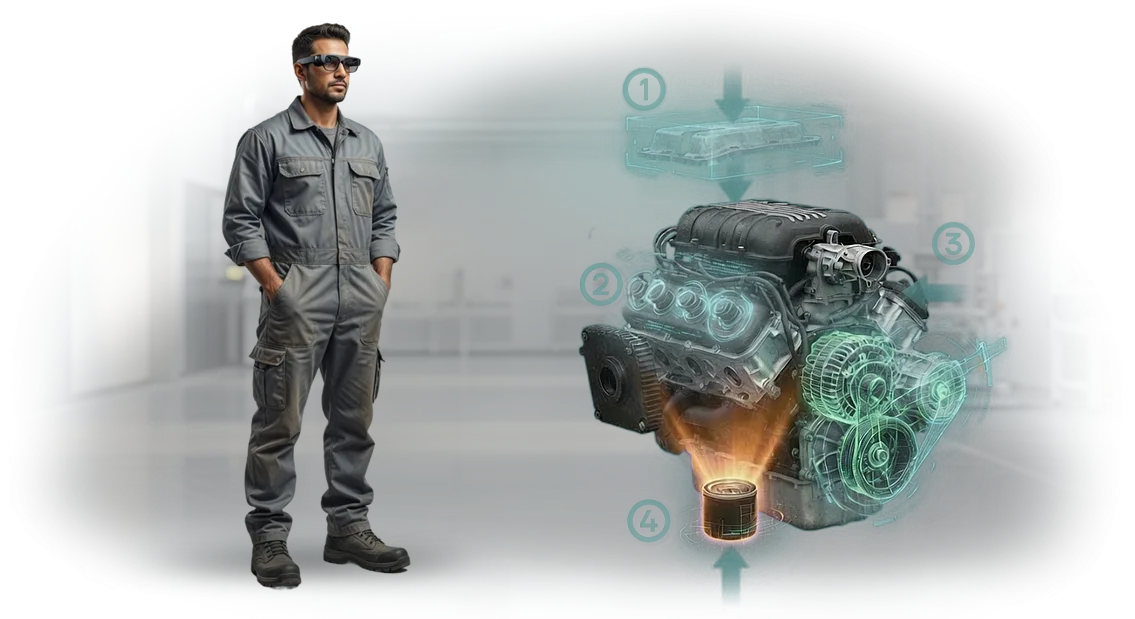
This is where AR for construction comes in. Augmented reality overlays step-by-step actions, diagrams, and parameters directly onto real equipment. The worker sees what to do and how to do it without pausing to search for documentation.
This cuts the time spent on each operation, reduces errors, and improves safety — the specialist follows a proven visual sequence.
What matters most is that AR instructions solve the problem of staff training. A new employee masters the equipment faster, and an experienced foreman spends less time explaining.
The company gets a standardized process: everyone performs the task using the same proven sequence, which reduces reliance on the human factor and makes the result predictable.
In short, AR for construction helps bring facilities into service faster and lowers risks at every stage — from installation to commissioning. Downtime decreases, on-site errors stop being "business as usual," and safety becomes manageable.
These are exactly the challenges we solve for our clients: we tailor AR instructions to specific equipment and processes so you get measurable savings in time and budget.
What Changes After Implementing AR Instructions: 4 Key Benefits
Implementing AR instructions on construction sites is not an experiment; it is an efficiency management tool. According to McKinsey, they cut employee training time by 30–40% and halve the number of installation errors.
We have adapted this approach for industrial equipment — here are four measurable benefits you get after launch.
Faster Commissioning
The employee sees the next step right on the equipment without turning to drawings or long instructions. As a result, the first commissioning takes hours instead of days, and new equipment starts operating on schedule.
Accuracy and Work Quality
AR markup shows mounting points, tightening order, and the correct position of components. This removes guesswork: even an inexperienced installer works like a highly skilled specialist. Defects and rework are reduced by 30–50%.
Safety on the Construction Site
AR instructions highlight hazardous zones, remind workers about personal protective equipment, and warn against prohibited actions. Incidents involving staff decrease, and inspections pass without remarks.
Employee Satisfaction
Work becomes clearer and calmer — there is no need to memorize dozens of pages of text. Employees master new components faster and feel more confident, which reduces turnover and increases productivity.
These are four results you will see in the first month. We will assess the effect for your facility and calculate the payback — send us a request.
AR Formats for Construction: Choose What Fits Your Task
Every construction task has its own AR format. Mobile instructions suit those who work with a tablet or smartphone on site; holographic instructions are for complex operations where both hands must be free; stationary AR simulators are for large-scale training and skill practice.
The choice of format determines the time to deployment, equipment requirements, and employee coverage.
We do not choose AR "for the sake of technology" — we start from the task: speed up installation, reduce defects, train new employees, or prepare a facility for handover.
That is why it is important to understand which format scales, where additional investment in equipment is needed, and where the smartphones the crew already has are enough.
Below is a comparison of the three main formats we use in projects for construction and industrial enterprises.
| Format | Who it's for | What it gives the client |
|---|---|---|
| Mobile AR instruction (tablet / smartphone) | Installers, maintenance technicians, on-site staff | Step-by-step guidance overlaid on real equipment, replacing paper instructions. Fewer errors and fewer questions to engineers. |
| Holographic instruction (AR glasses) | Assembly of complex components, quality control, work handover | Instruction anchored to parts right before the eyes, hands stay free. Higher accuracy, faster training for newcomers. |
| Stationary AR simulator | Training centers, staff training departments | Training without risk to expensive machinery, practicing procedures before the first visit to the site. |
Regardless of format, we take on the creation of AR content and integration into the workflow.
Each format has its own payback scenario: mobile instructions are faster to deploy — employees' smartphones are enough — while holographic instructions pay off on complex components where a mistake costs hours of downtime. We help calculate the effect before development starts and select a format that fits the budget.
Stages of AR Implementation at Your Facility: From Brief to Support
Adopting AR for construction is not about buying a ready-made application; it is a consistent project with clear stages.
We start with an analysis of your facility and end with a working system in the hands of your specialists — without stopping production and with a measurable result at every step.
- Brief and site audit. We document typical scenarios: where errors occur most often, which instructions are worth converting to AR, who will use the guidance, and on which equipment.
- Creating visual instructions. We turn your documentation into clear 3D scenarios tied to real components. The employee sees the hint right at their workplace instead of reading a drawing.
- Prototype approval. We demonstrate AR on your critical area before full-scale development. This removes risks and confirms that the solution addresses exactly your task.
- Development and integration. We adapt the system to your equipment, tablets, and internal processes — from work orders to quality control. The instructions work alongside existing procedures, not instead of them.
- Pilot launch. Your installers and site supervisors work with AR in real conditions. We collect feedback and make adjustments so the scenarios match the rhythm of the construction site.
- Training, launch, and support. We deliver a short training session for key employees, activate AR on site, and stay in touch for updates and refinements to the scenarios after the project.
This sequence saves time on approvals and reduces errors: each stage ends with a clear result that you accept before moving to the next. The project relies on professional equipment and the proven tools of our team — the client receives a stable working system, not an experiment.
What Is Included in the AR Solution Package for Builders
For AR instructions to really work on a construction site, a single application is not enough. The client receives a complete turnkey package — from content to integration with your processes. We have included everything needed for quick rollout and day-to-day operation.
- Production of AR instructions for your operations — step-by-step scenarios for installation, maintenance, and quality control. The employee sees what to highlight and where, which tolerances to check, and how to avoid typical mistakes.
- An application that runs on the crew's devices — we work with regular tablets and smartphones without requiring the purchase of expensive glasses. The foreman opens the instruction next to the equipment and follows the prompts right on the screen.
- An admin panel for updating content — your engineers make changes to instructions themselves, link new procedures, and do not depend on developers.
- Integration with existing documentation — we connect the AR system to your databases of drawings, standards, and procedures so all data is in one window.
- Staff training — we conduct training sessions for technical specialists and workers. The team masters the system in a couple of shifts without stopping production.
- Support and updates throughout the entire service life — we monitor stability, answer questions, and promptly resolve any tasks that come up.
This is a complete package: you get not raw technology but a working tool for improving safety and speed on site. Integration and training are already included in the package — all that remains is to launch and evaluate the result.
Case Study: How We Cut Facility Commissioning Time by 30%
AR for construction is often seen as entertainment for presentations, but our case study is about production schedules and money.
A contractor was installing industrial lines: bringing each unit into operation took 2–3 weeks because workers waited for the commissioning engineer to arrive, and paper instructions did not take into account the specifics of that particular site.
We designed AR instructions for typical operations: point the camera at the equipment — and you see which component to unscrew, what to check, and where an error can occur. The pilot ran on one site for a month; results were measured before and after:
| Metric | Before AR instructions | After AR instructions |
|---|---|---|
| Time to bring a unit into operation | 2–3 weeks | 30% faster |
| Installation errors per site | 4–6 | 1–2 |
| Commissioning engineer site visits | 2–3 | 0–1 |
| Worker engagement in training | ~40% | ~90% |
The client handed over the facility ahead of schedule and saved on expert travel: the effect from the pilot area alone exceeded the cost calculated after audit.
The most telling sign for us — the workers kept using the instructions after the project was completed and did not go back to paper.
The contractor's department head summed it up this way: AR instructions have become the standard for our crew. A new employee works without an on-site engineer by the second day — before, this used to take weeks.
This AR case study shows that reducing commissioning time is achievable without stopping production or replacing crews. If you face a similar challenge — let us calculate the potential effect at your facility, run a pilot within two weeks, and record the before/after result.
What If AR Is Not Right for Your Type of Construction?
You are right: AR does not work if it is used as a ready-made template. That is exactly why we never take a standard solution and never push "magic glasses." First, we analyze your type of construction, working conditions, and the task your employees need to solve.
The limitations of the technology are objective: on an open site in bright sunlight screens glare, in dust and during welding a tablet cannot be set down on the formwork, and for work at height the accuracy of geo-anchoring can be excessive or insufficient. But this does not mean AR should be ruled out.
We honestly assess the constraints and, where they are critical, offer an alternative: conventional tablet 3D models, QR markers on components, printed layer-by-layer assembly diagrams, or simplified AR without strict geo-positioning.
Customization is the key word. For new construction, reconstruction, interior finishing, or linear facilities, we produce different instruction formats: from viewing a component on the screen to step-by-step control with photo capture.
We choose tools not for prestige but for the value they bring to the specific site. We work with professional equipment and rely on BIM practices, so rejecting AR never means giving up on results.
If you are unsure whether AR fits your project, send us a plan, photos, and a couple of questions. On the first call, we will show where the technology will deliver real time savings and where a simple drawing is better.
This is non-binding — and you get an honest assessment from engineers with ten years of experience in construction.
Frequently Asked Questions About Implementing AR in Construction
Implementing AR in construction usually raises the same questions. Let's address the most common concerns — from cost to safety — so you can evaluate the solution without technical details.
Is it difficult to implement AR on a construction site?
No more difficult than training an employee to use a tablet. Our engineers adapt the instructions to your processes and existing equipment. The worker sees step-by-step prompts right on the screen, so training takes a couple of hours, not weeks.
How much does development cost and when does it pay off?
The cost depends on the number of instructions and the complexity of the facilities. We estimate the project based on your task, and payback usually comes through fewer errors, defects, and downtime. At the meeting, we will show the calculation based on your figures.
Is AR compatible with our equipment and documentation?
Yes. We work with your drawings, procedures, and 3D models. All we need is access to the source materials and a device with a camera — a tablet, a smartphone, or equipment you already use.
Is it safe to use AR on real sites?
Safety is not replaced but enhanced. AR hints show hazardous zones and the correct sequence of operations without obscuring the real environment. Instructions are developed in line with occupational safety standards and can be reviewed by your safety specialist.
Book a Consultation on AR for Your Construction Site
A construction site is a place where every mistake costs time and money. Staff often work with new equipment without instructions at hand, and paper procedures do not help: they are either outdated or stored far from the work area.
AR instructions solve this problem, but before implementing the technology it is important to understand what effect it will deliver for your particular facility.
We offer a consultation on AR for your construction project. Our engineers will review your project, show where augmented reality will reduce downtime and lower the risk of errors, and provide a preliminary budget estimate.
You do not need to understand the technology — we will translate everything into the language of your tasks and benefits.
What you will get from the consultation:
- A preliminary assessment: whether an AR instruction is suitable for your equipment and which operations should be converted first.
- An effect calculation: how much training and repair time you will save, and how commissioning speed will change.
- Examples from our practice: how similar tasks were solved at other facilities and what that gave clients.
- An implementation plan: stages from pilot area to full deployment, with clear timelines.
- A preliminary budget — you will understand the scale of investment before signing the contract.
- Honest recommendations: if your case does not require AR, we will say so rather than push the service.
To book a consultation, just leave a request — choose the convenient contact method on the page. We will respond within one business day, ask a couple of questions about your facility, and prepare a personal analysis.
This is non-binding: you will make the implementation decision only after you see the benefit for your project.